 Print
Print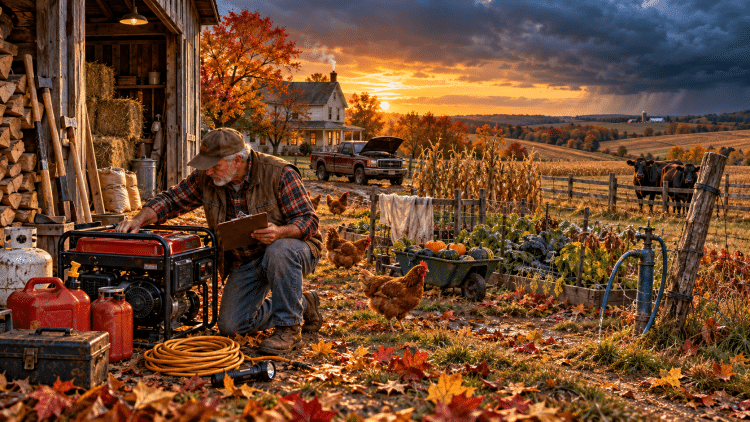
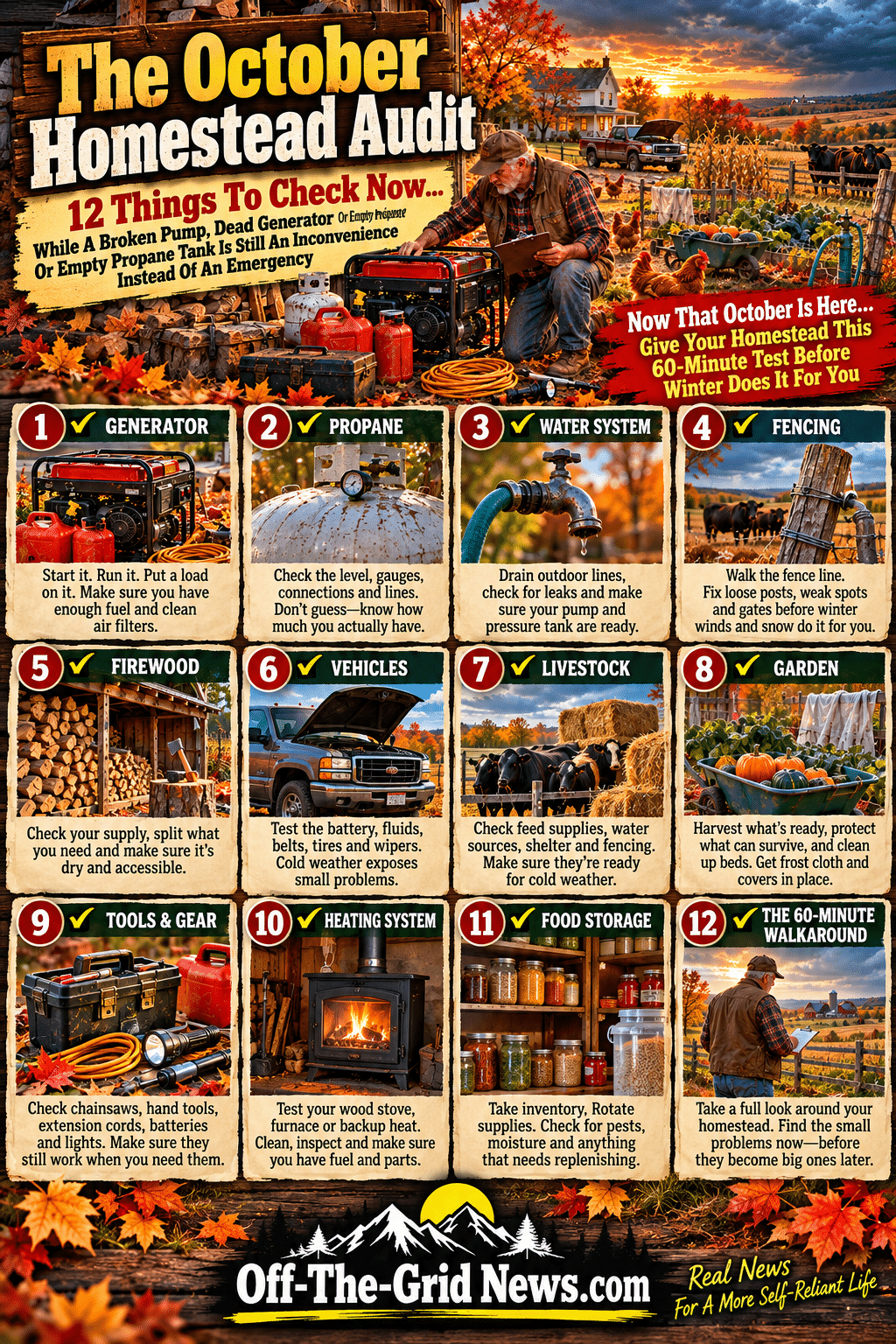
The October Homestead Audit: 12 Things To Check Now—While A Broken Pump, Dead Generator Or Empty Propane Tank Is Still An Inconvenience Instead Of An Emergency
Now that October is here, the garden is winding down, leaves are collecting along the fence line, and mornings have that little bite that tells you what’s coming. Somewhere out behind the barn there’s probably also a project you’ve been promising yourself you’ll finish before winter.
You know the one.
But October isn’t winter, and that’s precisely what makes October so valuable. You still have time to discover that the generator won’t start, the chicken-water heater has a cracked cord, the snow shovel disappeared last March, or the backup propane tank you thought was full is considerably more philosophical about the meaning of the word “full.”
In January, those are problems.
In October, they’re chores.
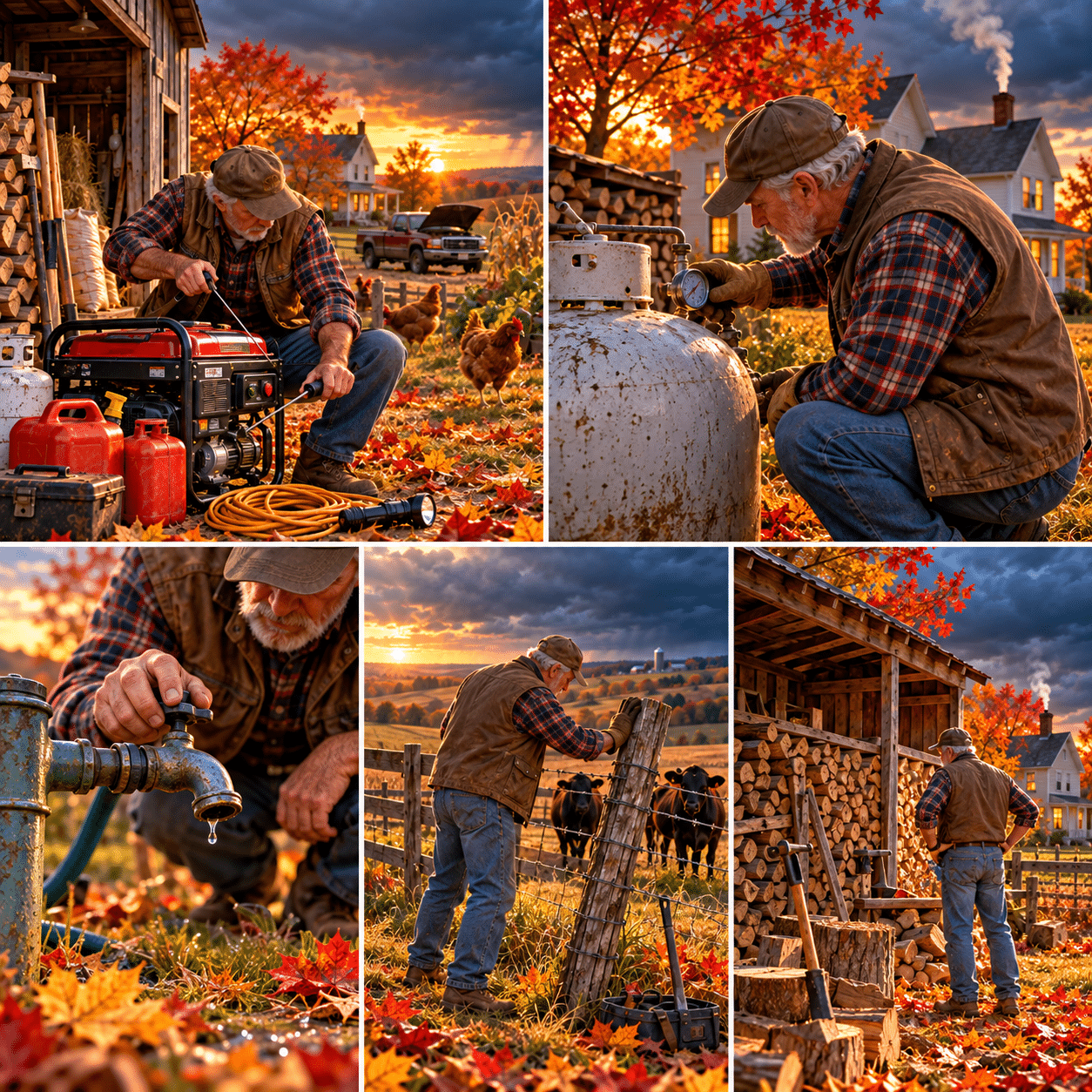
That’s why I like the idea of an October Homestead Audit. Don’t start by buying anything, and don’t make another gigantic preparedness list that’ll wind up underneath a stack of seed catalogs.
Give yourself an hour instead. Walk around the place and find out what actually works, what doesn’t and what you’ve been assuming was ready without actually checking.
Because winter is going to perform this inspection eventually.
You might as well beat it to the punch.
1. Start The Generator—Don’t Just Look At It
Let’s begin with the machine everybody assumes is ready because it worked the last time they remember using it. Go start your generator and let the thing run.
Better yet, follow the manufacturer’s instructions and test the system under an appropriate load. A generator coughing happily in the driveway doesn’t necessarily prove your actual backup-power setup can operate the well pump, freezer, furnace blower or other loads you’re counting on when the grid goes down.
The U.S. Department of Energy recommends testing portable generators before an outage and keeping them properly maintained. And the CDC’s generator-safety guidance says generators should be operated outside and at least 20 feet from the home, with exhaust directed away from windows, doors and vents because carbon monoxide can kill without warning.
Check the oil, fuel, cords, plugs, adapters and whatever transfer equipment your particular system requires. Then find the person in the house who normally doesn’t touch the generator and see whether he or she knows what to do.
Could somebody besides you operate it?
That’s not a trick question. If only one person understands the backup-power system, that person may be another single point of failure.
2. Find Out How Much Fuel You Actually Have
Next, quit measuring fuel in vague rural units like “a couple cans out there.” Count it.
How much gasoline, diesel, propane or heating fuel do you actually have, and approximately how many hours or days will that amount operate the equipment you’re depending upon? A generator with a five-gallon gas can beside it isn’t necessarily five gallons of preparedness if you don’t know how quickly the machine burns through it.
If you heat with wood, look at the woodpile with the same skepticism. Is it really enough dry, seasoned firewood, or does the pile just photograph well?
The EPA’s Burn Wise guidance recommends burning properly seasoned wood and notes that moisture meters can help determine whether firewood is ready to burn. Wet wood wastes energy driving off moisture and generally burns less efficiently.
October is an excellent month to discover you’re short.
February is a lousy one.
3. Pretend The Water Just Stopped
Now walk to your well, pressure tank or main water supply and ask a simple question: What has to work for water to reach this house?
For many rural families on private wells, electricity is somewhere in that chain. The EPA’s private-well emergency guidance specifically notes that power outages can affect private wells because pumps may not operate without electricity.
So imagine the power disappears tonight. Can your backup power actually start and operate the well pump, and have you ever tested it rather than merely assuming it will?
Then look beyond drinking water. How much water would the household need for cooking, washing and sanitation, and what about chickens, goats, cattle, horses or other animals?
Finally, inspect the cold-weather side of the system. Find exposed plumbing, hoses, hydrants and pipes that could freeze, because water problems have an annoying habit of becoming plumbing problems—and plumbing problems have an equally annoying habit of becoming expensive problems.
4. Perform The First-Freeze Walk
Walk the property as though tonight’s forecast says 25 degrees. Look at everything containing water and ask what happens when that water freezes.
Disconnect and drain garden hoses where appropriate, and inspect outdoor faucets, irrigation equipment, pumps and livestock watering systems. Then walk through the garden and decide what needs harvested, protected or simply surrendered to the season.
The University of Minnesota Extension’s frost guidance explains that cold tolerance varies considerably among crops, with some cool-season vegetables tolerating frost while tender plants can be damaged or killed. Knowing what you’ve planted matters more than throwing blankets over everything in sight.
And while you’re out there, look at the tools and supplies you’ll need after the first real cold snap. There’s nothing quite like discovering at 9:47 at night that your frost cloth is actually an old bedsheet currently sailing toward Wisconsin.
October gave you notice.
Use it.
5. Check The Heat Before You Need Heat
Go inside and turn on your primary heating system, even if the afternoon is pleasantly warm. You want to discover the furnace problem while the windows can still be opened and the HVAC company isn’t answering 147 emergency calls from everybody else who waited.
If you heat with wood, inspect the stove, stovepipe and chimney and follow the manufacturer’s maintenance requirements. The U.S. Fire Administration recommends having chimneys inspected and cleaned each year as necessary, along with keeping combustible materials safely away from heating equipment.
While you’re at it, test your smoke alarms and carbon-monoxide alarms. The U.S. Fire Administration recommends testing smoke alarms monthly, while the CDC recommends CO detectors near sleeping areas and emphasizes their importance when fuel-burning equipment is involved.
Then ask the preparedness question that matters more than whether the furnace works today: If your primary heat disappears during the coldest night of the year, what is Plan B?
And does Plan B still work when the electricity doesn’t?
6. Open The Pantry—But Stop Counting Cans
Here’s where we’re going to steal a lesson from our survival-pantry discussion. Don’t just count containers; count usable meals.
Could you make breakfast, lunch and supper tomorrow without visiting a store? Could you keep doing that for a week while still providing enough calories, protein and fat to make those meals useful?
Look for the quiet weaknesses: cooking oils, peanut butter, canned meat or fish, salt, spices, powdered milk, coffee and foods requiring little or no cooking. Ready.gov’s food guidance recommends keeping nonperishable food available and specifically suggests considering foods that don’t require refrigeration, cooking, water or special preparation.
Then look at the hidden dependencies in the pantry. Dry beans and grains can be excellent storage foods, but many require water, cooking fuel and time before they become supper.
A hundred pounds of beans is wonderful.
Unless you have no water and no way to cook them.
7. Give The Freezer A Backup Plan
Walk over to your freezer and imagine the little green light goes dark. Don’t think about it as an appliance anymore; think about it as a clock that just started ticking.
According to the CDC’s food-safety guidance for power outages, an unopened refrigerator generally keeps food cold for about four hours, while a full freezer can maintain a safe temperature for roughly 48 hours—about 24 hours if it’s half full—provided the door stays closed.
That should change the way a homesteader looks at a freezer containing hundreds or thousands of dollars’ worth of beef, pork, venison, poultry and garden produce. Your food-storage system now depends upon electricity, which may depend upon a generator, which depends upon fuel.
So ask the whole question. Can backup power handle the freezer, how long can you supply that power, and what happens if the outage lasts longer?
Maybe you have another preservation method. Maybe you don’t.
Either answer is useful in October.
8. Walk The Barn Before Dark
Now head outside and look at your livestock supplies with the same cold eye. How much animal feed is actually on hand?
Not “plenty.”
Count the bags, bales, bins or buckets that make sense for your animals, and translate those quantities into days. Then look at the water system and ask whether it still functions if electricity disappears, a pipe freezes or the primary pump fails.
Inspect gates, fencing, latches, shelter and bedding while you’re there. The animals don’t particularly care that it’s Christmas morning when they discover the fence staple you’ve been meaning to replace since June.
This is also where dependencies start becoming obvious. Chickens may provide eggs, but chickens depend upon feed, water and shelter; livestock can strengthen a homestead while simultaneously creating systems the homesteader has to keep running.
That’s not a reason to avoid livestock.
It’s a reason to prepare for the livestock you actually have.
9. Open The Medicine Cabinet
October is also a good time to inspect the household medical setup. Check supplies and expiration dates where appropriate, replace what has been used, and make sure ordinary necessities haven’t quietly disappeared over the summer.
Think beyond bandages. Prescription medications, eyeglasses, hearing-aid batteries, medical-device batteries and other household-specific needs can become far more important than another exotic item in a giant trauma bag.
Then inspect the first-aid kit and ask who actually knows how to use what’s inside. The American Red Cross offers first-aid and CPR training, and that’s one preparedness investment that doesn’t require another shelf in the basement.
Because owning medical equipment isn’t the same thing as having medical capability.
Skills don’t need shelf space.
10. Put Winter In The Vehicle
Your homestead isn’t the only thing headed into winter; your vehicles are too. Check tires, battery condition, fluids, lights, wipers and the spare tire before cold weather turns a small mechanical weakness into a roadside problem.
Then make sure your winter emergency supplies are actually inside the vehicle, rather than sitting beautifully organized on a garage shelf. The National Weather Service’s winter-safety guidance recommends preparing vehicles for winter and carrying emergency supplies such as blankets, food, water, a flashlight and first-aid supplies.
I’d add something less glamorous: keep some fuel in the tank. A snowstorm isn’t the ideal time to discover that “E” was less of a suggestion than you thought.
The world’s finest emergency blanket won’t drive you home.
11. Do The 60-Second Darkness Test
Tonight, after dark, turn off the lights and find your flashlight. No cheating by using the flashlight on the phone you’re holding.
Then find the lanterns, spare batteries, medications, fire extinguisher, water shutoff and whatever equipment you would need to get backup power running. If you spend six minutes opening drawers and muttering words inappropriate for publication, you’ve discovered a preparedness problem without spending a dime.
That’s where organization becomes part of resilience. Equipment you can’t locate during an emergency is remarkably similar to equipment you don’t own.
Put critical items where everybody knows how to find them. Then show everybody.
12. Finally, Find Your October Weak Link
Now step back and look at what the hour revealed. Maybe the generator needs servicing, you’re short on seasoned firewood, the pantry needs more cooking fat, the livestock water depends completely on electricity, the truck battery sounds tired or nobody except you understands the backup heating system.
Don’t try to fix 47 things at once. Look for the failure most likely to cause several other failures.
Think about the dominoes. A power outage can stop an electric well pump; losing the well can create drinking-water, cooking, sanitation and livestock problems; and suddenly one electrical failure has wandered all over the property.
That’s the weak-link principle in action.
Fix that one first.
But Don’t Forget The Free Fixes
This is where preparedness gets wonderfully unglamorous. Some of the best improvements you discover during this audit may cost nothing.
Move the flashlight somewhere everybody can find it. Write generator-starting instructions and put them near the machine; teach another family member where the water shutoff is; rotate old pantry food forward; charge the battery packs; put the snow shovel where winter won’t require an archaeological expedition to locate it.
Then spend money where money actually solves something. A $15 replacement part that makes a critical system dependable can be worth far more to your household than a $500 gadget that solves a problem you don’t actually have.
That’s the point of auditing before shopping.
Find the problem first.
Try One More Test: What Happens If You’re Gone?
Before you’re finished, imagine the first winter emergency happens while you’re 40 miles from home. Your spouse, children or another family member is standing there when the lights blink out.
Can they start the backup power? Do they know where the water shutoff is, how the alternative heat works and where the emergency supplies are stored?
This test can be uncomfortable because a well-prepared homestead sometimes turns out to be a well-prepared person surrounded by people who depend upon that person’s knowledge.
That’s another single point of failure.
The solution doesn’t necessarily cost anything. Walk through the systems together, write simple instructions where useful, and make sure more than one person can perform the critical jobs safely.
A family should inherit your knowledge before it inherits your toolbox.
Winter Is Going To Audit You Anyway
That’s what makes October different from January. Right now you can still make a hardware-store run without snow blowing sideways across the highway, order a generator part without paying emergency shipping, repair the hydrant, stack more firewood, replace the truck battery and rotate pantry supplies.
October gives you something winter won’t.
Time.
So take one hour this weekend and walk your homestead. Start the machines, open the cabinets, count the supplies, inspect the pipes and actually test the things you’ve been assuming would work.
Look especially hard at anything that depends entirely upon one machine, one fuel, one electrical source or one person. Those are the places where little failures have a nasty habit of becoming big failures.
Because the smartest October preparedness purchase may not be another piece of survival gear. It might be a $14 part that keeps the well working, a carbon-monoxide alarm beside the backup heat, another week’s worth of animal feed, a repaired fence or simply enough fuel to make the generator useful.
Or it might cost absolutely nothing.
Maybe it’s discovering that the generator everybody thought was ready hasn’t started since February.
That’s what the October Homestead Audit is really about. Not predicting every emergency, buying everything in the survival catalog or preparing for the end of civilization.
It’s finding the little things that can become big things before cold weather gets a vote.
Because winter is coming to inspect the place whether you invite it or not.
October is your chance to inspect it first.