 Print
Print
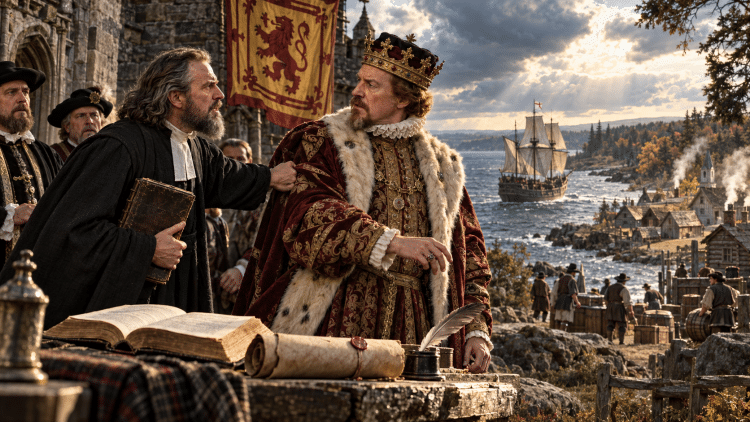
What Your Pastor Never Told You About The Men Who Really Built America
Before America Had A Constitution… A Bunch Of Stubborn Christians Were Already Telling Kings They Answered To Someone Higher
Most Americans have heard about the Pilgrims, the Mayflower, and that first Thanksgiving dinner. But there’s another story hiding behind those familiar pictures of black hats, wooden ships, and Pilgrims kneeling in the snow.
It’s a story about kings who thought they spoke for God, preachers who refused to bow, and ordinary Christian families who crossed an ocean because they believed no earthly ruler owned their conscience.
And here’s the remarkable part: Some of the ideas that eventually shaped American self-government were being hammered out in churches long before anybody dreamed of an American Constitution.
The King Who Thought God Had Given Him The Whole Farm
King James I ruled England from 1603 to 1625, after already spending decades on Scotland’s throne as James VI. He wasn’t an ignorant man, either. He knew his Bible, understood theology, and wrote an entire defense of royal authority called The Trew Law of Free Monarchies.
Unfortunately, James had a rather convenient interpretation of Scripture.
He leaned heavily on passages such as Romans 13, where Paul instructs Christians to respect governing authorities. He also appealed to the biblical language describing rulers as gods, treating royal authority as something ordinary subjects had little business questioning.
Now, Scripture certainly teaches that civil government has a legitimate place under God’s authority. But James stretched that principle until the king’s authority seemed to swallow nearly everything else.
In his thinking, resisting the king could amount to resisting God Himself.
Imagine a rancher who owns the pasture, the barn, and the well, then announces that he owns the sunshine falling on them, too. That’s roughly how James approached royal authority, and it didn’t sit particularly well with Christians who believed Christ alone was Lord of the conscience.
The Scottish Preacher Who Grabbed A King By The Sleeve
Long before James inherited England’s throne, a Scottish Presbyterian minister named Andrew Melville had already challenged his understanding of kingship.
In 1596, during a confrontation at Falkland Palace, Melville reportedly grabbed the king’s sleeve and called him “God’s silly vassal.” Then he explained something James probably didn’t enjoy hearing.
Scotland had two kingdoms.
One belonged to the king, who exercised civil authority. The other belonged to Jesus Christ, and in that kingdom James was merely another subject.
Think about that for a moment. A preacher was telling the most powerful man in Scotland that he had no business acting like the head of Christ’s church.
Melville wasn’t arguing that Christians could ignore every civil law they disliked. He was insisting that kings, like everybody else, answered to a higher authority.
That distinction would become enormously important in the centuries ahead.
The Puritans Asked For Reform… And The King Smelled Trouble
When James arrived in England, Puritan ministers saw an opportunity. Roughly a thousand ministers were said to support the famous Millenary Petition, asking the new king to remove practices they believed had no biblical foundation.
They weren’t demanding independence from England. They wanted the Church of England brought into closer agreement with Scripture, particularly in worship and church government.
So James summoned church leaders to the Hampton Court Conference in 1604.
Unfortunately for the Puritans, the king quickly recognized where some of their arguments might lead. He had already experienced Presbyterian resistance in Scotland, and he wasn’t eager to encourage anything similar in England.
His famous response was essentially, “No bishop, no king.”
James understood something modern Americans often overlook. Church government and political government weren’t separate questions in seventeenth-century Britain, because the crown exercised substantial authority over the established church.
Nevertheless, the conference produced one extraordinary result. James authorized a new English translation of Scripture, which appeared in 1611 and became known as the King James Bible.
Ironically, the king who wanted to protect royal authority helped produce a Bible that generations of Americans would eventually read while questioning the authority of kings.
History has a sense of humor.
The King Signed The Papers… And America Got A Foothold
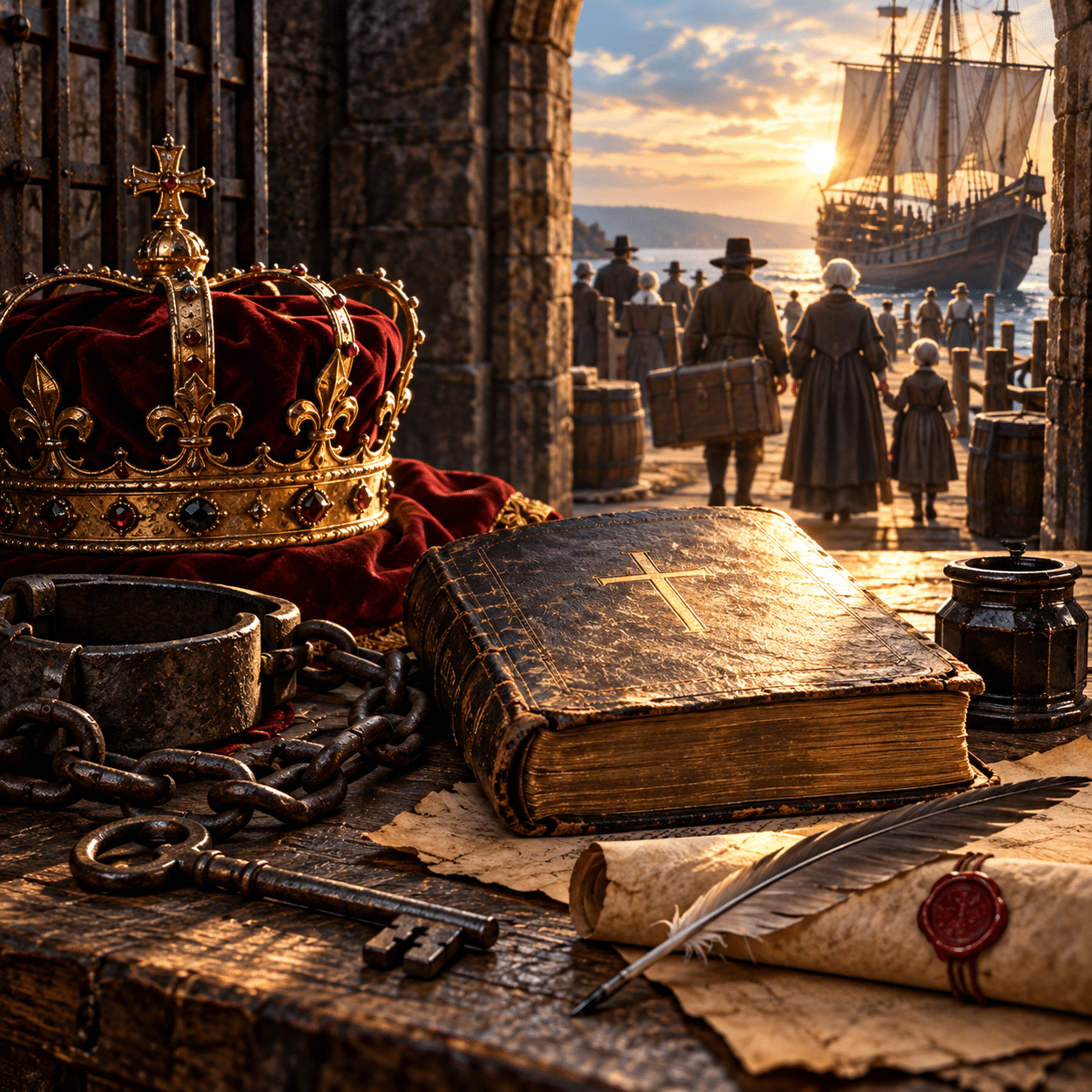
Meanwhile, England was looking westward. Across the Atlantic lay a continent Europeans barely understood, filled with forests, rivers, mountains, and Indigenous nations that had occupied the land for generations.
In 1606, James issued the first Virginia charter, authorizing two colonial ventures associated with the London and Plymouth companies. These were commercial undertakings, but religion, politics, and economic ambition were thoroughly tangled together.
Some investors and colonial promoters had strong Protestant reforming sympathies. Others were interested primarily in trade, land, and profit, while still others saw colonization as an opportunity to spread Christianity.
The ventures weren’t simply a royal scheme to ship troublesome Puritans overseas. Nevertheless, they created opportunities that religious dissenters and reform-minded Englishmen would later use in ways the crown hadn’t necessarily anticipated.
Consider Virginia.
Under the leadership of men including Sir Edwin Sandys, the Virginia Company developed a greater interest in representative government. In 1619, settlers gathered at Jamestown for the first representative legislative assembly in English America.
Imagine the scene: a handful of English colonists meeting in a struggling settlement surrounded by unfamiliar wilderness, attempting to establish rules for governing themselves.
They were still subjects of the king, and the colony was hardly a modern democracy. Yet the principle of local representative government had taken root.
And that was only the beginning.
The Royal Charter That Reached Clear Across America
Now comes one of the strangest pieces of paperwork in American history.
The second Virginia charter, issued in 1609, described territory extending from the Atlantic coast toward the west and northwest, reaching from sea to sea.
You can still examine that remarkable language in the original 1609 Virginia Charter.
The trouble was that nobody in London possessed anything resembling an accurate understanding of the continent’s geography. The king and his advisers were describing enormous territories they had never seen, much less surveyed.
It’s like handing somebody a deed to the back forty without realizing the property line might run clear across the Rocky Mountains.
Of course, writing a claim on parchment didn’t make the land empty or establish actual control over it. Indigenous nations occupied these territories, and later European powers contested them.
Nevertheless, those sweeping colonial claims mattered enormously.
Virginia eventually asserted rights to vast western lands, and disputes over those claims helped shape the boundaries of the emerging United States. The state’s own legal code still preserves the historical importance of those early charters.
You can see the language in Virginia’s official account of its territorial boundaries.
A few lines written by royal officials in London would echo through centuries of American history.
The Pilgrims Had No Government… So They Made One
Now let’s turn to the Pilgrims, because this is where theology and American self-government become especially interesting.
First, understand that not all Puritans were alike. Some wanted to reform the Church of England from within, while the Separatists believed the established church was so compromised that faithful Christians needed to leave it altogether.
The Pilgrims belonged to that second group.
After suffering pressure in England, they settled in Leiden, Holland, where they enjoyed greater religious freedom. But life was difficult, economic opportunities were limited, and they worried about losing their English identity.
Eventually, they decided to cross the Atlantic.
In 1620, the Mayflower carried them toward territory where they hoped to establish a settlement. But storms and navigational difficulties brought them to Cape Cod, outside the area where their intended colonial arrangements would clearly apply.
Suddenly, they faced a serious problem.
Who was going to govern these people?
Before establishing their settlement, forty-one adult male passengers signed what became known as the Mayflower Compact. They agreed to form a civil political community and establish laws for their common good.
The document wasn’t a declaration of independence, and it didn’t create universal political equality. The settlers still professed loyalty to King James.
But the language reveals something important about their understanding of government.
They voluntarily bound themselves together through a covenant.
That word mattered because covenant theology was woven deeply into their religious life. They understood that people could enter solemn obligations before God and one another, and that those obligations carried real responsibilities.
Their church had been organized around covenant commitments. Now, in the wilderness, they applied a related principle to civil government.
It wasn’t the American Constitution.
But you can certainly recognize some family resemblance.
The Lawyer Who Put The King’s Charter On A Boat
Ten years later, another group of Puritans made an even more remarkable move.
Their leader was John Winthrop, an English lawyer who became governor of the Massachusetts Bay Colony. Unlike the Pilgrim Separatists, these Puritans generally hoped to reform English Protestantism rather than abandon its identity altogether.
In 1629, King Charles I granted the Massachusetts Bay Company a royal charter.
And here is where things became interesting.
The charter didn’t explicitly require the company’s governing officers to remain in England. Consequently, the company’s leaders arranged to transfer its government across the Atlantic.
Winthrop sailed aboard the Arbella in 1630, bringing the charter with him.
You can examine the original document through the Massachusetts Secretary of State’s historical collection.
Think about what that meant.
The company’s governing machinery was no longer sitting comfortably in London, where royal officials could easily supervise its daily business. It was now operating across an ocean, in a settlement surrounded by forests.
Massachusetts wasn’t an independent republic. It remained a colony under the English crown, and its government restricted political participation in ways modern Americans would reject.
Nevertheless, its leaders enjoyed an unusual degree of practical self-government.
And Winthrop believed that freedom came with a frightening responsibility.
In his famous sermon A Model of Christian Charity, he warned the settlers that their community would be like a city upon a hill, borrowing the imagery of Matthew 5:14.
The world would be watching them.
If they dealt dishonestly with God and one another, their failure would become a public disgrace.
That wasn’t a victory speech.
It was a warning delivered before the hard work began.
The Scots Signed A Covenant… And The King Lost His Head
Back across the Atlantic, the struggle between royal authority and the Reformed churches was becoming downright explosive.
Charles I inherited his father’s belief in strong monarchy, but his religious policies provoked fierce resistance. When he attempted to impose a new prayer book on Scotland, many Scots believed their church’s independence was under attack.
In 1638, thousands rallied behind the National Covenant, famously associated with Greyfriars Kirkyard in Edinburgh.
They pledged to defend Scotland’s religious settlement against innovations they believed violated their obligations before God.
Tradition holds that some signers even used their own blood, although the dramatic stories surrounding the signing should be treated cautiously.
What mattered was the principle.
These Scots believed that a king could exceed his lawful authority, and that their obligations to God could require them to resist him.
By 1643, the Scots and England’s Parliament had entered the Solemn League and Covenant. England was already engulfed in civil war, and the struggle involved questions of church government, parliamentary authority, taxation, and the limits of monarchy.
Eventually, Parliament’s forces defeated the king.
In January 1649, Charles I was executed outside the Banqueting House in London.
The monarch who claimed extraordinary authority over his subjects had been brought before a court established by his enemies.
Whatever one thinks about the legality or justice of his execution, the old understanding of kingship had suffered an enormous blow.
The Men At Westminster Were Building Something Bigger Than They Knew
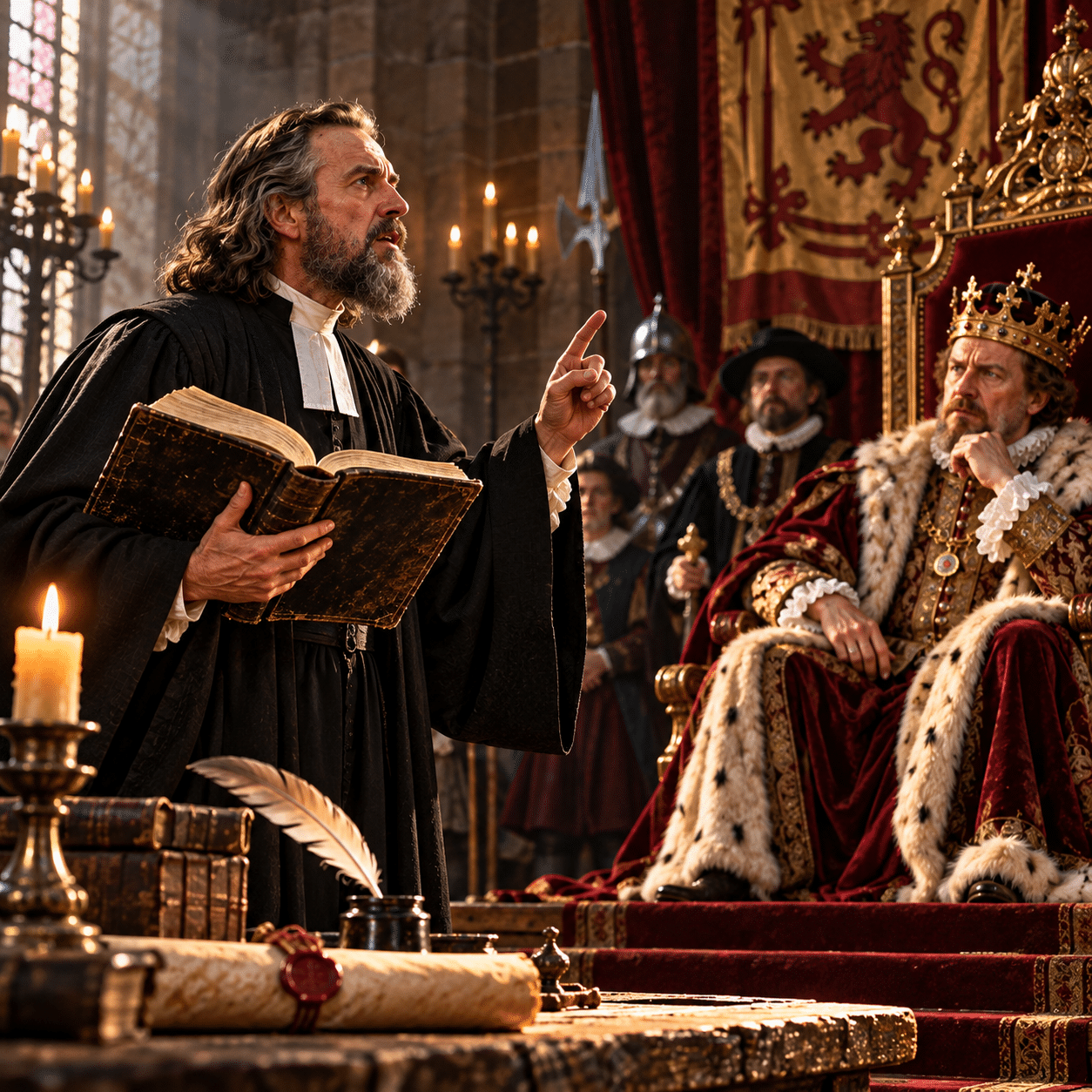
While England was fighting over its political future, another gathering was working through questions of theology.
In 1643, Parliament summoned the Westminster Assembly, bringing together ministers and theologians to consider reforms to the English church.
Scottish commissioners also participated, helping shape the discussions.
These weren’t men trying to invent a fashionable new religion. They were overwhelmingly committed to the Reformed Protestant tradition and believed their task was to express biblical doctrine faithfully.
Their work eventually produced the Westminster Confession of Faith, along with the Larger and Shorter Catechisms.
And buried inside those theological documents were principles with enormous implications for civil and religious liberty.
Chapter 20 of the Confession famously declares:
“God alone is Lord of the conscience.”
Think about the weight of those words.
Neither a king nor a bishop possesses unlimited authority over what a Christian must believe. Human commands cannot legitimately override the authority of God’s Word in matters of faith and worship.
The Confession also taught that Jesus Christ alone is head of the church.
That was the same essential distinction Andrew Melville had defended before King James decades earlier.
Now it had become part of a formal statement of faith that would influence Presbyterian churches across the English-speaking world.
The Archbishop Who Helped Shape A Confession He Never Attended
There’s another interesting character in this story, and his name is James Ussher.
Most people who recognize his name remember his famous biblical chronology, which placed creation in 4004 B.C. But Ussher was much more than a man with a calculator and an Old Testament genealogy.
He was a serious theologian and scholar whose work helped shape the Reformed tradition.
In 1615, the Church of Ireland adopted the Irish Articles, a detailed statement of Protestant doctrine closely associated with Ussher.
Those articles later exercised substantial influence on the Westminster Confession, particularly in their treatment of Reformed theology.
You can explore that relationship in Oxford’s historical study of Ussher and the Irish Articles.
Interestingly, Ussher didn’t participate in the Westminster Assembly. His loyalty to the king and his position within the established church placed him on the opposite side of important political and ecclesiastical disputes.
Yet his theological work still influenced the men who gathered there.
History doesn’t always divide neatly into good guys wearing one uniform and bad guys wearing another.
Sometimes men who disagree bitterly about politics still share deep theological convictions.
And sometimes their ideas outlive every political quarrel that separated them.
The Scots-Irish Carried Those Ideas Into The American Backwoods
Now here’s where the story begins moving toward the American frontier.
King James had supported the plantation of Ulster, bringing Protestant settlers from Scotland and England into northern Ireland. Over the generations, many of their descendants developed a distinctive Presbyterian culture.
Later, economic pressures, rising rents, religious disadvantages, and other hardships encouraged substantial migration to North America.
During the eighteenth century, large numbers of these Scots-Irish immigrants moved into Pennsylvania and then pushed southward and westward through the Appalachian backcountry.
They brought their Bibles, their Presbyterian traditions, and a strong attachment to congregational and community institutions.
Picture a rough log cabin tucked into a mountain hollow.
There’s a rifle hanging over the fireplace, a Bible on the table, and a family trying to carve a living out of rocky ground. On Sunday, neighbors gather to hear a preacher explain Scripture in a meetinghouse that might not look much better than somebody’s barn.
These settlers didn’t all think alike, and their history included conflict, dispossession of Indigenous peoples, and plenty of contradictions.
But their religious inheritance helped shape the culture of numerous frontier communities.
They had grown up with stories of covenants, persecuted churches, and kings who needed reminding that they weren’t God.
Those ideas didn’t automatically produce the American Revolution. Nevertheless, they contributed to the wider religious and political culture in which Americans debated liberty, representation, and resistance to tyranny.
The Forgotten Theology Behind Your Front Porch
So what does all this mean for somebody living on a few acres in rural America today?
It means the story of American freedom didn’t begin in Philadelphia in 1776. Some of its important religious and political roots reach much farther back, into Scottish churches, English courtrooms, colonial charters, and little congregations meeting under difficult circumstances.
The men we’ve been discussing weren’t modern libertarians, and they certainly weren’t consistent champions of religious liberty for everyone.
Some supported established churches. Some restricted dissenters. Some defended forms of government that Americans today would find deeply objectionable.
But that doesn’t erase what they contributed.
They helped preserve and develop an idea that remains enormously important: civil rulers possess legitimate authority, but their authority isn’t unlimited.
The king isn’t God.
The state isn’t God.
And no earthly institution gets to occupy the throne that belongs to Jesus Christ.
That’s why Acts 5:29 mattered so much to generations of Christians who wrestled with the limits of obedience to human authority.
“We ought to obey God rather than men.”
Of course, that verse doesn’t mean every disagreement with government becomes a holy crusade. But it does establish a boundary that no Christian ruler, legislature, or bureaucrat can simply erase.
And here’s the part worth remembering.
America’s political institutions emerged from many influences, including English common law, classical political thought, Enlightenment philosophy, colonial experience, and Christian theology.
The Christian contribution wasn’t the whole story.
But it was unquestionably part of the story.
And if somebody tells you that Christianity had nothing to do with the ideas that shaped early America, you might suggest they spend an afternoon reading the Mayflower Compact, the Massachusetts Bay Charter, and the Westminster Confession.
They might discover that some of the men who helped build the foundations of this country were arguing about the limits of government long before anyone had ever heard of Washington, Jefferson, or Madison.
And the argument usually started with one stubborn conviction:
The king might own the crown… but he didn’t own the conscience.