 Print
Print

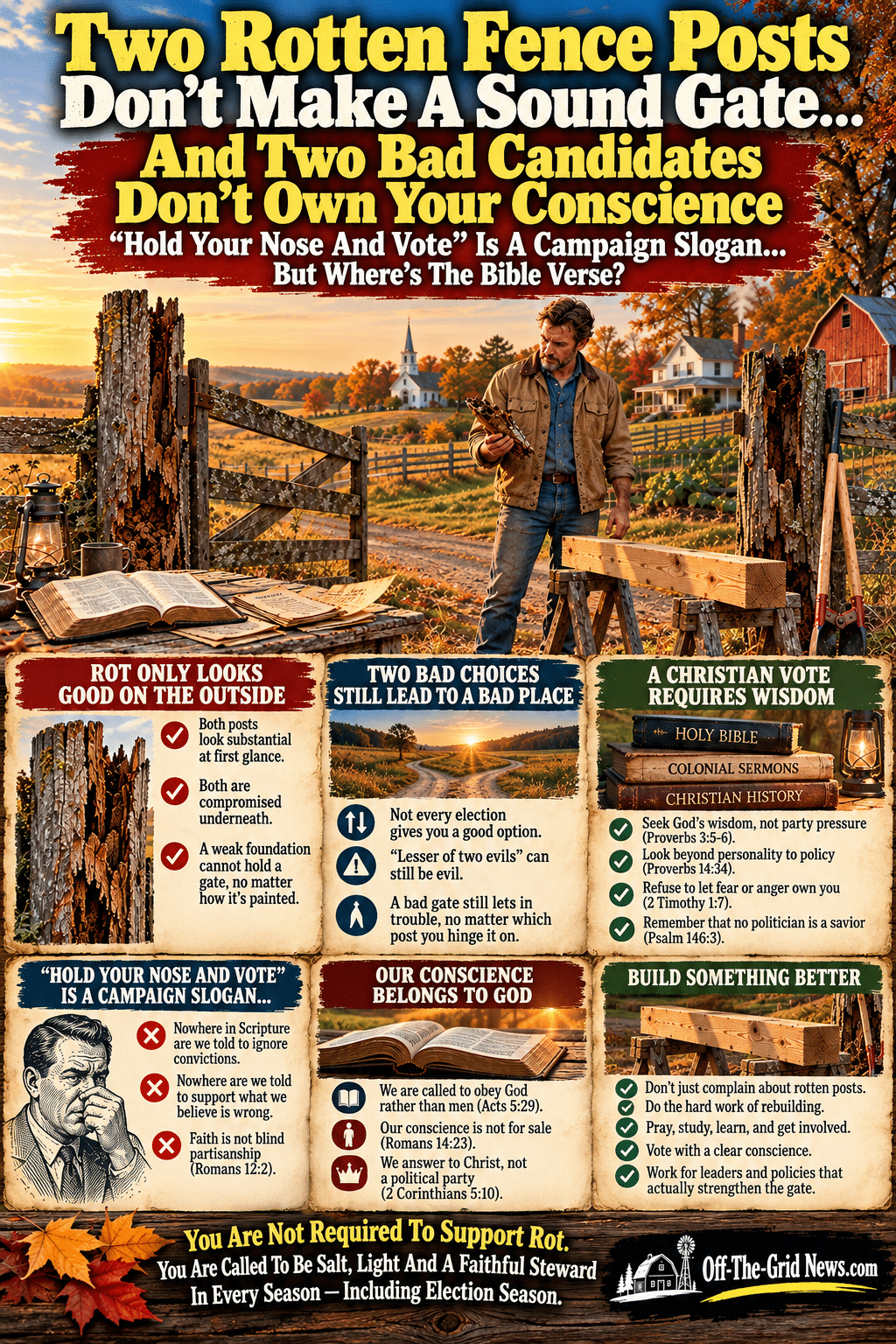
“Hold Your Nose And Vote” Is A Campaign Slogan… But Where’s The Bible Verse?
Before You’re Told To “Hold Your Nose And Vote”… Hear What America’s Old Colonial Election Sermons Said About Putting Any Unfit Men In Power
Well, it’s that time again. Elections. Midterms. So how did Americans in any earlier era apply wisdom to casting their votes? They didn’t do it perfectly, that’s for sure. But some old election sermons give us a few clues.
Alright, suppose you need a gatepost. The fellow at the lumberyard shows you two: one rotten clear through, the other rotten halfway up. When you ask about sound timber, he gets annoyed.
“Those are your choices. And if you don’t buy this one, you’re helping the other one win.”
You would recognize that sales pitch anywhere except, apparently, during an election. Then somebody puts a flag behind it, adds a Bible verse, and tells you your Christian duty is to pick a rotten post.
But does God actually require that?
For the Christian staring at two candidates he believes are seriously unfit, that question deserves something better than a guilt trip. And some old American sermons make the conversation considerably more uncomfortable for the people selling the posts.
The Preachers Who Put The Voter Under Judgment
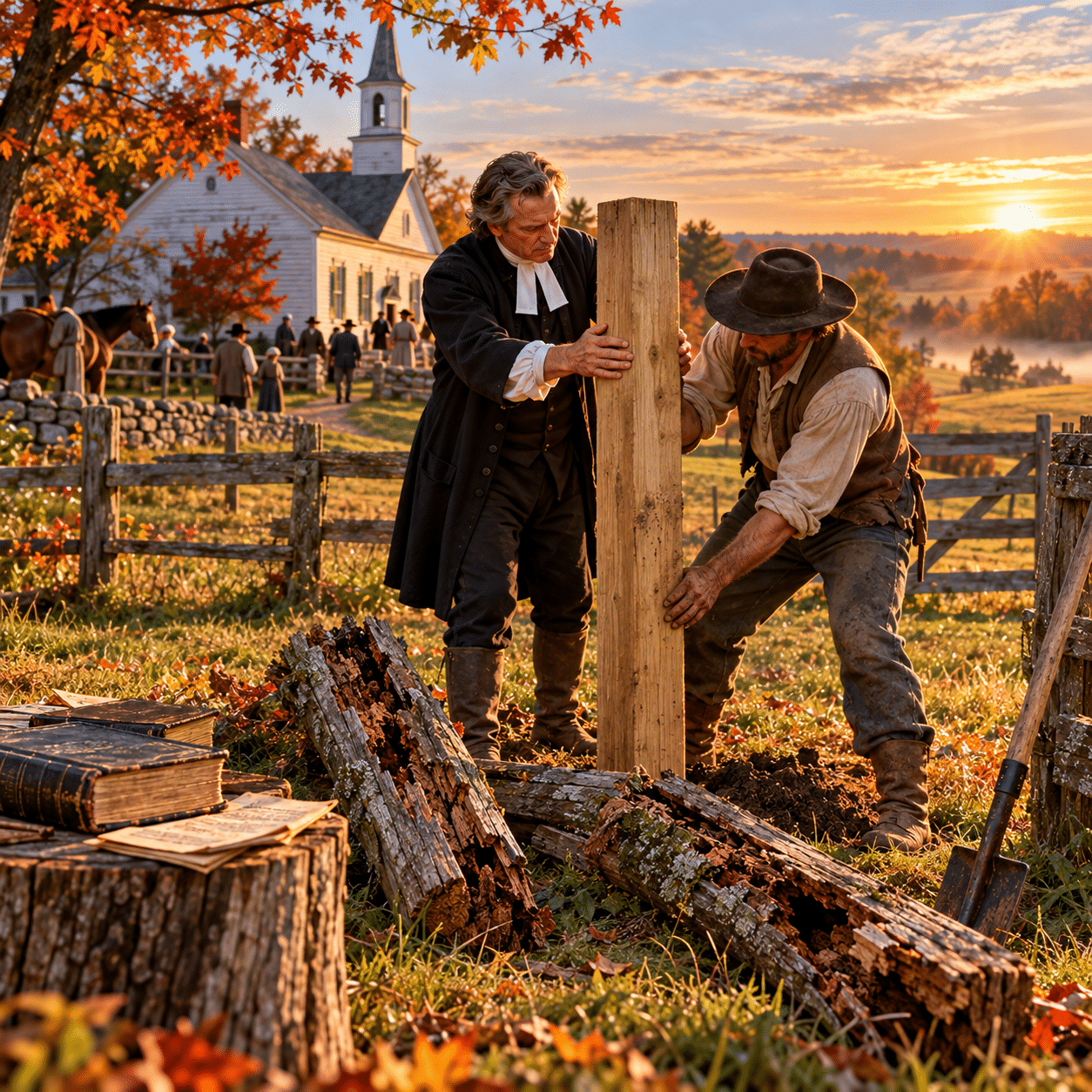
Before we go further, let’s keep the history honest. The sermons discussed here do not explicitly stage our modern two-candidate dilemma and command everybody to abstain. Hardly. Some were preached before legislators chose officials, and two come from the period after independence.
What they do establish is a demanding principle: choosing rulers carries moral responsibility. A candidate’s character does not become irrelevant because somebody prints his name on your side’s ticket.
In his Massachusetts election sermon of May 29, 1776, Samuel West called voters “criminally guilty in the sight of Heaven” when caprice or bribery moved them to choose irreligious, immoral magistrates. He warned that choosing dissolute rulers could bring misery upon their children as well as themselves.
West’s warning had specific conditions; it was not a blanket ruling on every difficult election. Still, notice where he put the spotlight: on the people doing the choosing.
Apparently, “But the other fellow was worse” was not the whole political theology.
God Sees The Name You Mark
Go back another generation. On May 27, 1747, Charles Chauncy preached Civil Magistrates Must Be Just, Ruling in the Fear of God, urging Massachusetts officials to select men of integrity, knowledge, justice, and courage.
He reminded his hearers that God observed “how you vote, and for whom you vote.” Their choice was something they would answer for.
Chauncy wanted electors to resist factional arrangements and judge men by their fitness for office. The party meeting did not outrank the judgment of God.
Now bring that question home: Would you trust this candidate with responsibility if the party label were covered up? Or have you spent so long defending your team that you no longer inspect its lumber?
“Only” Is A Mighty Inconvenient Word
The closest passage to our question comes from Simeon Howard, pastor of Boston’s West Church. In his May 31, 1780, election sermon, he preached from Exodus 18:21 and distinguished qualified rulers from men who fell short.
His instruction was “to give their votes only for the former.”
Howard also reasoned that helping appoint someone you consider unqualified is a form of false dealing: your act presents him as fit for the position. That’s a serious challenge to the idea that choosing a ruler has no moral meaning beyond beating the opposition.
Howard assumed suitable men could be found. Applying his standard when both leading candidates appear unacceptable requires further judgment; we should not make him deliver a modern sermon he never preached.
But neither should we quietly erase his word “only.”
Similarly, Samuel Langdon’s June 5, 1788, sermon warned: “Let not men openly irreligious and immoral become your legislators.” He also urged participation and the selection of the best available men.
These preachers expected citizens to exercise judgment, not surrender it at the polling place.
A Crooked Man And An Imperfect Man Are Not The Same Thing
Here comes the familiar objection: “Everybody’s a sinner. You’ll never find a perfect candidate.”
Of course you won’t. You won’t find a perfect mechanic either, but that does not oblige you to hire one who steals your truck.
The question is fitness, not sinlessness. Exodus 18:21 identifies ability, fear of God, truthfulness, and hatred of covetousness as qualifications; it does not demand angels.
Neither does ordinary prudence require identical judgments about every candidate. One Christian may see a flawed but serviceable official where another sees disqualifying corruption.
That disagreement needs evidence, biblical reasoning, and honest attention to likely consequences. Calling every compromise apostasy is no better than calling every refusal cowardice.
But “everybody sins” cannot become a tarp thrown over every rotten board.
The Lesser-Evil Argument Has To Prove Its Case
Choosing a course that reduces harm can be morally responsible. A vote need not endorse everything a candidate has ever said or done, and the suffering likely under the alternatives matters.
Still, that does not establish that every proposed lesser-evil vote is obligatory. You must first determine what you are authorizing, whether the candidate is fit, and whether your action is morally permissible.
Romans 3:8 rejects doing evil so good may result. Applying that principle to voting requires demonstrating that the particular vote is wrongful; merely attaching the word “evil” to a candidate does not settle the question.
The same standard cuts both ways. Predictions of disaster do not automatically turn a wrongful choice into a righteous one.
A campaign cannot issue you a permission slip from God.
Nor does political necessity explain itself. Ask who defined the emergency, what evidence supports the prediction, and whether the proposed remedy will deepen the very habits of corruption you are supposed to be stopping.
Rushdoony’s Bigger Question: Who Is Governing Your Life?
This is where R. J. Rushdoony’s historical framework becomes useful. In The Biblical Doctrine of Government, he argued that modern people mistakenly reduce government to the state, while the older Christian understanding included self-government, family, church, work, and other institutions.
“The basic government is self-government,” he wrote.
Through that lens, a nation’s condition cannot be repaired merely by exchanging the person at the top. Responsibility must also be exercised throughout society, under God’s authority.
For a homesteader, that ought to sound familiar. You cannot neglect the soil, let the livestock wander, ignore the leaking roof, and then expect a new name on the mailbox to fix the property.
In Freedom and the Vote, Rushdoony acknowledged the ballot’s important function while arguing that elections reflect the people’s character. His point was that lasting reform must reach the voters themselves. Worth reading.
That framework does not mechanically decide your ballot. It does expose the folly of treating election day as the whole Christian strategy.
You May Refuse A Candidate Without Abandoning Your Neighbors
So what should you do when, after serious examination, you conclude that both leading candidates are unfit?
First, make sure the conclusion comes from knowledge rather than disgust. Examine records, policies, competence, honesty, and the powers of the actual office; a campaign’s religious vocabulary is no substitute for evidence.
Then consider the alternatives available in that race. A qualified alternative deserves examination, and refusing support to both leading contenders is a different decision from abandoning every contest and responsibility around you.
A conscientious refusal should be explainable. “I won’t help entrust this authority to either person, for these reasons” is a moral argument; “they’re all crooks, pass the chips” is an excuse to quit thinking.
Also, judge your refusal as honestly as you judge somebody else’s vote. Consequences matter, pride can dress itself as purity, and conscience needs instruction rather than applause.
But an informed conscience is not campaign property. Nobody establishes your duty merely by announcing that you owe his candidate your support.
Start Growing What You Keep Complaining Is Missing
If qualified leadership is scarce, Christians should help produce it. That means teaching children honesty, supporting sound education, strengthening churches, and encouraging capable neighbors to accept public responsibility.
It means learning what local offices actually do and paying attention before the last two names dominate the conversation. A community that waits until harvest to ask where the seed went has a problem no campaign commercial can solve.
Meanwhile, serve the people within reach. Help the vulnerable, keep your promises, conduct your business honestly, and raise children who can recognize a bribe even when it arrives wearing patriotic colors.
Such work will not make elections unnecessary. It helps build the character and institutions on which better choices depend.
The old sermons leave us with an uncomfortable question: Have we trained Christians to judge rulers by a moral standard, or trained them to lower the standard whenever their party needs a vote?
Your ballot matters. So does the conscience behind it… and the life you live after the ballot is counted.
When both posts look rotten, you are allowed to question the lumber salesman.
And you had better start growing some sound timber.