 Print
Print

The Lunar Calendar… Moses… Rome… And The Strange Case Of The Missing Sabbath
Was The Biblical Sabbath Originally Tied To The Lunar Calendar… Then Moved By Rome… Constantine… Or An Even Weirder Calendar Change?
There’s an interesting question about the Sabbath that sounds a little strange the first time you hear it. Then you start pulling on the thread, and before long you’re knee-deep in ancient calendars, Babylonian moon cycles, Egyptian pottery shards, Roman siege warfare, and a pope who made ten dates disappear. Lots of interesting stuff here.
The question is simple: What if the Sabbath ancient Israel kept wasn’t originally tied to the uninterrupted seven-day week we know today? What if it was tied instead to the moon, with Sabbaths landing on certain dates of each lunar month?
Then comes the question that really got my attention.
If that’s true… who moved it?
Was it Rome? Julius Caesar? Constantine? Pope Gregory? Somewhere along the long dirt road between Moses and the calendar hanging beside your refrigerator, did somebody quietly pick up the Sabbath fence posts and move them?
I decided to follow the trail.
And what we found wasn’t quite the story I expected.
First, Let’s Give The Whole Moon Thing A Fair Hearing
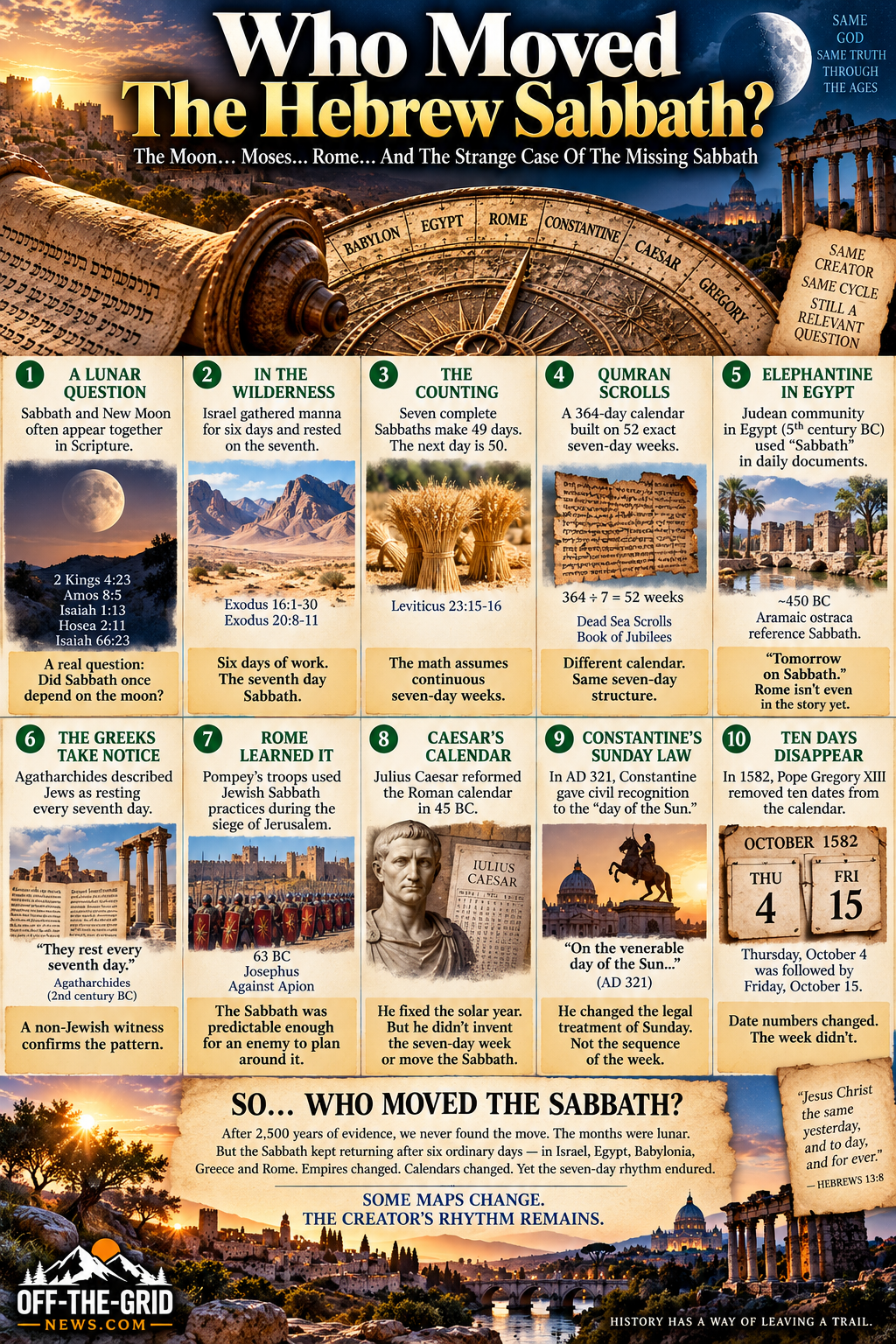
 The lunar-Sabbath argument isn’t completely pulled out of thin air. Hardly. The Old Testament repeatedly places the New Moon and Sabbath beside one another, including 2 Kings 4:23, Amos 8:5, Isaiah 1:13, Hosea 2:11, and Isaiah 66:23.
Ancient Mesopotamia also observed lunar observances and special days tied to parts of the lunar month. That’s one reason scholars have long debated whether the Hebrew shabbat might have some distant historical connection with a lunar or full-moon observance.
Yep. That’s a legitimate historical question.
But somewhere along the road, that question became a much larger claim. The modern “lunar Sabbath” system generally argues that New Moon Day sits outside the ordinary weekly count, after which six workdays are counted and Sabbaths consequently fall around the 8th, 15th, 22nd and 29th days of the lunar month.
Then the weekly count starts over with the next New Moon.
If that’s what Moses taught, our familiar Saturday Sabbath would be something very different. So instead of assuming either side was right, we started looking for the machinery that would make such a calendar work.
The Manna Trail Gives Us Our First Clue
Exodus 16 seemed like the obvious place to start. Israel arrives in the Wilderness of Sin on the 15th day of the second month, and shortly afterward God begins providing manna.
The Israelites are instructed to gather manna for six days. On the sixth day they gather twice as much, because on the seventh there will be none to gather.
At first glance, the chronology can look attractive to the lunar-Sabbath argument. Depending on how tightly we reconstruct the narrative, a Sabbath can plausibly land around the 22nd day of the month.
But there was a problem. Exodus never says, “The 22nd day of every month shall be Sabbath,” nor does it tell Israel to return to the beginning of the weekly count when the next New Moon appears.
Instead, the machinery seems remarkably simple:
Six gathering days → Seventh-day Sabbath.
Then the Fourth Commandment reinforces exactly that rhythm: “Six days shalt thou labour, and do all thy work: But the seventh day is the sabbath of the LORD thy God” (Exodus 20:8–11).
There is no instruction saying:
Stop counting when the New Moon arrives.
That missing instruction became more important the farther I traveled down this crazy trail.
Then Leviticus Handed Me A Math Problem
Next came Leviticus 23:15–16, and suddenly this wasn’t merely an argument over words. Israel is commanded to count seven complete Sabbaths and then count to the following day: “Even unto the morrow after the seventh sabbath shall ye number fifty days.”
Run the arithmetic. Do the math.
Seven uninterrupted weeks are 7 × 7 = 49 days. The following day is day 50.
Clean as some of our Northern Illinois fence lines.
But insert one or two New Moon days outside the weekly count every month and something changes. You may still accumulate 49 counted weekly days, but more than 49 actual elapsed days can pass.
Now we have to explain why Scripture tells Israel to “number fifty days” without explaining that certain intervening days aren’t supposed to count. Deuteronomy 16:9 likewise simply commands Israel to number seven weeks.
That’s when the lunar-reset trail started getting muddy.
Qumran Should Have Found The Missing Week
So I headed for the Dead Sea Scrolls. (with some assistance from ChatGPT)
If anybody in ancient Judaism was going to fight over God’s calendar, the Qumran community was qualified for the job. These folks cared intensely about calendrical disputes and believed the Jerusalem establishment was getting important parts of the sacred calendar wrong.
Their solution was a 364-day calendar, similar to the system found in Jubilees. And 364 has a rather beautiful feature:
364 ÷ 7 = exactly 52 weeks.
The calendar divides into four 91-day quarters, each containing exactly thirteen weeks. Modern scholarship on the Qumran/Jubilees system explicitly describes that 364-day year as 52 complete seven-day weeks.
But hold on. That doesn’t prove Moses used Qumran’s annual calendar. It does prove something historically important: ancient Jews could disagree (sometimes bitterly) over months, seasons, and festival dates while continuing to organize sacred time around uninterrupted seven-day weeks.
The monthly clock and weekly clock were separate things. Read that again.
Onward.
Then I Found Jews In Egypt 2,500 Years Ago
The trail became even more interesting at Elephantine, an island in southern Egypt where a Judean military community lived under Persian rule during the fifth century BC. These weren’t Jews sitting safely in Jerusalem; they were hundreds of miles away, living inside a very different imperial and calendrical world.
And they left paperwork.
Among the surviving Aramaic material are at least six ostraca that reference Shabbat, though none are complete enough to reconstruct the activity being discussed. One surviving message even refers to something happening “tomorrow on Sabbath.”
Think about where we are on the timeline.
We’re roughly 450 years before Christ.
Some Elephantine documents may even show Judeans performing ordinary activities on Sabbath. But again, that doesn’t show they had a different Sabbath calendar; it shows something farmers understood long before somebody first stretched wire between two posts.
Knowing where the fence is doesn’t mean nobody ever climbs over it.
More importantly for our investigation, the Sabbath was recognizable enough in this distant Jewish community to function as a normal temporal reference: tomorrow is Sabbath.
Rome hasn’t Christianized anything yet.
Constantine won’t be born for centuries. (meaning no Sabbath yet on government calendars)
Then Those Crazy Greeks Notice Something
By the second century BC, we get evidence from somebody who wasn’t trying to defend Judaism at all.
The Greek writer Agatharchides of Cnidus, whose account is preserved by Josephus in Against Apion, actually mocks Jewish Sabbath behavior. Yet while making fun of them, he provides us with an extraordinarily useful detail: the Jews, he says, were accustomed to rest “every seventh day.”
That’s pretty important wording.
He doesn’t say Jews rested four times during a lunar month. He describes a recurring every-seventh-day practice, and the surviving Greek itself uses language meaning “every seventh day.”
Sometimes your opponent makes a surprisingly useful witness.
Then Rome Discovers The Sabbath And Leverages It
The Romans eventually learned that Jewish Sabbath observance could have military consequences. During Pompey’s siege of Jerusalem in 63 BC, Roman forces learned to use Jewish Sabbath restrictions to their advantage as they advanced siege works.
Other Roman descriptions eventually associate the Jewish Sabbath with the planetary day of Saturn. That matters because we’re now seeing the Jewish Sabbath synchronized with the day that becomes our Saturday centuries before Constantine’s famous Sunday legislation.
The Sabbath was predictable enough for an enemy to plan around it.
That’s difficult to square with the idea that Rome later invented the weekly Sabbath cycle for the Jews.
But Wait… Didn’t Rome Have An Eight-Day Week?
Yep, and this was one of the more interesting turns in the whole investigation.
Traditional Roman civic life used an eight-day nundinal cycle, normally represented A-B-C-D-E-F-G-H. That real historical fact sometimes gets turned into the claim that our seven-day week therefore could not have been running continuously.
Except those are two different clocks.
Rome could count A-B-C-D-E-F-G-H, while a Jewish community simultaneously counted 1-2-3-4-5-6-Sabbath. Eventually the seven-day planetary week became increasingly common in the Roman world and for a time operated alongside the older nundinal cycle.
We do something similar without thinking about it. The same day can simultaneously be Sunday, September 20, the third quarter, and also the beginning of a pay week.
One clock doesn’t reset the others. Both are running.
Then Next… We Put Constantine On Trial
Now, Constantine is usually where this story gets spicy.
In AD 321, Constantine famously issued legislation concerning the “venerable day of the Sun“ — dies Solis. Judges and many urban workers were to rest on that day, although agricultural labor was expressly permitted when circumstances required it.
So yes, Constantine gave Sunday important civil recognition.
But I was looking for something else.
Where does Constantine say, “I hereby create the seven-day week”? Where does he say, “I hereby move the Jewish Sabbath”? Where does he command Jews to abandon Sabbaths calculated from New Moon and begin observing Saturn’s day instead?
I couldn’t find it.
In fact, Constantine’s legislation assumes his subjects already understand what dies Solis means. You don’t regulate a recurring weekday without your audience already knowing which recurring weekday you’re talking about.
Constantine did change the legal treatment of Sunday.
Important: That’s not the same thing as changing the sequence of the week.
Surely Julius Caesar Changed Something
Next suspect: Julius Caesar.
Caesar’s great calendar reform took effect in 45 BC, following the enormous transitional 46 BC “Year of Confusion.” He reorganized the Roman calendar around a solar year, regularized month lengths, and established the leap-year principle that became the foundation of the Julian calendar.
But changing the annual calendar isn’t the same thing as resetting every recurring cycle running inside it. More importantly, Jewish Sabbath reckoning wasn’t dependent upon Caesar’s month names or Roman nundinal letters in the first place.
A Jewish farmer didn’t need Caesar to tell him six days had passed.
The sun went down. Another day began. Six ordinary days passed, and Sabbath returned.
We all know that changing the mile marker doesn’t move the road.
Then… Boom! Ten Days Simply Disappeared
The Gregorian reform gives us perhaps the cleanest demonstration in the entire investigation.
By 1582, accumulated drift in the Julian calendar had become large enough that Pope Gregory XIII ordered a correction in the bull Inter gravissimas. The document explicitly ordered ten dates to be omitted from October 1582 as part of the transition to the corrected calendar.
In the first countries adopting the reform, Thursday, October 4, 1582, was immediately followed by Friday, October 15, 1582.
Read that carefully.
Ten numbered dates disappeared, but Thursday was still followed by Friday. Nobody slept through ten extra sunsets, and nobody woke up eleven actual days older.
The date labels jumped.
The week didn’t.
That’s about as clean a historical experiment as we could ask for. A government can change the civil calendar dramatically without breaking the recurring seven-day sequence.
Britain repeated essentially the same experiment when it adopted the Gregorian calendar in 1752. Dates were omitted to bring Britain into alignment with Gregorian reckoning, but the weekday succession continued normally.
You can move the mile markers without moving the road.
Finally, The Jewish Diaspora Became Our Control Group
Then one last thought bothered me.
What about all the Jews scattered across the ancient world?
Long before Christianity became the religion of Roman emperors, Jewish communities existed from Babylonia and Egypt to Judaea, Syria, Asia Minor, Greece and Rome. They lived under different governments, spoke different languages, and functioned inside different civil calendars.
If the weekly Sabbath depended upon periodically resetting the week according to the New Moon, geographically separated communities had enormous opportunities to drift apart. One questionable month-start could potentially move every Sabbath for the rest of that month.
Yet that’s not the historical picture we kept finding.
Philo writes from Alexandria about a recurring seventh-day institution. Josephus comes from Judaea and eventually writes in Rome. Qumran follows a radically different annual calendar, while the Greek Agatharchides nevertheless knows Jews as people who rest “every seventh day.”
Different countries.
Different calendars.
Different arguments.
Same seven-day rhythm.
So… Who Moved The Sabbath?
After following the trail for 2,500 years, I think that’s actually the wrong question.
Because I never actually found an official move.
What I found, which was more interesting, was a legitimate scholarly question about whether some distant ancestor of the Hebrew shabbat had a connection with lunar phases or ancient Near Eastern lunar observances.
That possibility deserves discussion rather than being waved away.
But that’s very different from proving that biblical Israel kept Sabbaths on the 8th, 15th, 22nd and 29th and then stopped the weekly clock until New Moon restarted it.
I looked for that mechanism in Exodus and couldn’t find the reset command. I tested it against Leviticus, where seven complete weeks naturally produce 49 days followed by day 50.
Then I went to Qumran, where a 364-day calendar produces exactly 52 seven-day weeks.
I went to Elephantine and found Sabbath language among Jews living in Egypt roughly 2,500 years ago. We asked a Greek critic, and he described Jews as resting every seventh day.
I followed Rome and found the Sabbath associated with the recurring planetary week before Constantine. Then we questioned Constantine, Caesar, and finally Gregory XIII.
Still no weekly reset.
And when Pope Gregory made ten calendar dates disappear in 1582, something almost comically simple happened:
Thursday, October 4, 1582 jumped right to Friday, October 15, 1582.
That doesn’t give us a day-by-day attendance sheet stretching unbroken from Moses to the Saturday printed on your kitchen calendar. History almost never hands us evidence that tidy, and claiming otherwise would go farther than the documents allow.
But history does leave tracks.
And these tracks keep pointing in the same direction.
Israel’s months ran on one clock, while Israel’s Sabbath ran on another. The moon helped tell Israel where it stood in the month and when annual appointed times arrived, while six ordinary days kept bringing Israel back to the seventh.
Again and again.
Empire after empire.
Calendar after calendar.
Maybe the great Sabbath mystery isn’t that somebody moved the day.
Maybe it’s that after Jews were scattered across continents, Jerusalem fell, Rome rose, Rome fell, emperors converted, calendars were rebuilt, and ten dates vanished from October…
The seven-day fence posts proved remarkably hard to move.