Print

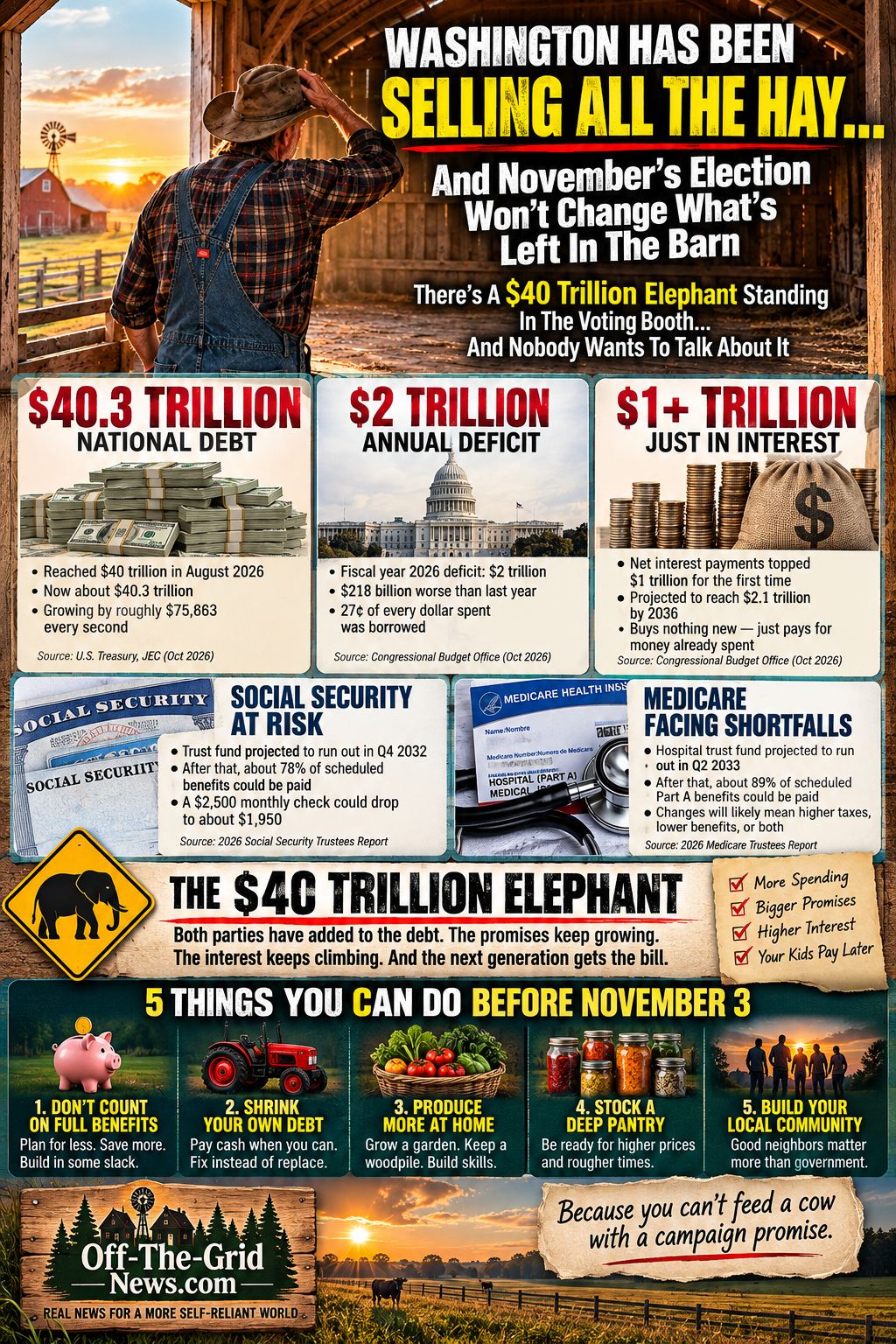
There’s A $40 Trillion Elephant Standing In The Voting Booth… And Nobody Wants To Talk About It
A 48-Year-Old Warning About America’s Empty Treasury Is Coming Home To Roost… And The Numbers Are Getting Mighty Hard To Ignore
Every farmer knows the feeling of walking into the barn in February and counting what’s left of the hay. You can tell the banker everything’s fine. You can tell your wife you’ve got plenty put away. But sooner or later, you’ve got to climb into that hayloft and face what you’ve actually got.
And here’s the trouble.
You can’t feed a cow with hay you already sold.
Washington has been selling the hay for decades, promising everybody a full manger while quietly borrowing against next year’s crop. Now, with the November 3 midterm elections just three weeks away, the politicians are back at the gate promising even more.
Meanwhile, the barn is looking mighty empty.
Somebody Saw This Coming Back In 1978… But Even He Didn’t Know How Bad It Would Get

Nearly half a century ago, some sharp-eyed economists were already warning that America was building a government it couldn’t afford. They saw the borrowing, the growing dependence on government benefits, and the dangerous habit of making promises that somebody else would eventually have to pay for.
One particularly bold prediction was that Keynesian economics would collapse by the year 2000 and America’s treasuries would be empty, or stuffed with nearly worthless paper money, by 2020.
Well, those dates came and went. The economy didn’t collapse exactly on schedule, the dollar didn’t become completely worthless, but the federal government did keep borrowing, spending, and sending out checks.
So the underlying problem didn’t disappear.
In fact, the warning contained an observation about human nature that ought to make every American squirm a little. People love the idea of a free lunch, especially when somebody in Washington promises to pick up the tab.
Unfortunately, there’s a rather unpleasant detail everybody seems determined to overlook.
Somebody always pays for lunch.
And when the government borrows the money, that somebody may not even have been born yet.
Let’s Walk Out To Washington’s Barn And Count The Hay
Forget the campaign speeches for a minute. Forget the television commercials showing smiling families, waving flags, and politicians standing in front of American factories.
Instead, let’s look at the actual numbers.
According to the U.S. Congress Joint Economic Committee’s October 2026 debt report, America’s gross national debt reached approximately $40.25 trillion on October 5.
That’s trillion with a T.
The country crossed the $40 trillion mark for the first time in August, according to Treasury figures reported by Reuters. And over the preceding twelve months, the national debt increased by approximately $2.39 trillion.
Now, here’s a number worth chewing on while you’re drinking your morning coffee.
According to that same congressional report, America’s debt increased at an average rate of approximately $75,863 every single second over the previous year.
That’s not what Washington spends every second. That’s how fast the mountain of unpaid bills has been growing.
And while politicians argue about who deserves the blame, the interest meter keeps running.
The Most Expensive Hired Man In America Doesn’t Lift A Finger
Imagine hiring a fellow to work your farm. You promise him a good wage, give him a place to stay, and tell him to report for work Monday morning.
Only there’s one problem.
He never shows up.
Nevertheless, every Friday you write him another check. And every year, his wages go up, even though he hasn’t repaired a fence, fed a calf, or hauled a single bale of hay.
Sounds ridiculous, doesn’t it?
Well, meet the federal government’s interest bill.
According to the Congressional Budget Office’s October 8 budget review, the federal government ran an estimated $2 trillion deficit during fiscal year 2026, approximately $218 billion worse than the year before.
Meanwhile, net interest payments on the national debt climbed above $1 trillion. That’s money spent servicing past borrowing rather than directly purchasing new equipment, repairing roads, or providing additional public services.
And here’s where the story gets downright ugly.
The Congressional Budget Office’s long-term projections show annual net interest costs climbing toward approximately $2.1 trillion by 2036.
Think about that for a moment. Washington could eventually be spending more than two trillion dollars a year just to carry yesterday’s bills.
That’s one mighty expensive hired man.
And unlike the fellow who never shows up for work, this one can’t simply be fired.
Washington’s Credit Card Is Smoking… And Nobody Wants To Put It Down
Let’s bring these enormous numbers down to something a little closer to the kitchen table.
During fiscal year 2026, the federal government collected approximately $5.4 trillion while spending roughly $7.4 trillion, according to the latest federal budget estimates.
In other words, Washington borrowed approximately 27 cents of every dollar it spent.
Now imagine a family bringing home $46,000 a year while spending $63,000. Every December, they’re another $17,000 deeper in debt, and the interest on their old borrowing keeps eating a bigger piece of next year’s paycheck.
Would your banker call that responsible money management?
Would you?
Of course, the federal government isn’t exactly like a household. It can collect taxes, refinance its debts, and borrow in a currency the United States itself issues.
But even those advantages don’t make the arithmetic disappear. Interest still has to be paid, lenders still expect repayment, and taxpayers eventually face the consequences of decisions made years earlier.
The Congressional Budget Office projects that annual deficits will continue growing over the coming decade, with federal debt held by the public rising faster than the economy.
And that’s the part that should concern anybody who has ever tried to keep a farm afloat.
You cannot borrow your way into prosperity forever.
The Retirement Promise That Could Shrink By 22 Percent
Now let’s talk about something that hits a little closer to home.
Maybe you’ve worked forty or fifty years, paid your taxes, raised your children, and figured Social Security would help keep the lights on when your working days were finished.
You aren’t asking for a handout. You’re expecting the benefits you’ve spent a lifetime paying into.
Unfortunately, the government’s own accountants are waving a red flag.
According to the 2026 Social Security Trustees Report, the trust fund supporting retirement and survivor benefits is projected to exhaust its reserves during the fourth quarter of 2032.
After that, continuing program income would cover only about 78 percent of scheduled benefits, unless Congress changes the law.
Let’s put some dollars on that.
Suppose your scheduled retirement check is $2,500 a month. If benefits were reduced proportionally to 78 percent, that check would fall to approximately $1,950.
That’s $550 disappearing from your monthly household budget.
And if you’re living on a modest retirement income in rural America, $550 isn’t pocket change. That’s propane for the winter, repairs on the pickup, property taxes, groceries, or medicine.
Meanwhile, the 2026 Medicare Trustees Report projects that Medicare’s Hospital Insurance Trust Fund will exhaust its reserves in the second quarter of 2033.
At that point, incoming revenue would cover approximately 89 percent of scheduled hospital insurance costs.
Now, don’t misunderstand these warnings.
Social Security and Medicare aren’t scheduled to disappear. Payroll taxes will continue coming in, and Congress has options for changing taxes, benefits, or program financing before those deadlines arrive.
But those changes would involve real choices, and somebody would have to bear the cost.
And here’s what bothers me most.
The people making these promises today may be long gone from Washington when the bill finally arrives.
Everybody Wants Their Money Back… And That’s Part Of The Problem
There’s another uncomfortable truth hiding underneath America’s enormous debt.
Most Americans believe they’ve been treated unfairly by the government at one time or another. Maybe it’s the taxes they paid, the regulations they endured, or the inflation that quietly ate away their savings.
And after years of getting squeezed, it’s only natural to think, Well, maybe it’s my turn to get something back.
That’s understandable.
But there’s a dangerous trap hiding inside that reasoning.
Imagine a careless driver runs a stop sign and smashes into your pickup. You’re entitled to seek compensation from the person responsible, and nobody would argue otherwise.
But suppose you decide to get even by driving down the road and smashing somebody else’s truck.
Suddenly, you’re no longer correcting an injustice. You’re creating another one.
The same principle applies when government becomes a giant machine for transferring money from one group of Americans to another.
Everybody has a reason for wanting something. Everybody has a story about why they deserve it. And everybody figures somebody else ought to pick up the bill.
Before long, the whole country is standing around the same feed trough, wondering why the grain keeps disappearing.
Rural America Isn’t Standing Outside This Mess
Now, before we start pointing fingers at city folks and Washington bureaucrats, we ought to look in our own barn.
Rural America receives plenty of government support, too.
There are farm programs, federally supported crop insurance, subsidized loans, conservation payments, rural development grants, Medicare, and Social Security.
Some of those programs serve legitimate purposes. Others may be poorly designed, wasteful, or overdue for serious reform.
And there’s an important difference between collecting retirement benefits you’ve spent decades paying into and demanding a new subsidy simply because another group already has one.
Still, the larger problem remains.
When every industry, every organization, every voting bloc, and every special interest insists that its particular program is untouchable, Washington eventually runs out of easy places to make cuts.
Then the politicians discover something remarkable.
It’s much easier to borrow another trillion dollars than to tell voters something they don’t want to hear.
So the borrowing continues.
And the next generation gets handed the invoice.
Before You Vote November 3… Ask One Question Nobody Wants To Answer
I’m not going to tell you which candidate deserves your vote. Republicans and Democrats have both contributed to the debt problem through combinations of spending increases, tax policies, and promises they couldn’t fully finance.
But before you walk into that voting booth, I’d suggest asking every candidate one simple question.
Where’s the money coming from?
Not where they’d like it to come from. Not how wonderful the proposed program sounds. Not how many smiling families will supposedly benefit.
Where is the actual money coming from?
If a candidate promises a new program, ask what it will cost and whether taxes, spending cuts, or borrowing will pay for it.
And if the answer involves borrowing, ask how much interest taxpayers will eventually owe.
Better yet, ask what existing government program that candidate would actually be willing to reduce or eliminate.
Because promising benefits is easy.
Explaining how to pay for them is where the sweating starts.
Five Things I’d Do Before Washington Sends Another Bill
Of course, you can’t personally straighten out the federal budget. But you can make your own household considerably harder to knock over when Washington’s financial troubles begin reaching deeper into ordinary people’s pockets.
And that’s where the homesteader has an advantage.
1. Stop Building Your Retirement Around Washington’s Promises
If your retirement plan depends on receiving every penny of your projected Social Security benefits, it’s worth running the numbers again.
The Social Security Administration’s retirement planning tools can help you estimate benefits, while the trustees’ projections give you a reason to consider less favorable scenarios.
Maybe Congress fixes the problem before 2032. Maybe lawmakers change the retirement age, raise taxes, adjust benefits, or adopt some combination of reforms.
Nobody knows exactly what will happen.
But a little extra savings, less debt, and a household that can operate on less income are mighty good insurance against political promises that don’t turn out as advertised.
2. Make Your Own Debt Smaller Before Somebody Else Makes Your Bills Bigger
If there’s one lesson every old-fashioned homesteader understands, it’s that owing less gives you more freedom.
A paid-for pickup might have rust around the wheel wells, but it doesn’t come with a $700 monthly payment. And that old tractor you’ve repaired three times may be worth more to your household than a shiny new machine financed for the next seven years.
So before you borrow for another convenience, ask whether you really need it.
Fix what you can. Buy used when it makes sense. Keep some emergency cash available, and pay down expensive debt before the interest eats another hole in your budget.
The fewer people you owe, the fewer people can tell you what to do.
3. Turn Your Homestead Into Something That Produces More Than It Consumes
A good garden won’t eliminate your grocery bill. Neither will a chicken coop, a woodpile, or a pantry stocked with home-canned vegetables.
But taken together, those things can make a surprising difference.
When food prices rise, a productive garden gives you something besides another expensive trip to the supermarket. When heating costs jump, a properly installed woodstove and a seasoned woodpile may give you another option.
And when the economy gets rough, practical skills become a kind of wealth that doesn’t appear on a bank statement.
The fellow who can repair a pump, grow potatoes, preserve meat, and keep an old engine running has options that somebody completely dependent on outside services may not have.
That’s worth remembering.
4. Build A Pantry That Can Carry You Through A Bad Stretch
A deep pantry isn’t just for hurricanes, blizzards, or some dramatic national emergency.
Sometimes the emergency is a lost job, an unexpected medical bill, a broken transmission, or a government check that doesn’t stretch as far as it used to.
And when that happens, a household with six months of carefully rotated food supplies has something valuable.
Breathing room.
So keep the shelves stocked with foods your family actually eats. Learn to preserve what your garden produces, maintain your freezer equipment, and have a backup plan for keeping food safe during an extended power outage.
You don’t need to prepare for the end of civilization to appreciate having supper already paid for.
5. Get To Know The People Who Could Help Put Your Community Back Together
Here’s something Washington can’t manufacture with another trillion dollars.
Good neighbors.
When the ice storm knocks out power, the creek floods, or somebody’s barn burns down, it’s usually the people living nearby who show up first.
They’re the ones bringing chainsaws, tractors, casseroles, generators, and strong backs.
And that’s why local churches, volunteer fire departments, farming cooperatives, feed stores, and neighborhood relationships matter so much.
A community full of capable people who trust one another can solve problems that would leave isolated households helpless.
So get involved. Trade skills. Help the widow down the road. Teach a young fellow how to repair something instead of throwing it away.
Because when trouble arrives, knowing somebody who can fix a well pump may be worth considerably more than knowing somebody who can explain the federal budget.
There’s One More Thing Washington Doesn’t Want To Talk About
America’s debt problem didn’t appear overnight, and it won’t disappear after one election.
In fact, there are only so many ways a government can deal with borrowing that persistently outruns its ability to pay.
It can raise taxes. It can reduce spending or future benefits. It can allow inflation to erode the purchasing power of money, although that comes with serious economic costs of its own.
Or it can pursue some combination of those choices while hoping economic growth makes the burden easier to carry.
None of those possibilities is painless.
Higher taxes leave families with less money. Reduced benefits can hurt retirees and other people who depend on government programs. Inflation quietly punishes people who saved carefully and expected their dollars to hold their value.
And rising interest costs can make every one of those problems harder to solve.
That’s why the Congressional Budget Office’s long-term budget outlook deserves more attention than another round of campaign advertisements.
The numbers aren’t a prediction that America will collapse next Tuesday.
They’re a warning that continuing down the same road will eventually force decisions politicians have spent decades avoiding.
The Hay Doesn’t Care Who Wins The Election
Back in the barn, there’s a simple truth every farmer learns sooner or later.
If you’ve got enough hay to make it through winter, you can sleep pretty well when the snow starts blowing. But if you’ve already sold half of what you needed, no amount of wishful thinking will put those bales back in the loft.
And the cows aren’t interested in hearing your excuses.
Washington can argue about whose fault the debt is. Politicians can promise prosperity, security, lower taxes, bigger benefits, and all sorts of wonderful things.
But eventually, somebody has to pay for what was promised.
That’s why November 3 matters.
Not because one election will magically fix forty years of bad financial habits, but because voters still have an opportunity to demand something better than another helping of promises financed by somebody else’s grandchildren.
So ask hard questions. Look past the slogans. And pay attention to the candidates who are willing to admit that America’s financial problems won’t be solved without difficult choices.
Meanwhile, get your own barn in order.
Stack the firewood. Mend the fences. Fill the pantry. Pay down the debt. Build friendships with people who know how to work, produce, repair, and help one another.
Because when the political speeches are over and the campaign signs have blown into the ditch, the bills will still be coming.
And sooner or later, somebody will have to climb into that hayloft and count what’s left.
Because you can’t feed a cow with a campaign promise.