 Print
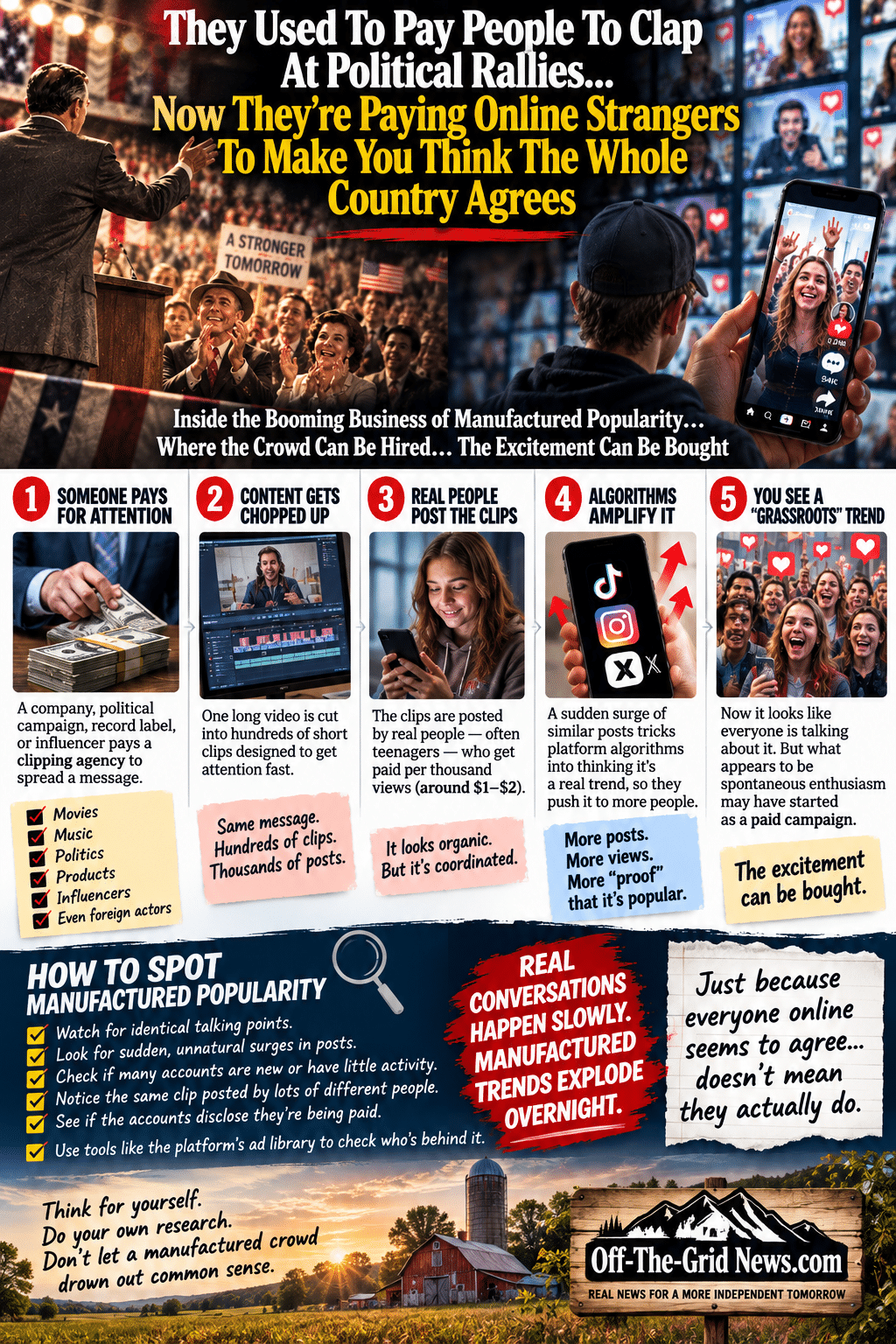
Inside The Booming Business Of Manufactured Popularity… Where The Crowd Can Be Hired… The Excitement Can Be Bought… And The Truth Gets Buried Under A Mountain Of Videos
The Feed Is For Sale: Who’s Paying Strangers to Make You Think Everybody Agrees?
You know that booth at the county fair with a line stretching halfway past the livestock barn? You figure the apple pie must be something special. But suppose the fellow running the booth paid a hundred strangers to stand there, grin, and tell everybody how good the pie was.
The line would be real. The people would be real. But the excitement that got the whole thing started? Bought and paid for.
Now take that same trick, put it on a phone, and multiply it by a few million views. Welcome to a little corner of the internet where popularity can be planted like seed corn—and harvested for cash.
First, Somebody Buys the Crowd
In May 2026, journalist Lane Brown published “The Feed Is Fake” in New York Magazine’s Vulture. He went inside the growing business of “clipping,” where clients pay networks of creators to cut podcasts, interviews, songs, speeches, or promotional footage into bite-size videos and spread them across TikTok, Instagram, YouTube, and X.
Some of this is ordinary promotion. A musician wants more ears on a song. A podcaster wants more listeners. There is nothing mysterious about paying for publicity—farmers have been buying newspaper ads since before your grandfather owned a tractor.
But there is a catch. When dozens or hundreds of accounts that look independent begin pushing the same person, product, or argument, the average viewer may mistake a coordinated campaign for a spontaneous groundswell. The audience sees the smoke without knowing who lit the fire.
Sixty-Five Thousand Accounts. Fifty Thousand Videos a Day.

One of Brown’s most striking examples came from Joe Lim, who said his company, Floodify, once controlled roughly 65,000 dummy accounts and published around 50,000 videos a day across major platforms. Those are Lim’s reported claims, not independently audited totals—but even a fraction would represent an enormous publicity machine. Brown’s reporting describes a business built to flood the feed.
Think about that number the next time you see the same clip pop up five times before breakfast. You may be watching a genuinely popular moment. Or you may be seeing the work of a distribution operation with a very full fuel tank.
And here is the sneaky part: the accounts do not all have to be robots. Real people can and do take paid assignments, edit a clip, post it, and collect money when it performs. The viewers who watch and share may be completely genuine, even if the first push was purchased.
The Price of Looking Popular Can Be Surprisingly Cheap
Brown described campaigns offering roughly $1 or $2 per thousand views. At a dollar per thousand, a million views works out to $1,000 in creator compensation, before other costs or payment rules. That is not a guaranteed price for a million real impressions; it is an illustration of how the incentive can work.
One agency in the story, Chaotic Good Projects, used the term “trend simulation.” That phrase ought to make your ears perk up. It suggests an attempt to create the appearance of a trend rather than merely waiting to see what catches on naturally. Read the original investigation and decide what you think of the sales pitch.
Now picture a feed full of clips praising the same celebrity, mocking the same public figure, or declaring the same product the next big thing. The question is not simply whether the videos are real. It is whether you have been told who paid to put them in front of you.
Want to See the Price Tags? They’re Sitting in Public
You do not have to take a reporter’s word for the existence of this market. Visit Whop’s Content Rewards listings, where campaigns advertise budgets, payout rates, and platforms. One example documented in the source material was a “Todd V | Clipping Campaign” listing $0.80 per thousand views and a $1,700 budget. Listings change, so treat that as a dated example rather than a standing offer.
The Whop documentation and Content Rewards launch instructions explain the basic machinery: a sponsor funds a campaign, sets rules and rewards, and creators submit content for payment. Some listings are for original user-generated content rather than clips, so do not throw every campaign into the same bucket.
That is the beauty of following the money. Instead of arguing about whether a video “feels fake,” you can look for a sponsor, a budget, a payout formula, and instructions telling participants what to post.
From Selling Music to Selling a Political Story
Here is where the stakes get bigger than entertainment. In September 2024, the U.S. Justice Department announced action against 32 internet domains allegedly used in a Russian government-directed influence operation known as Doppelgänger. Prosecutors said imitation news websites, disguised social-media accounts, and paid ads were used to push political narratives and steer readers toward material that looked like established journalism.
According to the government, one deceptive domain imitated The Washington Post. The operation allegedly sought, among other things, to weaken support for Ukraine and influence American voters. Those are government allegations about a particular foreign operation—not proof that clipping companies are secretly working for foreign governments.
Still, the comparison matters. Whether someone is promoting a new song or trying to influence a national debate, the underlying temptation is similar: make a message look more widely accepted than it really is. A hand-painted sign outside the barn says “Advertisement.” A paid crowd pretending to be your neighbors does not.
The Law Has Something to Say—but Not Everything Is Illegal
In 2024, the Federal Trade Commission adopted a rule against certain fake reviews, testimonials, and fake indicators of social-media influence. It took effect October 21, 2024. The FTC’s own Q&A explains the limits and conditions of that rule.
Separately, the agency’s endorsement guidance says material relationships that could affect how consumers judge an endorsement generally need clear disclosure. But do not jump from “this clip was paid for” to “this clip broke the law.” The content, commercial connection, disclosures, and applicable rules all matter.
In other words, a paid farmhand is not a thief because somebody paid him to work. The trouble starts when someone tries to pass off paid work as independent testimony and misleads the customer.
The Fake Crowd Can Get Loud in a Hurry
Paid clippers are only one piece of the puzzle. Bot networks and coordinated inauthentic accounts can also make an argument seem larger than it is. Brown cited research from Cyabra claiming that fake accounts helped drive online reaction to a Sydney Sweeney advertisement. Separately, People reported on Gudea’s analysis of suspicious early activity surrounding criticism of a Taylor Swift album.
These are company analyses using their own detection methods, not court findings or definitive measurements of what every viewer believed. A suspicious account is not automatically a bot, and a loud argument is not automatically manufactured. Still, the examples show why raw comment counts are a poor substitute for evidence.
A thousand chickens squawking in the yard might mean a fox is nearby. Or it might mean somebody just tossed out a bucket of corn. Either way, count the chickens if you like—but first find out what set them off.
Four Places to Start Digging Before You Share
First, check the Meta Ad Library. You can search advertisers and examine many ads running across Meta’s services. Political and social-issue ad records have additional transparency features; Meta explains its tools here.
Next, try Google’s Ads Transparency Center. Search an advertiser or website and look at the available ads and dates. Google explains how its transparency center works.
Then, examine TikTok’s Commercial Content Library. Be careful with geography: TikTok’s documentation describes coverage centered on the European Economic Area, Switzerland, and the United Kingdom. It is not a complete catalog of everything promoted to Americans.
Finally, look at public content-reward campaigns themselves. If a campaign brief names the same footage, slogan, caption, or posting instructions you keep seeing, that is a meaningful lead. Save the date and the page. Public listings can disappear or change.
The Five-Minute Test for a Suspicious Viral Clip
Start by saving what you actually saw: a screenshot, the account name, the date, the caption, and the link. Then hunt down the original podcast, speech, interview, or video. A ten-second clip can make a perfectly ordinary conversation sound like a barn fire if someone cuts away the sentence before it.
Next, compare several posts. Are they using the same odd caption, identical crop, or unusual phrase? Is there a visible sponsorship disclosure? Can you connect the post to a published campaign brief or payment instructions? Similarity alone is not proof: genuine fans copy one another all the time.
And remember, an empty ad-library search proves very little. A company may pay creators directly without buying a conventional platform ad. The absence of a listed advertisement does not establish that a post was unpaid.
Only after those checks should you make an accusation—and make it no broader than the evidence supports. “These posts match a paid campaign brief” is a stronger and fairer statement than “everybody sharing this is a paid liar.”
Don’t Confuse a Long Line With Good Pie
The old county-fair trick works because human beings notice crowds. We figure that if enough neighbors are standing around a booth, somebody must know something we do not. On social media, that instinct can be turned into a business model.
So the next time your feed insists that everybody loves a product, hates a person, or agrees about some big controversy, ask three plain questions: Who benefits? Who paid? And what evidence would still be there if all those views vanished tomorrow?
A million views can tell you a message traveled a long way. They cannot tell you whether the message is true.
And no matter how long the line gets, you still ought to taste the pie yourself.