Print
Why The Most Valuable Things Your Homestead Produces Will Never Show Up On A Spreadsheet
Working The Four Fields: Knowing What To Keep, What To Change, And What You’re Really Building For The People Who Come After You
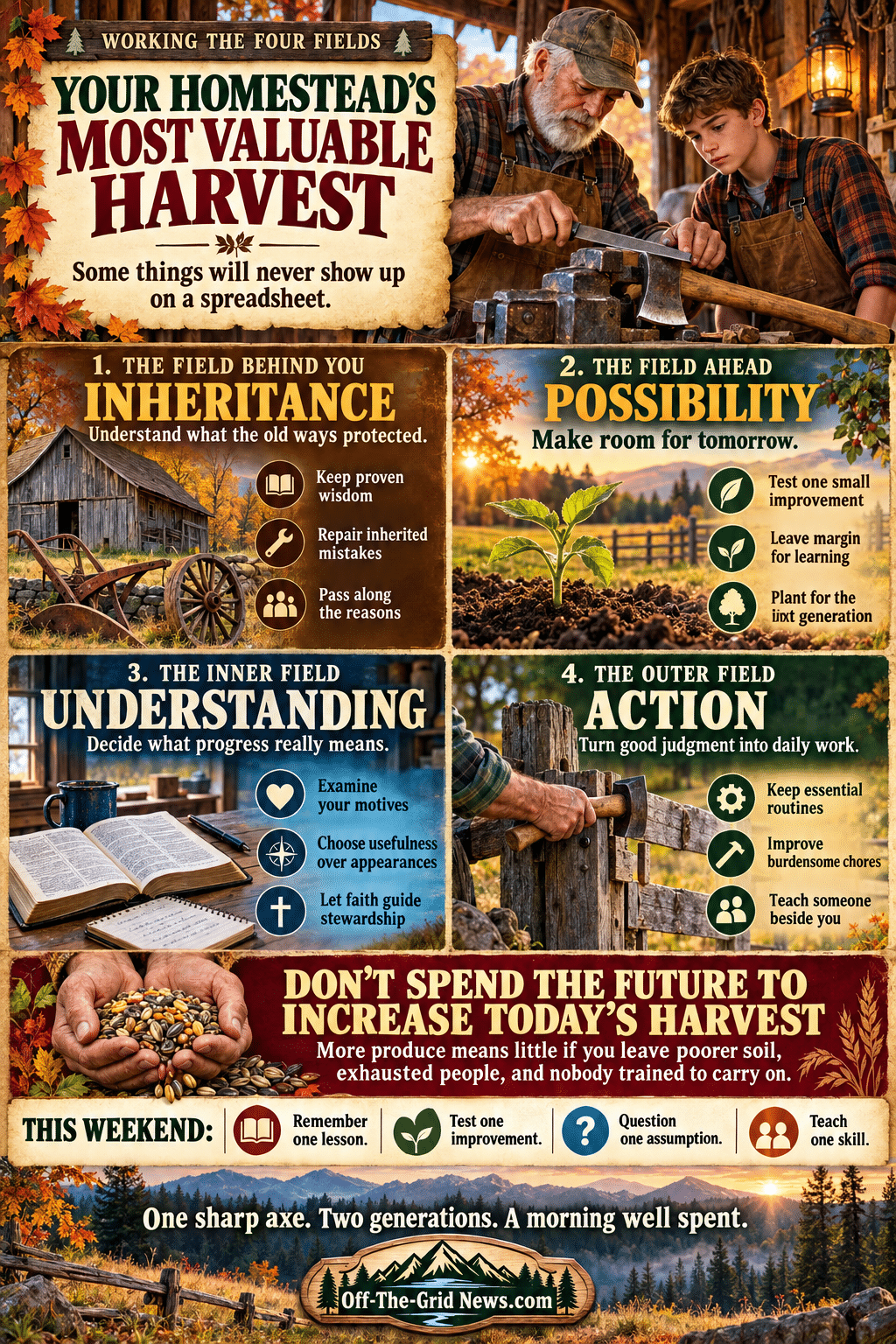
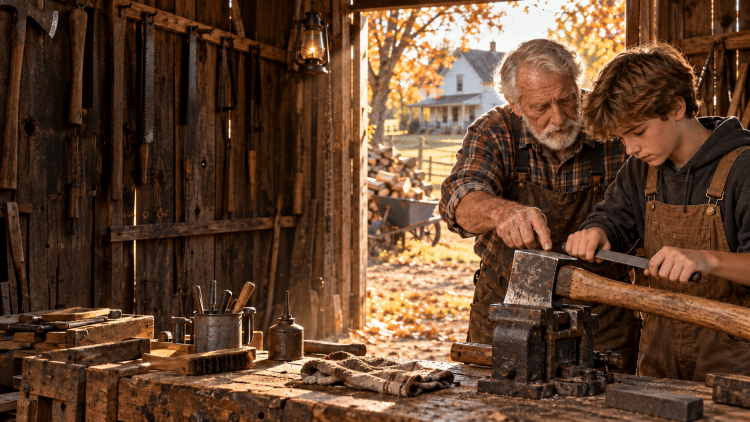
Suppose you spend Saturday teaching your grandson to sharpen an axe. You could have finished the job yourself in twenty minutes, but instead, it takes most of the morning.
There are questions, crooked strokes, a little frustration, and several stops to explain something your hands learned so long ago you hardly remember learning it. By lunchtime, you have one sharp axe.
From a production point of view, that’s a pretty lousy morning.
From a grandfather’s point of view, something worthwhile may have happened. And that difference gets at a problem that reaches far beyond the woodpile.
We have become so accustomed to measuring life by speed, output, and convenience that we sometimes forget to ask what our work is supposed to produce. We count the finished jobs without noticing what happened to the people doing them.
Look, a family homestead can produce food while wearing out its soil. It can produce income while wearing out a marriage, or look impressive from the road while leaving the next generation with no desire to stay.
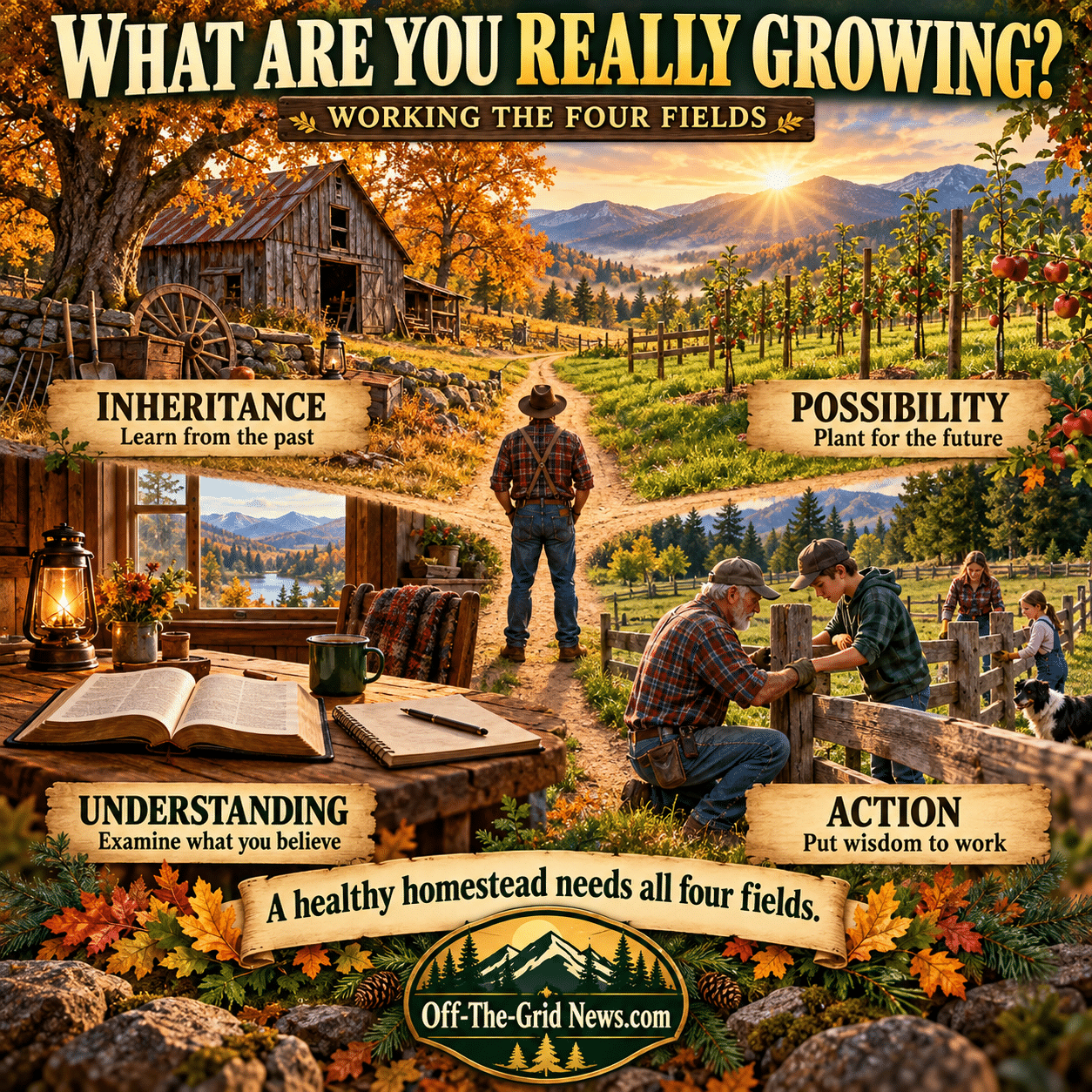
Working the Four Fields means learning to see the whole harvest.
The Trouble With Counting Everything
Numbers have their place, of course. You should know what feed costs, how much firewood you’ve got left, and whether your little egg business is paying its way.
A homestead run entirely on warm feelings can become an expensive education or worse. But trouble starts when we use one measuring stick for every kind of work.
How many minutes should you spend comforting a frightened child? What is the hourly return on visiting a lonely neighbor, or the dollar value of teaching somebody to keep his word?
Those questions require judgment beyond arithmetic. Sometimes the slower job produces the greater good.
Teaching someone to repair a gate takes longer than fixing it alone. Explaining why you rotate garden beds interrupts the planting, but it also passes along knowledge that can protect future harvests.
That particular lesson has practical backing. University of Minnesota Extension explains how rotating crops helps interrupt disease cycles and manage demands on the soil.
Here’s the thing: The conversation beside the garden will produce fewer planted rows before supper. But it will also produce a gardener who understands what he is doing.
The Field Behind You: Find Out What The Old Ways Were Protecting
Walk into an old barn and you’ll find decisions somebody made before you were born. The roof pitch, the placement of the doors, and the hooks beside the workbench all tell part of the story.
Some decisions were wise. Others reflected limited money, available materials, or a mistake nobody ever corrected.
Inheritance calls for examination. Before tearing something out, ask what problem it solved.
Grandpa may have kept spare hardware because town was far away and a broken hinge could leave livestock loose. Grandma’s habit of cooking from pantry staples might reflect an understanding of lean weeks worth remembering.
The useful inheritance lies deeper than the particular object or habit. It is the judgment behind it.
You might need a different tool while keeping the same thrift. You might heat differently while preserving the old insistence on having a second way to stay warm.
There are two easy ways to mishandle the past: assume everything old was foolish, or assume everything old was wise. Both save you the trouble of thinking.
The field behind you deserves better. Keep the lessons that sustain life, repair what was damaged, and admit where your people were wrong.
Then carry something worth having into the next season.
The Field Ahead: Leave A Little Ground For Experimenting
Now turn toward the future. A homestead that refuses every change can become as fragile as one that chases every new gadget.
Bodies age, and family circumstances change. A method that worked when three teenagers lived at home may become pretty darn exhausting when the chores fall to two older folks with sore knees.
Faithfulness sometimes requires a new arrangement. Perhaps you need a smaller garden, better watering equipment, or raised beds that bring the work to a more comfortable height.
That is one practical benefit identified in Extension’s guide to raised-bed gardening. Changing the arrangement can help people keep gardening as their needs change.
Maybe an old crop deserves another trial, or a new tool could remove drudgery and leave you with enough energy to enjoy supper. The question is whether the change serves the life you are responsible for.
Give yourself a manageable place to find out. Try the unfamiliar variety in one row, test the watering arrangement on one bed, or learn a repair on equipment you can afford to have sitting idle. Just makes good sense, right?
An experiment needs room to disappoint you without taking the whole operation down.
That is one reason margin matters. A calendar jam-packed with chores leaves little room for fun or discovery, and every suggestion starts sounding like another burden.
Sometimes tomorrow’s improvement begins with leaving a little breathing room today.
The Inner Field: Decide What Deserves To Change
The hardest decisions often happen before you pick up a tool. They happen in the inner field, where you decide what progress means.
A new machine or gizmo could save labor while bringing specialized parts and repair bills you cannot handle yourself. An old machine might be wonderfully repairable while demanding more time than your household can spare.
Neither its age nor its advertising can make the decision for you. You have to ask what it does to your responsibilities.
Does it help you care for the people entrusted to you? Can you maintain it, and what new obligations come with it?
Then ask a question that may feel less comfortable: Why do I want it?
Sometimes we buy because we need something. Sometimes we buy because owning it makes us feel capable, current, or admired.
Homesteaders are as vulnerable to the same temptations as anybody else standing in a showroom. A person can purchase the appearance of independence while becoming more dependent on payments and distant service departments.
Scripture gives us a steadier starting place. “The earth is the LORD’S” means our possession of a little piece of it brings responsibility.
That changes the question from “What can I get out of this place?” to “How should I care for what has been entrusted to me?” The answer may call for restraint one day and invention the next.
The Outer Field: Somebody Still Has To Feed The Chickens
Good ideas eventually meet a cold morning. The water needs checking, animals need care, and the gate you meant to repair last weekend is still dragging.
This is the outer field, where understanding becomes visible. A lot of a homestead’s strength comes from ordinary tasks done at the proper time, whether anybody feels inspired or not.
But it also needs someone to notice when a routine has become foolish. If you carry water farther every year, perhaps the arrangement needs changing.
Even familiar garden work deserves examination. Extension’s discussion of reducing tillage explains how repeated soil disturbance can contribute to erosion and compaction, and describes alternatives for particular jobs.
Doing any task faithfully includes being willing to learn how to do it better. Effort matters, but effort alone cannot correct a poor arrangement.
Often, these duties fall to different people. One family member sees possibilities everywhere, while another remembers who will have to clean, feed, maintain, and finish whatever gets started.
They need to listen to each other. The dreamer needs the practical person’s knowledge, and the practical person may need the dreamer’s willingness to imagine relief.
A household grows stronger when both can speak honestly without being dismissed.
Don’t Harvest The Seed Corn Of Your Own Life
There’s another danger in treating your place like a factory. You can become proud of extracting more while quietly leaving less behind.
More produce, but poorer soil. More projects, but less patience; more work accomplished, but nobody taught to continue it.
That is a harvest purchased by spending the future.
Consider a garden that produces beautifully because you give it every spare hour. If the work becomes so consuming that you never teach anyone else, its success may depend entirely on your continued strength.
What happens when that strength changes? The same question applies to the pantry, the workshop, and the household finances.
An orderly system that only one person understands has a weakness worth addressing. Write things down, explain the reasons, and let somebody work beside you while the stakes are small.
Accept that their learning will slow you down. Passing on responsibility takes patience before it brings relief.
A homestead becomes more durable when knowledge travels beyond one pair of hands.
What Will Still Be Growing When You’re Gone?
So this weekend, walk your place with all four fields in mind. Look behind you and identify one inherited practice worth understanding, then look ahead and choose one modest improvement worth testing.
Look within and examine one assumption about what makes your life successful. Then look outward and do the next useful thing.
Maybe you’ll repair a tool instead of replacing it. Maybe you’ll replace equipment that has become an unreasonable burden, or ask your wife which chore most needs improving… and listen to the answer.
Or maybe you’ll invite a grandchild to the workbench. The morning may go slowly, and you may finish fewer jobs than you planned.
Still, years from now, that child may stand beside another youngster, holding the same axe and explaining how to find the edge. By then, nobody will remember Saturday’s unfinished list.
Something you planted will still be growing.