 Print

A Small Tart Cherry Study Offers A Big Reason To Pay Attention
Could the Next Useful Tree on Your Homestead Help You Sleep Better?
It’s 2 a.m., and the homestead has finally gone quiet. The woodstove ticks as it cools, a coyote yips somewhere beyond the fence, and you’re lying there counting everything except sheep. By now, you know every knot in the ceiling boards.
Meanwhile, dawn is coming whether you sleep or not. The goats will want breakfast, the fence still needs fixing, and that stack of firewood won’t split itself. You’re tired enough to sleep standing up, yet somehow you can’t sleep lying down.
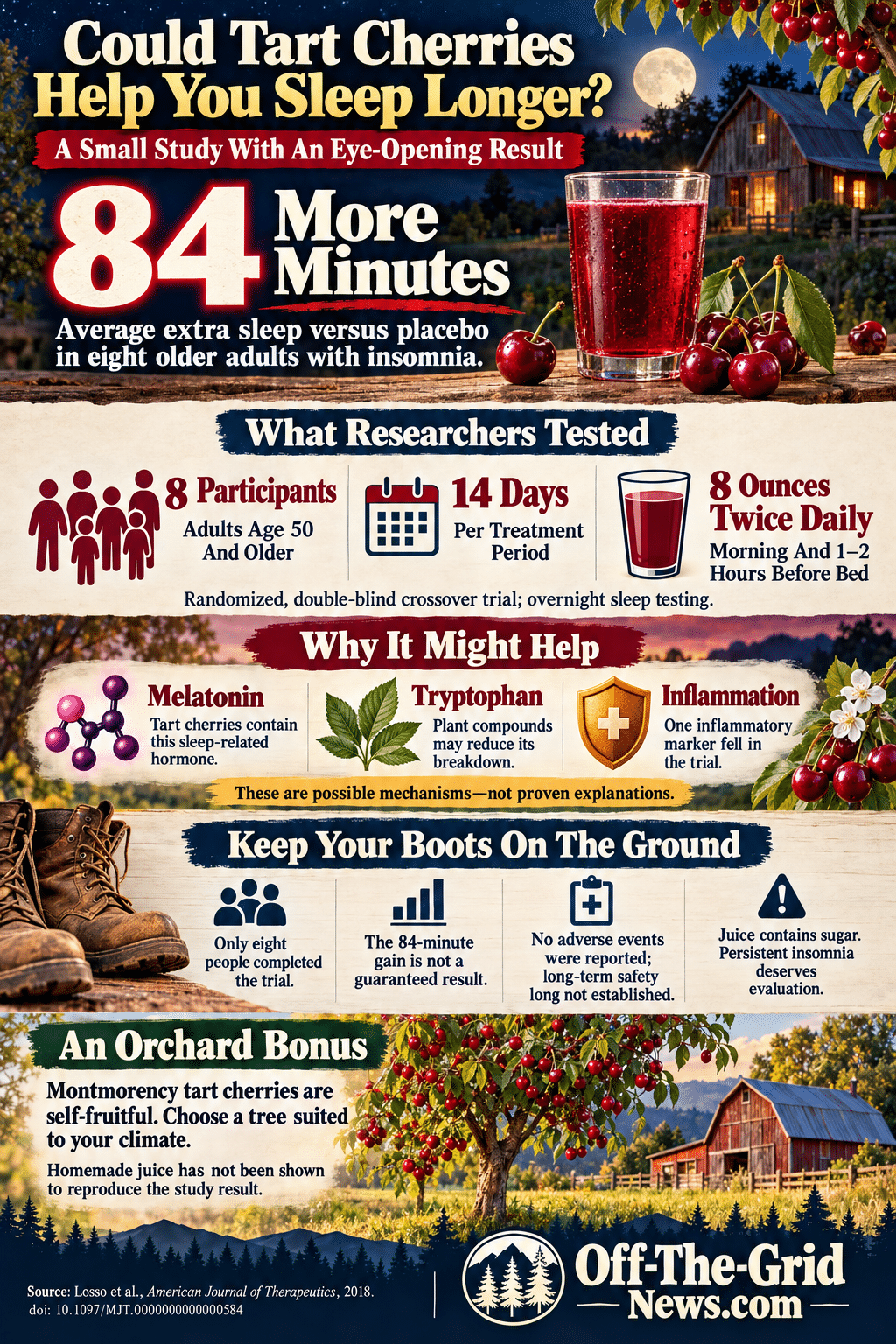
Then along comes a little red fruit with a result big enough to make a weary homesteader put down the coffee cup. In a small clinical trial, older adults with insomnia slept an average of 84 minutes longer after drinking tart cherry juice than after drinking a placebo. That’s nearly an hour and a half—an interesting finding, even with a small study’s limits.
Eight Sleepers and One Eye Opening Result
First, let’s open the gate and look at what the researchers actually did. The pilot trial published in the American Journal of Therapeutics enrolled adults aged 50 and older with chronic insomnia. Eleven people were randomized, but three were found to have sleep apnea and were referred for evaluation and treatment, leaving eight in the analysis.
For two weeks, participants drank about 8 ounces of Montmorency tart cherry juice in the morning and another 8 ounces one to two hours before bed. They also completed a two-week placebo period, with a two-week break between the two. In other words, each person tried both drinks, and the order was randomly assigned.
Better yet, this was double-blind: participants and the researchers assessing them weren’t supposed to know which drink was which. The comparison drink was made to look and taste like cherry juice. That matters, because expecting a good night can color your morning report.
Still, the researchers didn’t simply ask, “How’d you sleep?” over scrambled eggs. They used overnight polysomnography, a detailed sleep test that records brain activity, breathing, movement, and other signals. The extra sleep showed up in recorded measurements, not just somebody’s hopeful recollection.
An Extra Hour and a Half Before the Rooster Calls
After each treatment period, the sleep testing showed an average of 84 additional minutes of sleep with cherry juice compared with placebo. The difference met the researchers’ threshold for statistical significance, with a p-value of 0.0182. That makes the finding worth investigating; it doesn’t guarantee that the next person who pours a glass will get the same result.
Participants also reported better habitual sleep efficiency on one part of a sleep questionnaire. Put plainly, that’s the share of your time in bed you actually spend sleeping. However, the machine-measured improvement in sleep efficiency wasn’t statistically significant, and several other questionnaire results didn’t show significant differences.
So the strongest headline here is longer measured sleep in a very small group. It isn’t proof that every part of insomnia disappeared.
Even so, anybody who works a place can understand why 84 minutes catches the eye. Imagine heading toward the barn without feeling as though you spent the night rattling around in a grain dryer. Imagine sitting down to breakfast with a little more daylight between your ears.
Of course, the study didn’t test tractor driving, chainsaw work, or fence building. Those are the everyday reasons better rest matters to us—not outcomes the researchers measured. But they explain why this little orchard story deserves a closer look.
The Cherry May Be Doing More Than Delivering Melatonin
Naturally, most folks hear “cherries” and “sleep” and think melatonin. Tart cherries contain some of that hormone, which helps regulate sleep timing. Yet the researchers suspected that melatonin alone wasn’t enough to explain the whole story.
Instead, they investigated a plant compound called procyanidin B2. It’s a polyphenol, one of the many compounds tucked inside foods that don’t come with a flashing sign on the label. In laboratory cell experiments, it inhibited an enzyme called indoleamine 2,3-dioxygenase, mercifully shortened to IDO.
Now, IDO helps break down tryptophan through something called the kynurenine pathway. Tryptophan is an amino acid your body can also use to make serotonin and, farther along, melatonin. You don’t need a chemistry degree to see why researchers would want to follow that trail.
Picture an irrigation ditch feeding a vegetable patch. In this simplified picture, tryptophan is the water, and increased IDO activity diverts some of it down another channel. The researchers’ theory is that procyanidin B2 may help reduce that diversion, leaving more available for other uses.
Sure enough, participants’ blood tests showed a lower kynurenine-to-tryptophan ratio during the cherry juice condition. That fits the proposed explanation. It doesn’t prove that more melatonin was produced or establish exactly what caused the longer sleep, but it gives researchers a useful fence line to follow.
Banking the Coals of Inflammation
Meanwhile, the researchers found another change: lower levels of prostaglandin E2, usually called PGE2. This is a messenger involved in inflammation, and its decline added another piece to the puzzle. The laboratory work also pointed toward effects on inflammatory pathways.
If you’ve ever crawled into bed after hauling hay or splitting a stubborn pile of oak, you know how hard it can be to settle an uncomfortable body. Your back keeps talking long after the work is finished. The day’s chores seem to have followed you right under the quilt.
That familiar feeling helps explain the researchers’ interest in inflammation. Still, this trial didn’t demonstrate that cherry juice relieved workday aches, or that lowering PGE2 caused the sleep improvement. The blood findings and cell experiments suggest possibilities rather than closing the case.
For now, think of several possible gears turning inside the same little red fruit. Melatonin may be one, tryptophan metabolism another, and inflammatory signaling another. Figuring out which gear does what will take more work.
Keep Your Boots on the Ground Before You Buy a Barrel
Here’s where a sensible homesteader checks the footing. Eight people is a small gathering around a kitchen table, much less a firm foundation for a medical promise. A short pilot trial can uncover something useful, but larger studies have to show whether an effect this size holds up.
Also, the overnight recordings were taken after the treatment periods, not every night for two weeks. There were no adverse events reported, which is encouraging, but eight people followed briefly can’t establish long-term safety. And the study didn’t compare the juice directly with prescription sleep medicines.
For completeness, the paper discloses support from the Cherry Marketing Institute as well as research grant support. The authors said the institute had no role in designing the trial. That’s useful background to keep alongside the results.
So where does that leave the tired person standing in the grocery aisle? Tart cherry juice looks promising as a food-based option worth discussing, rather than a guaranteed ticket to eight solid hours. Check that you’re buying tart cherry juice, and read the serving size and sugar information instead of letting the picture of cherries do all the selling.
If you have diabetes, the sugar deserves particular attention; people with diabetes were excluded from this trial. If you take medicines or have a condition that affects your diet, ask your clinician whether this amount of juice fits. That’s the same common sense you’d use before changing anything else you put into your body twice a day.
And if sleepless nights keep stacking up, get the cause checked. Remember those three people whose testing uncovered sleep apnea? A glass of juice won’t fix an obstructed airway, any more than topping off the fuel tank will fix a plugged fuel line.
Put a Cherry Tree to Work on the Place
Now for the part that belongs beside the seed catalogs. Montmorency is a tart cherry variety with a long kitchen history, and tart cherries can suit cold-winter gardens. They’re self-fruitful, so a single suitable tree can produce fruit without a second variety planted beside it.
Still, give the tree an honest place to grow. The University of Minnesota Extension guide to growing stone fruits explains the importance of full sun, spacing, pruning, and spring frost risk. Choose a variety and rootstock suited to your location, and plan around the mature tree rather than the little stick coming out of the nursery pot.
With the right conditions and a few seasons of patience, you could be carrying bright red fruit back to the kitchen. Then you can freeze cherries, make juice, or preserve the harvest using tested food-preservation guidance. Cooking juice down doesn’t automatically make it safe to store on a pantry shelf; use a tested process for what you’re putting up.
One more distinction belongs here: homegrown fruit and homemade juice weren’t tested in this trial. Researchers used a particular batch of juice with measured plant compounds. Your orchard harvest may be excellent eating, but there’s no established home recipe that reproduces the study’s sleep result.
Even with that understood, a productive cherry tree has plenty going for it. Pies, preserves, freezer bags, and glasses of juice give it several ways to earn its space. A possible sleep benefit is an interesting reason to pay attention, alongside all those familiar kitchen uses.
A Jar of Summer for a Long Winter Night
By January, when snow is shouldered against the barn and the orchard stands bare, there’s something satisfying about opening fruit you put up yourself. You remember the warm day, the heavy branches, and the red juice on your fingers. Summer has left you a little something to work with.
That’s the homestead habit: notice what might help, look at the evidence, and put useful things to work. This small trial gives tart cherries an intriguing place in the conversation about sleep, while leaving plenty of questions for the next round of research.
After all, some hard times arrive as storms. Others arrive at two in the morning, when the stove has gone quiet and you’re still wide awake.
Maybe that old orchard has another useful trick to teach us.