Print
Here’s Why Your New Data Center Might Cost You More Than Just Peace And Quiet
The Neighbor From Hell Doesn’t Throw Parties… It Runs Servers All Night
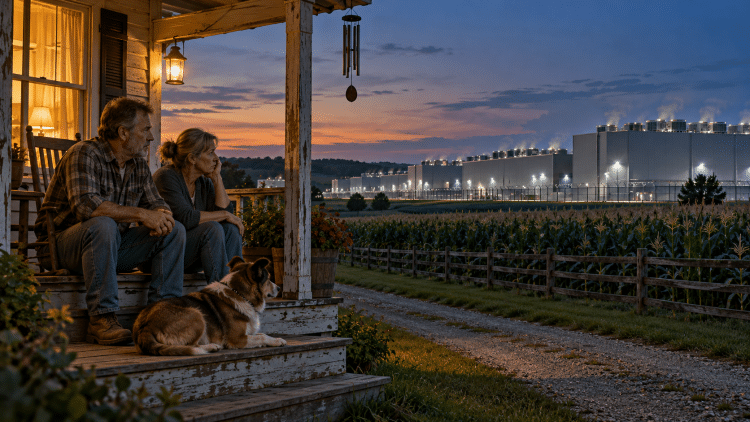
Picture a gravel road at dusk. The corn has tasseled, the porch light is drawing moths, and the last chores are finally done. You settle into a chair to hear the whip-poor-wills—and discover somebody has parked a giant vacuum cleaner beyond the fence.
Except this one never shuts off.
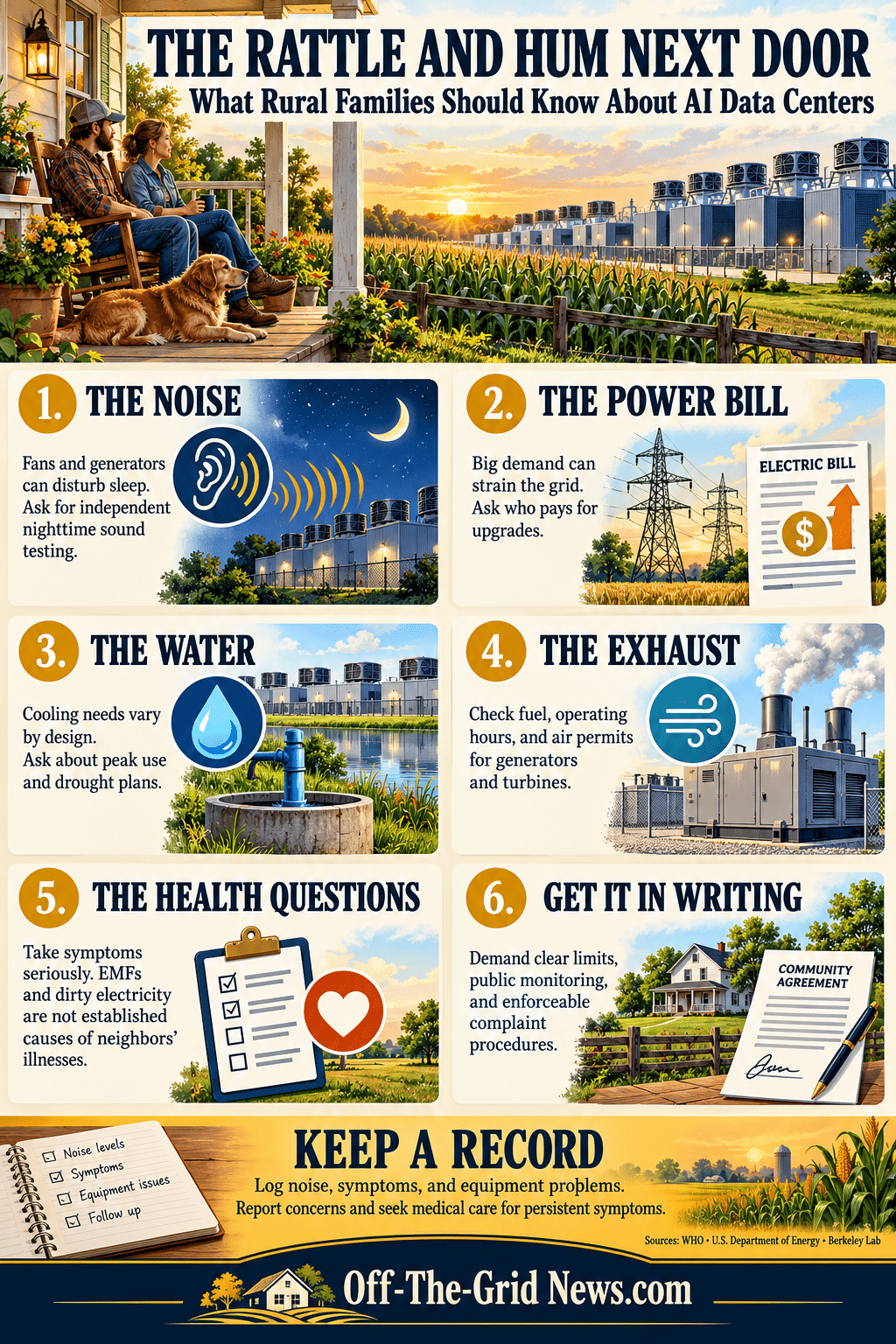
Across parts of rural America, enormous data centers are moving into places folks chose for their elbow room and quiet nights. The buildings may look harmless from the highway, but their cooling equipment, generators, electricity demand, and water needs can reach well beyond the property line. For the family trying to sleep next door, the digital economy has become mighty physical.
Now, neighbors are reporting headaches, exhaustion, ringing ears, and nights that never quite turn into rest. Those complaints deserve serious investigation. The strongest case starts with measurable noise and other local burdens; claims that electromagnetic fields or distorted household electricity explain the illnesses remain unproven.
In other words, country folks have plenty of reason to ask hard questions without hitching their wagon to every theory rolling down the road.
Follow The Money Before You Follow The Sales Pitch

First, consider an old lesson from the farm: a fellow rarely volunteers to move a profitable operation because the neighbors dislike the smell. Change gets easier when the rules require it, the public demands it, and somebody develops a better way to make a dollar.
Call it the “law of displacement” if you like. It is a useful observation about incentives, although no single rule explains every corporate decision. A harmful practice can survive for years, but public pressure and regulation can help end it, too.
Take leaded gasoline. The EPA’s history of the lead phaseout shows how health protections and technology worked together: the agency required broadly available unleaded gasoline to protect catalytic converters arriving on new cars. Lead damaged those devices, which automakers needed to control exhaust pollution.
That history offers a practical lesson. Build a cleaner alternative, then make the old bargain harder to defend. But give the people who fought for health protections their due; the market did not simply wake up one morning with a tender conscience.
For data centers, that means asking who pays when a profitable project brings trouble. If the company collects the revenue while neighbors absorb the noise and utility costs, the deal needs fixing before the concrete trucks arrive.
A New Land Rush With A Very Long Extension Cord
Meanwhile, Washington has put its shoulder behind the buildout. The July 2025 executive order on data center permitting directed agencies to accelerate qualifying projects, while America’s AI Action Plan called for making federal land available for data centers and supporting power infrastructure.
That is a powerful invitation to build. Still, a fast permit does not make a cooling fan quiet, refill a well, or manufacture spare electricity on a hot August afternoon.
The scale is worth understanding. A Department of Energy summary of Berkeley Lab’s 2024 analysis estimated that data centers used about 4.4 percent of American electricity in 2023 and could reach roughly 6.7 to 12 percent by 2028. Those are projections, but even the lower end describes a substantial appetite.
So when a developer starts talking about an enormous campus outside town, ask to see the utility plan. Where will the power come from, how much new equipment will it require, and whose monthly bill will pay for it?
This is no academic concern. In a June 2026 market report, PJM’s independent market monitor attributed roughly $9.3 billion of the 2025–2026 capacity auction’s revenue to data center load. Capacity payments buy future power availability; they are one part of electricity costs, rather than the whole household bill.
A town can welcome investment and still insist that the biggest customer carry its own feed sack.
The Hum That Moves Into Your Bedroom
Next, start with the problem people can actually hear. Large banks of fans and cooling equipment may operate continuously, while backup generators add another sound during testing or outages. Depending on the site, power generation can create additional noise and exhaust.
A steady mechanical tone can become especially intrusive after dark, when ordinary country sounds settle down. It may seem tolerable beside a busy road at noon and maddening through a bedroom wall at two in the morning.
There is solid reason to take disrupted sleep seriously. The World Health Organization’s environmental noise guidance identifies sleep disturbance and other health risks from excessive environmental noise. Much of that research concerns transportation and other established sources, so it should not be treated as a diagnosis for every data center neighbor.
Nevertheless, you do not need a mysterious new disease to explain why repeated sleep loss leaves somebody wrung out. A person who spends the night listening for the next surge of machinery still has to get up and feed chickens, drive to work, or run a tractor.
Low-frequency sound also deserves proper measurement. However, “low frequency” and “infrasound” are different terms: infrasound generally refers to frequencies below 20 hertz. A deep hum does not, by itself, prove that dangerous infrasound is present.
That is where an independent acoustical investigation earns its keep. Measure the sound at homes, include nighttime conditions and individual frequency bands, and examine prominent tones and vibration. A single daytime reading at the company fence tells a family precious little about what happens beside its bed.
Real Symptoms Deserve Better Than A Guess
Now comes the delicate part. Headaches, nausea, dizziness, fatigue, and brain fog can be real and distressing while still having several possible causes. Similar symptom lists do not establish a shared exposure, and drawing a bell curve does not prove that an entire neighborhood has become electrically sensitive.
The WHO’s discussion of electromagnetic hypersensitivity recognizes that affected people can have disabling symptoms. Recognition of suffering, however, is different from establishing that electromagnetic fields caused it.
Likewise, an Australian radiation protection agency summary of a WHO-commissioned review reports that controlled human experiments did not show radiofrequency exposure causing the symptoms studied. Those findings concern the exposures and study conditions examined; they do not replace site-specific checks of noise, air pollution, or electrical safety.
So take the neighbor seriously and investigate the property carefully. There is no need to tell a tired mother her misery is imaginary, and no justification for telling her the servers are changing her blood without convincing evidence.
If symptoms persist, seek medical evaluation while documenting when and where they occur. Leaving home and feeling better may offer a useful clue, but it cannot identify the cause by itself.
Dirty Power Is An Engineering Question First
Then there is “dirty electricity,” a phrase that can muddy the creek before the discussion gets started. Engineers measure specific problems such as voltage distortion, harmonics, electrical transients, and grounding faults. These are different from radiofrequency emissions, and different again from ordinary sound.
Electrical distortion has been reported near data center clusters. That raises engineering questions, without establishing a neighborhood illness mechanism.
Power electronics can introduce harmonics, but the equipment, filters, wiring, and grid connections determine what actually reaches other customers. A facility’s size alone cannot tell you the exposure inside a nearby farmhouse.
For that reason, requests for utility monitoring should be specific. Ask about voltage quality, applicable limits, measurements at the point of connection, and responsibility for correcting any violations. If appliances malfunction, document the events and involve the utility and a qualified electrician.
Be careful with livestock comparisons, too. Stray voltage and electrical faults on a dairy farm are legitimate matters to investigate, but a fall in milk production does not automatically prove that a distant data center is sending harmful harmonics through the barn. Heat, feed changes, disease, equipment faults, and other causes still belong on the checklist.
Anyone who has chased a bad fence charger knows the value of finding the actual fault before buying the cure.
Water And Exhaust Belong In The Same Conversation
Beyond the hum, find out how the campus will cool itself. Water demand varies with climate and cooling design, and electricity production may create additional water demands elsewhere. The developer should disclose expected use, peak use during hot weather, and what happens during a drought.
A Berkeley Lab report on American data center energy use examines energy and water requirements together. That is the right way for a community to approach the question: follow the resources beyond the building walls.
Then ask about generators and any proposed on-site turbines. What fuel will they burn, how often may they operate, and what do the air permits allow? Emergency backup equipment and a power plant running regularly create different local burdens.
A homesteader would not judge a new livestock operation by looking only at its barn roof. Follow the water, the waste, the noise, and the bills. A server campus deserves the same plain scrutiny.
Could Colder Country Offer A Better Deal
Naturally, all that cooling demand makes colder locations attractive. Alaska has been examining data center development, as its legislative record on Senate Bill 250 shows. Cold weather can offer advantages, but a cold map is not a complete business plan.
Developers still need dependable power, suitable land, communications links, workers, and a workable construction budget. Local residents also deserve a say; a sparsely populated place is still somebody’s home.
Likewise, making electricity on-site may reduce certain demands on the shared grid, but it does not automatically eliminate noise, pollution, or electrical problems. The outcome depends on the actual system and how it connects to surrounding infrastructure.
The useful principle is simple: choose sites and designs that reduce burdens on neighbors, then verify the results. Moving a problem beyond one county line is a poor substitute for solving it.
Thorium Has Promise And Still Has Homework
Finally, the power hunger has renewed interest in advanced nuclear reactors, including molten-salt designs and thorium fuel cycles. That is worth watching. It is also a subject where the sales pitch can gallop several fields ahead of the machinery.
Molten-salt reactors are a family of designs, and they do not all use thorium. Thorium itself must be converted into fissile material in a reactor fuel cycle; a proposed thorium system still needs an initial fissile fuel supply and a credible fuel-handling strategy.
America has genuine experience here. The Department of Energy describes today’s molten-salt work as building on experiments dating to Oak Ridge in the 1960s. But historical operation is different from a modern commercial fleet delivering inexpensive electricity year after year.
Nor does liquid fuel make every safety problem disappear. An Oak Ridge safety assessment examines issues relevant to preventing radioactive releases. Materials, chemistry, containment, and reliable operation still matter.
So treat bargain electricity forecasts as estimates to be tested, rather than a price available at the local co-op. Advanced nuclear may help meet future demand, but families living beside noisy equipment need enforceable protections today.
Get The Promises In Writing Before The Fans Start
For now, the best defense begins at the county meeting. Ask for baseline measurements before construction, independent follow-up testing, clear operating limits, and a public complaint process with deadlines. Require answers about noise, water, air emissions, grid upgrades, and who pays when the promises fall short.
Also, insist that agreements explain what happens if the project changes hands, expands, or closes. A cheerful presentation is easy to deliver. An enforceable obligation takes more work—and is worth a great deal more.
If a facility is already operating, keep a dated log of disturbances, equipment problems, and symptoms. Coordinate with neighbors, request official inspections, and bring persistent health problems to a clinician. Good records give investigators something sturdier than a shouting match.
Above all, do not let anybody sell you the idea that progress requires surrendering your own back porch. We can use better computers and still expect a decent night’s sleep.
Out here in the country, a good neighbor keeps his trouble on his own side of the fence. A company building the future ought to manage that much.