Print

What Every Rural Household Should Ask Before The Concrete Gets Poured
Okay… You’ve Cut Your Electric Use… Here’s Why Your Power Bill is Still Climbing
Rural folks know a thing or two about hidden costs. The feed bill never stops at the feed. There’s diesel for the trip to the co-op, tires on the truck, and that shed you built so the whole load wouldn’t turn into a soggy mountain of expensive oatmeal.
So when a developer rolls into the county promising jobs, quiet operations and shiny green credentials for a giant new data center, folks around the kitchen table have a perfectly reasonable question. What’s this thing going to do to my electric bill?
After all, the computer building may belong to somebody else. The bill for feeding it could get a whole lot closer to home.
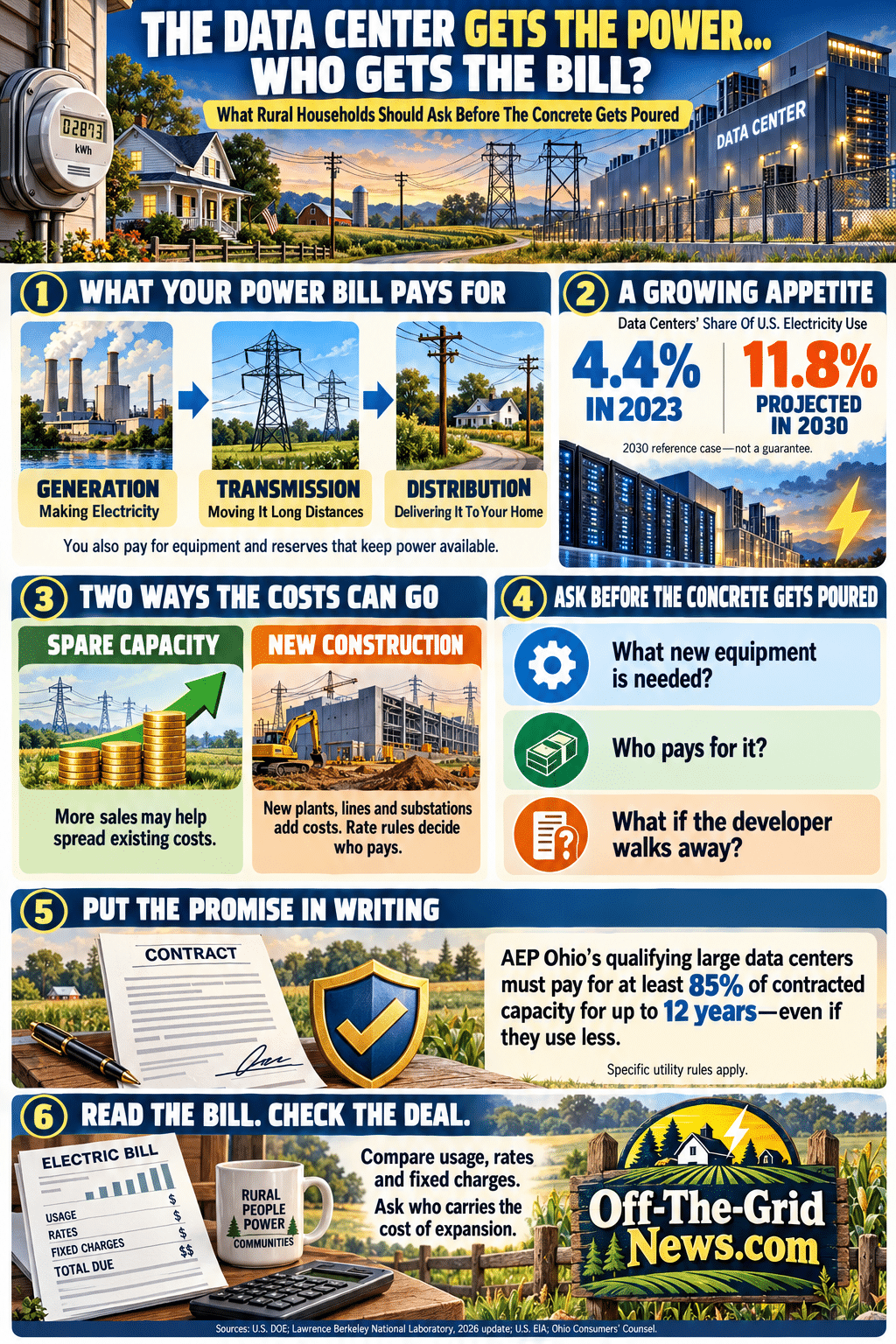
According to the Department of Energy, data centers used about 4.4% of America’s electricity in 2023. A Lawrence Berkeley National Laboratory update, published in June 2026, puts their projected share at 11.8% by 2030 in its reference case, with a wider range depending on how the industry develops. Artificial intelligence is a major driver of that growing appetite.
That’s a mighty big new mouth at the feed trough. And somebody has to pay for the power plants, wires, poles and substations that keep it eating.
Washington Finally Looks At The Meter
Naturally, Washington has noticed. With electric bills landing on kitchen tables and midterm campaigning in full swing, the question of who pays has become a political issue as well as a household one.
In March, the White House unveiled its Ratepayer Protection Pledge. Participating companies promise to cover the new power supply and delivery infrastructure their data centers require. They also agree to negotiate separate rates that cover those commitments even if they end up using less electricity than planned.
Meanwhile, on June 18, the Federal Energy Regulatory Commission ordered the six regional grid operators under its jurisdiction to justify or revise their rules for connecting large electricity users. The effort includes preventing costs from being shifted onto other customers while speeding up connections.
Then, on August 5, Ohio regulators added another protection for AEP Ohio customers. Data centers returning to the utility’s default electricity supply must give 180 days’ notice, and the cost of procuring their power must be assigned to them separately.
The concern is easy enough to understand. Nobody wants a server farm’s tab tucked inside Grandma’s electric bill.
Still, promises at a podium don’t tell you what’s happening on your own meter. For that, let’s pull the bill off the refrigerator and see what you’re actually buying.
Your Electric Bill Has A Whole Supply Chain Inside It
When you pay for electricity, you’re paying for an entire system to stand ready around the clock. Somewhere, equipment has to make the power, move it across the countryside and deliver it at a voltage your well pump can use.
Think about ordering a replacement part for your tiller. That little box doesn’t sprout wings and land beside the mailbox. Warehouses, delivery trucks, fuel, dispatchers and drivers all have a hand in getting it there.
Electricity has its own delivery chain. Generation makes it. Transmission carries it over long distances, and distribution brings it down the local lines to your house.
As the U.S. Energy Information Administration explains, prices reflect the cost of building, financing, maintaining and operating that whole arrangement. For some utilities, they also include a financial return for owners and shareholders.
Generation is the biggest component nationally, but delivery takes a substantial bite too. The exact split varies by utility, location and rate plan, so a national average won’t tell you precisely where every dollar on your own bill goes.
And here’s the part that gets overlooked: you help pay for the system’s readiness even when your own household is having a quiet afternoon. The freezer may be humming along without a care, while the utility is planning equipment to handle a much bigger load down the road.
Fuel Prices Can Follow You Right Into The Kitchen

First, somebody has to generate the electricity. That means paying for a power plant or other generating equipment, operating it and, where fuel is involved, keeping it supplied.
Generally, grid operators use lower-cost available generation before calling on more expensive sources. As demand climbs, pricier power may be needed to finish the job. Think of getting the hay in with your own tractor, then having to hire extra equipment when the weather starts closing in.
That’s why fuel prices matter. Natural gas is especially important in many American electricity markets, while coal and petroleum fuel costs matter where those sources are used. A fuel-price jump doesn’t necessarily land on your bill overnight, but it can work its way through.
For a memorable example, look back at 2022. After Russia invaded Ukraine and cut gas deliveries to Europe, the squeeze hit energy markets hard. According to the International Energy Agency, Europe’s leading gas benchmark averaged more than seven times its 2016–2020 average during the first 11 months of that year.
The shock spilled into electricity markets, too. It was a costly reminder that something happening an ocean away can eventually show up beside the salt shaker when you open the mail.
Of course, making electricity is only the first leg. Now it has to get home.
The Steel Towers And The Poles Along Your Gravel Road
Those towering steel lines marching across the bean fields are the grid’s long-distance highways. They move electricity from generating plants toward the communities that need it, often at high voltage to limit losses along the way.
Then the local delivery system takes over. Substations, distribution lines and transformers step the voltage down along the route until the power is ready for your lights, refrigerator and shop tools.
If transmission is the interstate, distribution is the county road and the driveway leading to your house. Both cost money to build, and neither maintains itself.
Meanwhile, Mother Nature keeps sending repair bills. Ice loads up the wires, wind drops trees across them, and lightning can ruin equipment in a heartbeat. Even squirrels cause their share of outages when they get into the wrong place.
A billion-dollar system can still have a very bad morning because of a squirrel.
Anyone who has waited for a line crew after a derecho understands how much depends on that last stretch of wire. The generating plant may be running beautifully, but that doesn’t help your freezer if a maple tree has flattened the line at the bend in the road.
For regulated investor-owned utilities, approved rates generally recover allowable costs and provide an opportunity to earn a return on invested capital. State commissions oversee much of the local rate setting, while federal rules govern important parts of interstate transmission and wholesale markets. Electric cooperatives and municipal utilities have different governing arrangements, but they still have equipment and financing bills to pay.
So when a utility announces a big construction program, pay attention. Somebody will be asked to cover it, and the rate rules help decide who.
You Also Pay For The Worst Afternoon Of The Year
Now picture the hottest July afternoon you can remember. Air conditioners are roaring, businesses are open, and equipment all over the region is pulling hard at the same time.
The grid has to be ready for that afternoon. Building it only for a pleasant Tuesday in April would be like sizing your woodshed for the warmest winter you ever had.
On top of expected demand, the system needs reserves for trouble. A generating unit can fail. A line can trip out, and suddenly the remaining equipment has to carry more of the load.
Those readiness costs turn up in several places, including generation, capacity and delivery charges, depending on the market. Separately, grid operators incur costs to coordinate and balance the system in real time. Their operating fees are only one part of what it costs to keep electricity reliable.
In other words, don’t confuse the cost of running the control room with the cost of having enough equipment ready when trouble arrives. Keeping watch is one expense. Having the spare muscle to answer the alarm is another.
That’s why a higher bill can have several causes at once. You may have used more electricity, fuel may have gotten pricier, or the system may be recovering money spent on repairs and expansion.
And right there, among the expansion plans, is where that new data center enters the story.
One Giant Customer Can Help Carry The Load Or Add To It
Imagine a small-town delivery company landing one enormous new customer. If it already has spare trucks and warehouse space, the extra business may help spread existing costs over more deliveries.
But suppose that customer needs twenty new trucks, another warehouse and a bigger loading dock. Now the company has a mountain of new expense before the first package leaves the building.
Who pays for all that becomes the whole ballgame.
Electricity works much the same way. A data center that can use genuinely available capacity may help spread existing system costs across more sales. One that requires new generating plants, substations and major transmission upgrades creates a different set of obligations.
Even then, size alone won’t tell you what happens to household bills. You need to know what must be built, when it must be ready and how the customer’s rates cover the expense. The demand for power also has to be considered alongside the supply available to meet it.
Then comes the question nobody should skip: what happens if the developer reserves a mountain of capacity and later wants only a molehill?
The utility may already have ordered equipment or committed to construction. Unless the contract covers that risk, other customers could be left helping pay for infrastructure built around a promise that shrank.
Ohio Makes Big Customers Put Some Money Behind The Promise
Here’s where the fine print starts earning its keep. The Ohio Consumers’ Counsel explains that AEP Ohio’s approved data center tariff requires qualifying new large data centers to pay for at least 85% of their contracted electricity capacity for up to 12 years, even if they use less.
That’s a lot like a neighbor reserving your hayfield for the season. If you’ve turned away another renter and made your plans around his agreement, he doesn’t get to erase the rent because he decides he needs fewer bales.
The point is to put financial responsibility behind the reservation. A big customer’s forecast should come with more substance than a firm handshake and a colorful artist’s drawing.
Of course, that protection applies within a particular utility’s territory and under particular terms. It doesn’t automatically cover every rural household or every data center project in America. That’s why the deal in your county deserves its own hard look.
Ask Who Pays Before The Concrete Gets Poured
Before the ribbon cutting, ask what new equipment the project requires. Ask which expenses the developer must cover directly and which ones the utility plans to recover through rates paid by other customers.
Then ask what happens if construction stalls, the company leaves or its power needs change. How long does its payment obligation last, and what backs that obligation up? A contract is worth reading while everybody is still smiling.
For your own household, start with a year’s worth of electric bills. Compare electricity use as well as the dollars charged, then look for changes in supply rates, delivery charges and fixed fees. Using less power and still paying more is a good reason to ask for an explanation.
Ultimately, a data center’s effect on your bill comes down to real costs and who carries them. A giant building full of computers may help share existing expenses, create new ones or do some of both.
That’s also a practical reason to examine your own energy habits and backup options. Solar can reduce purchased electricity when the numbers work; batteries and a properly sized generator can help keep essential equipment running during an outage. Fixed grid charges may remain, and backup equipment has costs of its own, so give those numbers the same kitchen-table scrutiny.
Farmers already know enough to read the feed invoice before we write the check. We ought to bring that same habit to the electric bill.
Especially when somebody else is adding a very large animal to the trough.
Next time, we’ll dig into whether smarter use of the grid can ease the pressure on electricity prices.