Print
Different Times… Different Dangers… The Same Need To Keep Your Family Safe and Well Fed
“Stock Up The Pantry” Warnings Are Back… And Why It Makes More Sense Than Ever
Seventy years after the Cold War sent Washington knocking on the pantry door, officials are telling families to put food and water aside again. Here is what that old advice means for your homestead today.
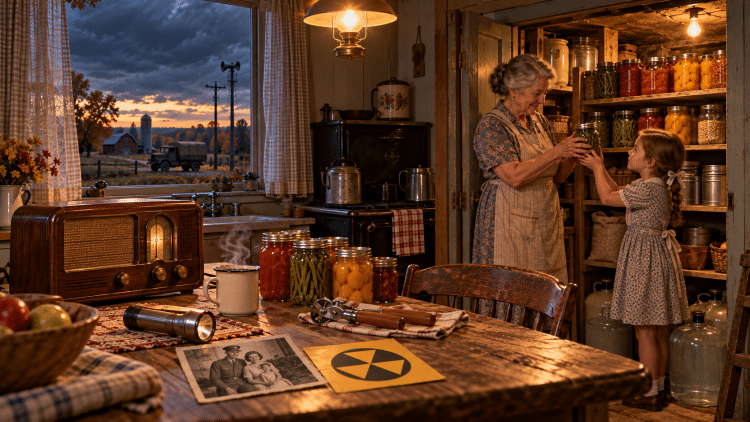
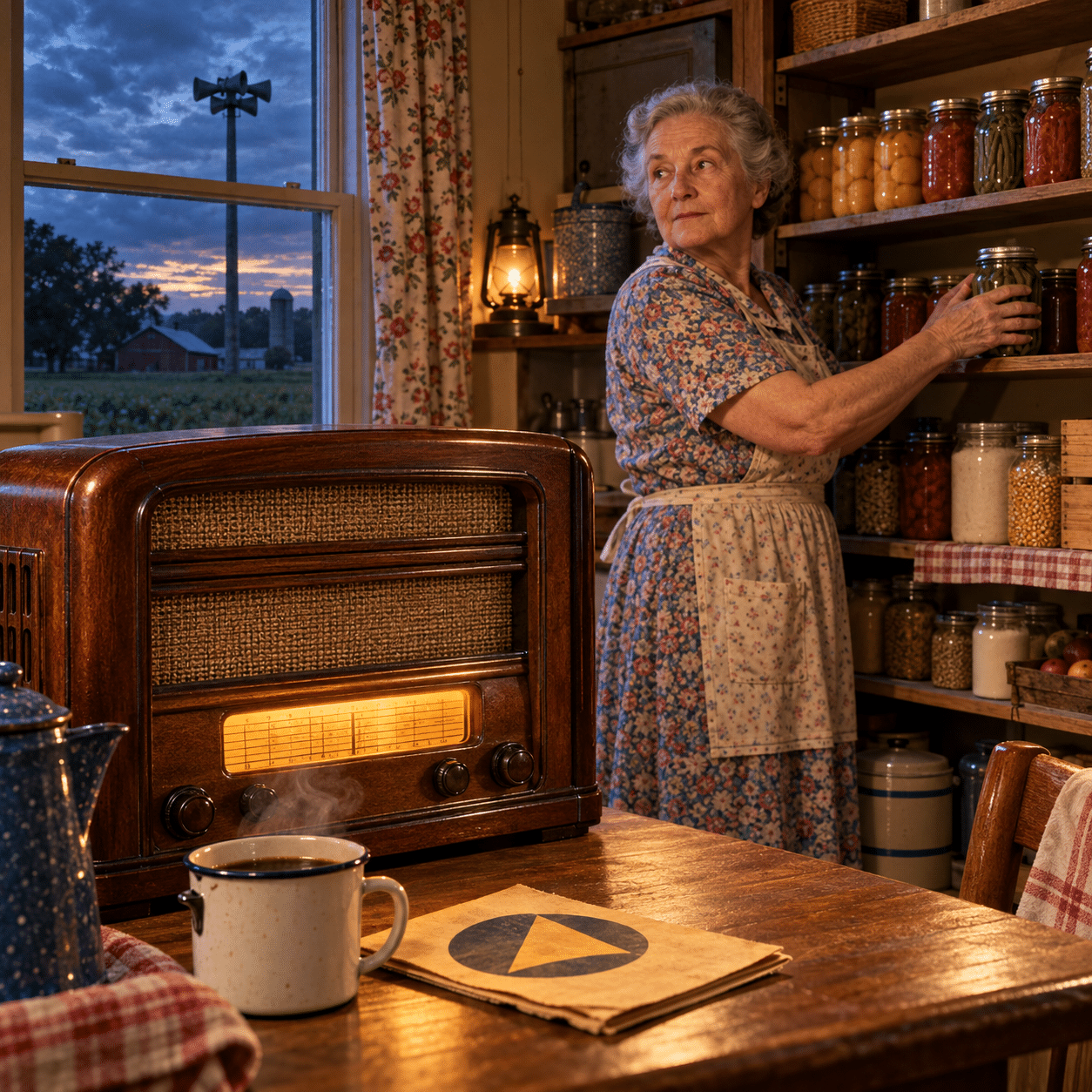
Grandma had a shrewd way of preparing for trouble. She put beans in jars, potatoes in the cellar, and enough food on the shelf that a bad week didn’t automatically become an empty supper plate.
Now, get this: governments are spending good money telling people to do something remarkably similar. Across Europe and beyond, officials want households to keep supplies handy when the power quits, the water stops, or deliveries fail to arrive.
Well, pull up a chair. Grandma appears to be getting her reputation back.
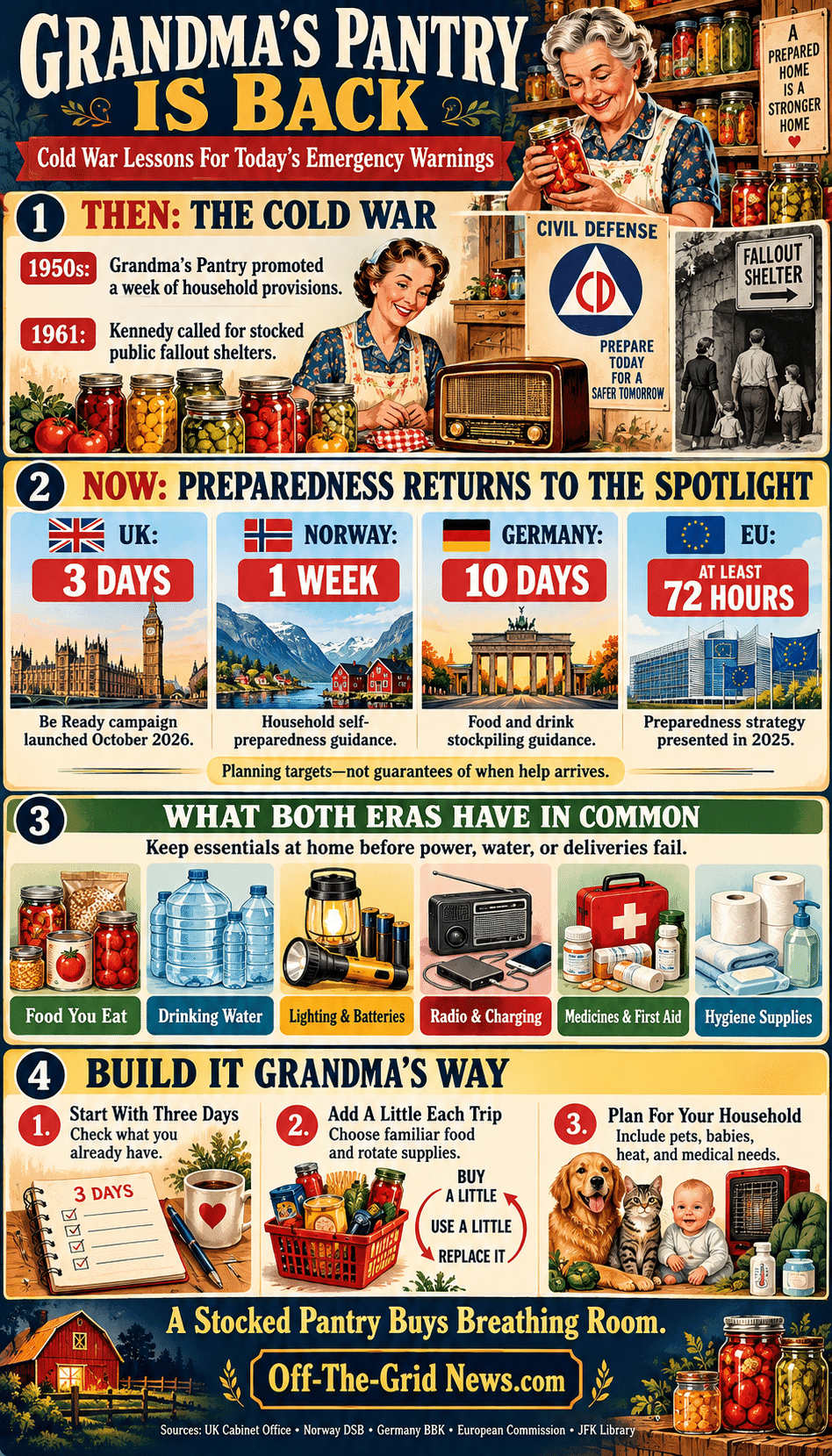
Here’s the twist: this all sounds mighty familiar. During the Cold War, Washington promoted a household preparedness campaign called Grandma’s Pantry; today’s checklists carry much the same kitchen-table message, with phone chargers added to the mix.
So let’s clear away the fog and take a look at that history. It tells us something useful about the limits of outside help, the danger of depending on everything working all the time, and the plain good sense of keeping tomorrow’s supper under your own roof.
When Washington Borrowed Grandma for Civil Defense
Back in the 1950s, federal civil defense officials urged Americans to keep emergency food supplies at home. Their Grandma’s Pantry campaign wrapped that advice in a familiar picture of household thrift.
The basic pitch was a week of provisions against an emergency. You didn’t need a load of mumbo-jumbo to understand the attraction of a stocked cupboard when the alternative was waiting for somebody else to feed you.
Meanwhile, in Maine, preparedness even came with a membership card. The Maine Historical Society’s collection records Grandma’s Pantry supplies such as food, water, first-aid equipment, blankets, a flashlight, and a portable radio.
Put it in plain English: a family needs to eat, stay warm, see in the dark, and hear what’s happening. Strip away the atomic-age artwork and you could carry that list straight into a hardware store this afternoon.
Of course, a pantry couldn’t make a nuclear attack safe. But officials recognized something every snowbound farm family already understood: when normal services break down, what you’ve got at home starts to matter in a hurry.
Britain Sends Families Back to the Cupboard
Fast-forward to October 22, 2026. Britain launched the first stage of a three-year Be Ready campaign, encouraging households to prepare for disruptions to everyday services.
The government’s statement to Parliament makes the household target clear: three days of self-sufficiency. Officials explain that families who can manage temporarily on their own help emergency services concentrate on people needing more support.
There’s a crucial admission tucked into that advice. Help has to travel down an actual road, with actual people and equipment, and sometimes that road has a tree across it.
Britain’s household checklist covers three days of bottled water and shelf-stable food, along with hygiene supplies, cash, important documents, first aid, and household needs such as baby formula and pet food. Other advice includes keeping lighting, a radio, and backup charging available.
Best part? Very little of that requires a shopping cart full of gadgets. The government encourages people to check what they already own and build supplies gradually, buying food they normally eat.
Grandma could’ve delivered that speech while wiping her hands on an apron. She probably would’ve finished sooner, too.
Three Days Is Only One Country’s Starting Point
Elsewhere, the recommended cushion gets thicker. Norway’s civil protection authority increased its household preparedness recommendation from at least three days to a full week.
Meanwhile, Germany’s emergency stockpiling guidance describes keeping food and drink for ten days. These are planning targets, not iron-clad promises that every emergency will politely end when the calendar reaches the right square.
Japan also has a long-established habit of encouraging household reserves. Its agriculture ministry’s food education guide recommends emergency food for at least three days and preferably a week, while Tokyo’s household guidance explains how buying extra everyday supplies can build that reserve.
Now, before we get carried away, be careful with the claim that every country is suddenly issuing a brand-new warning. Some campaigns are new, some advice has been refreshed, and some recommendations have been around for years.
Still, the common message is worth hearing. A household with a little breathing room is easier to keep safe than one that needs a delivery before breakfast.
The Cold War Made the Pantry a National Concern
To understand the historical echo, turn back to 1961. The Berlin crisis had brought the confrontation between the United States and the Soviet Union close enough for Americans to feel it across their kitchen tables.
On July 25, President John F. Kennedy used his televised address on the Berlin crisis to call for more civil defense work. His proposals included identifying public fallout shelters and providing food, water, first-aid supplies, and other essentials.
Within weeks, the Berlin Wall went up. Against that backdrop, shelter planning had an urgency no cheerful pamphlet could quite disguise.
The federal shelter program also produced one of the stranger chapters in American food history: the survival cracker. As historical reporting on the shelter food program explains, long-lasting provisions were intended to feed people crowded into protected spaces after an attack.
Imagine trading the smell of fresh cornbread for the prospect of eating shelter rations underground. That alone might have persuaded a few more people to appreciate the jars in their own cellar.
Yet the larger point was serious. National plans hinged partly on supplies being positioned before a crisis, because moving food after an attack could turn into a logistical nightmare. A grocery run on Tuesday was one thing; delivering through wrecked roads was another.
And here’s where that history can directly affect you: smaller disasters create the same timing problem. Once the bridge washes out, the load you wish you had hauled home yesterday becomes a mighty interesting subject.
Britain Tried to Keep the Warning Quiet
Across the Atlantic, officials struggled with another question: how do you tell people to prepare for something terrible without frightening the daylights out of them? Britain’s Protect and Survive campaign offers a revealing example.
The booklet and related material were developed during the 1970s, but officials initially intended to hold public release until a crisis required it. A history of the campaign based on government records describes concern about alarming the public; the booklet eventually became publicly available in 1980 after press attention.
Frankly, that tension hasn’t disappeared. Officials want households prepared, but they also want the warning delivered gently enough that people keep listening.
Unfortunately, a soft message can land like a feather on a barn floor. People hear that socking away supplies would be sensible, then put it on the same list as fixing the screen door.
Then crunch time arrives. The screen door’s still broken, and the pantry’s still thin.
Sweden Took the Old Booklet Off the Shelf
Sweden provides another useful piece of the story. Its official history of the crisis and war brochure lists nationwide household distributions in 1943, 1952, 1961, and 2018, followed by the updated 2024 edition.
That means the 2018 mailing was the first nationwide household distribution since 1961. After that long gap, practical instructions about getting through a crisis were landing in household mailboxes again.
The modern edition addresses a wider set of dangers, including war, extreme weather, cyberattacks, terrorism, and disinformation. Sweden’s civil defense agency describes a worsening security environment as a reason for updating the guidance.
In other words, the old preparedness cupboard has been opened again. The contents now have to cover unexpected trouble arriving through a computer network as well as trouble arriving over a border.
Europe Is Coordinating the Message in Plain Sight
Meanwhile, there’s an openly coordinated European effort behind some of the renewed attention. The European Union’s Preparedness Union Strategy, presented in March 2025, includes developing guidance toward a minimum of 72 hours of population self-sufficiency.
Its published policy text explains why the opening period of a severe disruption matters. It proposes household guidance covering essential supplies and crisis planning, supported by public information campaigns.
So yes, some of these similar messages share a policy framework. You can read it yourself without finding a secret meeting in a candlelit basement.
But don’t overlook this: the reasons reach beyond weather. European officials identify geopolitical conflict, cyber threats, and attacks on essential systems alongside natural hazards.
However, that doesn’t make every storm warning a coded announcement of war. A damaged substation can leave your kitchen dark whether the cause is ice, equipment failure, or deliberate sabotage.
For the household trying to make supper, the first problem looks much the same. The stove doesn’t work, the well pump has stopped, and everybody is still hungry.
The Pentagon Wants a Much Bigger Cushion
Now comes a head-turning detail likely to make a homesteader set down his coffee. The Pentagon’s FORTRESS initiative is intended to strengthen military installations and reduce their dependence on vulnerable outside systems.
Reporting by The War Zone, drawing on the September 30, 2026 memorandum and subsequent coverage, describes energy independence, stronger supply chains, reserves, and installation protection among the program’s priorities.
The eye-catching figure is 90 days. An October 25 Fox News report attributed that self-sufficiency target to plans for major domestic bases, covering essential needs beyond electricity.
Still, let’s keep the cold, hard facts attached to that number: the program is confirmed, while the reported 90-day requirement was not explicitly confirmed in the public material examined by The War Zone. That makes it a reported target; we can’t call it a settled, publicly documented mandate for every base.
Even with that distinction, the planning principle deserves attention. Military planners understand that a mission can unravel when power, water, fuel, or deliveries disappear.
Your mission’s closer to the kitchen table. Keeping your family warm and fed still counts.
Three Days of Supplies Does Not Buy Three Days of Rescue
It’s tempting to put the civilian recommendation beside the military report and say families get three days while the bases get 90. That’s a sharp line, but it compares a household starting point with a reported military operating target.
Here’s the catch: neither number tells you when help will arrive. Nor does either establish that officials know a particular catastrophe is coming on a particular date.
But the comparison exposes a glaring blind spot worth checking: how much interruption could your household actually handle? If the answer is one missed grocery trip, you’ve pinpointed a weakness worth fixing.
A three-day reserve is useful, especially if you currently have none. But reaching it doesn’t mean your household has crossed some magical finish line.
Out in the country, distance can stop a delivery cold. So do winter roads, an electric well pump, livestock needing water, and relatives who depend on refrigerated medicine or powered medical equipment.
So work from those realities. Your plan should fit your place as closely as your boots fit your feet.
Build a Pantry You Can Actually Live Out Of
Fortunately, you can jumpstart the job without fanfare or drama. Open a cupboard. Count meals your family can eat if the refrigerator, stove, and grocery store are temporarily out of the picture.
Then start adding familiar food a little at a time. A few extra cans of meat, beans, soup, or fruit can deliver the goods long before you need a bucket of mystery meals nobody’s tasted.
Next, think through the missing pieces. Have you got a manual can opener, usable lights, a way to hear local updates, and drinking water you can reach when the pump quits?
If your food needs cooking, account for water and a safe way to heat it. Outdoor cooking equipment stays outdoors, and a portable generator belongs outside well away from doors, windows, and vents; the CDC’s generator guidance explains the carbon monoxide danger.
Meanwhile, rotate what you buy. Eat the older food, replace it, and let your ordinary grocery habits help maintain the reserve.
Better yet, that approach makes room for small budgets. A pantry can grow one shopping trip at a time, without emptying your wallet to impress anybody on the internet.
And remember the neighbors. A nearby family who knows your driveway, your phone number, and your circumstances may be useful long before a distant agency reaches your road.
Grandma Prepared Before Trouble Needed a Name
After all that history, the lesson’s plain enough. Supplies already inside the house give a family a valuable advantage when outside systems stumble.
Cold War officials understood it, European planners are saying it again, and military planners are applying the same principle on a much larger scale. None of that requires you to predict the next crisis correctly.
Grandma put up beans in August because February was coming. She didn’t need a national advertising campaign to explain why an empty cellar was a poor winter plan.
So begin with three days if that’s where you are. Then consider a week, a month, and a deeper reserve suited to your budget, storage space, and household needs; a longer-term goal such as 90 days takes planning, rotation, and more than a stack of food.
Now put it on the table: what can your family do when the normal routine stops working? Open the cupboard and take an honest look.
Grandma already showed us where to start. We’ve got a cupboard to fill.