Print
Before You Pay A Privacy App To Hide Your Tracks… Find Out What Tracks It Keeps
You Lock Your Gate At Night… But Who’s Holding The Keys To Your Phone Records?
Shawn Ryan’s privacy app promises untraceable conversations. Its own paperwork shows why you should read past the sales pitch—and what the company has changed since questions started flying.
There’s an old rule on a farm: you don’t judge a fence from the pickup window. You get out, walk the line, and give those wobbly posts a good shove. Otherwise, you might discover the rotten corner after your goats have eaten the neighbor’s sweet corn.
Privacy apps deserve the same treatment. They promise to keep strangers out of your business, and that’s an easy promise to like. Nobody wants a salesman, snoop, or government agency rooting through the digital equivalent of the kitchen junk drawer.
But before you shell out, check what’s holding up the wire.
Glacier, the privacy app promoted and co-founded by former Navy SEAL and podcast host Shawn Ryan, makes a mighty appealing pitch. For $14.99 a month, it bundles privacy features; its website lists a plan with one burner number at $19.98 monthly. The crucial question is whether the protection behind those reassuring words can deliver the goods.
An investigation by The Leah Files raised questions about Glacier’s records, business background, and earlier disclosures. However, the fence line has changed since the October 25 cutoff in the original draft of this article. Glacier has since added disclosures that deserve to be included, too.
Fair is fair. When somebody repairs a loose post, you acknowledge the repair. Then you keep walking.
The Promise That Got Narrower
First, examine the promise customers saw before launch. The June 15 archived privacy policy said Glacier “does not store, retain, or archive any logs.” To an ordinary buyer, that sounds like an empty filing cabinet.
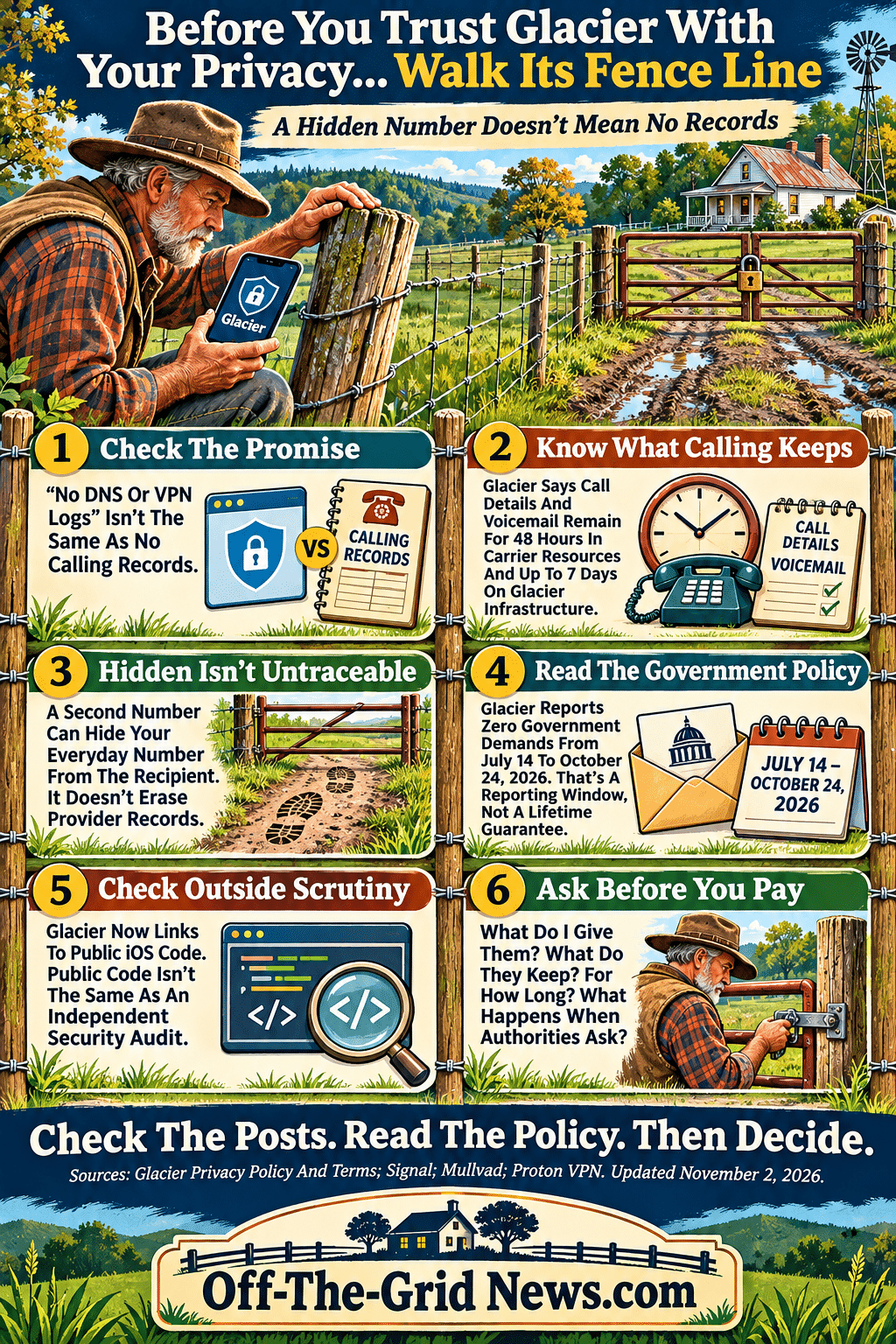
By the July 24 archived version, the wording had narrowed to DNS or VPN activity logs. Meanwhile, the policy described records generated by its calling feature, including phone numbers, call times, duration, and voicemail associated with an account.
In plain English, that distinction matters. A promise about internet browsing records doesn’t automatically cover telephone records. Yet a customer hearing “no logs” over breakfast might reasonably miss the difference between those two buckets.
Think of a hired hand saying he doesn’t keep records of what happens in the barn. Later, you discover he meant only the hayloft—and there’s a notebook covering everything downstairs. You’d want that explained before you handed him the keys.
The archive gap also matters: snapshots on June 15 and July 24 don’t establish the exact day every sentence changed. They show different versions, not a minute-by-minute history of what each buyer saw.
The New Paperwork Deserves A Fair Hearing
Now comes the update. Glacier’s current privacy policy, dated October 27, includes a revision history, specified calling-record retention periods, and government-request disclosures. So the original draft’s claims that these disclosures are entirely absent are outdated.
For calling, Glacier now describes pseudonymous identifiers, rather than anonymity. It says carrier resources retain call details and voicemail for 48 hours, while encrypted copies on Glacier infrastructure remain for up to seven days; users can delete them through the app.
Those details help clear away the fog. A stated retention window gives customers something concrete to weigh, unlike an open-ended promise to keep information as long as needed. But records held temporarily are still records held temporarily.
Here’s the crucial distinction: keeping fewer receipts isn’t the same as never writing one.
The useful question, then, isn’t whether Glacier offers any privacy protection. It’s whether the protection customers imagine matches the protection the company actually describes. That’s where the sales language needs a good, hard tug.
A Hidden Number Can Still Leave Tracks
Glacier’s homepage says its calling feature keeps conversations “untraceable.” Frankly, that’s a powerful word to hang over a service whose paperwork describes account-linked calling records.
Of course, a second number can be a valuable tool. You might use one when selling a tractor, answering an online classified, or keeping a business call from exposing your everyday number. Those are practical reasons to want a little space between your personal life and a stranger.
Still, hiding your usual number from the person answering doesn’t, by itself, erase the service provider’s records. It’s like putting a different return address on an envelope: that changes what the recipient sees, but it doesn’t tell you what the post office recorded along the way.
And ordinary telephone calling involves more than the app on your screen. Glacier identifies Twilio as a provider for its calling service. Twilio publishes reports on government information demands, along with law enforcement guidelines describing how it handles them.
Those guidelines explain that reseller relationships can lead investigators toward the business providing service to the end user. That doesn’t prove any Glacier customer has been investigated or any Glacier record disclosed. But don’t let the label give you false confidence. A “burner number” isn’t a magic eraser.
What Happens When The Government Comes Knocking
Here’s another correction to the earlier draft: Glacier now says its consumer operator, Security App LLC, received zero government demands from July 14 through October 24, 2026. It also describes reviewing legal requests, limiting disclosures to legally required available information, and notifying customers when permitted.
That reporting period is a defined window, not a lifetime guarantee. Nor does it establish what every outside provider received independently. Nevertheless, publishing a policy and figures gives readers more to examine than silence does.
To put those cold, hard facts in perspective, Signal publishes examples of government demands and its responses. Its explanations show how collecting very little information limits what can be produced. That’s the privacy equivalent of keeping the shed empty instead of buying a bigger padlock.
Meanwhile, Mullvad reported a 2023 police search that yielded no customer information. Its account system also allows signup without an email address and payment by cash. Those design choices shrink the pile of information entrusted to the company in the first place.
Proton VPN’s transparency report lists 59 orders in 2025 and 59 denied. And the commercial Burner app’s privacy policy explains its provisions for legal disclosures. Readers can inspect those promises before deciding which service fits their needs.
These products do different jobs. An encrypted messenger, a VPN, and a number that connects to ordinary phones aren’t interchangeable tools, any more than a shovel replaces a chainsaw. Compare the job, the records, and the disclosures together.
You Can Look At Some Code Now
The original draft also said Glacier’s code couldn’t be checked. That needs updating: Glacier now links to a public iOS app repository. Whatever was available earlier, readers shouldn’t be told today that no public app code exists.
Even so, publishing client code doesn’t establish how every production server operates. It also isn’t the same thing as an independent security audit. A set of barn plans helps, but somebody still has to inspect the building standing in the field.
Glacier’s terms of service retain a prohibition on reverse engineering the app or its infrastructure. That restriction deserves to be considered alongside the public repository, rather than described as proof that every form of outside review is forbidden.
The earlier research reported finding no independent security audit. That’s a finding with limits, not proof that none could exist. Before you buy, ask for a published audit identifying its date, scope, findings, and any fixes.
Likewise, a provider’s capabilities don’t prove those capabilities are switched on. Glacier lists NextDNS among its infrastructure providers, but NextDNS offering logging options doesn’t establish that Glacier uses them. Evidence about an actual configuration carries more weight than speculation about a settings menu.
Read The Name On The Gate
Then there’s the business behind the app. The Apple App Store listing names Security App LLC as the seller, while Glacier’s terms assign its intellectual property to Glacier Security, Inc.
Those names matter because customers ought to know who sells the service and who stands behind its technology. Multiple companies in a business arrangement aren’t evidence of wrongdoing. Still, clear explanations help a savvy buyer follow the trail without hiring a bloodhound.
The original investigation also cited an archived biography of Glacier Security executive Lemuel Riggins, describing intelligence-related technical experience. That background is relevant context for readers evaluating the company’s expertise and history.
It isn’t evidence of a hidden surveillance operation. The same skills that can help someone understand a threat can help them build defenses against it. Judge the product by documented behavior, technical evidence, and enforceable promises—not by treating a résumé like a criminal conviction.
When The Pitchman Owns Part Of The Product
Ryan’s ownership connection also belongs in the discussion. His LinkedIn profile identifies him as a co-founder, and the original draft cites an October episode transcript in which he explicitly tells listeners he’s a co-founder with his own money involved.
To be fair, that disclosure deserves acknowledgment. It’d be unfair to suggest he’s never told his audience about the relationship.
At the same time, written promotions deserve scrutiny, too. The supplied research points to August episode notes that list Glacier without explaining his ownership connection there. Someone reading a promotion may never hear the disclosure in another episode.
The FTC’s endorsement guidance explains why material business connections should be clear to an audience. That principle supports asking for consistent disclosure; it doesn’t establish a legal violation from one example alone.
Around here, if the fellow recommending a seed company owns a piece of it, we’d like to know. Heck, his seed might be excellent. We still want the whole story before planting forty acres.
Walk The Line Before You Buy
So where does that leave an ordinary household? Start by deciding what you want protected: your number from strangers, your browsing from the local network, or the contents of conversations. Different concerns require different tools, and none makes every part of your life invisible.
Next, find out what information signup requires, what records the service keeps, and how long it keeps them. Then pin down what happens when a legal demand arrives. Finally, look for outside scrutiny that covers the specific protection you’re buying.
Glacier’s newer disclosures improve the information available to customers. They also reinforce the central lesson: a sweeping advertising phrase needs to be measured against the details underneath it.
You wouldn’t trust a pasture fence because the salesman wore good boots and told a stirring story. You’d check the posts, test the latch, and find out who had the spare key.
Before you gamble with your privacy, give it the same courtesy.
Research note: Updated November 2, 2026, to reflect Glacier’s October 27 policy changes and its linked public iOS repository. Earlier-policy comparisons and historical reporting draw on the supplied draft and linked archives. Original investigation: The Leah Files.