Print

Rising Dementia Cases To A Pesticide Linked To Parkinson’s
You Can Replace A Tractor Engine… But You Can’t Order A Replacement Brain
You can mend a sagging gate, patch a leaky roof, and put another row of beans in the ground. But when a brain starts losing its bearings, you can’t grab a spare part off a nail in the barn.
That’s why a new dementia forecast deserves your attention at the kitchen table. Set it beside recent research linking a familiar farm pesticide to Parkinson’s disease, and you’ve got two good reasons to pay attention to what’s happening upstairs.
These are different conditions, and the studies don’t prove that country living causes either one. Still, for families who work the land, live near sprayed fields, or hope to stay independent into old age, the findings hit up close and personal.
A New Forecast With Thunder in It
First, take a look at the cold, hard facts behind this forecast. A study published October 12, 2026, in JAMA Neurology combined information from 38,418 people in 22 population studies across 18 countries and territories.
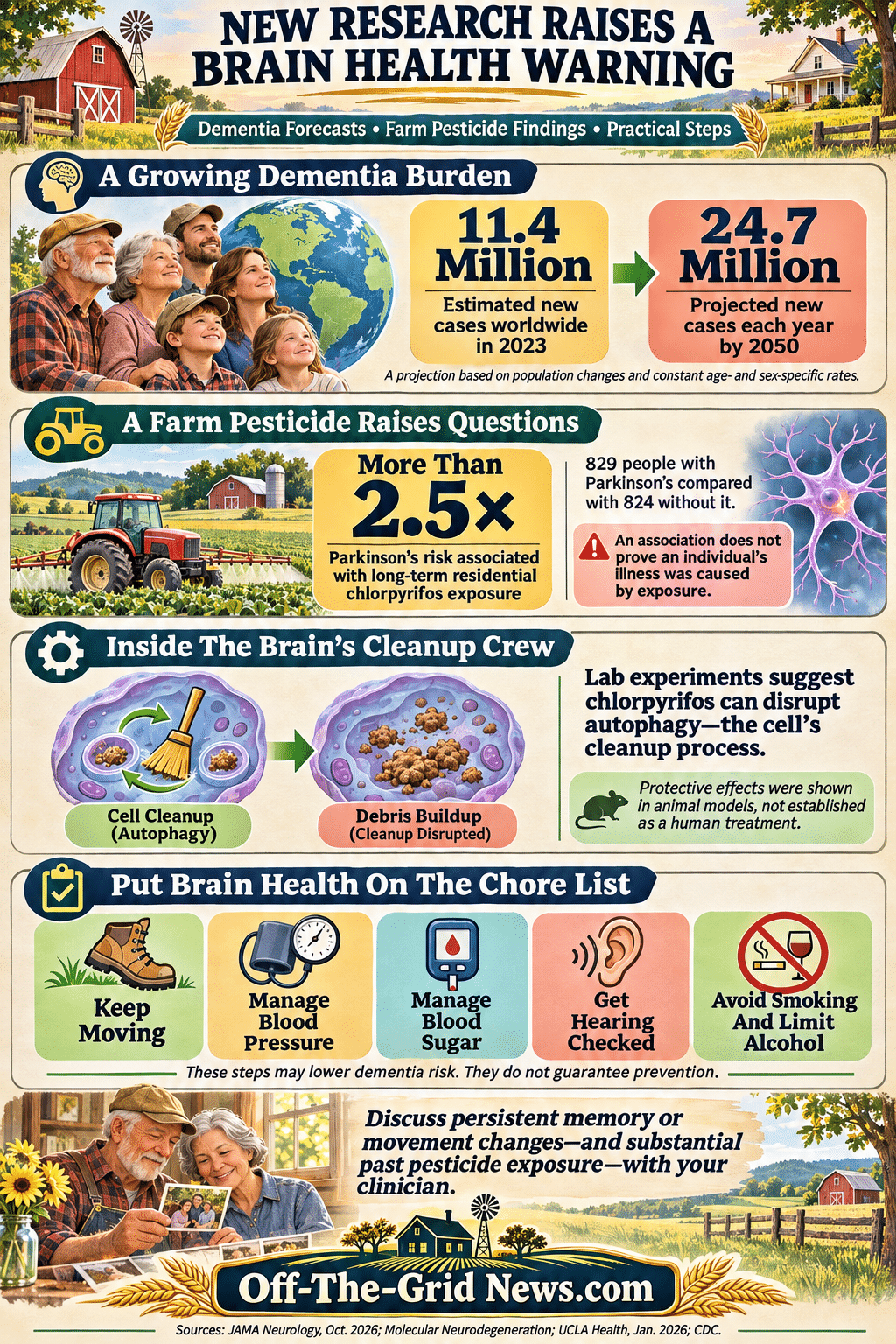
The researchers projected 24.7 million new dementia cases worldwide in 2050. That projection assumes age-specific and sex-specific incidence rates stay constant while the population changes.
Meanwhile, UNSW Sydney’s October 13 explanation of the research put the estimated 2023 figure at 11.4 million new cases. Going from 11.4 million to 24.7 million means more than doubling the number of families facing a first diagnosis each year.
Here’s a crucial detail: notice that word “new.” This isn’t the total number of people already living with dementia; it’s the annual stream of people joining them.
Picture a rain barrel filling faster while the folks carrying buckets are already worn out. That’s the growing pressure this forecast piles onto families, clinics, and caregivers.
When the People You Love Are Vulnerable and Help Is Miles Away
The study also found higher dementia incidence among women and in low- and middle-income countries. It didn’t establish why those differences existed, so there’s no honest way to pin them on one habit, one chemical, or one missing vitamin.
In the university’s discussion, researchers stressed the need to prepare earlier, especially where resources are thin. Their concern is about global health systems, but rural Americans can recognize the practical problem: needing help is one thing; getting to it’s another.
Before you know it, an appointment with a specialist half a day away becomes a family operation. Somebody drives, somebody covers the chores, and somebody keeps an eye on the person who can no longer safely stay alone.
A forecast like this belongs beside the seed order and the winter fuel budget. It gives families a reason to talk before trouble comes through the door.
America’s Numbers Belong at Your Table Too
Now bring it home. NIH reported in February 2025 that researchers estimated a 42 percent lifetime risk of dementia after age 55. The estimate came from a long-running study of more than 15,000 people, rather than a crystal ball for every American household.
Here’s the crucial distinction. It doesn’t mean 42 percent of people turning 55 are about to become confused; much of the estimated risk accumulated at very old ages, particularly after 85.
The same research projected annual new U.S. cases rising from about 514,000 in 2020 to roughly one million in 2060. An aging population helps drive that increase.
Dementia means problems with memory, thinking, or decision-making severe enough to interfere with daily life. Alzheimer’s disease is its most common cause, but dementia isn’t one single disease with one single switch to flip.
For a homestead family, the consequences can rip through everyday life, from the checkbook to the tractor shed. Independence rests on a thousand small decisions most of us hardly notice until somebody struggles to make them.
Some Brain Maintenance Looks Familiar
Fortunately, you aren’t helpless while researchers keep working. The CDC’s dementia risk guidance points to physical activity, diabetes management, blood pressure control, hearing care, and limiting or avoiding alcohol and smoking.
For starters, you don’t need a fancy gadget to make room for movement. Walking the garden rows or doing chores can help you stay active, provided the work suits your health and ability.
Still, don’t let a busy day lull you into false confidence. A person can haul feed all morning and still have high blood pressure that needs treatment.
Likewise, get blood sugar managed and hearing trouble checked. If a conversation around the supper table sounds like everybody’s talking through a screen door, it’s time to stop blaming the mumbling.
None of this guarantees protection. Dementia isn’t proof that somebody failed to live right, and people who do everything sensibly can still develop it.
You can’t order a replacement brain. But you can give the one you’ve got better odds.
Check the Pressure Before Something Blows
For one thing, blood pressure is an often-overlooked item that deserves its own line on the chore list. The CDC explains that high pressure can damage blood vessels, reduce blood flow to the brain, and increase stroke risk.
In plain English, that’s a quiet problem that can inflict lasting damage. You wouldn’t keep running a tractor with a warning light glowing just because the engine still sounded fine.
So get your pressure checked, discuss your readings with your clinician, and take prescribed medicine as directed. After all, feeling sturdy isn’t a measurement, and guessing isn’t much of a maintenance program.
A Blood Clue From Years Down the Road
Meanwhile, a March 2026 study in JAMA Network Open offers a revealing peek at how earlier warnings might improve. Researchers studied 2,766 older women, using stored blood samples and cognitive follow-up extending as long as 25 years.
They measured p-tau217, a blood marker associated with Alzheimer’s-related brain changes. Higher starting levels were associated with later mild cognitive impairment or dementia, with stronger associations in some groups, including women older than 70.
Even so, the wording needs a good tight fence around it. The study didn’t show that every woman can take a test today and receive an accurate appointment date for dementia 25 years from now.
Nor did it prove that testing healthy people decades early prevents illness. Instead, think of it as research toward a better warning system, something clinicians may eventually use alongside other information.
Now Look Beyond the Fence Line

Next comes a different concern: Parkinson’s disease and chlorpyrifos, an insecticide used in agriculture for decades. This research isn’t brand-new October news; UCLA Health highlighted it in January 2026.
Parkinson’s gradually damages the nervous system and commonly causes slowed movement, stiffness, tremor, and balance trouble. A major feature is the loss of cells that make dopamine, a chemical messenger involved in smooth movement.
The study in Molecular Neurodegeneration compared 829 people with Parkinson’s and 824 without it. Researchers combined home and workplace histories with California pesticide-use records to estimate past exposure.
Long-term residential exposure to chlorpyrifos was associated with more than 2.5 times the Parkinson’s risk compared with no such exposure. That’s a striking finding, though it doesn’t tell you the absolute chance that a particular neighbor will get sick.
At the same time, an association isn’t proof that the chemical caused every case. People can encounter several pesticides and other exposures over a lifetime, which makes untangling the strands difficult.
The Spray Story Has More Than One Chapter
Before going further, let’s clear away the fog around the rules. Saying chlorpyrifos faced restrictions in 2021 leaves out a sizeable turn in the road.
According to EPA’s current chlorpyrifos information, a court overturned the 2021 food-tolerance revocation in 2023. Subsequent cancellations and revised labels narrowed permitted food and feed uses; EPA says use on canceled crops became unlawful after June 30, 2025.
Remaining crop uses are limited by crop, state, and label requirements, with additional restrictions in some states. So don’t assume either that it’s gone everywhere or that it can legally be sprayed on whatever grows behind your house.
Also, living beside a field doesn’t establish which chemical was used, how much reached you, or whether your well contains it. This study didn’t test readers’ drinking water, and a cornfield view isn’t a laboratory result.
Instead, start with facts about the actual product and actual exposure. That’s more useful than worrying about every tractor that passes.
When the Brain’s Cleanup Crew Gets Jammed
To dig deeper, the researchers investigated the biology using mice and zebrafish. Mice inhaling chlorpyrifos over 11 weeks developed movement problems, dopamine-cell loss, inflammation, and abnormal accumulation of alpha-synuclein, a protein implicated in Parkinson’s.
The zebrafish experiments pointed toward disrupted autophagy, the process cells use to clear damaged material. Picture a barn where the cleanup crew quits: broken-down parts accumulate until the clutter sabotages ordinary work.
Restoring that cleanup process, or removing synuclein, reduced the nerve cells’ vulnerability in the laboratory models. That makes the human association more biologically plausible, but it doesn’t turn a fish experiment into a proven treatment for your uncle.
There isn’t a home autophagy fix established by this study. What it does give scientists is a specific target to investigate. Don’t confuse that with a reason to empty your wallet on a miracle cleanse.
What to Do Before You Head Back Outside
So, where do you start? Sensible action begins close to home. Keep up the medical maintenance, and take persistent changes in memory, movement, or balance seriously enough to discuss them with a clinician.
If you have a history of substantial pesticide exposure, bring that history along. Product names, years of use, jobs, and where you lived can make the conversation more useful than simply saying you grew up around farms.
Likewise, if you’re concerned about nearby applications, ask what was applied and follow the product’s safety requirements. For questions about possible well contamination, ask your local health department or a qualified testing laboratory which tests fit your situation.
As you already know, neglected homestead problems can grow like a weed when nobody checks the hinges, watches the weather, or walks the fence. Brain health deserves that same patient attention, even though nobody can promise to keep every storm away.
After all, the finest pantry in the county is worth more when you can remember the recipes, enjoy the company, and teach the grandkids where the good jars are kept.