Print
Thousands Of Pilots Describe Fatigue And Fear Of Speaking Up
Your Boarding Pass Doesn’t Tell You How Tired The Pilot Is
There’s an old rule on the farm: when you’re so tired you can’t think straight, you park the tractor. You don’t squeeze another hour out of the chainsaw just because there’s still a little daylight hanging over the back pasture. That’s how a job that could’ve waited until morning turns into a ride to the emergency room.
Besides, the woodpile won’t complain if you quit early. Your fingers might complain if you don’t.
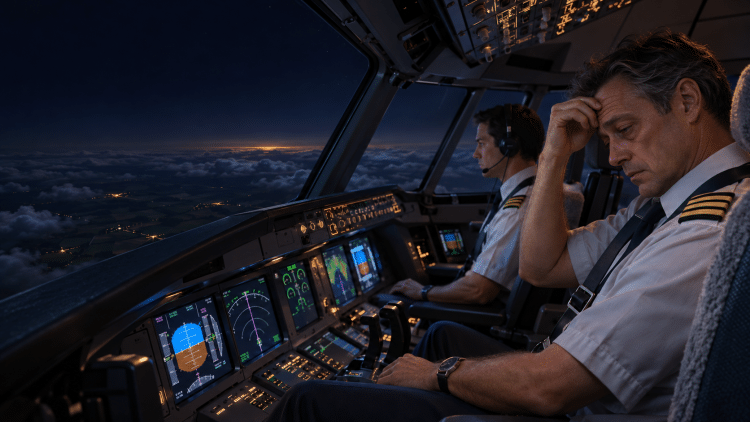
Now carry that same rule into an airliner, where a few hundred people are settling into their seats and somebody’s little girl is pressing her nose against the window. Up front, the crew has a responsibility that can’t be handed off to a strong cup of coffee.
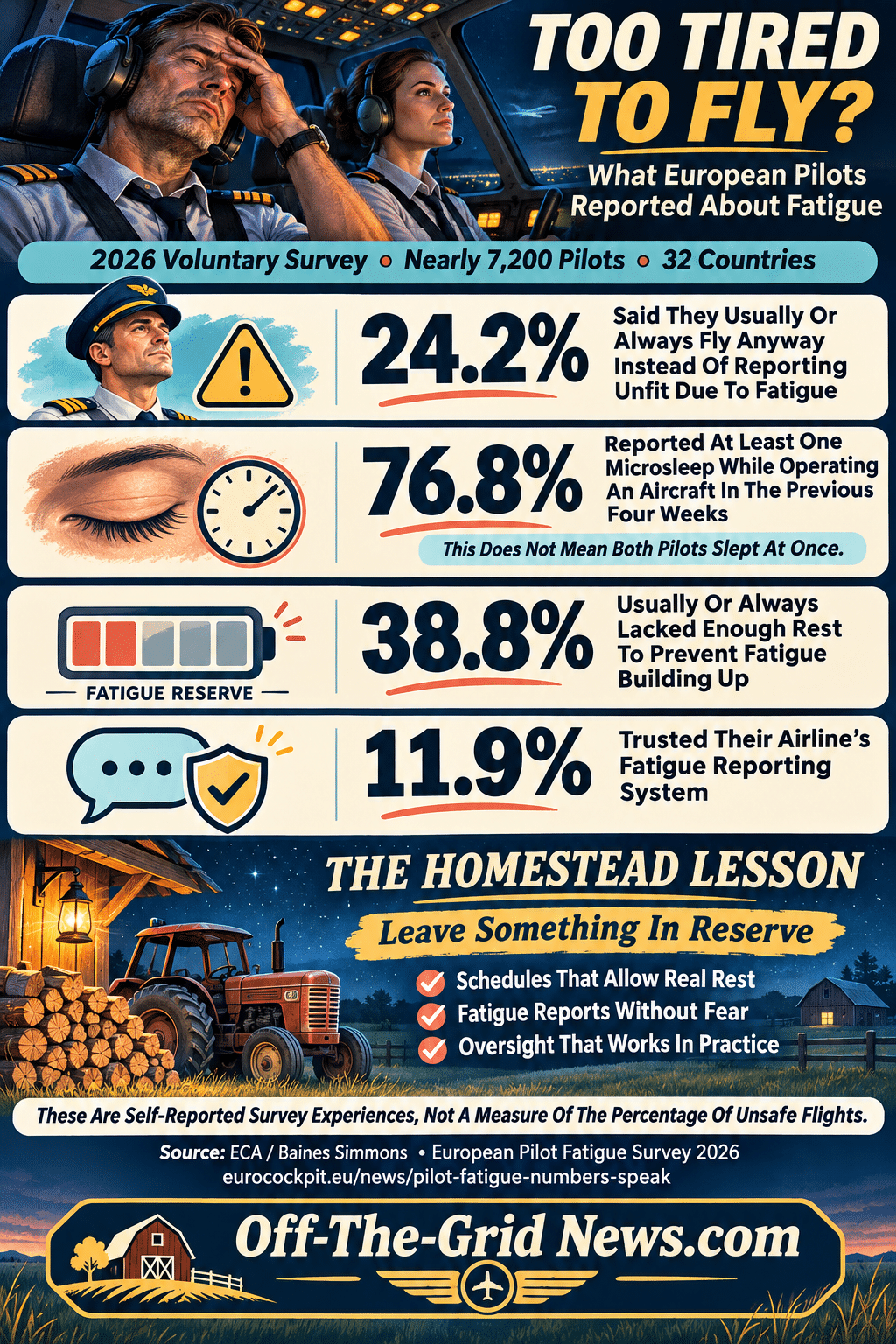
Yet a 2026 European pilot fatigue survey raises a troubling question: what happens when the person who needs to stop working feels pressured to keep going? Among the pilots who answered, nearly one in four said they usually or always continued flying instead of reporting themselves unfit because of fatigue.
In plain English, that’s an urgent warning light. Ignoring it won’t fix what’s happening under the hood.
The Numbers Behind the Cockpit Door
For the report prepared by aviation consultancy Baines Simmons, nearly 7,200 pilots across 32 countries shared their experiences. The European Cockpit Association, or ECA, promoted the voluntary survey, which ran from August 4 through September 7, 2026, during Europe’s busy summer flying season.
First, let’s keep our boots planted firmly on the ground. This was a survey of pilots describing their experiences, not an inspection of every cockpit or a random sample proving exactly how often fatigue occurs throughout European aviation. It doesn’t mean one quarter of all flights are unsafe, either.
Even so, these findings demand a closer look.
A startling 76.8% said they’d experienced at least one microsleep while operating an aircraft during the previous four weeks. That’s a brief, involuntary episode of sleep—the kind of unwanted lapse nobody wants behind the wheel of a pickup, much less at the controls of an airliner.
Now picture the difference between choosing to take a nap and having sleep sneak up and grab you. The second one is the concern here. However, the survey figure doesn’t tell us that both pilots fell asleep together, that every episode happened at cruising altitude, or that the aircraft was left without anyone awake at the controls.
Meanwhile, 38.8% said they usually or always lacked enough rest to prevent fatigue from piling up. On the homestead, we’d call that borrowing tomorrow’s strength to finish today’s chores. Eventually, tomorrow shows up demanding its strength back—and you can’t replenish it by sheer stubbornness.
When Speaking Up Feels Riskier Than Staying Quiet

Then comes a chilling detail that ought to jolt airline managers out of their chairs: 24.2% said they usually or always flew anyway rather than reporting themselves unfit because of fatigue. Nearly half also reported operating a flight within the previous three months when they should have declared themselves too fatigued to fly.
Those are related findings, but they aren’t identical. One describes a usual response to fatigue; the other asks whether a pilot had done it at least once over a longer stretch. Either way, brushing these warnings aside as somebody merely needing another cup of coffee defies common sense.
So why would a trained professional keep going?
Out by the woodshed, a worn-out homesteader can put down the splitting maul and head inside. Tomorrow’s firewood will still be there. In an airline operation, though, a pilot’s decision can run straight into schedules, staffing pressures, and worries about what management will do next.
Nearly half of respondents feared negative consequences from management for reporting themselves unfit because of fatigue. Just 11.9% trusted their airline’s fatigue reporting system. Together, those responses reveal a serious problem with confidence in the system; they don’t prove every airline punishes people who speak up.
Even so, fear doesn’t have to come with a written warning to do damage. If a hired hand believes he’ll catch trouble for mentioning soft tractor brakes, he may keep his mouth shut. Meanwhile, that hidden threat doesn’t disappear just because the boss never hears about it.
Neither does fatigue.
The Map Reveals Room to Do Better
Across Europe, the answers varied considerably depending on where an airline was based. Here’s a crucial detail: these comparisons concern the country of the airline’s operating certificate, not necessarily the pilot’s nationality or the country underneath the aircraft.
Among respondents working for Spain-based airlines, roughly two in five said they usually continued flying when fatigued rather than reporting themselves unfit. For Ireland- and France-based airlines, the figure was about one in three. Among respondents at UK-based airlines, it was about one in ten.
Now, one in ten still isn’t a number you’d hang proudly above the barn door. Still, the differences suggest that a pilot’s working environment deserves close scrutiny. Fatigue isn’t simply a matter of whether somebody has enough grit to tough it out.
Meanwhile, Finland and the Netherlands offered more encouraging examples in aspects of fatigue management and reporting culture. That doesn’t make every airline in those countries perfect, or prove that one particular policy caused the better responses. It does give the industry something useful to study.
After all, if one neighbor’s fence keeps the cattle in while another’s keeps falling down, you don’t settle the matter by calling the second herd stubborn. You inspect the posts, the wire, and the way the whole thing was built.
An Emergency Extension Should Stay Exceptional
The survey also looked at commander’s discretion, a provision allowing captains to extend flight duty in exceptional circumstances. Some 38.3% of respondents said they’d used it at least once during the previous four weeks. More troubling, 69.1% expressed concern about negative consequences if they refused an extension.
To be clear, an extension isn’t automatically evidence of wrongdoing. But when the safety valve comes with pressure attached, somebody needs to hunt down the source of that pressure.
On a farm, an unexpected storm might force you to stay out late getting animals under cover. That’s an exception. If you’re doing it night after night because the regular chore schedule never leaves enough time, the weather isn’t your only problem.
Likewise, the crucial test comes when a captain says the crew has reached its limit. A rule printed in a binder won’t provide much protection if the people expected to use it are afraid to do so.
The Crew Can’t Fix the Whole System From the Flight Deck
ECA president Capt. Tanja Harter has called for airlines and regulators to take responsibility for fatigue management. In the association’s published response to the findings, she urged stronger oversight and reporting arrangements that don’t punish pilots for raising fatigue concerns.
For starters, that’s a sensible demand. Pilots have responsibilities, of course, but they don’t personally control every roster, staffing decision, or company response to a fatigue report. Yet telling the crew to handle it all themselves dumps too much work on the people already running short of rest.
After all, every homesteader understands the value of making a sensible decision before exhaustion starts bargaining with you. You decide ahead of time when the chainsaw gets put away. You don’t wait until you’re stumbling over the brush pile to hold a debate about whether you can manage one more tree.
Naturally, the same principle belongs in an airline’s planning office. Build the safeguards while everybody’s thinking clearly, then support the people who need to use them.
Leave Some Strength in the Battery Bank
Now, what does a European cockpit have to do with your garden, your goats, or the woodstove waiting for its next armload? Plenty, if you’ve ever built a life around having a little something in reserve.
You don’t plan your winter firewood supply down to the last stick. You don’t want a battery bank that reaches empty the minute a cloud crosses the sun. You leave yourself room for a cold snap, a broken part, or a day when nothing goes according to plan.
People need that precious reserve, too.
Here’s the trap: a schedule can look tidy on paper and still drain the person working it until there’s nothing left in the tank. These survey responses raise questions about whether rest opportunities, reporting systems, and operational decisions are providing enough protection in practice. Meeting a limit on paper doesn’t settle every question about how a crew actually feels and performs.
Besides, a good reporting culture gives you something precious: an early warning. The hand who tells you the tractor’s brakes feel wrong has given you a chance to fix them before the downhill turn. The pilot who reports fatigue is providing information a safety system needs.
That’s valuable information. Welcome it before a small problem grows into major trouble.
Park the Tractor Before the Trouble Starts
Fortunately, the practical direction is clear enough: schedules that allow meaningful recovery, fatigue reports people trust, careful use of exceptional extensions, and oversight that checks how those protections work. Of course, putting that into practice takes more effort than printing a fresh policy and calling the job finished. The safeguards have to deliver the goods when a worn-out crew actually needs them.
Nor does this survey tell us what’s happening on every American airline. These are European findings, gathered during a particular period, and they shouldn’t be stretched into a worldwide head count. Nevertheless, the crucial question travels well: can workers say they’re too tired to continue and expect the system to support a safe decision?
Back home, we’d never praise a man for running a chainsaw until he couldn’t keep his eyes open. We’d tell him to set it down, come inside, and finish tomorrow.
Likewise, airline passengers deserve a system built around that same plain sense. The person buckling into a passenger seat can close their eyes and dream about Grandma’s kitchen. The crew needs enough rest—and enough support—to stay alert all the way there.
Finally, the old farm rule still holds: park the tractor before exhaustion grabs the wheel.