 Print
An Old Paper Trail Raises New Questions At The Kitchen Table
Grandma Used Mason Jars… Maybe We Should Ask Why
Back when Watergate filled the evening news, Senator Howard Baker asked a question that could strip the paint off a polished excuse: What did the president know, and when did he know it? More than half a century later, that same question belongs beside the coffee pot when we talk about plastic.
After all, this stuff isn’t confined to a grocery sack caught on a fence. It’s woven into the daily business of a homestead, from seed trays and feed bags to water lines and the wrapping around a bale of hay.
Now comes a chilling detail from the industry’s past. The Los Angeles Times reports that industry records documented awareness of research on swallowed plastic particles more than fifty years ago.
Frankly, that deserves some serious scrutiny.
Because a warning doesn’t lose its bite just because somebody tucked it into a filing cabinet.
That’s much like putting a bucket under the same roof leak for twenty years and calling the roof dependable.
A Warning Older Than the Plastic Bags in Your Pantry

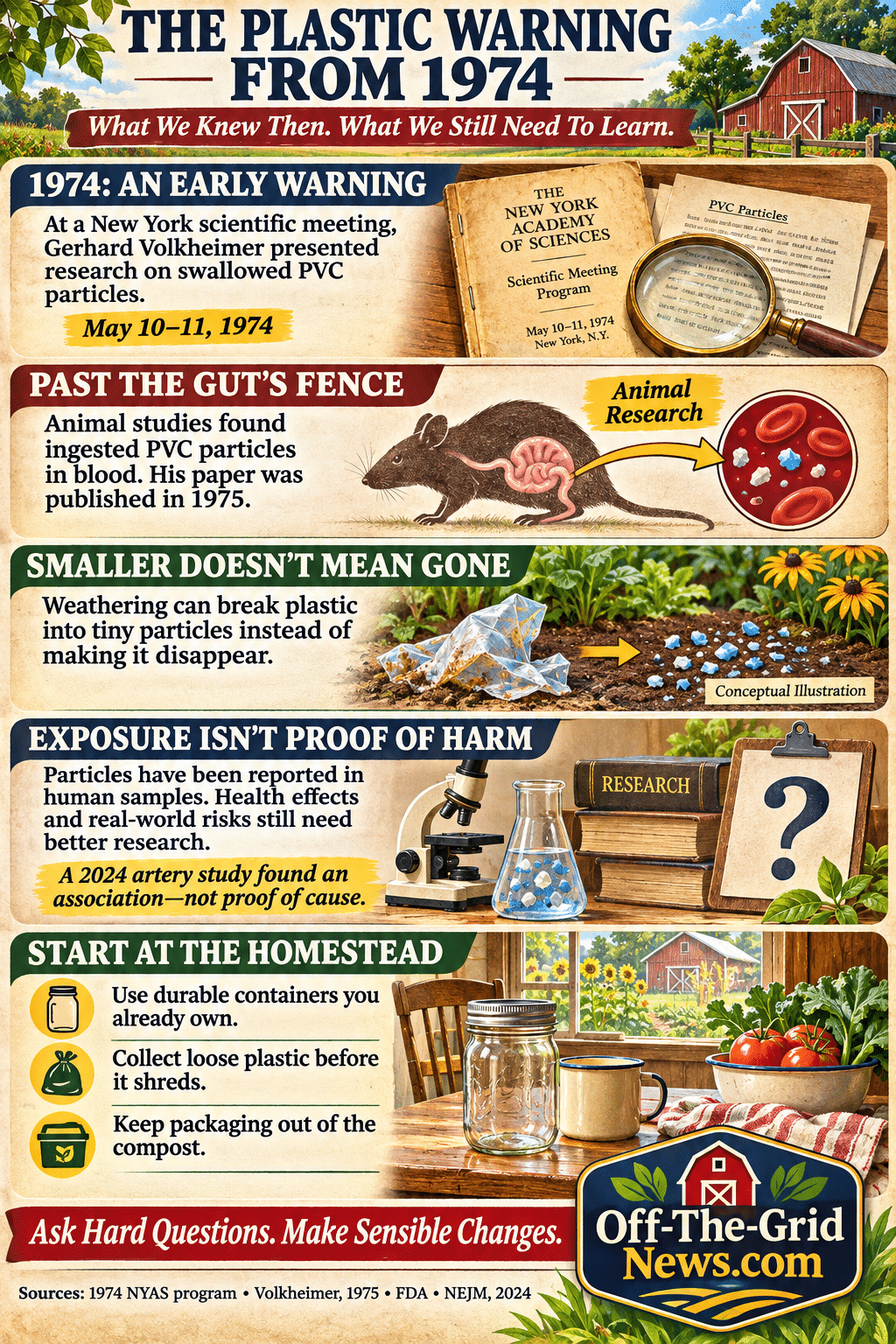
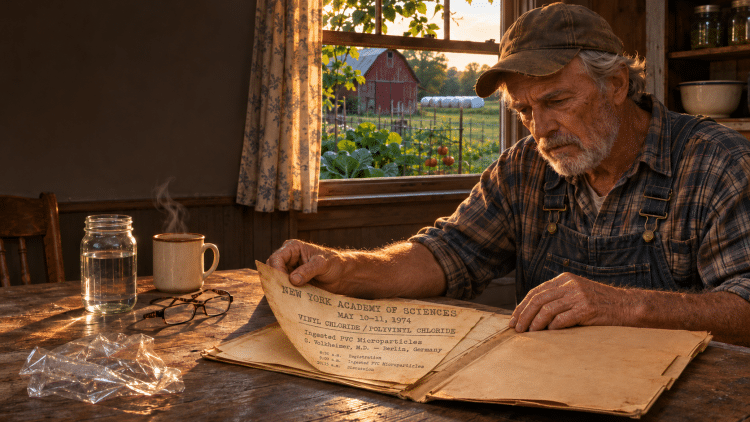
For starters, examine the paper trail yourself. An archived conference program lists a New York Academy of Sciences meeting on vinyl chloride and PVC for May 10 and 11, 1974, with sessions at New York’s Delmonico Hotel.
The program names researchers from government, universities and industry. It also lists German physician Gerhard Volkheimer presenting research on ingested PVC microparticles moving through the bloodstream.
In plain English, this wasn’t a warning whispered across a backyard fence. The subject had a place on a scientific meeting’s official agenda, in front of people whose work involved making, studying and regulating these materials.
Some Particles Got Past the Fence
Volkheimer’s published paper followed in 1975. Its central finding was plain enough: after animals swallowed PVC particles, researchers could find particles in their blood.
Scientists call the passage of solid particles across the intestinal lining “persorption.” Around the kitchen table, we’d put it this way: some particles got past the gut’s fence.
That’s crucial. Even so, let’s keep our boots on solid ground: showing that particles can cross that barrier doesn’t establish what every kind of plastic does, at every dose, in every person.
It does reveal a question that deserved serious attention long before most of us had heard the word microplastics.
The Old Question Every Homesteader Understands
Anybody who keeps animals knows that “it went down the hatch” isn’t the end of the story. You care what happens afterward, whether you’re choosing feed, treating a sick goat or deciding what belongs in the compost.
With that in mind, here’s the question that should follow every miracle material out of the factory gate: Where does it go when we’re finished with it?
Does it break down harmlessly? Does it drift, crumble, collect or travel somewhere we never intended?
Plastic makes that question especially stubborn. As the FDA explains, most plastics don’t biodegrade; weathering can break them into smaller particles instead.
Now picture a weathered scrap of plastic breaking loose beside the garden. The piece may disappear from sight without disappearing from the world.
That’s the difference between cleaning up a mess and making it too small to see.
Leaded Gasoline Left a Long Trail of Trouble
Of course, we’ve already learned the hard way what happens when we confuse a useful product with a harmless one. Leaded gasoline ought to hang over this discussion like an old warning sign on a dangerous gate.
In the early 1920s, Thomas Midgley Jr. and colleagues helped develop tetraethyllead as an additive to reduce engine knock. Engines ran better, but the people handling the chemical paid a brutal price.
An EPA historical account describes Midgley’s own lead poisoning and the severe illnesses and deaths among workers making the additive. The danger wasn’t some distant possibility waiting for a computer model; it was striking workers up close and personal.
Yet leaded gasoline remained part of American life for decades. Every trip to town helped feed a pollution problem that families couldn’t solve by sweeping their own porch.
The Highway Ban Didn’t Close Every Gate
Now, let’s pin down the cold, hard facts. The EPA began gasoline lead reductions in 1973, and the remaining leaded fuel for on-road vehicles was banned effective January 1, 1996.
So this wasn’t a tidy fifty-year march from invention to ban. From its early commercial use to the final highway prohibition, the story stretched across roughly seven decades.
And the highway ban didn’t finish every chapter. Some piston-engine aircraft still use leaded aviation gasoline, while the FAA is working toward a transition to unleaded fuel by the end of 2030.
A problem can leave the family car and still remain in the neighborhood.
The Refrigerator Miracle Had a Catch Up in the Sky
Then there’s the other famous chapter connected to Midgley’s work: chlorofluorocarbons, or CFCs. His team’s refrigerants helped replace chemicals that could poison people or catch fire, which explains why households and manufacturers welcomed them.
To be fair, that benefit was real. So was the hidden trouble nobody could spot by standing beside a refrigerator.
According to the American Chemical Society’s history, CFCs became widely used in refrigeration, air conditioning and aerosol cans. Their stability helped make them useful, but it also allowed them to persist and reach the upper atmosphere.
There, sunlight could break them apart and release chlorine that destroys ozone. Meanwhile, the protective layer overhead was paying a bill that never appeared on the appliance’s price tag.
The Warning Finally Reached the World Stage
In 1974, Mario Molina and F. Sherwood Rowland published the pivotal warning. Their work pushed an uncomfortable question into public view: what happens when a handy household chemical travels far beyond the household?
The Montreal Protocol was signed in 1987, setting an international course to control ozone-depleting chemicals. That was thirteen years after the scientific warning, followed by phaseouts over time, rather than an automatic fifty-year clock.
The lesson hits harder when we get the history right. Useful inventions can carry hidden costs, and finding those costs should change what we do next.
Around the farm, “seemed like a good idea” generally means there’s another afternoon’s work coming.
What We Know About Microplastics and What We Still Need to Learn
With that history in mind, bring the question back to your kitchen table. Researchers have reported microplastics and nanoplastics in human samples, including blood and organs, and the FDA acknowledges those findings while emphasizing important gaps in measurement and health evidence.
Frankly, that’s unsettling enough without dressing uncertainty up as certainty. Finding a particle tells us something about exposure; it doesn’t automatically tell us how much harm it caused.
Still, some research gives us good reason to keep digging. A 2024 study in The New England Journal of Medicine examined material removed from the neck arteries of patients undergoing surgery.
Patients whose plaque contained detected plastic had a higher rate of heart attack, stroke or death during follow-up. That was an association in a particular group of patients, not proof that plastic caused those outcomes or that the same risk applies to everybody.
Unanswered Questions Aren’t a Permission Slip
Meanwhile, the FDA says current evidence doesn’t demonstrate that the levels detected in food pose a human health risk. It also says better methods and more research are needed.
Let’s put both points on the table.
At the same time, we can demand honest science while refusing to treat unanswered questions as a permanent permission slip. If something can spread widely and persist, the people selling it should help answer the hard questions about where it ends up.
Grandma Had Useful Ideas Without Having Every Answer
Of course, nobody needs to pretend the old days were spotless. Earlier generations used lead, unsafe glazes and plenty of other materials we’d rather keep away from supper.
Nor is every plastic product useless. A dependable water line, medical device or piece of farm equipment can earn its keep.
Still, your grandparents understood something valuable that’s worth bringing back: buy things that last, mend what you can, and don’t scatter your leftovers across the place.
For instance, a sturdy glass jar can serve through years of pantry duty. A metal pail can take a beating, and a wooden crate can carry more than one harvest without becoming another armful of disposable packaging.
Those materials have their own limits, and choosing them doesn’t guarantee a life without exposure. They do remind us that convenience doesn’t always require something designed to be thrown away.
Start With What’s Already in Your Cupboard
So start with the choices right in front of you. Use the durable containers you already own, collect loose plastic before the mower finds it, and keep shredded packaging out of the compost.
Better yet, when you’re replacing a worn-out item, ask whether a longer-lasting option will deliver the goods. Anybody who’s bought the same cheap shovel twice has already begun that education.
You don’t have to empty the cupboards into a dumpster to begin using better judgment.
Read the Warning Before the Barn Starts Smoking
To be clear, the history of lead and CFCs doesn’t prove that every plastic particle carries the same danger. It does show why early warnings deserve investigation instead of a long nap behind a closed office door.
And the 1974 research leaves us with a fair question: How thoroughly did we follow up once we knew swallowed plastic particles could get beyond the gut?
After more than fifty years, families deserve clear answers, sound measurements and a determined effort to reduce unnecessary pollution. We shouldn’t have to choose between breathless scare stories and soothing assurances that outrun the evidence.
Out here, a good steward checks the fence before the cattle reach the road. He doesn’t need to predict the exact minute of the wreck to see that a loose gate needs attention.
So here’s the job in front of us: scour the records, demand straight answers, and make sensible changes while the research continues.
Because when you smell smoke near the barn, you go have a look.