 Print

Before The Thanksgiving Story… Came The Arrests… The Torture… The Imprisonments… And The Fight Over Conscience
The Pilgrims Escaped An Established System Of Coercion… Later Puritans Faced Its Anti-Calvinist Enforcers
Imagine being hauled before a court because your Sunday sermon offended the men who controlled your church. You thought you were explaining Scripture. They thought you needed to be silenced.
Now imagine those men can take your livelihood, lock you up, and turn your religious objections into a crime against the government. Suddenly, that argument over theology has teeth. And the teeth belong to the fellow holding the jailhouse keys.
This happened in Protestant England. Some of the Christians caught in the machinery were Calvinists, and some of the powerful churchmen operating it belonged to the movement historians call English anti-Calvinism or Arminianism.
That little-known chapter of history deserves a closer look. And some of its details are chilling.
Before We Load The Wagon Clear Away The Fog
First, a necessary distinction. The Mayflower Pilgrims were Separatists who believed they must leave the established Church of England. Most Puritans initially wanted to reform that Church from within. Those positions overlapped in their Reformed convictions, but they were not identical.
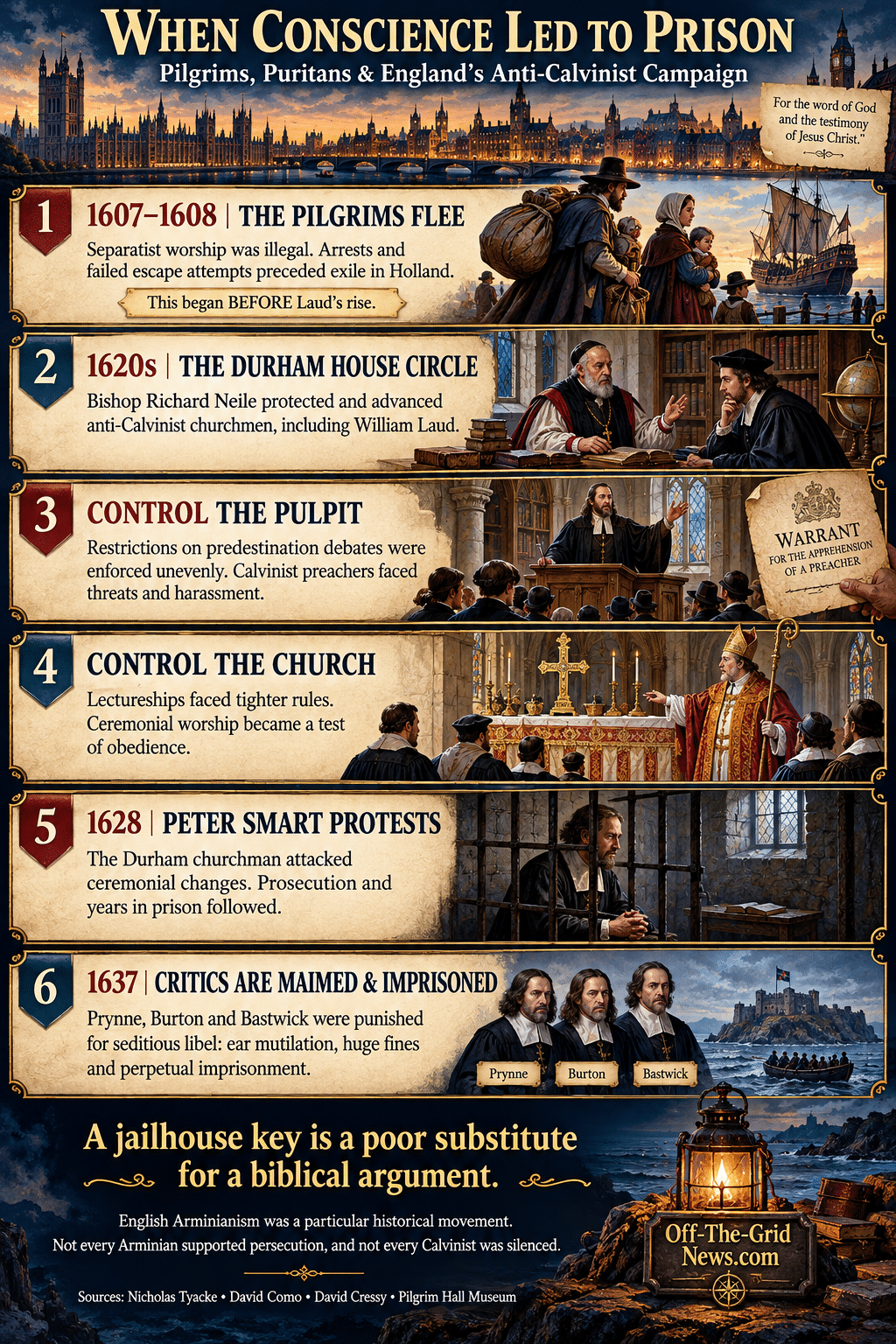
The Scrooby congregation fled England in 1608, eventually settling in Leiden. Their departure preceded William Laud’s ascendancy and the great anti-Calvinist offensive of the 1620s and 1630s.
So we should not put Laud at the scene of every earlier offense. The Pilgrims suffered under an existing system of compulsory religious conformity. Later, anti-Calvinist churchmen used and strengthened that system against other Reformed Christians.
The fence was already standing. New men took charge of the gate.
The Pilgrims Had Trouble Leaving As Well As Staying

The Pilgrims’ problem was painfully practical. Their independent congregation was illegal. Worshipping according to conscience could bring official punishment, and even getting out of England was hazardous.
Pilgrim Hall Museum recounts their escape attempts. In 1607, a shipmaster betrayed them, and members of the congregation were arrested. During another attempt in 1608, a Dutch vessel departed with some men aboard while women and children remained behind, exposed to arrest.
Try picturing your family in that predicament. You have decided that obedience to God requires leaving home. Then the authorities make leaving home another offense.
These people were not boarding a pleasure cruise. Their eventual Atlantic crossing followed years of exile, difficult work, and uncertainty.
Meet The Bishop Who Knew How To Grow A Network
Enter Richard Neile, bishop of Durham and later archbishop of York. A shrewd organizer, he recognized promising churchmen, found them positions, and gave them protection.
His London residence, Durham House, became a gathering place for an influential inner circle of clergy opposed to Calvinist dominance. Laud belonged to this circle, alongside figures such as John Buckeridge, Richard Montagu, Francis White, and John Cosin. Their connections and convictions varied; this was a network, not a club issuing identical membership certificates.
Historian Nicholas Tyacke devotes an entire chapter to Neile and the Durham House group. His argument emphasizes the machinery of patronage and protection behind the anti-Calvinist advance.
A theological movement needs more than an interesting pamphlet. Put sympathetic men in influential offices, and the pamphlet suddenly has somewhere to go.
Arminian Did Not Mean Everybody Gets Religious Freedom
Here is where modern assumptions can lead us into a ditch.
Opposition to Calvinist predestination did not automatically produce support for liberty of conscience. In this English setting, anti-Calvinism could accompany a powerful commitment to bishops, royal authority, and enforced uniformity.
Nor does the label prove that everyone involved accepted every proposition of Dutch Arminian theology. Historians continue to argue about its boundaries.
Nevertheless, Peter Lake’s study of Laudian political theology identifies a revealing concern: Christians claiming the right to interpret Scripture could use that interpretation to call their superiors to account.
For the authorities, that threatened order. For a conscientious dissenter, it raised the obvious question: What happens when the superior is wrong?
Peace For The Church Could Mean Silence For Your Pulpit
Royal restrictions on controversy over predestination sounded like a way to quiet both sides. Stop the arguments. Restore peace. Get everyone back into the same pews.
But here is the crucial question: Who actually paid the price?
Historian David Como’s study of Laud’s London administration finds that Laud pressed Calvinists while apparently leaving their anti-Calvinist opponents largely untouched. Much of that pressure took the form of quiet intimidation: threats and harassment that rarely needed the spectacle of a public prosecution.
That matters. You do not have to drag every preacher into prison. Make a few men fear for their livelihoods and their families, and plenty of pulpits become quieter without another warrant being served.
Meanwhile, the policy still wears its Sunday clothes and calls itself peace.
They Went After The Irrigation As Well As The Crop
Puritan influence spread through additional sermons delivered by ministers known as lecturers, often supported by voluntary contributions. Those arrangements gave preaching a reach beyond ordinary parish routines.
They also worried church authorities who wanted closer control.
A study of the suppression of Norwich lecturers traces increasingly strict regulation, including directions drawing on Laud’s proposals and subsequent efforts by allied bishops to reduce certain lectureships.
The practical lesson was plain. If you wanted to weaken an unwelcome religious movement, you could restrict the channels carrying its teaching. A farmer understands that principle immediately: shut off the irrigation, and you need not pull every plant by hand.
Protect Your Friends And Promote Them
The Richard Montagu controversy offers another window into the system. His writings ignited a theological firestorm because opponents believed he was undermining established Protestant teaching. Yet influential bishops rallied to his defense.
In January 1626, Neile, Laud, Andrewes, Buckeridge, and George Montaigne considered his case by royal command. They found his teaching compatible with the English Church and urged restrictions on further public controversy. Kathryn Marshalek traces these interventions in her study of the rise of Arminianism.
Notice the sequence. A controversial author challenges what opponents regard as orthodoxy. Powerful friends defend him. Then the authorities propose quieting the argument.
If you believe the disputed teaching is dangerous, that arrangement hardly feels neutral. It feels as though the hired hand moved your boundary fence, and the sheriff arrived to forbid discussing property lines.
For Charles I, church appointments were decisions about the large-scale government of his kingdom. Bishops exercised public authority… their disputes could not stay inside the vestry. The crown’s support gave the anti-Calvinists influence far beyond their numbers.
That combination helps explain the alarm. Their opponents feared losing both the teaching they cherished and the ability to defend it. What the court described as settlement could look, from the parish pulpit, like surrender under orders. No elaborate conspiracy was necessary. Shared convictions, access to power, and selective enforcement could do considerable damage all by themselves. A network of appointments made those advantages durable across offices and successive controversies.
The Candles Were Only The Beginning
The conflict also reached the physical arrangement of worship. Laudians emphasized sacramental ministry and sacred space, expressed through altarwise communion tables, rails, and gestures of reverence. Lake explains the theology behind their altar policy.
Their opponents saw some changes as dangerous movement toward practices the Reformation had rejected. The trouble sharpened when compliance became obligatory.
At Durham, cathedral prebendary Peter Smart attacked ceremonial innovations associated with Neile’s administration and Cosin’s worship in 1628. The Smart and Cosin controversy ended with one man’s ceremonial reputation growing while the other endured years behind bars.
Smart was an established churchman. You did not have to abandon the Church to discover that the Church’s officials could make your life miserable.
Then Came The Knives And The Island Prisons
In 1637, William Prynne, Henry Burton, and John Bastwick learned how brutal the government could become toward its religious critics. Their attacks on episcopal government and religious policy brought convictions for seditious libel in Star Chamber.
They were pilloried, mutilated by the cutting of their ears, fined £5,000 apiece, and sentenced to perpetual imprisonment. Eventually, the government confined them separately on Jersey, Guernsey, and the Isles of Scilly.
David Cressy’s research on these island prisoners describes restrictions intended to sever communication and prevent further writing. These punishments came through royal government and its courts, not Laud acting alone.
The formal charge was sedition. That legal label did not make the religious conflict disappear. Label a Christian critic a dangerous disturber, and the state could punish him while claiming merely to defend public order.
Tell The History Without Cooking The Books
None of this means every Calvinist was silenced, or that every Arminian favored persecution. Research on Calvinist preaching under Neile shows that negotiation sometimes allowed it to continue.
Nor were Reformed Christians always champions of toleration when they gained power. Both sides must face the same scrutiny.
But that is precisely why this neglected chapter matters. Christians associated with opposition to Calvinism helped enforce policies that intimidated, silenced, and punished other Christians. A theological label was no iron-clad protection against tyranny.
When a churchman reaches for the magistrate’s sword to settle your objection, look carefully at what he is asking you to obey. A bishop’s title does not turn his judgment into Scripture.
And a jailhouse key is a mighty poor substitute for a biblical argument.