 Print
Print
The Civil War, The War Between the States, The Lost Cause. Though it had several titles, the American Civil War’s causes were much more complicated than is often presented by modern pundits. Some say it was all about slavery, while others protest states rights was the real problem. The reality is that the war was both and yet many points between. Nothing illustrates this better than a brief consideration of two presidents who served as bookends of the bloodiest war in American history.
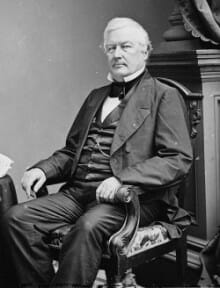
 Millard Fillmore and Andrew Johnson aren’t exactly household names, but controversy hung over both presidents like the foreboding dark clouds before a storm and the devastation left after it passes. Both men’s presidencies were marred by compromises, accusations, and in the case of Johnson, an attempted impeachment. But oddly enough, while slavery would be a central issue in both men’s political lives, they shared a common legacy. As boys both Millard Fillmore and Andrews Johnson were indentured servants.
Early America has a deep history of indentured servanthood. Sometimes called contract labor, the master of those indentured effectively owned a servant for the duration of his or her contract. The contracts were usually between five and seven years in length. During that period the rights of the individual were hardly a notch above that of a slave.
Millard Fillmore was born just a week into the nineteenth century, and fourteen years later, his father contracted him out as an apprentice to a cloth maker in Sparta, New York. The next few years of Fillmore’s young life were marked by several stints as an indentured servant. Finally, as a young adult he managed to buy his own freedom for the sum of thirty dollars. Without family means he managed only six months of formal education. In spite of these obstacles, Fillmore became an apprentice under a judge, began to study law, and became a self-made attorney.
Thought he never attended college, Fillmore became chancellor of the University of Buffalo in 1846. But Fillmore was never fooled by heady titles. When offered an honorary degree at Oxford University, he declined, saying, “I had the advantage of a classical education and no man should in my judgment accept a degree he cannot read.”
Andrew Johnson likewise had few advantages growing up. His father died when he was three, and in an age when social security had not even been dreamed of, Johnson’s family was destined for poverty. His mother lent her son out to be indentured as a tailor before he was barely a teenager. Like Fillmore, the result was the same. Johnson had no formal education and taught himself how to read and write.
Both men’s ultimate success that led to the presidency also landed them in fires of the dissolution of the Union. Fillmore was the last of the Whigs, and his presidency was marked by his continuing efforts to bring compromise where such was doomed to failure. Slave states were angered by his efforts to bring California into the Union as a free state and offer other protections to former slaves. Free states berated him as a sellout because he sought a middle ground between protecting slave owners and moving the nation toward ending the trade.
 Andrew Johnson inherited an even less enviable task than Fillmore. With President Lincoln assassinated and the northerners thirsting for vengeance, Johnson was tasked with Reconstruction. When the Radical Republicans gained control of Congress in 1866, they turned their attention on the compromises Johnson had sought to institute. His mollifying policies towards the South, his apparent rush to reincorporate the Confederate states back into the union, and his vetoes of civil rights bills painted a bulls-eye on his presidency. Were it not for one more vote, Johnson would have been impeached in 1868.
Fillmore and Johnson were born in different times. Neither was born to money, prestige, or the other perks of the elite. Perhaps their closeness to servanthood colored both men’s view of slavery and the answers to it. Andrew Johnson is consistently ranked as one of the worst presidents ever. Fillmore is not much higher.
Whether these men were as bad as our chief executive as modern historians paint them or were simply men of their time is open to debate. What is certain is that both men overcame great obstacles to rise to the pinnacle of success, only to look down and realize what they had inherited as a result – a nation in turmoil with no consensus for a solution.
©2011 Off the Grid News