 Print
Print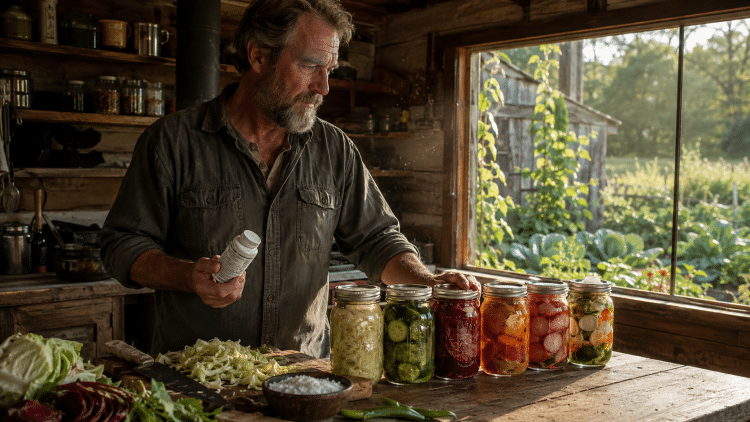
A Handful of Salt… A Garden Row… And An Old Mason Jar Can Produce More Living Diversity Than Most Pharmacy Bottles Ever Will
There’s a jar sitting on a farmhouse counter somewhere right now that holds more living bacteria than every probiotic capsule stacked on a pharmacy shelf… combined. It didn’t come from a lab. It didn’t arrive in a padded envelope. And it sure didn’t cost $49.99 plus shipping.
Instead, it came out of the dirt.
A handful of vegetables. A little salt. A few quiet days on the counter. That’s it.
And yet, somehow, the entire supplement industry is built on the idea that you need something more complicated than that. Something packaged. Something measured. Something you have to reorder every 30 days or risk “falling behind.”
Funny how that works.
The Wall of Promises at the Pharmacy

Walk into any pharmacy tonight and head past the cold medicine aisle. Keep going until you hit the vitamins. Then look up.
You’ll find it.
An entire wall dedicated to gut health—rows of plastic bottles, shiny labels, bold claims about “billions of live cultures,” “advanced delivery systems,” and “clinically proven strains.” Everything looks polished. Everything sounds important. And everything comes with a price tag that makes a practical homesteader stop and squint.
Now step back and take it in for what it is.
That’s not a health section.
That’s a marketplace.
The global probiotic industry is pushing toward hundreds of billions of dollars. That kind of money doesn’t come from simple solutions. It comes from repeat customers—people who believe the answer lives in a capsule instead of their own backyard.
And once you see that, it’s hard to unsee it.
What Those Labels Leave Out
Here’s the part they don’t print in bold font.
Your gut already holds somewhere between 30 and 40 trillion microorganisms. Not one strain. Not ten. Hundreds—working together in a living system more complex than most ecosystems we study in nature.
Now compare that to the average supplement.
One to ten strains. Maybe a few more if they’re feeling generous.
That’s not restoration. That’s a token gesture.
It’s like trying to rebuild a forest by planting three trees in a gravel lot and calling it “recovery.”
And then there’s the journey those bacteria take.
They’re grown in controlled environments. Freeze-dried. Pressed into powder. Sealed into capsules. Shipped across the country. Stored under fluorescent lights for months. Then finally swallowed with a cup of coffee and sent through stomach acid and bile.
Some survive.
Many don’t.
And yet, the billing cycle keeps ticking.
Eight Thousand Years Before the First Capsule
Now let’s rewind the clock.
Long before pharmacies. Long before lab coats and supply chains, people were already solving this problem with their hands.
Archaeologists have found evidence of fermentation going back roughly 8,000 years—ancient vessels holding the remains of fermented rice, fruit, and honey. No microscopes. No sterile factories. Just observation and necessity.
Food that bubbled didn’t spoil.
Food that lasted kept people alive.
So they kept doing it.
Across continents and cultures, fermentation became a quiet constant. In Korea, families still gather to prepare massive batches of fermented vegetables before winter sets in. In Europe, barrels of cabbage crossed oceans with sailors to prevent disease. These weren’t trends.
They were survival tools.
And they worked.
What Modern Research Finally Admitted
Here’s where it gets interesting.
Modern science—after decades of catching up—has started confirming what those old systems already proved through experience.
Studies have shown that diets rich in fermented foods can increase microbial diversity in the gut and reduce markers of inflammation. Not slightly. Significantly.
And in some cases, fermented vegetables have been found to carry dozens of distinct bacterial strains in a single batch.
Dozens.
That’s not a capsule. That’s a living ecosystem.
And it comes out of a jar you can make on your own counter.
Five Garden Crops That Make the Industry Nervous
Now here’s where it gets practical.
Because this isn’t theory. This is something you can grow, harvest, and turn into living food in one season.
Cucumbers: More Than Just a Crunch
Most people think cucumbers belong in salads.
But the real story starts when you stop slicing them and start fermenting them.
Here’s the kicker—most store-bought pickles aren’t fermented at all. They’re soaked in vinegar, dressed up with preservatives, and sold as tradition.
Real pickles? They don’t need vinegar.
Just cucumbers, water, salt, and time.
Leave them in a jar for a few days and the natural bacteria already living on the skin go to work. What you get isn’t just a snack—it’s a living culture, loaded with strains that actually survive the trip through your digestive system.
And they grow right on the vine.
Cabbage: The Quiet Workhorse
Cabbage doesn’t ask for much.
A little cool weather. A bit of space. Some patience.
But once you shred it and add salt, something remarkable happens. The microbial life shifts in stages—one group rises, creates acidity, then hands things off to the next. Eventually, the whole system stabilizes into something resilient and alive.
That’s sauerkraut. That’s kimchi.
And inside that jar? A diversity of bacteria that most supplements can’t even begin to match.
Simple food. Deep complexity.
Beets: The Overlooked Powerhouse
Beets don’t just feed your gut.
They reach further.
When you ferment them into a traditional drink like kvass, you’re creating something that works through the gut and into the liver. The connection between those two systems is direct—what strengthens one often protects the other.
So instead of targeting a single point, you’re working along a pathway.
That’s the kind of synergy you don’t find in a pill.
Hot Peppers: Fire With a Purpose
Hot peppers bring heat. Everyone knows that.
But under that burn is something else—compounds that help regulate inflammation and support metabolism. Now add fermentation to the mix, and you’ve got a double-layer effect.
The plant does one job.
The bacteria do another.
Together, they hit from two directions at once.
That’s not just flavor. That’s function.
Radishes: Fast, Forgotten, Powerful
Radishes grow fast. Sometimes in under a month.
And yet, most people never think to do anything with them beyond slicing and tossing.
That’s a missed opportunity.
When fermented, radishes develop a completely different profile—both in taste and microbial content. Different vegetables bring different bacterial communities, and that variety is what builds resilience in your gut.
Think of it like instruments in an orchestra.
Each one matters.
Together, they create something bigger.
One Season Changes Everything
Now step back and look at the whole picture.
You don’t need acres of land. You don’t need fancy tools.
A single raised bed. A handful of buckets. A small patch near the fence line.
Start in early spring with cabbage and radishes. Move into cucumbers and peppers as the weather warms. Add beets wherever they fit.
Then as each crop comes in, you start filling jars.
A few days here. A week there. By the time fall rolls around, you’ve got a lineup of living foods sitting in your kitchen—each one different, each one contributing something unique.
And here’s the shift.
You’re not buying anything.
The garden feeds the jars.
The jars feed the gut.
The gut feeds the body.
That loop closes fast.
The Part Nobody Wants You to Notice
There’s no subscription in that system.
No refill reminder. No “limited-time discount.” No dependence.
Just a process that’s been working quietly for thousands of years.
The bacteria don’t care about branding. They don’t care about marketing funnels or quarterly profits. They’ve been doing their job long before anyone thought to monetize them.
Your ancestors didn’t swallow them in capsules.
They ate them.
And once you start doing the same, you begin to see just how unnecessary that whole aisle at the pharmacy really is.
So Here’s the Real Question
It’s not whether fermentation works.
That’s already been answered—over and over again, across generations and continents.
The real question is simpler.
Are you going to keep outsourcing something this basic?
Or are you going to put a jar on your counter… and let the process start?
This article is for informational purposes only and does not constitute medical advice. Consult a qualified healthcare provider before making changes to your diet or health regimen.