Print

Sort Out What’s Really True And Get Your Family Ready Without Panic
What The China Reports Reveal And What To Do Before Winter
A crowded hospital half a world away can make your own kitchen feel a little less secure. Add pictures of sick children, school outbreaks, and a headline about bird flu, and pretty soon an ordinary evening turns into a midnight inspection of the pantry.
First, let’s clear away the fog before you count the soup cans. Seasonal influenza and occasional bird flu infections in people are different problems, and stirring them together makes a frightening stew.
Here are the cold, hard facts: the recent H9N2 cases reported from China deserve attention. They don’t, by themselves, establish that a new pandemic virus is spreading through the human population. For a homesteader, the useful response starts with clear facts, a household sick plan, and sensible habits at the chicken coop.
Don’t let a headline rattle you out of your common sense.
Ordinary Flu Can Still Take You Down

First, “seasonal” doesn’t mean harmless. According to the World Health Organization, influenza causes about a billion infections worldwide each year, including three to five million severe illnesses and an estimated 290,000 to 650,000 respiratory deaths.
Frankly, if you’ve had a nasty case, you don’t need a chart to explain the misery. The chills settle into your bones, your muscles ache like you spent yesterday wrestling fence posts, and you shuffle to the kitchen like you’ve already put in a full day.
Typically, symptoms begin one to four days after infection. Most people recover within about a week, though a cough and that wrung-out feeling can hang on longer, especially in older adults, as the CDC’s influenza overview for travelers explains.
Meanwhile, the virus can get a head start on you. People can spread it roughly a day before symptoms begin and for five to seven days afterward; children and people with weakened immune systems may remain contagious longer. The CDC’s guide to flu transmission explains why staying home only after you feel awful can’t catch every infection.
Flu spreads mainly through respiratory particles from infected people. Contaminated hands and surfaces can also play a part, but don’t let wiping the doorknob become your whole defense while everybody shares the same stuffy room.
What Those China Bird Flu Reports Actually Say
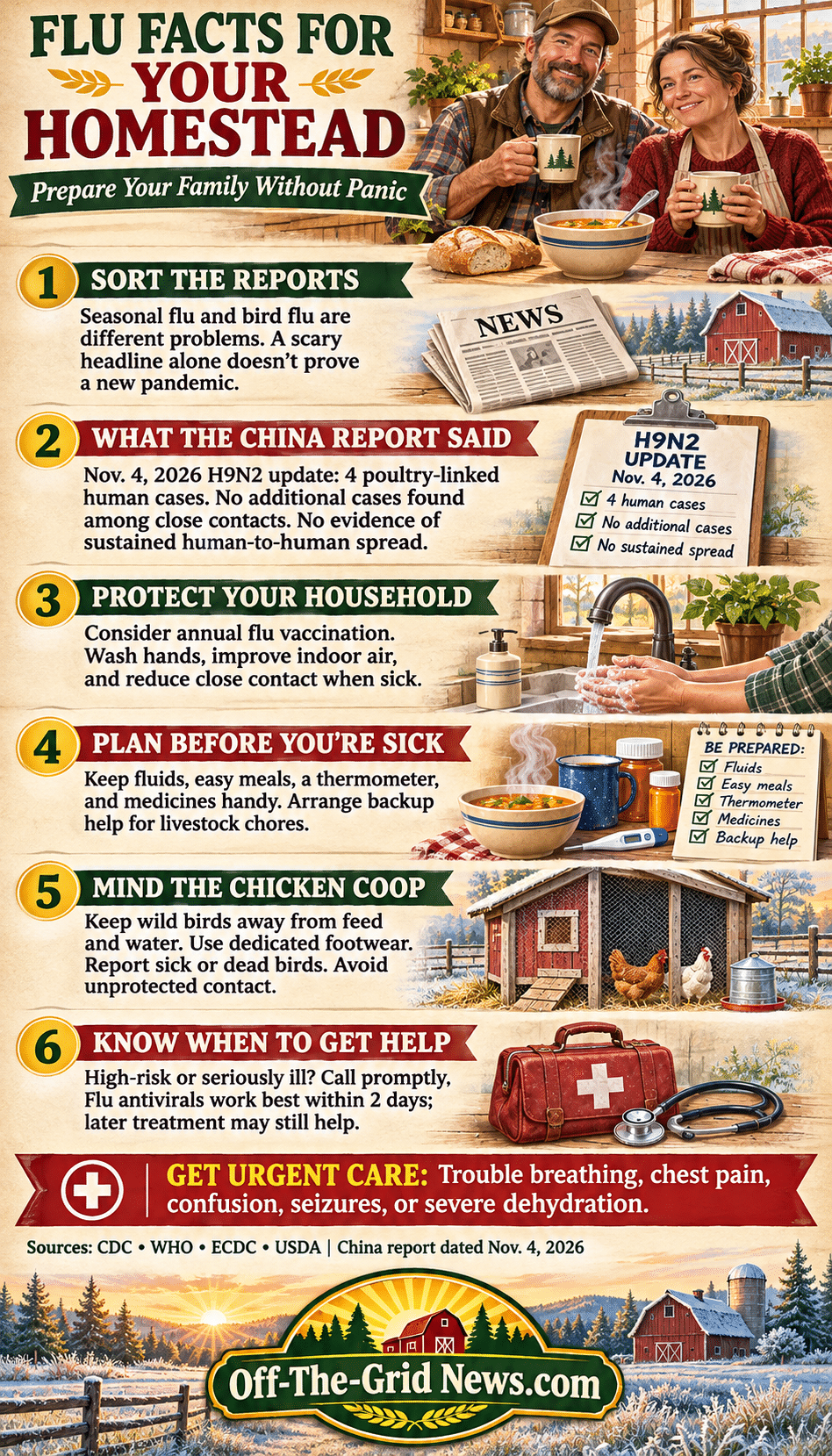
Now, let’s put the evidence on the kitchen table, starting with a date. In its November 4, 2026 H9N2 update, the European Centre for Disease Prevention and Control described four newly reported human infections in China: three children and one adult.
All four had poultry exposure. The cases weren’t linked to one another, and no additional cases had been identified among their close contacts. That’s a very different picture from a virus moving easily from one household to the next.
Also, H9N2 infections in people have generally caused mild illness, although serious illness can occur. The crucial detail is the subtype: you can’t lump every bird flu virus into one deadly threat and expect an accurate picture.
The European assessment found no evidence that H9N2 had gained the ability to spread sustainably between people and rated the risk to the general EU/EEA population as very low. That assessment concerns this particular virus and population; it isn’t a guarantee for someone handling infected poultry without protection.
Still, don’t mistake a reassuring report for an iron-clad promise that influenza will never surprise us. It tells us what investigators had found at the time of that report, which is exactly the sort of solid ground a sensible reader ought to stand on.
Don’t Overlook the Family Members Most at Risk
Of course, seasonal flu can still rip through classrooms and bring serious trouble home. Children share close quarters, cough near one another, and then arrive at the supper table with more than homework in their backpacks.
However, the age group with the most detected infections isn’t automatically the age group at greatest risk of severe illness. Children younger than five, especially those under two, are among the groups at higher risk of complications, along with adults 65 and older, pregnant women, and people with certain chronic conditions.
The CDC’s guide to flu symptoms and complications describes problems ranging from pneumonia to uncommon but serious inflammation of the heart or brain. Healthy people can develop complications, too, so “he’s usually tough as a hickory stump” isn’t a medical clearance.
For that reason, don’t treat childhood infection as a necessary way to build lifelong protection. Flu immunity changes and fades, and the viruses keep changing, too. There’s no prize for letting a preventable illness make the rounds through three generations at Sunday dinner.
Clear Away the Mumbo Jumbo About Changing Flu Viruses
Next, here’s the science in plain English. Flu viruses change over time, and the CDC calls their smaller antigenic changes “drift”. Those changes can help a virus get around some of the protection left by an earlier infection or vaccination.
“Shift” describes a major antigenic change in influenza A. A virus with a major change can pose a pandemic risk if people have little immunity and it gains the ability to spread efficiently among humans.
Think of drift as familiar weeds finding another gap in the garden fence. A major shift is a much bigger change in what’s coming through the gate, but even then, the ability to spread matters.
Here’s the catch: you can’t diagnose either situation by counting crowded waiting rooms. Investigators need laboratory results, genetic information, exposure histories, and evidence about transmission. Reports of school closures alone don’t establish a new pandemic strain, and reassuring reports don’t justify declaring that no pandemic could be on the horizon.
Read the Date Before You Trust the Numbers
Likewise, familiar names such as H1N1, H3N2, and influenza B don’t mean every country has an identical flu season. The mix of circulating viruses, the timing of outbreaks, and the pressure on hospitals can differ from one place to another.
For an American household, the useful place to check changing conditions is the CDC’s weekly FluView surveillance report. Read the week covered by the report before repeating a tally, because preliminary numbers change and yesterday’s total can travel a long way on the internet.
A prediction of a precise December peak or a comfortably “moderate” winter needs a dated, identifiable source. Without one, it’s weather forecasting by looking at last year’s woodpile.
So leave room for uncertainty. You don’t need a promise about the whole winter to make good decisions this week.
Don’t Leave a Blind Spot at the Chicken Coop
Now, here’s where the homestead connection becomes useful. Some influenza A viruses circulate in animals, and pigs can be infected by certain human, bird, and swine flu viruses. When two compatible influenza viruses infect the same cell, their gene segments can sometimes mix through a process called reassortment.
That biological possibility deserves respect, without turning every hog pen into a horror story. But keeping chickens and pigs on the same property doesn’t mean you’ve built a pandemic factory, and keeping them in separate pens doesn’t make infection impossible. The practical lesson travels well beyond any one country. Backyard keepers and commercial producers both need to limit opportunities for infection, recognize sick animals, and get veterinary help when something looks wrong.
Start with the USDA’s guidance for protecting your flock. Keep wild birds away from poultry feed and water, use dedicated footwear around the flock, and clean equipment before it carries trouble between properties.
If birds suddenly die, stop laying, or look seriously ill, contact your veterinarian or animal health officials promptly. Don’t pick up suspect birds barehanded or stir up dirty bedding while your face hangs over the dust; follow the CDC’s protection guidance for backyard flock owners.
And if you develop red eyes or flu-like symptoms after contact with sick birds or other potentially infected animals, tell your healthcare provider about that exposure immediately. The CDC’s advice for exposed people explains why that detail matters.
Build Your Winter Backup Plan Before Flu Knocks
Back inside, tap into a resource that’s easy to overlook: a willing neighbor or relative. Build a plan that still works when the person who usually feeds everybody is under a blanket. Keep easy meals, drinking fluids, a working thermometer, and necessary medicines where someone else can find them, and arrange backup help for livestock chores before the whole household feels rotten.
Then cover the basics. Eat a varied diet with enough protein, get regular sleep, and keep moving when you’re well. Sauerkraut and a decent supper have their place, but no jar in the root cellar comes with a guarantee against influenza.
Even so, if you’re concerned about a vitamin deficiency, ask a clinician whether testing or supplementation makes sense. Don’t turn high-dose vitamin C, zinc, or vitamin D into a substitute for prevention or timely treatment; more isn’t automatically better, and supplements can have side effects.
For prevention, the CDC recommends an annual flu vaccination for everyone six months and older, with rare exceptions. Vaccination can reduce illness and serious outcomes, although it doesn’t prevent every infection and seasonal flu vaccines aren’t designed to protect you against bird flu.
Meanwhile, wash your hands, cover coughs, and improve indoor air when practical. When someone is sick, reducing close contact and using a well-fitting mask around others can add protection, especially if Grandma or a medically vulnerable family member shares the house.
Know the Warning Signs You Can’t Afford to Ignore
First, don’t gamble on “waiting it out” if flu symptoms begin and you’re in a higher-risk group; call your healthcare provider promptly. Prescription antivirals work best when started within two days, though later treatment can still help people who are seriously ill or at higher risk. Don’t wait until you’re struggling to breathe before making that call.
For comfort, rest and drink fluids. Fever reducers can be used when appropriate, following the label and your clinician’s advice; there’s no need to make enduring a fever a test of character. Check combination cold remedies so you don’t accidentally take acetaminophen twice, and don’t give aspirin to children or teenagers with suspected flu unless a clinician specifically directs it.
More urgently, don’t shrug off trouble breathing, chest pain, confusion, seizures, or severe dehydration. These warning signs call for immediate medical care. In children, watch for blue lips, unusual difficulty waking, or a lack of normal interaction; the CDC’s emergency warning signs are worth reading before you need them.
Also, pay attention when fever or cough improves and then returns or worsens. That turn in the road can signal a complication, not simply a slow recovery.
Don’t Let Stubbornness Wreck Your Recovery
Finally, ease back into chores at your own pace as your strength returns. The chainsaw will wait, and a half-finished fence is easier to fix than a fall taken while you’re dizzy and worn out.
Meanwhile, the China reports are a reason to read carefully and keep watching reliable updates. The H9N2 cases described here don’t establish sustained spread among people, while ordinary seasonal flu remains capable of causing serious illness close to home.
Above all, keep the soup pot handy, protect the flock, and know when to call for help. A well-run homestead doesn’t depend on pretending trouble can’t come; it depends on noticing what matters and having a workable plan when it does.
Before the next cold snap, walk through that plan with the people who’ll help you carry it out. A phone number stuck to the refrigerator and somebody who knows where the feed is stored can spare you a miserable scramble when you’re in no shape to explain.