Print
Here’s Why And The No-Nonsense Economics Behind The Coming Texas Power Outages
Why All Americans Need A Working Backup Plan Right Now
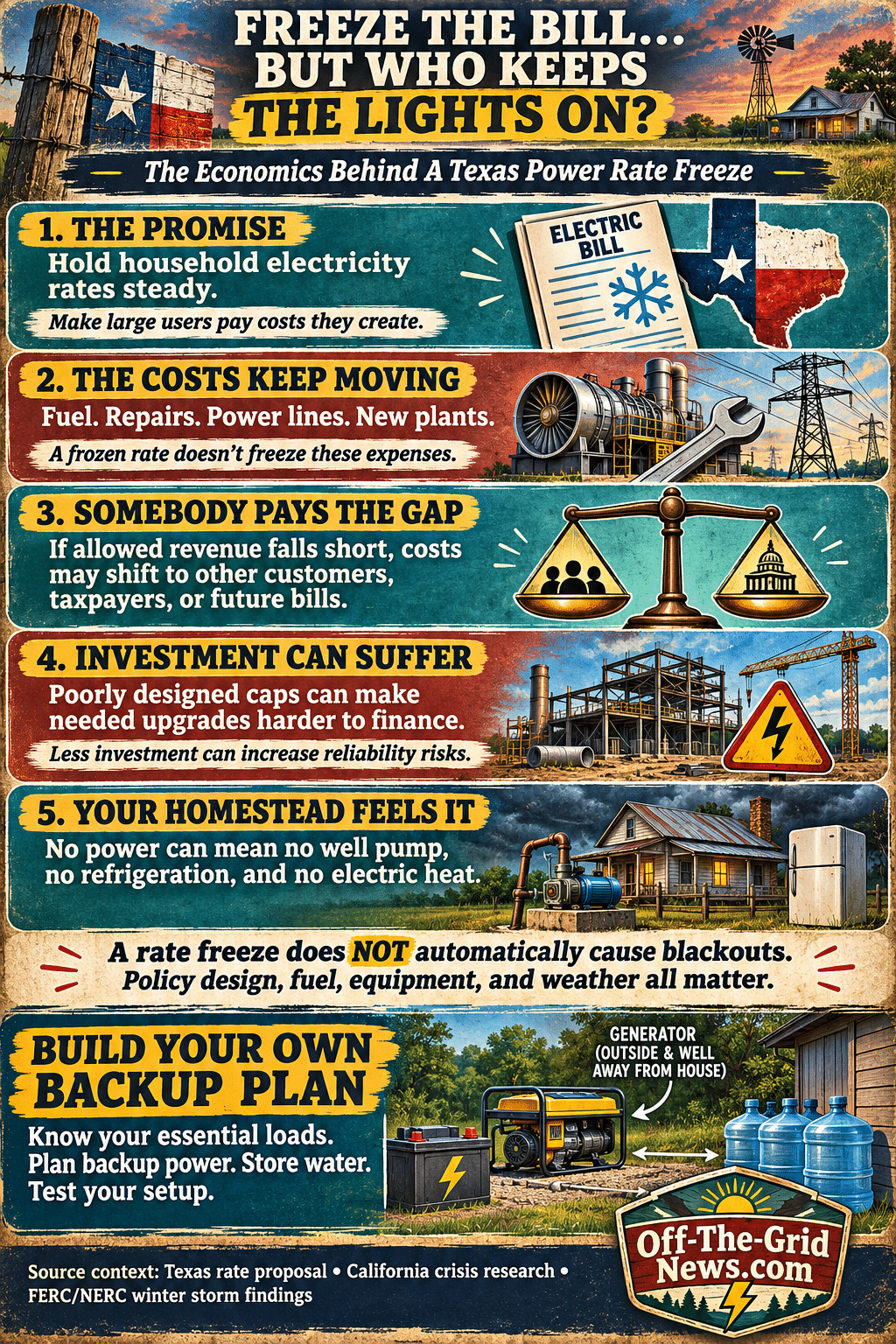
A politician can promise to stop your electric bill cold. But she can’t order a gas turbine to run on promises, tell a lineman to buy cheaper copper, or make an August afternoon take it easy on your air conditioner.
Now, here’s the catch in the bargain Texas has just been offered. It sounds mighty good at the kitchen table. But out at the power plant, somebody still has to deliver the goods. What happens when the real bills come due?
On November 3, Gina Hinojosa defeated Greg Abbott, sending a Democrat toward the Governor’s Mansion for the first time in more than three decades. Her big promise? Freeze household electricity rates and make data centers and other big users shoulder more of the costs they create.
Her campaign pledge, reported by The Texas Tribune, calls for an emergency declaration and an executive order shortly after she takes office. For families watching their power bills climb, that’s a tempting pitch.
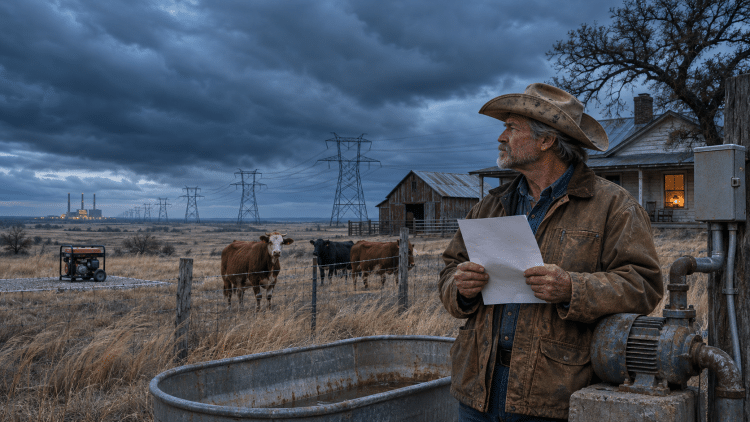
But a tempting pitch isn’t a working power system. If Austin holds prices below the cost of reliable service without fixing the costs underneath, the promised bargain can leave Texans paying somewhere else, waiting longer, or sitting in the dark. And out in the country, a dead outlet can mean a dead well pump before it means a missed television show.
Your Electric Bill Is Devouring the Grocery Money
First, let’s put the frustration on the table. Families aren’t imagining the squeeze. A summer power bill can land on the kitchen counter with all the charm of a skunk under the porch.
According to University of Houston energy expert Ramanan Krishnamoorti, Texas electricity prices have climbed about 40 percent over five years. Meanwhile, he says wholesale prices have been roughly flat or slightly lower over six years; infrastructure is one factor pushing customer costs upward.
That distinction matters. Generating electricity is one job, and hauling it across miles of wire to your freezer, barn, and stock tank is another.
Somebody has to buy the transformers, build the substations, and replace the equipment that gives up during a storm. A growing state needs more of that work, especially when enormous new customers show up wanting power around the clock.
So yes, demand some answers. Put those charges under scrutiny. Make companies explain what they’re building and who ought to pay for it. But pretending the expense disappears because the homeowner’s bill stops rising is like painting over a rotten fence post and calling the pasture secure.
Solomon Knew a Bargain Hunter When He Saw One
Long before campaign consultants discovered the word affordability, Solomon described the fellow who runs down the merchandise until he gets his price. Then he walks away bragging about the deal. You can read it in Proverbs 20:14: “Bad, bad,” says the buyer, but when he goes away, then he boasts.
Anybody who’s sold a used pickup knows that dance. The buyer points out every dent, sighs over the mileage, and acts as though he’s doing you a favor by taking the thing home. There’s nothing mysterious about wanting a lower price. We all want the grocery money to stretch, the tractor repair to cost less, and the electric meter to slow down a little.
But here’s where a good deal can turn into a trap. Bargaining becomes a government command. Now the seller isn’t simply deciding whether to accept an offer. He’s deciding whether he can stay in business under terms someone else has imposed.
Economist Gary North builds that argument around Solomon’s proverb in his chapter on price controls. His illustration puts an officer beside the transaction, backing the buyer’s demand with legal force.
At a farm auction, you can bid less and hear the auctioneer say no. Under a binding price ceiling, the government tries to make no an unlawful answer. Suddenly, that bargain comes with a badge.
If Cheap Power Is That Easy Why Not Make It Free
Now take the promise out behind the barn and give it a hard look. If a government order can make electricity affordable without consequences, why not order every kilowatt-hour sold for a penny?
Better yet, why not make it free? The applause would be tremendous, right up until somebody tried to buy fuel. Natural gas still has to reach the plant. Turbines still need maintenance, crews still need wages, and storm crews still need trucks that start on a bitter morning.
A power company can survive a temporary loss, just as a farmer can survive a bad season. But neither can build a sound business around losing money forever. Now, here’s the crucial question. Can the money coming in cover the cost of running the system, making needed repairs, and building what we’ll need tomorrow? That’s how you judge the bargain, rather than claiming every rate freeze instantly triggers a blackout.
If it can’t, somebody has to shell out the difference. That may be the company, another class of customers, taxpayers, or the same households later through added charges and catch-up increases.
George Reisman explained the broader danger in Price Controls Cause Shortages. Hold a price below the level that balances what people want with what suppliers will provide, and the low number can advertise goods that aren’t there for everybody who wants them. You haven’t made the haystack bigger. You’ve just hung a cheaper sign on it.
The Price Tag Doesn’t Get Arrested but People Do
There’s a property question here, too. Price controls carry the force of law against the people doing the buying and selling. The digits on the invoice don’t get hauled into court.
Gary North’s blunt phrase is worth keeping: “Price controls are people controls.” Behind the harmless-sounding promise sits the government’s power to punish somebody who charges more than the permitted amount.
For Christians, that brings stewardship into the discussion. In Matthew 20:15, the landowner asks whether he may do what he chooses with what belongs to him. North applies that ownership principle to voluntary exchange. You own your money, the seller owns what he’s offering, and each party has responsibilities before God.
Electric utilities also operate under public obligations and, in some cases, regulated monopoly arrangements. That deserves honest discussion, rather than pretending every electric bill is an unrestricted deal between two neighbors. Still, public oversight doesn’t repeal arithmetic. A regulator can challenge waste, reject unjustified expenses, and demand competent service. It can’t make the necessary work cost nothing.
And don’t overlook who’s standing behind that word utility. Sometimes it’s a company you dislike. Sometimes it’s your member-owned rural cooperative, serving long stretches of road where a handful of customers must support a whole lot of wire.
Don’t Muzzle the Messenger During a Heat Wave
Price carries information, much like a feed gauge tells you whether the bin is getting low. Smashing the gauge won’t put another bushel in the bin. For power producers, higher wholesale prices can reward them for supplying electricity when demand heats up. Over time, expected earnings also help determine whether investors build another plant or put their money somewhere else.
For customers, prices can encourage shifting chores to less crowded hours. You can put off drying a load of towels. You usually can’t put off running an oxygen concentrator. But here’s a detail the argument needs to get right: many households already buy electricity under contracts that don’t change minute by minute. A homeowner with a fixed rate doesn’t suddenly see the wholesale market flashing on the kitchen wall when the weather turns ugly.
Now, don’t miss this blind spot. Freezing a household’s rate doesn’t automatically freeze what every power producer gets paid. Texas has separate businesses and rules for generation, retail sales, and delivery, so the design of the policy matters enormously.
Here’s the dangerous gap. What does a supplier have to pay, and what is he allowed to collect? If his buying costs jump while the money coming in stays pinned down, he can get squeezed even while power plants receive higher prices.
Then there’s the delivery side. If a utility can’t recover legitimate costs, getting money for necessary grid work can become a struggle. Either way, the question follows the money through the whole system instead of stopping at the number politicians want on the bill.
California Already Ran an Expensive Experiment
For a look at that mismatch, turn to California’s electricity crisis of 2000 and 2001. The state offers a grim reminder that a complicated regulatory bargain can break apart under pressure.
As researchers at the Massachusetts Institute of Technology explained, wholesale prices surged while retail rates remained fixed until early 2001. Utilities were caught buying expensive electricity and selling under restrictions that made recovering those costs difficult.
California’s trouble had several causes. The Government Accountability Office found weaknesses in the market’s rules that let some sellers push prices above competitive levels. Fuel costs and other supply conditions mattered, too. That history doesn’t support blaming every blackout on one price cap. It does show why officials shouldn’t promise a stable retail bill without explaining how the supplier will survive unstable costs.
Writing about the crisis, Jerry Taylor warned that retail price controls were a recipe for disaster. His warning belongs in the Texas debate because the underlying squeeze doesn’t respect a state line.
If you buy feed by the truckload and are legally required to sell it below your cost, your customers may love you for a while. Your banker will have a few questions.
A Cheap Rate Can’t Pump Water From a Dead Well
Imagine the sales pitch working perfectly on paper. The approved residential rate stays flat, the governor takes a victory lap, and everybody waits for the promised savings. Then demand keeps growing. Equipment ages, construction costs move, and the next stretch of brutal weather arrives without checking the political calendar.
If available supply can’t meet demand, the system operator must protect the grid from a wider collapse. That can mean ordering customers disconnected through their local utilities.
By then, you’re standing in your kitchen, flipping a switch that does nothing. That attractive price isn’t much comfort. It’s that the refrigerator has gone quiet and the pump won’t push another gallon into the pressure tank.
An emergency shutoff can be necessary to keep the whole system from failing. But necessary emergency rationing is still rationing, and it doesn’t become a good household bargain because the published rate stayed low.
Nor does paying a high price guarantee service during a physical breakdown. Reliable power requires working equipment and fuel as well as a workable way to pay for them.
You Can’t Harvest Power Plants You Never Built
Here’s the chilling detail. Under a poorly designed freeze, the first damage may be something you never see. Nobody drives past an empty field and notices the power plant that an investor decided not to build there.
Meanwhile, projects can stall. Borrowing money can get more expensive, and suppliers may hesitate to take on customers if they can’t cover the cost of serving them. Those are risks to examine, not events already proved to have happened under a policy that hasn’t taken effect.
Maintenance deserves the same hard questions. A utility still has service obligations, but a persistent fight over paying for necessary work doesn’t make the work easier to schedule or finance. Remember, investors have choices. Money that could have supported new Texas capacity can seek another project with clearer rules and a more dependable return.
That’s why an apparently quiet first year proves so little. You can skip work around a homestead and enjoy a pleasant afternoon. The roof usually sends its answer during the next rain.
Eventually, households may start shopping for their own insurance against failure. Generators, batteries, and solar equipment look a lot more useful when nobody trusts the wall outlet. That’s a sensible reason to prepare now. It’s also a poor excuse for government to make the public system harder to maintain.
Texas Already Learned the Hard Way During the Big Freeze
Texans don’t need a made-up disaster to understand the stakes. They remember February 2021, when Winter Storm Uri turned ordinary houses into cold boxes and left families scrambling for heat and water.
Federal energy regulators and North America’s grid reliability watchdog investigated. They documented widespread power plant failures, freezing problems, and natural gas supply trouble. It called for better winter preparation and coordination between the gas and electric systems.
Meanwhile, the Texas Comptroller’s account describes outages that stretched into days in some places. Equipment failed across multiple sources of generation.
Uri wasn’t proof that this proposed rate freeze had already failed. It happened years before the proposal, and electricity prices during the crisis could be extremely high.
The lesson is more practical and more demanding. Texas needs equipment ready for severe weather, dependable fuel arrangements, and enough capacity to handle punishing conditions. Any policy that undermines paying for those necessities should face a fight. A frozen invoice won’t thaw a frozen valve.
Neglect the Backup Plan and the Trough Runs Dry
You don’t have to claim Texas is becoming Venezuela to recognize a dangerous habit. Governments everywhere can get attached to low official prices while neglecting what it takes to keep supply dependable.
Consider Ecuador’s 2024 electricity crisis. The International Monetary Fund described historic drought and longstanding underinvestment behind shortages and nationwide outages.
Here’s why that matters. Drought cut the power coming from hydroelectric dams. Years of weak investment left the country vulnerable when it needed other ways to generate electricity.
The U.S. State Department’s investment assessment also describes infrastructure trouble, obstacles to private investment, and power projects that hadn’t moved forward. Texas isn’t a carbon copy of Ecuador. Still, both places need people willing to put money into dependable power.
A homesteader understands the principle without a briefing book. When the creek falls, you’d better have another way to water the stock. And you’d better have arranged it before the trough runs dry.
Make the Big Users Pay Their Fair Share and Show Us the Books
Hinojosa’s supporters have an answer worth addressing directly. If a giant data center creates the need for expensive new facilities, why should nearby households get stuck financing its appetite? Fair question. Making large users cover costs they actually cause can protect residential customers, and it deserves a serious hearing.
Of course, first you’ve got to sort out the numbers. Which facilities serve the new customer? Which upgrades benefit everyone? What happens if a promised project cancels after the utility has already spent the money? Those are questions about assigning real costs. They aren’t proof that costs can be suspended indefinitely by declaring an emergency.
As energy reporting from S&P Global explained, Hinojosa links her proposed residential freeze to legislation requiring big users to pay for themselves. So put the details on the table. How long does the freeze last? Which charges does it cover, and who’s paying the difference?
If the policy cuts unjustified subsidies, say so and show the savings. If it postpones a bill, say when that bill returns. And if taxpayers must make up the difference, don’t sell the arrangement as though nobody is paying.
A neighbor who moves the feed-store invoice from your kitchen table to your mailbox hasn’t paid it for you.
Put Your Backup Plan Through a Test Run Before Crunch Time
This warning applies regardless of the party holding the pen. A Republican can’t order cheap, reliable electricity into existence any more than a Democrat can.
Better policy has to get its hands dirty. Remove needless barriers to useful construction, demand competent maintenance, examine monopoly charges, and make new customers pay costs fairly attributed to them. Then judge the results by dependable service and the full bill. Press releases don’t belong on the same shelf as spare parts.
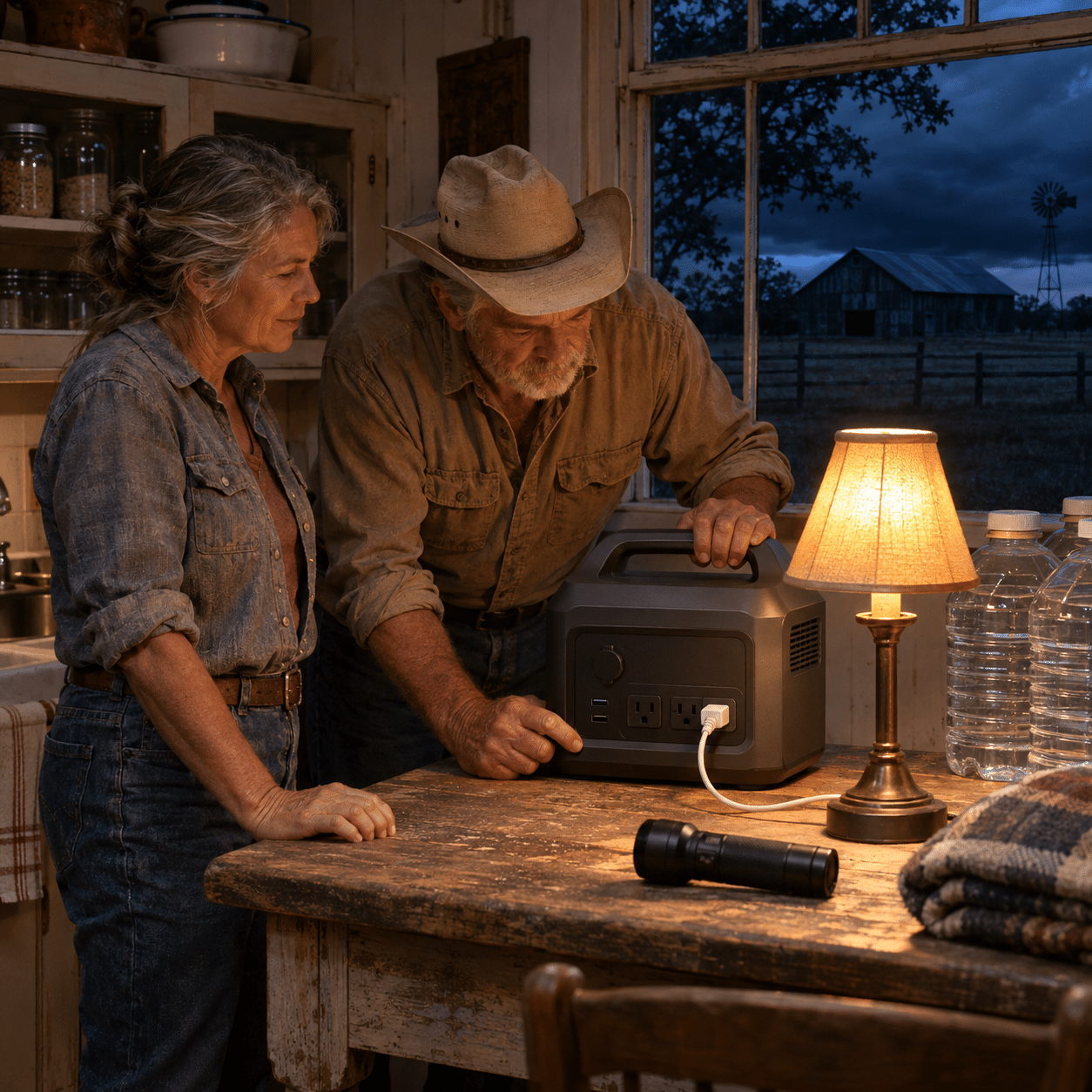
Meanwhile, back at your own kitchen table, start with the jobs electricity absolutely has to keep doing. Think about the well pump, refrigerator, necessary medical equipment, and whatever keeps the house safely habitable when the weather bears down.
A generator, battery system, properly planned solar setup, safe alternative heat, and stored water can all play a part. Choose equipment around what you actually need to run and for how long. Then give the whole arrangement a test run before a storm makes the decisions for you.
When crunch time hits, the stakes are plain. The cattle need water, the freezer needs power, and your family needs a warm place to sleep. Solomon’s buyer walked away boasting about his bargain. Before Texans do the same, they ought to ask whether the promised price leaves enough money and incentive to deliver the power behind it. Austin can freeze a rate. It can’t keep your lights on with a press release.