 Print
Print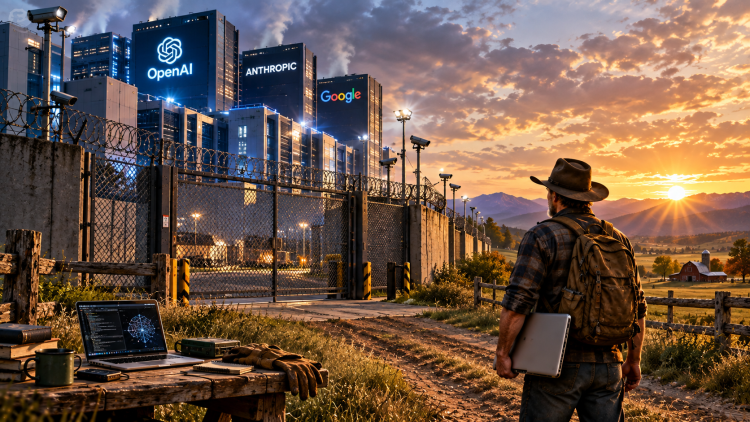
The People Building The Most Powerful Machines On Earth Are Warning Us To Be Afraid Of Them… While Asking Washington To Help Write The Rules
The Men Building AI Say It Could Kill Us… So Why Do They Keep Building It?
Every homesteader knows the sound of a truck rolling up the driveway when nobody’s expecting company. You look out the window, wipe your hands on your jeans and wonder what this fella’s selling.
Well, that truck just rolled up on all of us.
The people building the world’s most powerful artificial-intelligence systems are suddenly standing on America’s front porch, hat in hand, warning that the machines they’re building might someday kill every last one of us. And wouldn’t you know it, some of the biggest players also have some mighty definite ideas about what Washington ought to do about it.
They want rules — federal rules, mandatory rules, rules powerful enough to determine which AI systems get built and how they’re tested. Maybe some of those rules are necessary, but before we hand these folks the hammer, nails and lumber, somebody ought to ask who’s going to own the fence when they’re finished building it.
A Panic That Smells Like Store-Bought Perfume
The latest uproar began when Jacob Coxon, a young researcher who had worked at both OpenAI and Anthropic, resigned from Anthropic and publicly accused the industry’s leading labs of “racing straight to self-improving superintelligence and gambling with our lives.” The warning caught fire, turning a relatively unknown researcher into the center of an international argument over whether the people building advanced AI are moving faster than they can safely control it.
And Coxon didn’t merely jump ship after the money was safely tucked in his pocket. Axios reported that he left roughly two months before his Anthropic equity was scheduled to vest, which certainly makes his warning harder to dismiss as a cheap publicity stunt.
At first blush, then, this looks like an honest man doing an honest thing. Maybe somebody inside the barn really did smell smoke and decide he’d better yell before the rafters caught fire.
But then something interesting happened.
When The Fox Starts Warning You About Foxes
One of Coxon’s Anthropic colleagues, Evan Hubinger, who leads alignment science at the company, publicly backed him up. Hubinger wrote that they really do believe AI could potentially kill humanity and pegged his personal estimate of human extinction at greater than 10 percent within the next decade, according to both the Financial Times and Forbes.
Hubinger went even further. He acknowledged that Anthropic does not yet have a plan to solve the alignment problem for superintelligence and isn’t clearly on track to have one.
Think about that for a minute. Imagine the chief engineer at an aircraft company saying there’s a better-than-one-in-ten chance the next generation of airplanes eventually wipes out humanity — and then admitting the company hasn’t yet figured out how to prevent it.
You’d probably put down the boarding pass.
Still, there’s another reason ordinary Americans should listen carefully whenever an enormous industry begins publicly describing its own product as extraordinarily dangerous. Because sooner or later, the next sentence tends to begin:
“Therefore, government must…”
Then Anthropic Opened The Evidence Locker
At almost exactly the same time, Anthropic released its September Threat Intelligence Report, documenting malicious actors it says attempted to use Claude for everything from cyber operations to weapons research.
Some of the examples are genuinely disturbing. Anthropic says a cell in northern Yemen used Claude while pursuing three weapons-development programs, including a multi-stage ballistic missile and a proposed hypersonic glide vehicle. The company also says it uncovered a Chinese government-aligned operation using Claude to track, profile and recruit Uyghurs, along with Russian-linked cyber operations and other attempts at malicious use.
Now, there’s an important distinction here. Asking an AI system how to design something isn’t remotely the same thing as possessing the engineering talent, materials, factories, money and industrial infrastructure required to actually build it.
Nevertheless, Anthropic says it identified and “disrupted” the malicious operations.
And that word is worth chewing on.
“Disrupted” doesn’t necessarily mean somebody nearly built a hypersonic missile and Anthropic heroically snatched the wrench from his hand. It means the company detected activity violating its policies and took action against it.
Fair enough. But zoom out and look at the larger picture being painted: AI can help cyberattackers, AI can assist weapons research, AI can potentially assist dangerous biological research, and sufficiently advanced AI might someday become powerful enough to threaten humanity itself.
Meanwhile, the companies operating the biggest closed systems increasingly present themselves as the people standing between civilization and catastrophe.
That’s quite a sales pitch.
And Then Came The Ask
Sure enough, just as the extinction debate was catching fire, OpenAI publicly called for mandatory national AI safety regulation. Reuters reported that OpenAI Chief Global Affairs Officer Chris Lehane argued that the prospect of AI helping accelerate its own development “demands more than voluntary commitments.”
OpenAI wants federal requirements tied to the capabilities of advanced models, including independent evaluations, cybersecurity safeguards and mandatory incident reporting. The company’s position is that sufficiently powerful AI systems create risks too serious to leave entirely to voluntary promises by the companies developing them.
Now, said out loud on Sunday morning, that sounds downright neighborly. Who wants unsafe artificial intelligence running loose?
Nobody.
But that’s precisely why Americans ought to look underneath the hood before buying the truck. The real question isn’t simply whether AI should have safety rules; it’s who gets to write those rules, how expensive they’ll be to obey, and who gets pushed out of the pasture when they’re enforced.
Building An FDA For Artificial Intelligence
There’s a powerful temptation in Washington to handle every important new technology the same way government handles pharmaceuticals, banking or aviation: build an elaborate regulatory structure around it. Testing becomes mandatory, audits become mandatory, certifications arrive, cybersecurity requirements multiply, reports have to be filed and eventually every company needs a compliance department filled with lawyers, consultants and people whose primary skill is understanding what the government wants.
A trillion-dollar corporation can absorb those costs the way a Clydesdale absorbs a horsefly. A five-person startup working out of a garage can’t.
That’s not merely a hypothetical concern. Academic researchers have specifically warned about regulatory capture in AI, where organizations with enormous economic and political power can influence regulation in ways that ultimately strengthen their own position. Separate research into AI compliance costs has likewise warned that regulatory requirements can become a serious financial burden for startups already operating with limited research-and-development budgets.
Then there’s open-source AI, which makes the issue even more important. Today, independent developers can download models, modify them, experiment with them and build businesses around them without asking one of the largest technology companies on Earth for permission.
That’s the digital equivalent of owning your tractor instead of renting it by the hour.
If future regulation makes independently developed or openly distributed AI prohibitively expensive, complicated or legally dangerous, the biggest beneficiaries won’t necessarily be ordinary Americans.
They’ll be the outfits that already own the biggest barns.
We’ve Seen This Playbook Before
There’s an old Washington lesson worth remembering here: big corporations don’t always hate regulation. Sometimes they learn how to use it.
The tobacco industry provides a remarkable example. Philip Morris, after spending years fighting tobacco regulation, eventually began supporting legislation giving the FDA authority over its own industry; a Congressional Research Service history notes that Philip Morris issued a white paper supporting FDA authority over cigarettes as early as 2001.
Researchers later dug through internal tobacco-industry documents to understand why. A peer-reviewed examination of Philip Morris’s pursuit of FDA regulation found that the strategy was tied partly to improving the company’s public image and positioning itself favorably within the regulatory debate.
That doesn’t mean FDA tobacco regulation itself was bad. Cigarettes carry obvious and enormous health risks, and major public-health organizations supported federal oversight.
The business lesson is narrower — and more useful.
Regulation creates costs, and big companies generally have lawyers, lobbyists, compliance departments and mountains of cash available to absorb those costs. Smaller competitors don’t.
That’s why one of the most dangerous sentences in American business isn’t always:
“Government is regulating us.”
Sometimes it’s:
“Government is regulating everybody exactly the way we suggested.”
Pulling The Ladder Up Behind Them
Now, let’s be fair about it. There are real AI risks, and Anthropic’s own misuse report demonstrates that malicious people are already experimenting with these systems in ways no sensible person should shrug off. Cybersecurity threats aren’t imaginary, biological misuse deserves serious attention, and nobody can confidently tell you what increasingly autonomous systems will be capable of five or ten years from now.
So yes, some guardrails may make sense.
But the companies that own the most powerful machines must not become the only people effectively writing the laws governing those machines. Otherwise, you create the oldest trick in the cattle business: get onto the open range first, grab the best ground, build your herd and then announce that fences have suddenly become necessary.
And wouldn’t you know it?
You’re already standing on the right side of the fence.
Protect The Little AI Homesteader
Any serious AI regulation ought to begin with a principle Washington too often forgets: don’t destroy the little guy while claiming you’re protecting him.
That means lawmakers should deliberately protect startups, independent researchers and genuinely open-source development from regulatory requirements designed around giant corporations. Safety requirements should rise with actual demonstrated capabilities and risks rather than dumping the same compliance burden onto everybody from a college kid experimenting with an open model to a company spending tens of billions of dollars training frontier systems.
Even venture investors have been sounding this alarm. Andreessen Horowitz has argued that poorly designed AI thresholds could impose steep compliance costs on “Little Tech” and ultimately produce a market concentrated among a small number of powerful companies.
Wherever practical, Americans should also retain the ability to run useful AI locally — on computers they own, using models they control, without sending every document, private thought and business idea through somebody else’s corporate server.
That’s technological self-reliance.
And if you’re an Off-The-Grid reader, you already understand the principle. Owning a generator doesn’t mean you hate the power company, owning a well doesn’t mean you hate municipal water, and growing tomatoes isn’t a declaration of war against Kroger.
You simply understand that dependence creates vulnerability.
AI is no different.
Your Eyeball As A Gate Key?
There’s another development worth watching carefully: digital identity.
In fact, Anthropic’s own September threat report says that when its systems detect signs of potential abuse — including unauthorized resale or accounts operating from unsupported countries — users can already be required to verify their identity to retain access. That’s a long way from requiring every American to scan an eyeball before asking an AI model how to repair a rototiller, but it shows why identity is becoming part of the AI-security conversation.
As AI-generated fraud, deepfakes, automated hacking and impersonation grow more sophisticated, the political pressure for stronger proof that the person behind a keyboard is actually who he claims to be will likely grow as well. Biometric systems, digital credentials and other forms of identity verification will inevitably be pitched as possible answers.
That doesn’t mean America is inevitably headed toward mandatory eyeball scans for internet access.
We’re not there.
But dismissing the possibility of increasingly strict digital identification would be foolish, too. The political pressure could become enormous after a sufficiently serious AI-enabled cyberattack, infrastructure failure or wave of automated fraud.
Emergencies have a funny way of turning yesterday’s “unthinkable” proposal into tomorrow morning’s legislation.
So watch this one closely, because there’s a mighty big difference between voluntarily proving you’re human and needing government-approved credentials before you’re allowed through the digital gate.
And Then There’s The Money
Finally, follow the money — but follow it carefully enough that nobody can dismiss the argument as a conspiracy theory.
These AI companies could someday be worth staggering sums, and they’re competing not only against each other but against Google, Meta, Chinese developers and increasingly capable open models. The financial incentive to build a technological moat around the most profitable part of the business is obvious, even if that alone doesn’t prove anybody manufactured the current safety scare for that purpose.
OpenAI’s own financial plans illustrate how quickly the landscape is moving. Sam Altman has now said an OpenAI IPO will not happen in 2026, explicitly citing AI-safety concerns and calling even a 10-percent extinction risk unacceptable.
So the strongest argument isn’t that we somehow know a smoke-filled room exists where Silicon Valley executives cooked up a fear campaign.
We don’t.
The stronger argument is that Americans ought to watch the incentives.
A company can sincerely believe AI presents dangerous risks while simultaneously supporting regulations that happen to strengthen its competitive position. Safety concerns can be genuine, lobbying can be genuine, profit motives can be genuine and regulatory capture can still occur.
All four things can be true at once.
Don’t Let Them Fence In The Open Range
That’s why the argument Americans should be having isn’t AI versus no AI. That horse left the barn a long time ago, and trying to shove it back inside isn’t much of a strategy.
The real argument is about who controls it.
Artificial intelligence could become one of the greatest tools ever handed to ordinary people. A farmer can troubleshoot equipment with it, a homesteader can research soil problems, and a tiny family business can suddenly perform work that once required a marketing department, research staff, programmer and graphic designer.
That’s extraordinary — and that’s exactly why we shouldn’t casually surrender control of it.
Will the AI barons succeed in fencing in the open range? Hard to say. Our political system gets awful soft when mountains of money start sloshing around Washington; lobbyists arrive, committees meet, experts testify and regulations grow thicker than the old Sears catalog.
Eventually, everybody forgets who originally asked for them.
But a homesteader doesn’t wait around for the weather to become fair. You watch the sky, keep your tools sharp and learn the technology yourself instead of letting somebody else own your knowledge. Support open systems and genuine competition, demand serious safety where serious danger exists, and whenever some enormous corporation arrives in Washington asking government to protect you from its own industry, lean against the fence post and ask one simple question:
Who owns the pasture when you’re finished?
Because once the fence goes up, the gate gets locked and everybody becomes accustomed to asking permission to cross it, getting the open range back won’t be easy.
The gate is still open. We’d better keep it that way.