 Print
Print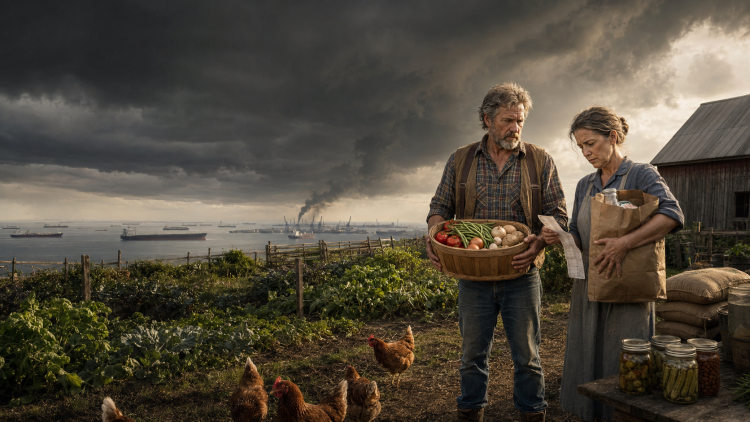
The Strait Closes… Fertilizer Vanishes… And Your Grocery Bill Explodes
And Why Your Homestead May Be the Best “Survival Insurance” You Own
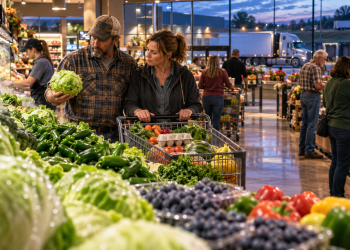
Half a world away, tankers are sitting idle near the Strait of Hormuz. Here at home, families are standing beneath the fluorescent lights at the grocery store, watching the total on the checkout screen climb higher than it did the week before.
Those may look like two separate problems. They aren’t.
They’re the same storm blowing through two different doors. One threatens the physical supply of food and fertilizer. The other quietly eats away at the value of every dollar in your wallet.
But if you’ve got a garden growing behind the house, jars of tomatoes lined up in the pantry, and a few laying hens scratching beneath the clothesline, you’re already ahead of millions of Americans who are just beginning to sense that something isn’t right.
A Chokepoint Half a World Away—And Trouble at Your Table

First, take a look at the Strait of Hormuz. It may be thousands of miles from your kitchen table, but what happens there can eventually show up on your grocery receipt.
The narrow waterway sits between Iran and Oman and serves as one of the most important shipping lanes on earth. Oil, natural gas, fertilizer, and other essential goods move through that tight channel on their way to farms, factories, and ports around the world.
Since the Strait was effectively closed earlier in 2026, ships have been delayed, cargoes have been stranded, and producers have been forced to scramble for longer, more expensive routes. Meanwhile, heat waves have scorched farmland, and renewed attacks around the Black Sea have added another layer of uncertainty to global grain shipments.
It doesn’t take an economist to understand what happens next.
When fuel costs more, fertilizer costs more. When fertilizer costs more, farmers either pay the bill or use less of it. Either way, the final price eventually rolls downhill until it lands in your shopping cart.
The Fertilizer Squeeze Most Families Never See
Meanwhile, the most serious damage may be unfolding in a place few shoppers ever think about—the fertilizer plant.
Researchers at the International Food Policy Research Institute have called the present situation an “input crisis.” That’s the tidy academic phrase. In plain homesteader language, it means the materials commercial farmers depend on are becoming more expensive and harder to move.
Modern nitrogen fertilizer production relies heavily on natural gas, both as a raw material and as an energy source. Therefore, anything that shakes the energy markets can rattle the food supply right along with them.
The Middle East supplies about one-third of the world’s traded urea, one of the most widely used nitrogen fertilizers. Since the end of February, an estimated 3.9 million metric tons of Gulf fertilizer exports have been suspended. That’s equal to roughly 30 percent of the Gulf states’ annual fertilizer exports, stuck behind a closed shipping lane. International Food Policy Research Institute
Urea prices briefly more than doubled this spring, rising from around $400 per metric ton to over $850 before falling back near $453 in June. That retreat brought some relief, but it didn’t remove the underlying danger. World Trade Organization
Plants across the region have already reduced production to avoid piling up fertilizer they can’t ship. And while urea can be stored for several months, hot temperatures and moisture can ruin its quality.
So, the longer the Strait remains disrupted, the tighter the squeeze may become.
When Fertilizer Stalls, Food Follows
At first, a fertilizer shortage sounds like a farmer’s problem. Then planting season comes.
Commercial growers must decide whether to pay the higher price, cut back on fertilizer, switch crops, or leave marginal ground unplanted. If they use less fertilizer, yields may fall. If they pay more, those costs eventually work their way into everything from a loaf of bread to a sack of chicken feed.
Then the pressure spreads.
Corn feeds cattle, hogs, and chickens. Grain becomes flour, cooking oil, breakfast cereal, and thousands of processed foods. Fertilizer costs even reach the produce aisle because fruit and vegetable growers face the same higher fuel, labor, transportation, and input expenses.
That’s why a disruption on the other side of the world can leave fingerprints all over an American supper table.
The World’s Breadbasket Is Under Fire Again
At the same time, Ukrainian ports along the Black Sea are once again facing attacks and shipping disruptions.
Before Russia’s invasion, Ukraine was known as one of the world’s great breadbaskets. Its deep black soil produced mountains of wheat, corn, barley, and other grains that fed people far beyond its borders.
Those exports still haven’t fully recovered. Now, renewed trouble around the ports is making an already fragile situation even more uncertain.
Picture two hands squeezing the same throat. The Middle East fertilizer trade is constrained on one side, while Black Sea grain movement is threatened on the other. At the same time, severe heat is damaging fields in several important growing regions.
One bad harvest can usually be absorbed.
Several shocks arriving together are another matter.
Millions More Could Be Pushed Toward Hunger
Naturally, this isn’t just about numbers flashing on a commodity trader’s screen. It’s about real families trying to put food on the table.
The 2026 United Nations food-security report says the average global cost of a healthy diet has risen from $3.44 to $4.28 per person per day in purchasing-power terms—an increase of roughly 24 percent. About 2.7 billion people still cannot afford a healthy diet. United Nations Nutrition
Depending on how long the energy and fertilizer shock continues, international projections suggest millions more people could be pushed into chronic hunger by 2030.
For the moment, the worst suffering may be overseas. But don’t fool yourself into thinking American families are insulated from the same forces.
The same diesel moves our tractors. The same fertilizer feeds our corn. The same global markets influence the price of wheat, meat, cooking oil, and animal feed.
The pain may arrive more slowly here, but it still arrives.
The Other Threat Is Hiding in Your Wallet
Shipping lanes and fertilizer plants only tell half the story. The other half has been brewing for more than fifty years.
On August 15, 1971, President Richard Nixon suspended the dollar’s convertibility into gold. Under the old Bretton Woods system, the dollar had been tied to gold at $35 an ounce. After Nixon shut the “gold window,” that connection began to disappear.
That night, Nixon assured Americans that “your dollar will be worth just as much tomorrow as it is today.” Nixon’s 1971 address
Technically, he was talking about the immediate effects of his policy. But over the decades that followed, the dollar steadily lost purchasing power. The paper bill may look nearly the same, but what it brings home from the store certainly doesn’t.
A Can of Soup Tells the Story
You can see the change in something as ordinary as a can of tomato soup.
Campbell’s condensed tomato soup sold for about a dime a can around the turn of the twentieth century. Remarkably, sale prices could still be found near 12 cents as late as 1973. Then the long climb accelerated.
The soup didn’t suddenly become ten times better. The tomatoes weren’t planted in gold dust. The can didn’t become a family heirloom.
The measuring stick changed.
Since 1971, the dollar has lost most of its purchasing power as measured by the Consumer Price Index. Wages have risen too, of course, but family expenses don’t always wait politely for the next raise. Food, housing, insurance, electricity, medical care, and property taxes can jump long before a paycheck catches up.
That gap is where families get squeezed.
It’s also one reason so many Americans are looking back toward the land. They’re planting gardens, keeping chickens, preserving food, and relearning skills their grandparents considered ordinary.
The Grocery Receipt Doesn’t Need a Government Formula
Naturally, you don’t need a federal report to tell you life costs more. You can feel it every time you fill a cart, buy a bag of feed, replace a tractor part, or pull into a gas station.
The Bureau of Labor Statistics reported that consumer prices were 3.5 percent higher in June 2026 than they had been one year earlier. Food-at-home prices rose 2.7 percent, while energy prices were up 15.7 percent, driven largely by a 26.7 percent increase in gasoline. U.S. Bureau of Labor Statistics
Those yearly figures don’t capture the full beating families have taken since 2021. Grocery prices are now roughly 27 percent higher than they were at the beginning of that year, with some staples rising much faster than the overall average.
Coffee, beef, eggs, sugar, and other basic foods have all suffered sharp spikes at different times. Some prices retreat, but few seem to return to where they started.
That’s what makes inflation so damaging. It doesn’t have to roar every year. It simply has to keep nibbling away.
Two Percent Inflation Still Means Your Money Shrinks
The Federal Reserve officially aims for inflation averaging 2 percent over the longer run. Officials describe that as price stability, but prices rising 2 percent every year are not actually stable. Federal Reserve
At that pace, $100 of buying power shrinks to about $90 over five years. Stretch the timeline to twenty years, and that same money buys roughly one-third less.
That’s during the “good” years.
Throw in a war, an oil shock, a shipping blockade, a poor harvest, or a fertilizer shortage, and the losses can come much faster. Meanwhile, savings sitting in cash must work harder just to keep from sliding backward.
A dollar saved is still useful.
But a dollar transformed into seed, tools, fencing, fruit trees, stored food, or practical knowledge may hold its usefulness in an entirely different way.
What This Means for the Homestead
Put everything together, and the picture becomes hard to ignore.
Global conflict is threatening fertilizer and grain shipments. Energy disruptions are raising production and transportation costs. At the same time, inflation continues quietly draining purchasing power from every household in the country.
None of us can reopen the Strait of Hormuz. We can’t protect Ukrainian grain ports, control the weather, or stop policymakers from tinkering with the money supply.
But we aren’t helpless.
We can improve the soil behind the house. We can save open-pollinated seed, plant another row of beans, keep a rooster with the laying flock, and learn how to preserve what the garden gives us.
We can buy staples before we need them, rotate them carefully, and build a pantry one jar and one sack at a time. We can repair an old tool instead of throwing it away, teach a grandchild how to grow potatoes, and trade eggs or produce with a neighbor.
Those actions may seem small compared with wars, blockades, and central banks.
They aren’t.
The Kind of Wealth You Can Eat
A well-stocked root cellar doesn’t care what happens in the Strait of Hormuz. A flock of hens laying eggs every morning doesn’t flinch when the Federal Reserve chairman walks to a microphone.
Seed saved from your own garden doesn’t lose value while sitting in a jar. A fertile patch of soil can keep producing long after money spent on entertainment, convenience, and disposable goods has vanished.
More importantly, homestead wealth isn’t merely what you own. It’s what you know how to do.
It’s knowing when to plant peas, how to mend a fence, how to pressure-can green beans, and how to turn a stack of firewood into winter heat. It’s knowing which neighbor has a milk cow, which one can weld, and which one will show up when a storm drops a tree across the lane.
That kind of wealth doesn’t fit neatly on a bank statement.
But when ships stop moving and money stops stretching, it may be the most valuable wealth in town.
Your homestead is no longer just a quiet place to live. The garden, pantry, barn, workshop, woodpile, and skills passed around the supper table form a living insurance policy—one no distant war or shrinking dollar can completely take away.
And with every new row planted, every jar sealed, and every skill passed down, that policy grows a little stronger.