Print
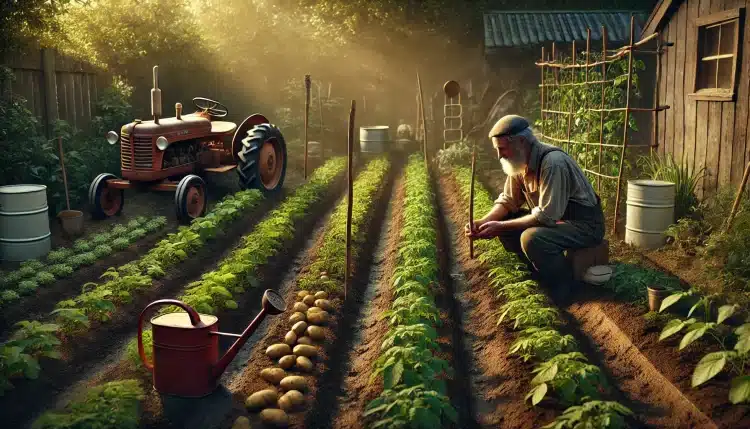
When War Hits the Fuel Tank
Out there, halfway across the world, missiles are flying over oil refineries and tankers. But back here, the impact shows up in a place most folks don’t expect—the diesel pump.
Right now, that ripple has turned into a surge. Diesel prices have climbed to around $5 a gallon, a level we haven’t seen since late 2022. And just like that, the cost of growing food starts climbing right along with it.
At first glance, it feels distant. Abstract. Another geopolitical headline.
But look closer.
Every tractor that tills soil, every irrigation pump that pulls water from the ground, every truck hauling grain down the highway—runs on diesel. When diesel jumps, food doesn’t just get more expensive… it gets harder to produce in the first place.
And just like that, a war thousands of miles away finds its way onto your dinner plate.
How the Strait of Hormuz Reaches Your Garden Gate

Now here’s where things tighten up.
Roughly 20% of the world’s oil supply flows through the Strait of Hormuz. And when that narrow stretch of water gets disrupted, everything downstream feels it.
As attacks hit refineries and tankers, crude prices climb past $100 a barrel. Diesel follows right behind. In just a month, prices jumped over 38%, adding more than a dollar per gallon nationwide.
And here’s the kicker—global markets set the price.
So even if America pumps plenty of oil, farmers here still pay the global rate.
That’s the hidden wire connecting a burning refinery overseas to a farmer filling a tank in the Midwest.
The Quiet Squeeze on Small Farms
Now step onto a small farm.
Picture a tractor idling at dawn. A pump pulling water through dry soil. A grain truck rumbling down a dusty road.
Every one of those machines drinks diesel.
So when prices jump, the math gets ugly—fast.
In places like Texas and Arizona, farmers are already feeling it. A single dollar increase per gallon can mean hundreds of extra dollars per day just to keep crops alive. Trucking costs are climbing by thousands per load.
And here’s the hard truth—most small farms don’t have fat margins to absorb that.
So they cut back.
Less fuel. Less fertilizer. Fewer inputs.
And that leads to something nobody wants to talk about—lower yields.
Fertilizer Gets Caught in the Same Trap
But it doesn’t stop at diesel.
The same chokepoint—the Strait of Hormuz—also carries a huge chunk of the world’s fertilizer supply.
When shipments slow down, prices spike.
Urea, one of the key nitrogen fertilizers, has already jumped sharply as supply tightens.
So now farmers are getting squeezed from both sides:
Higher fuel costs to run their equipment.
Higher fertilizer costs to grow their crops.
And when those two pressures hit at once, something has to give.
Usually, it’s production.
From Field to Fork—The Ripple You Can’t Dodge
Now follow the chain forward.
Food doesn’t magically appear at the store. It travels—sometimes hundreds or thousands of miles.
And every mile burns fuel.
So when diesel spikes, transportation costs climb right along with it. Fresh food gets hit the hardest—fruits, vegetables, dairy—because there’s no time to wait out price swings.
That cost gets passed on.
Shelf by shelf. Aisle by aisle.
You start seeing it in subtle ways first. A few cents here. A dollar there.
Then suddenly, your grocery bill feels heavier—and you can’t quite explain why.
The Backyard Becomes a Supply Chain
Now step back.
Because this is where the small off-grid farm—or even a modest backyard garden—starts to look a whole lot different.
Instead of relying on fuel-heavy systems, you shorten the chain.
Radically.
Food doesn’t travel 1,500 miles. It travels 15 feet.
No diesel. No trucking. No markup at every step.
Just soil. Sunlight. Water. And your own hands.
And that changes everything.
Why Gardening Isn’t a Hobby Anymore
For a long time, backyard gardening was treated like a side project. A weekend activity. Something “nice to have.”
Not anymore.
Now it’s starting to look like insulation against a system that’s getting more fragile by the year.
Across the country, more people are turning to gardens—not out of nostalgia, but out of necessity. Seed demand is climbing. Garden plots are filling up. Folks are quietly relearning skills their grandparents never forgot.
Because deep down, people can feel it:
The system works… until it doesn’t.
Building a Low-Fuel, High-Resilience Garden
So where do you start?
Right where you are.
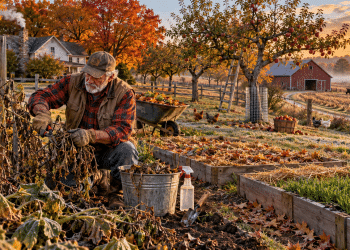
Even a small patch of ground—100 square feet—can produce more food than most people expect if it’s used wisely.
First, pay attention to sunlight. Six solid hours a day is your baseline.
Then, build your soil. Compost, manure, even kitchen scraps—these replace store-bought fertilizers and keep nutrients cycling right on your land.
Next, choose crops that pull their weight. Potatoes, beans, squash—things that feed you, not just garnish a plate. Add in fast growers like kale and lettuce to keep food coming steady.
And just as important, conserve water. Drip lines, mulch, rain barrels—these reduce your dependence on pumps and outside inputs.
Finally, save your seeds. Because every seed you keep is one less thing you have to buy next season.
Closing the Loop at Home
Now here’s where it really clicks.
A small off-grid system starts to form:
Kitchen scraps feed compost.
Compost feeds soil.
Soil feeds plants.
Plants feed your family.
And very little leaves the loop.
That’s how you step off the treadmill—one layer at a time.
Grow Something That Can’t Be Taken From You
At the end of the day, this isn’t just about diesel prices.
It’s about control.
Because when fuel spikes, supply chains stretch. When supply chains stretch, prices rise. And when prices rise, dependence gets exposed.
But a garden?
A garden answers to a different set of rules.
You plant. You tend. You harvest.
Simple. Direct. Real.
And in a world where so much feels uncertain, that might be the most valuable thing you can grow.
So start small.
Turn a patch of ground.
Put a seed in the soil.
And watch what happens next.