Print
The Median Farm Household Isn’t Making Its Living From Farming Anymore… And The New 2026 Numbers Explain Why
So Why Does Dad Have To Work a Second Job?
There’s an old picture of the American farm that still lives somewhere in our heads. Dad climbs into the tractor before sunrise. Mom keeps the books at the kitchen table while the kids carry feed buckets, pull weeds and complain about chores until they’re old enough to understand those chores were teaching them something.
The farm feeds the family. And just as importantly, the farm is supposed to pay the family enough to keep everybody there for another year.
But buried inside the USDA’s newest farm-income numbers is a statistic that ought to stop rural America cold. According to the USDA Economic Research Service’s latest farm-household income forecast, the median income farm households are expected to earn from farming itself in 2026 is:
Negative $467.
Not $46,700. Not $4,670.
Minus $467.
That doesn’t mean every farmer in America is losing money, and we’ll get to that important distinction in a minute. But it tells us something remarkable about what the words “family farm” mean in modern America.
For a huge portion of farm households, the paycheck keeping the lights on isn’t coming from the barn. It’s coming from somewhere else.
The Farm Household Is Doing Fine — Until You Ask Where The Money Came From

At first glance, USDA’s numbers don’t look especially alarming. The agency forecasts median total farm-household income of about $108,460 in 2026, which certainly doesn’t sound like a family standing in a Depression-era breadline.
Then pull the hood open.
USDA forecasts median off-farm income of $93,975. Meanwhile, median income earned from farming itself is forecast at negative $467. The agency cautions that you can’t simply add those median figures together because they’re calculated across households with different income patterns, but the larger message is unmistakable.
As USDA explains in its farm-household income forecast, many farm households primarily rely on off-farm income. In plain English, somebody often leaves the farm to help keep the farm.
Maybe Dad works construction. Maybe Mom is a nurse. Maybe somebody drives a truck, works at the school, welds at the factory or spends eight hours behind a desk before coming home and climbing onto a tractor.
The farm may still produce corn, cattle, soybeans, eggs, hay or vegetables. But another paycheck may be what covers the mortgage, buys groceries and keeps health insurance on the family.
Before We Get Carried Away, There’s An Important Catch
Now, here’s where we need to be careful because that $467 number can easily be misunderstood. USDA uses a broad definition of a farm, and many small operations qualify even though they aren’t full-time commercial businesses.
USDA also notes that many small farms aren’t profitable even during strong farm-income years. So that negative-$467 figure does not mean the typical 2,000-acre grain farmer works all year just to lose $467.
Commercial farms can look very different. USDA’s farm typology distinguishes larger commercial operations and other “farm businesses” from many smaller residential or retirement farms, and those operations account for the overwhelming majority of agricultural production.
For those farm businesses, USDA forecasts average net cash farm income of about $121,700 in 2026, according to its farm business income forecast.
That’s a radically different number, and it’s important to put it on the table.
But it doesn’t make the negative-$467 figure meaningless. Instead, it reveals something fascinating about the structure of modern American agriculture.
American farming increasingly contains two very different worlds.
The Big Number Can Hide The Little Farm
Look at agriculture from 30,000 feet and things don’t appear catastrophic. USDA forecasts overall U.S. net farm income at roughly $158.4 billion in 2026, which is obviously a tremendous amount of money moving through American agriculture.
But that number is forecast to decline. After adjusting for inflation, USDA expects net farm income to fall about 5.5 percent from 2025, a decrease of roughly $9.1 billion, although the agency says sector-wide income would still remain above its inflation-adjusted 20-year average. You can see the broader numbers in USDA’s Farm Sector Income & Finances data.
So this isn’t a story about American agriculture collapsing tomorrow morning. It’s about something slower and considerably harder to see from Washington.
The national farm economy can generate billions of dollars while thousands upon thousands of individual farm households still depend heavily on jobs that have nothing to do with farming. Both things can be true at once.
That’s the part those giant national numbers can hide.
Now Look At What’s Happening To The Expense Side
Anybody who’s ever grown a tomato knows revenue is only half the story. You can sell a truckload of produce and feel pretty good until you start subtracting seed, fertilizer, diesel, repairs, equipment, taxes and everything else it took to grow the stuff.
Farmers live inside that subtraction problem.
And USDA’s latest farm-sector income forecast contains a couple numbers that should make anybody who works dirt sit up straight.
Fertilizer, lime and soil-conditioner expenses are forecast to rise by billions of dollars in 2026, an increase of roughly 15.3 percent. That’s a serious increase for an input farmers can’t simply decide they don’t need anymore.
Then there’s fuel.
USDA forecasts fuel and oil expenses increasing roughly 28.8 percent.
Think about that number from the cab of a tractor instead of an economist’s office. Diesel doesn’t merely take a farmer to town; it plants, sprays, cuts hay, combines, hauls grain and helps feed cattle.
Even after the crop leaves the farm, somebody burns more fuel hauling it to an elevator, processor, warehouse, distribution center and grocery store. When energy gets expensive, agriculture feels it from one end of the food chain to the other.
You Can’t Eat Gross Revenue
This is something city folks sometimes miss when they hear about farm prices. Corn goes up, cattle go up or milk goes up, and somebody naturally assumes the farmer must be getting rich.
But the farmer doesn’t get to put the gross check in his pocket.
There’s fertilizer to buy, diesel in the tank, machinery to repair, seed to order, interest to pay, insurance, veterinary bills, feed, taxes and a list of expenses long enough to stretch from the farmhouse to the back forty. USDA tracks those costs through its farm-sector production expense estimates.
Some expense categories rise while others fall. Feed and pesticide expenses, for example, can move differently from fuel and fertilizer, which is why one headline number rarely tells you whether an individual farmer is having a good year.
The money coming through the front gate isn’t necessarily the money staying on the farm.
The Second Job Became Part Of The Farm Plan
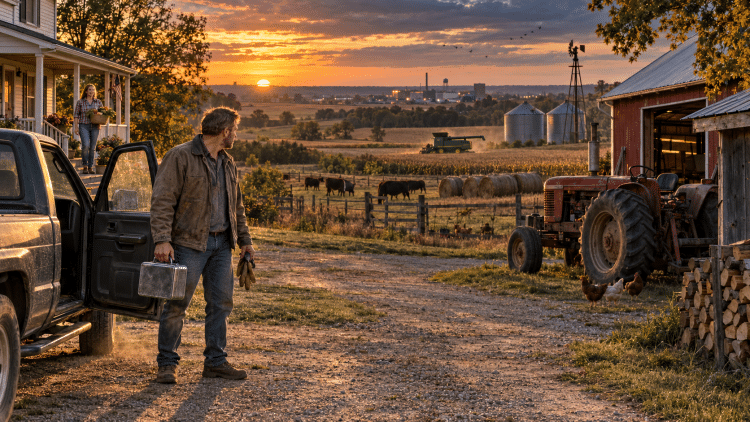
Drive enough country roads around the Midwest and you’ll see how this works. There’s a tractor sitting beside a machine shed at 5:30 in the evening because the guy who owns it just got home from his other job.
He changes clothes, grabs something to eat and climbs into the cab until dark. His wife may have spent her day working somewhere else too, partly because that paycheck provides something the farm doesn’t always provide reliably: predictable cash.
Maybe health insurance comes with it. Maybe retirement benefits do too. Maybe that regular paycheck is simply what carries the household through a bad crop year, a machinery breakdown or a lousy market.
And suddenly the “off-farm job” isn’t really separate from the farm at all.
It’s part of the machinery keeping the farm alive.
That’s a strange place for American agriculture to find itself, but USDA’s own household-income numbers show how important income earned away from the farm has become.
This Isn’t Just A One-Year Fluke
There’s another reason not to shrug off the latest forecast as one strange year. USDA estimates median farm income for farm households was negative $1,830 in 2024, while its newer estimates put it at negative $495 in 2025 and forecast negative $467 for 2026.
Those figures are available through USDA’s farm-household income estimates and forecasts. Again, they include many small and part-time operations, so they should never be confused with the profitability of a typical large commercial farm.
But look at the pattern. For the household in the middle of USDA’s farm-household distribution, farming itself isn’t necessarily generating the family’s livelihood.
Increasingly, that livelihood is being stitched together somewhere else.
What Happens When The Next Generation Looks At The Math?
Here’s the question that bothers me more than any percentage in the USDA report. What does the farmer’s son or daughter see after watching this arrangement for 20 years?
They see Dad leave before sunrise for a job in town and come home tired before climbing into the tractor. They watch Mom work all day and then handle farm paperwork at the kitchen table after supper.
They see equipment that can cost more than a house, unpredictable weather, volatile input prices and commodity markets nobody on the farm controls. Then somebody eventually asks the question every farm family knows is coming:
“You gonna take over the farm someday?”
Maybe they will. Hopefully they will.
But eventually sentiment has to meet arithmetic.
A farm can be a heritage, a calling and a beautiful place to raise children. It can carry a family name across generations and hold memories that couldn’t be replaced for any amount of money.
Sooner or later, though, it also has to pay bills.
Losing Farms Means Losing More Than Food
And this is where the issue reaches beyond the farm gate. A small family operation isn’t merely a food-production unit sitting on a tax map.
It’s a family living on the land. It’s somebody watching the creek after a hard rain, repairing a barn instead of letting it collapse, maintaining fence rows and knowing which low field floods first when three inches of rain falls overnight.
It’s also knowledge that rarely comes from a textbook. It’s a neighbor who knows how to pull a calf, weld a broken bracket, sharpen a chain, preserve tomatoes, repair a water line and coax a diesel engine back to life when it’s 12 degrees outside.
When that disappears, America doesn’t merely lose agricultural acreage.
We lose people who know how to do things.
That’s harder to measure than net farm income. But if you’ve ever lived somewhere where neighbors still know how to fix things, grow things and help each other when something breaks, you know exactly what it’s worth.
The Farm Isn’t Dead
None of this means the American family farm is finished. Far from it.
USDA’s own farm-business income data show that many commercial farm businesses remain profitable, while American agriculture as a whole remains one of the most productive food systems ever created.
But perhaps we’ve been asking the wrong question.
Instead of asking whether American agriculture is producing enough money, maybe we should ask how much of that money reaches the families actually living on the land. And how many of those families could remain there if nobody drove through the gate every morning to earn a paycheck somewhere else?
Those are different questions.
The newest USDA numbers don’t answer all of them. But they give us one heck of a clue.
Median farm income earned by farm households in 2026:
Negative $467.
Meanwhile, USDA forecasts median off-farm income at nearly $94,000.
So maybe the most important crop keeping thousands of American farms alive isn’t corn, soybeans, wheat or cattle anymore.
Maybe it’s the paycheck somebody brings home from town.