 Print
Print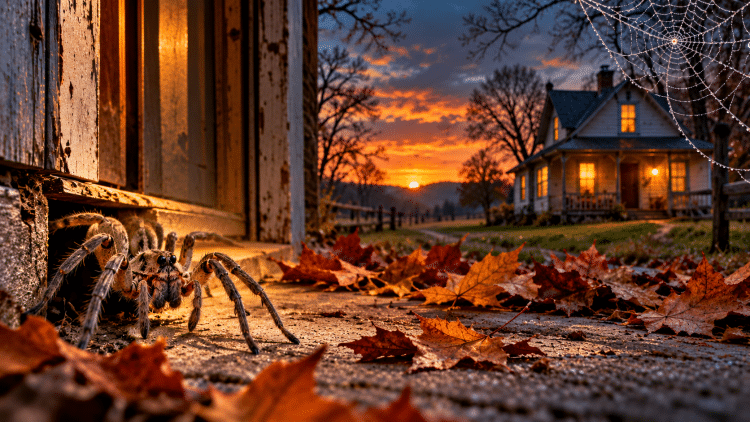
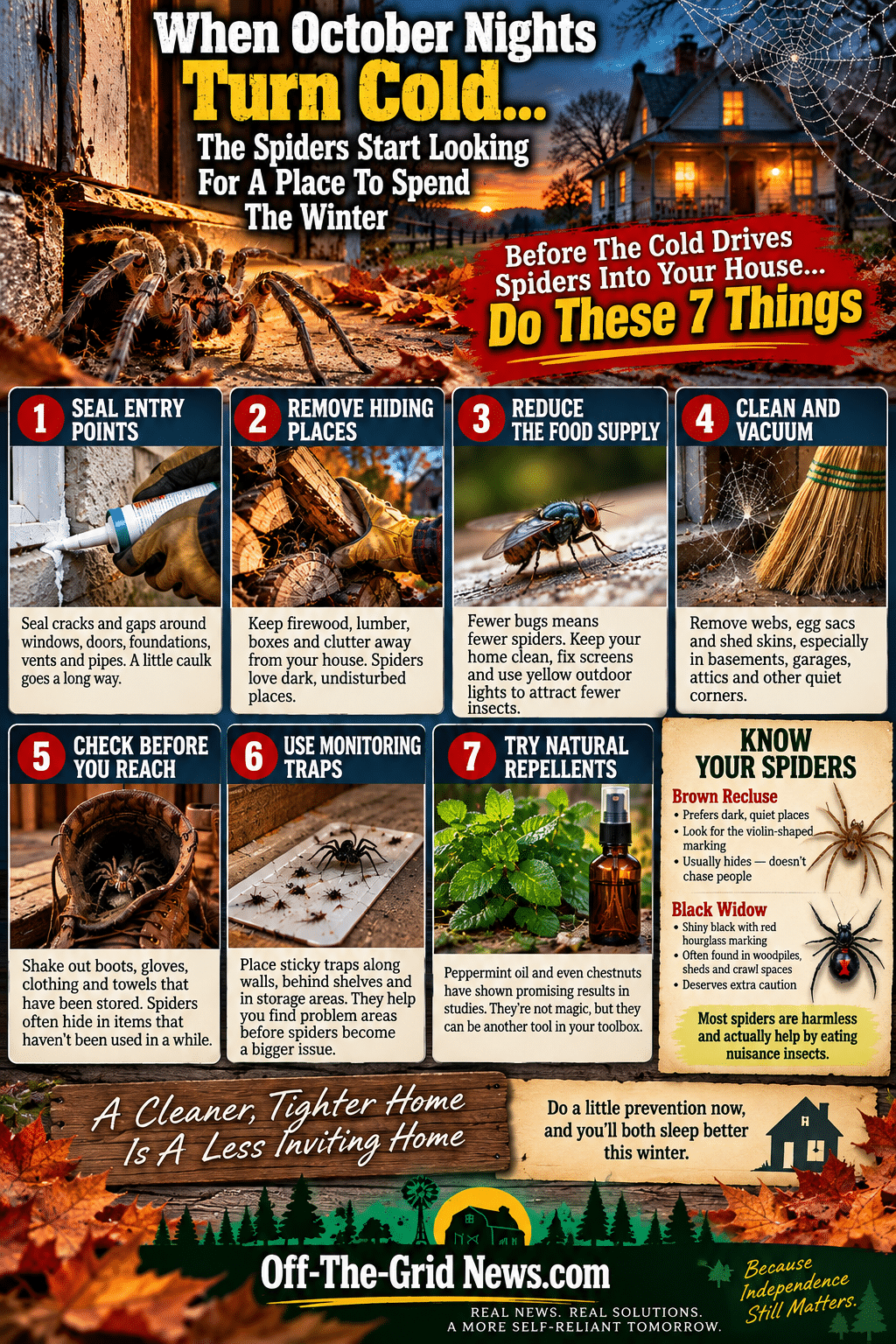
Before The Cold Drives Spiders Into Your House… Do These 7 Things
Forget The Bug Bomb… Grandpa Had A Better Way To Keep Spiders Out
There’s a certain point every fall when the house starts changing. The windows stay closed. The woodstove gets its first fire, boots begin piling up by the back door, and somebody finally admits it’s time to bring the long underwear upstairs.
Outside, things are changing too. The nights get colder, insects disappear into cracks and sheltered places, and spiders either settle into protected outdoor spots or sometimes wander into houses, garages, barns and sheds.
Now, spiders aren’t marching toward your house because they’ve checked the weather forecast and decided your basement looks cozy. In fact, many spiders spend the winter outdoors, and University of Minnesota Extension notes that many outdoor spiders entering houses in fall are simply accidental invaders.
Still, an old farmhouse provides plenty of things a wandering spider likes. There are cracks, dark corners, stacked firewood, old boxes, crawl spaces and places that haven’t been disturbed since Reagan was president.
And, most importantly, there may be food.
If You Have Spiders… You Probably Have Something They’re Eating
Spiders don’t move into your basement because they admire your canned tomatoes. They’re predators, which means flies, moths, beetles, ants and other little crawling things can turn an otherwise uninteresting basement into a pretty good hunting ground.
So a noticeable spider population may be telling you something else about your house.
You’ve got bugs.
That’s why one of the oldest methods of controlling spiders remains one of the best: make the house less inviting to everything they’re hunting. The National Pesticide Information Center recommends eliminating insect food sources, vacuuming webs and egg cases, reducing clutter and sealing openings.
In other words, Grandpa’s broom wasn’t such primitive technology after all. But before you start sweeping, it helps to know what you’re looking for.
Because you don’t necessarily have to see a spider to know one has moved in.
The Clues They Leave Behind
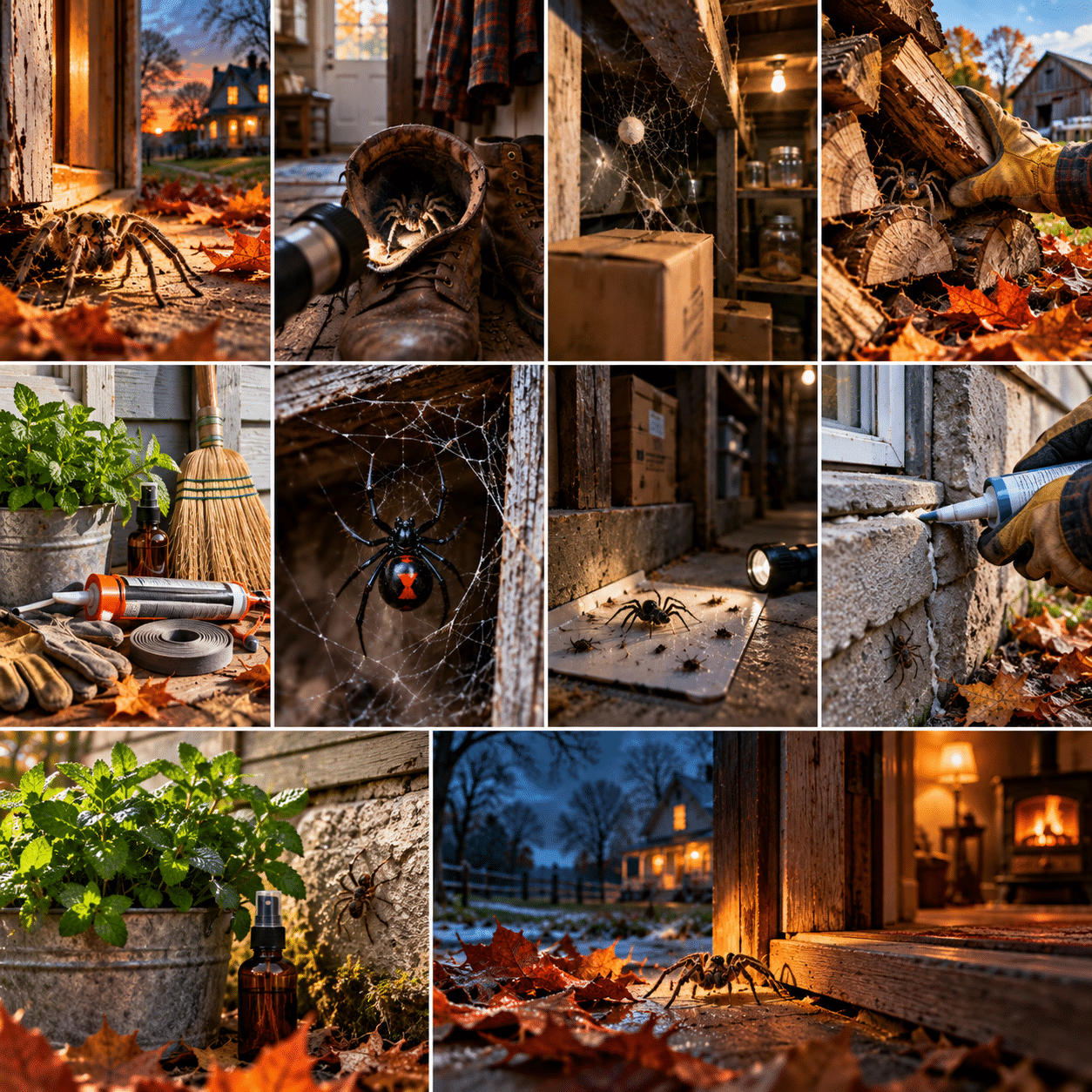
Start with the obvious one: webs. But don’t assume every spider makes the beautiful wagon-wheel web we picture hanging between two fence posts on a foggy October morning.
Some spiders hunt instead of building prey-catching webs, while others construct messy, irregular webs in protected corners. That means the flashlight inspection matters more than simply looking for a giant web hanging from the ceiling.
Look behind the freezer and underneath basement stairs. Check around floor joists, behind shelves, inside the corners of the woodshed, around window wells, behind stored lumber and underneath rolled insulation.
And pay particular attention to boxes, clothing and equipment that haven’t been disturbed in months. Those quiet places are exactly the sort of places secretive spiders can use.
Then look for something besides webs.
Egg sacs.
Spider silk isn’t used only for catching supper. It’s also used for shelters and egg cases, and removing those egg sacs during routine cleaning can interrupt the next generation before it gets started. University of Minnesota Extension specifically recommends vacuuming or sweeping away webs and destroying egg sacs.
Another clue is discarded prey. If you find a dusty web surrounded by little dried insect carcasses, something has been eating well there, whether you happen to catch the spider at home or not.
And there’s another sign most homeowners wouldn’t think to look for.
Shed skins.
Spiders molt as they grow, leaving their old exoskeletons behind. In a place where brown recluse spiders are a legitimate possibility, finding those remains in quiet storage areas, along walls or around hiding places can become another clue that deserves investigation.
That’s detective work an old homesteader would appreciate.
You’re not just looking for the critter. You’re looking for what the critter left behind.
Two Spiders Deserve A Little More Respect
Most spiders around an Illinois homestead aren’t dangerous. In fact, they’re useful predators, and Illinois Extension points out that spiders eat other nuisance arthropods such as ants and flies.
But Illinois Extension identifies two spiders deserving particular caution: the brown recluse and black widow. Neither one particularly wants a confrontation with you, which is actually part of what makes them easy to overlook.
They hide.
And the places they hide are often the same places where we blindly stick our hands.
The Brown Recluse Likes To Be Left Alone
The name tells you something.
It is reclusive.
Brown recluses prefer sheltered, dark and relatively undisturbed places. Oklahoma State University Extension lists closets, basements, attics, furniture, storage boxes, old clothing, shoes, stacks of paper and spaces behind baseboards among their possible indoor hiding places.
That’s why a cardboard box that has sat untouched for two years deserves more caution than the middle of your kitchen floor. The spider wants the place where nobody goes.
Brown recluse identification also deserves caution. The famous dark “violin” marking can help, but it shouldn’t be the only thing used to identify one; genuine brown recluses have six eyes arranged in three pairs, rather than the eight eyes typical of many spiders.
More importantly, brown recluses generally aren’t chasing people around bedrooms. Bites tend to happen when a hidden spider becomes trapped against someone’s skin.
Which suggests a wonderfully sophisticated piece of old-fashioned technology:
Shake things out.
If boots have been sitting in the mudroom for three weeks, turn them upside down. If you’re pulling a hunting coat from a basement closet, shake it, and if you’re reaching into old boxes or stored lumber, put gloves on first.
Virginia Tech’s 2026 guidance specifically recommends shaking out clothing, shoes, towels and bedding before use. It also notes that sealing entry points and removing hiding places provides a better long-term strategy than simply relying on insecticides.
That’s not paranoia.
That’s country common sense.
Then There’s The Black Widow
The mature female is the one everybody remembers: shiny black with the famous reddish hourglass marking on the underside of the abdomen. Younger widows can look different, however, so the textbook black-and-red appearance shouldn’t be treated as the only possible appearance.
Black widows favor protected locations such as woodpiles, boxes, stones, sheds, crawl spaces and other quiet areas. Mississippi State University Extension notes that cold and drought can drive black widows into buildings.
Again, think undisturbed.
The stack of firewood nobody touched all summer. The overturned flowerpots behind the shed. The scrap lumber beside the barn and the old cardboard boxes in the basement.
That’s why fall cleanup is about more than making the place look tidy.
You’re removing habitat.
Grandma’s Spider Repellent — And What Science Says About It
This is where things get interesting for an off-grid household. Country people have been putting strong-smelling plants, nuts, herbs and homemade concoctions around homes and outbuildings for generations.
Some work better in stories than they do against spiders.
Take hedge apples, those big green Osage oranges that litter the ground across much of farm country. You’ll still hear people swear that putting them around the basement will drive spiders away, but University of Minnesota Extension says hedge apples aren’t effective spider controls.
But another old-fashioned remedy has something more interesting behind it.
Mint.
Researchers actually tested peppermint oil, lemon oil and chestnuts against three spider species. In the study published in the Journal of Economic Entomology, peppermint oil and chestnuts produced significant avoidance in two of the three species tested, while lemon oil didn’t repel any of them.
That’s a fascinating result because it lands somewhere between Grandma’s cupboard and the laboratory. Some traditional remedies may contain a kernel of truth, while others get repeated for generations simply because everybody remembers Grandma doing it.
Still, don’t turn that study into more than it says. It tested particular spiders under controlled conditions; it did not prove that spraying peppermint oil around your farmhouse creates an invisible eight-legged force field.
So use those old remedies as another tool, not the whole toolbox.
The Best Spider Repellent May Be A Caulking Gun
Here’s the less romantic answer.
If you’re serious about keeping spiders out, stop them before they get inside.
Walk the perimeter of the house on a sunny October afternoon and look closely. Seal that little crack beside the basement window, replace the worn sweep beneath the back door, repair the torn screen and close the opening where a pipe disappears through the foundation.
Then look at what’s piled against the house. Firewood, lumber, bricks, buckets, weeds and heavy vegetation can create shelter for insects and spiders right beside the building.
And consider your outdoor lights. Light attracts insects, insects provide spider food, and suddenly that bright bulb beside the back door becomes part of the problem.
Sometimes we’re essentially hanging a glowing FREE BUFFET sign above the door every night.
That’s pest control without turning your home into a chemical factory.
Set A Few Traps — Not Just To Kill Them
Here’s one of the smartest tricks if you suspect spiders but haven’t actually seen any.
Put down inexpensive flat sticky traps.
Don’t scatter them randomly. Put them flush against walls, behind furniture, underneath shelving and appliances, beside storage boxes and along the edges of quiet basement rooms.
Then check them regularly.
Suddenly you’ve got little unmanned sentries telling you what’s walking around the basement after you turn off the lights.
This is especially useful when brown recluse is a legitimate concern. The Illinois Department of Public Health calls sticky monitors an invaluable tool, because they don’t merely catch spiders — they can reveal the hotspots where spiders are moving.
And that’s the real advantage.
You don’t have to see the spider to discover where it’s living.
The Old House Is Always Talking
That’s really the lesson.
A homestead gives you clues. Mouse droppings tell you where mice are traveling, sawdust beneath a timber tells you something may be chewing, and tracks in fresh snow tell you what crossed the yard last night.
Spiders leave clues too. There’s the strange web behind the freezer, an egg sac beneath a shelf, a shed skin near a hiding place, dead insects collecting beneath a corner or something showing up repeatedly on a sticky trap.
Pay attention and the house begins telling you where to look.
You don’t necessarily need to turn your home into a chemical fortress, either. Start with the broom, move the clutter, shake out the boots, vacuum the egg sacs, clean the basement, move the firewood, seal the cracks and reduce the insects spiders came there to eat in the first place.
Then, if you like the old remedies, experiment sensibly with things such as mint while understanding their limitations. There’s a satisfying place where old country knowledge and modern science occasionally shake hands.
Because when that first hard frost rolls across the fields and you throw another log into the stove, you’re not the only creature looking for a protected place to ride out the weather.
The trick is making sure the little eight-legged ones decide they’d rather spend winter somewhere else.