Print
The Chilling Grid Attack That Exposed Just How Fragile Modern Life Has Become
The Warning Every Homesteader Should Hear
For four days, a small British power generator sat silent.
The lights across Britain didn’t go out. Families weren’t left fumbling for candles, and hospitals didn’t switch to emergency generators. But according to British news reports, suspected Iran-linked hackers reached across borders, slipped through a digital doorway, and forced an energy facility offline.
The British government wouldn’t identify the plant, citing security concerns. Officials described it as a “small-scale energy generator” and said the attack posed no danger to the wider power system.
That may be true.
Still, a rattlesnake doesn’t have to bite you before you understand the warning.
The incident reportedly happened in July and became public in August. Afterward, British officials met with energy-company executives and circulated security guidance. The government, regulators, power companies, and Britain’s National Cyber Security Centre began reviewing the threat.
In other words, nobody in the room treated it like a harmless prank.
The facility may have been small, but the message was big: a determined enemy can reach through a computer screen and touch physical machinery hundreds or thousands of miles away.
For anyone who still believes attacks on the grid are somebody else’s problem, this ought to be a wake-up call.
Then the Hackers Went Looking for Water

Losing electricity for four days would be bad enough. Refrigerators would warm. Well pumps would stop. Freezers packed with beef, venison, vegetables, and last summer’s berries would begin counting down the hours.
But imagine losing clean water.
In June, an Iran-linked group calling itself Handala claimed it had broken into systems belonging to California Water Service, a utility serving roughly two million people. The hackers released about five gigabytes of allegedly stolen information, including customer data and administrative credentials.
However, this part matters: independent investigators had not confirmed that Handala reached the industrial controls capable of opening valves or shutting down drinking-water service. Evidence suggested the attackers reached business systems and an internet-connected positioning platform—not necessarily the equipment controlling the flow of water.
Even so, Handala claimed it possessed the ability to disrupt service but had chosen not to use it.
That boast may have been true. It may also have been cyberwar propaganda designed to frighten the public and exaggerate the group’s reach.
Either way, the intrusion was real enough to deserve attention.
American cybersecurity officials have separately warned that Iranian-affiliated actors are targeting internet-exposed industrial control equipment. The FBI has observed attempts to compromise programmable logic controllers—the small computerized brains that help run pumps, machinery, manufacturing equipment, and utility systems.
That is the kind of warning every homesteader should take seriously.
You don’t need to panic. But before sundown, it wouldn’t hurt to look at your stored water, test your filters, and ask how many days your household could function if the well pump stopped humming.
A Powder Keg Connected by Wires
Now, none of this is happening in a vacuum.
Military conflict, sanctions, covert operations, and threats against commercial shipping have raised the temperature between Iran and Western governments. In that kind of struggle, missiles aren’t the only weapons. A keyboard, a stolen password, and an unsecured controller can sometimes reach farther than a bomber.
Meanwhile, Handala has claimed other high-profile breaches, including the theft of sensitive files allegedly taken from the phone of former Israeli military chief Herzi Halevi. As with many claims made by politically motivated hacking groups, the full extent of the breach has been difficult for outsiders to verify.
But the broader danger is no longer in doubt.
Power plants, water systems, pipelines, hospitals, factories, and communications networks are increasingly tied together by software. That makes them efficient when everything works. It can also make them brittle when somebody finds the right digital weak spot.
A homesteader understands that kind of weakness.
Run the entire farm from one tractor, and one broken transmission can stop the planting. Depend on one well pump with no hand-pump backup, and one burned-out motor can turn a kitchen faucet into a piece of decoration.
Centralization may be convenient.
But convenience and resilience are not the same thing.
Two Fragile Systems—and One Hard Lesson
Here is where the story gets personal.
If somebody else controls your electricity, your water, your food supply, and your communications, how much control do you really have when trouble comes? And what about the most personal system of all—your health care?
Modern medicine can do remarkable things. A skilled surgeon can remove a dangerous tumor. Radiation can target cancer cells with astonishing precision. Chemotherapy, immunotherapy, and newer targeted drugs may have saved or extended countless lives.
But the medical system is also crowded, expensive, fragmented, and often difficult to navigate. Doctors are rushed. Rural hospitals are closing. Specialists may be hours away, and insurance companies can stand between a patient and the treatment his doctor recommends.
That doesn’t mean medicine is the enemy.
It means you cannot afford to surrender all responsibility for your health to an institution any more than you can surrender your family’s entire water supply to a distant utility.
You need knowledge. You need questions. You need trustworthy help—and enough sense to separate promising evidence from an attractive story.
The Doctor Who Outlived a Grim Prediction
David Servan-Schreiber was a French physician, psychiatrist, and neuroscientist who discovered a malignant brain tumor in 1992 when he was only 31 years old.
The discovery changed the direction of his life.
Servan-Schreiber underwent conventional treatment, including surgery, chemotherapy, and radiation. That fact sometimes disappears when his story is retold. He did not simply refuse medical care and defeat cancer through diet and meditation.
Instead, he began investigating what patients could do alongside medical treatment. He focused on food, movement, sleep, stress, emotional health, and strong relationships. Later, his book Anticancer encouraged patients to become active participants in their own care rather than passengers being carried from one appointment to another.
Servan-Schreiber lived for about nineteen years after his original diagnosis before dying from brain cancer in 2011. His survival was extraordinary, but one person’s experience cannot prove that a particular diet or lifestyle caused it.
Still, his larger lesson was sound.
A patient is more than a tumor.
The body around that tumor matters. Nutrition matters. Strength matters. Sleep matters. Emotional support matters. And even when those things cannot cure a disease, they can help a person endure treatment, preserve function, and live more fully in the time he has.
That isn’t magic.
That is stewardship.
Promising Treatments Still Being Put to the Test
Around the edges of conventional cancer care, researchers continue examining approaches such as intravenous vitamin C, metabolic therapies, ketogenic diets, and low-dose naltrexone.
Some of that work is genuinely interesting. But interesting is not the same as proven.
High-dose intravenous vitamin C, for example, produces blood concentrations that cannot be reached by swallowing vitamin C tablets. Laboratory research suggests those concentrations may damage certain cancer cells, and some small human studies have reported improved quality of life or fewer treatment-related side effects.
However, the National Cancer Institute says the clinical evidence remains limited. Results have been mixed, many studies have been small, and the FDA has not approved intravenous vitamin C as a cancer treatment.
It also isn’t risk-free. High-dose IV vitamin C can be dangerous for people with kidney disease, a tendency to form kidney stones, iron-overload disorders, or G6PD deficiency. It can also interact with certain cancer treatments.
So this is not something to try in the barn with a bag of vitamin powder and an IV line.
It belongs under the supervision of a qualified medical professional who understands both oncology and the patient’s complete medical history.
What We Know—and What We Don’t
Low-dose naltrexone is another inexpensive treatment that has attracted attention. At ordinary doses, naltrexone is approved for alcohol and opioid-use disorders. At much smaller doses, some clinicians prescribe it off-label in an effort to influence immune activity and endorphin signaling.
Researchers have proposed several ways it might affect cancer biology. But today, strong clinical evidence showing that low-dose naltrexone can cure cancer or reliably extend survival is still lacking.
The same caution belongs around dramatic pancreatic-cancer stories.
A patient who survives six years after a grim diagnosis deserves attention. Yet a single case cannot tell us whether a supplement, medication, tumor subtype, incorrect initial prognosis, conventional treatment, or some combination of factors produced the result.
And the claim that most pancreatic-cancer patients receiving chemotherapy die sooner than they would without it is not supported by reliable clinical evidence. Depending on the cancer’s stage and the patient’s condition, chemotherapy can extend survival, ease symptoms, or make surgery possible.
Cancer treatment can be brutal.
But that does not make every alternative effective—or every conventional treatment useless.
Can You Starve a Tumor?
The ketogenic approach has also produced considerable interest, partly through the work of Boston College professor Thomas Seyfried and other researchers studying cancer metabolism.
Many tumors consume large quantities of glucose. That observation has led researchers to ask whether lowering blood glucose and changing the body’s fuel supply might make certain cancers more vulnerable.
It is an intriguing question, but human biology is rarely as simple as closing one fuel valve.
Tumors can be metabolically flexible. Some cancer cells use glucose, while others can draw energy from amino acids, fats, or neighboring tissue. Different areas inside the same tumor may behave differently. A severe diet can also cause unwanted weight and muscle loss in a patient who is already struggling to remain strong.
For now, there is no good evidence that a ketogenic diet by itself cures cancer. It may eventually prove useful as a carefully supervised addition to treatment for certain patients or tumor types, but it should not be presented as a replacement for oncology care.
A cancer patient considering a major dietary change should speak with an oncologist and an oncology-trained dietitian.
The goal is to weaken the cancer—not the person fighting it.
Tend the Ground Without Worshiping the Soil
Every gardener knows the ground matters.
You can plant the finest heirloom seed in hard, exhausted clay and watch it struggle. Loosen that same soil, restore its minerals, add organic matter, manage the water, and give the roots room to breathe, and the plant has a better chance.
The human body is not literally a garden, and cancer is far more complicated than a tomato blight. Still, the old homestead lesson carries some truth.
Take care of the ground.
Eat nourishing food. Stay active as your condition allows. Protect your sleep. Stop smoking. Limit alcohol. Maintain muscle. Keep good people close. Ask about side effects before they become unbearable, and seek a second opinion when the road ahead is unclear.
Those steps cannot guarantee a cure. Anyone promising otherwise is selling certainty that medicine does not possess.
But they can help you enter the fight stronger.
Build Your Backup Before the Storm Arrives
The lesson connecting power, water, and medicine is not that every institution is evil. It is that every system can fail—and wise families prepare before failure arrives.
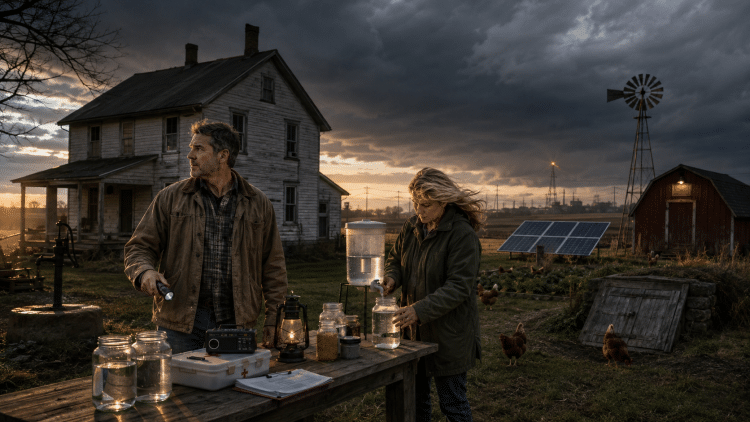
Store enough safe water to carry your household through an interruption. Keep more than one way to purify it. Know whether your well pump can operate from backup power, and test that backup while the sun is shining.
Protect the food in your freezer. Keep flashlights where you can find them in the dark. Maintain printed copies of prescriptions, diagnoses, allergies, medications, insurance information, and emergency contacts.
And when it comes to health, learn enough to ask intelligent questions. Know what a proposed treatment can realistically accomplish, what risks it carries, what alternatives exist, and what clinical evidence supports it.
If you want to explore an unconventional therapy, bring the research to a doctor willing to discuss it honestly. If your doctor refuses every question, find one who will listen. But don’t trade a rigid conventional system for an equally rigid alternative one filled with miracle claims.
Think for yourself—but demand evidence from everybody.
Resilience Is More Than Solar Panels
The grid is vulnerable. Water systems can be breached. Hospitals can become overwhelmed, and even good medical institutions sometimes move too slowly for the person sitting frightened in an examination room.
Yet you are not helpless.
You can store water. You can generate backup power. You can grow food, strengthen your body, organize your medical records, and build relationships with professionals before a crisis arrives.
Most of all, you can refuse passivity.
That is what off-grid living has always meant. It isn’t merely escaping an electric bill or putting solar panels beside the barn. It is building a life that does not immediately collapse when somebody else’s system stumbles.
The next failure may begin with a hacker tapping on a keyboard half a world away. It may begin with a silent well pump, a warm freezer, or a doctor setting a folder on the desk and speaking words you never expected to hear.
Whatever form it takes, the principle remains the same:
Prepare the ground. Build the backup. Ask hard questions.
And never wait until the lights go out to discover what your family truly depends on.