Print

Why Hospitals Are Bringing Back A Metal That Modern Kitchens Nearly Abandoned… And What Every Homesteader Should Know About Copper In Their Pots, Water Pipes, And Bodies
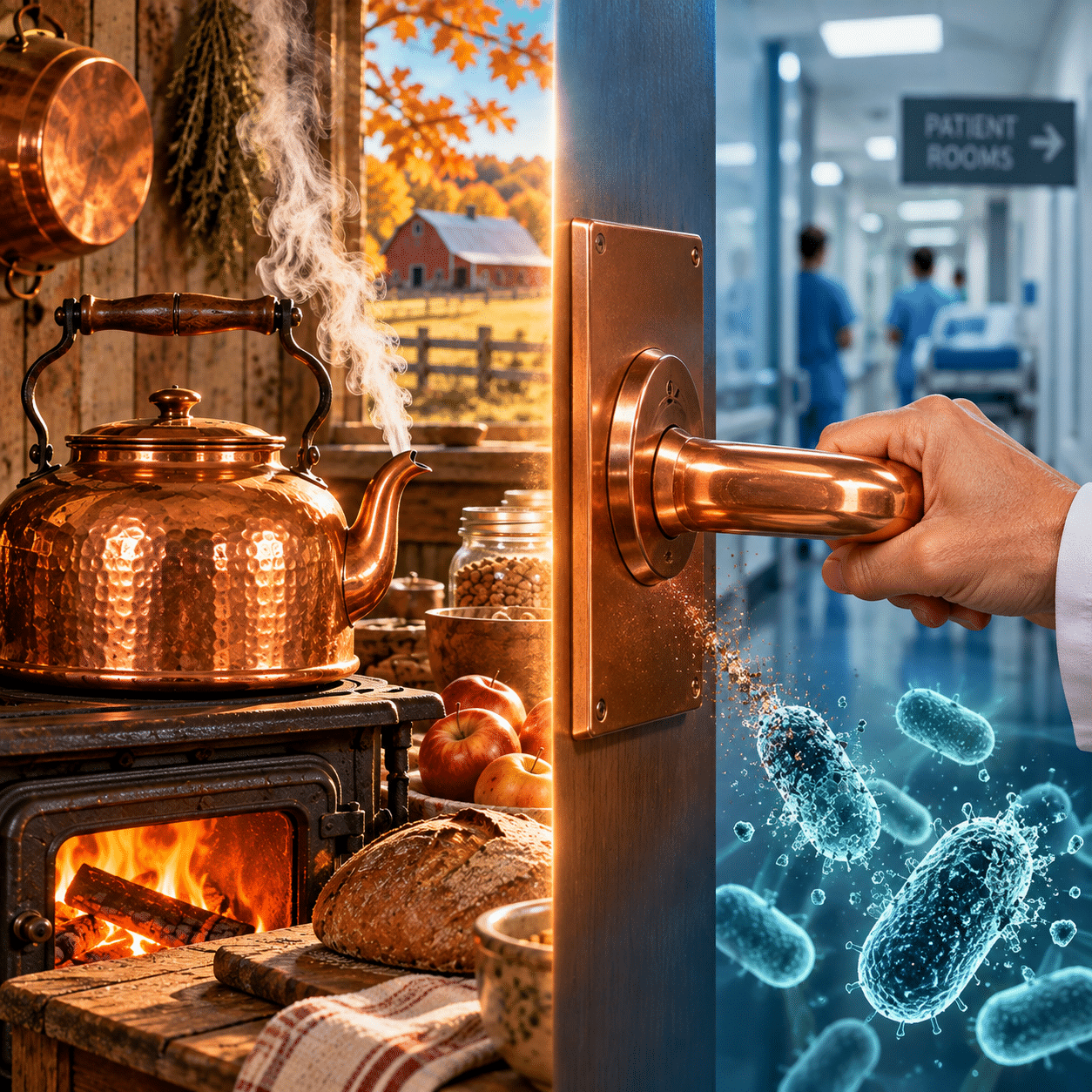
You know, there was a time when a big copper kettle hanging over the kitchen stove was a sign of a well-run farmhouse. Grandma might’ve used one to make apple butter, heat water, or cook up something wonderful. The copper glowed in the firelight while the kitchen filled with the smell of cinnamon, woodsmoke, and fresh bread.
And that old kettle could spread heat like nobody’s business. But somewhere along the way, those beautiful copper pots started disappearing. Stainless steel moved in, aluminum followed, and copper became something folks hung on the wall for decoration.
Now here’s the interesting part.
While copper was disappearing from American kitchens, hospitals were discovering that this old-fashioned metal had a remarkable ability to kill bacteria. In fact, some hospitals deliberately install copper door handles, bed rails, and other surfaces because of what happens when germs land on them.
So why would one place avoid copper while another welcomes it? The answer takes us from Grandma’s kitchen to the farmhouse water pipes… and finally into the remarkable machinery God designed inside every living cell.
The Secret Grandma’s Copper Pot Was Hiding
First, let’s talk about why copper was so popular in the first place. Copper is one of the best metals around for spreading heat, conducting it more than twenty times better than stainless steel and nearly twice as well as aluminum.
That matters when you’re standing over a hot stove stirring a pot of thick apple butter. A cheap pan can develop hot spots, scorching the apples in one corner while another section barely simmers. But copper spreads that heat quickly and evenly, which is why professional cooks prized it for generations.
However, copper has a troublesome habit. When certain foods touch bare copper, tiny amounts of the metal can dissolve into whatever you’re cooking. And the more acidic the food, the greater the concern.
Think tomato sauce bubbling on the stove, vinegar pickles waiting to be canned, or a kettle full of tart apple cider. Those foods can encourage copper to move from the pot into the food, turning an old-fashioned kitchen treasure into a potential food-safety problem.
Why The Government Drew A Line At Sour Foods
Today, the FDA’s Food Code restricts copper and copper alloys, including brass, from directly contacting foods with a pH below six in most commercial food-service situations. That’s a measure of acidity, and it includes plenty of familiar kitchen ingredients.
Vinegar is usually around pH three, while lemon juice is even more acidic. Wine and many fruit juices fall well below the limit, and even black coffee generally lands around pH five. So the restriction covers considerably more than the vinegar crock sitting beside Grandma’s stove.
Now, the Food Code is a model adopted by state and local governments for commercial food establishments. It doesn’t automatically regulate what you cook in your own farmhouse kitchen. But the chemistry doesn’t change when you walk through your back door.
Fortunately, there’s a simple solution. Traditional copper cookware was commonly lined with tin, while modern versions often use stainless steel. That protective layer keeps food from touching the copper while allowing the metal underneath to spread heat.
And that’s why a properly lined copper pan can still be a wonderful cooking tool.
But there’s a catch.
The Old Craftsman’s Job Nobody Talks About Anymore
Years ago, copper cookware sometimes went back to a craftsman for a job called retinning. He’d heat the pot, melt fresh tin across the inside, and carefully wipe it into a smooth protective coating. It was skilled work, and when the old lining wore through, it was necessary work.
You see, tin is relatively soft, and years of scrubbing and cooking utensils can damage it. It also melts at a much lower temperature than copper, so leaving an empty tin-lined pan over a roaring flame can ruin the lining.
Eventually, families got tired of the expense and upkeep. Stainless steel was cheaper, easier to clean, and didn’t need polishing every few weeks. So copper cookware slowly disappeared from everyday kitchens, although some modern stainless pans still hide copper inside their bases to spread heat.
But while Grandma’s copper kettle was gathering dust, another copper problem was hiding behind the farmhouse walls.
What’s Happening Inside Your Water Pipes?
If your home has copper plumbing, there’s something worth understanding. Copper can slowly dissolve into drinking water under certain conditions, and several things influence how much ends up in your glass.
First comes time. Water sitting motionless in copper pipes overnight has more opportunity to pick up copper than water flowing through them. That’s why the first glass drawn in the morning can sometimes contain higher levels.
Next comes acidity. Naturally acidic water can be more corrosive to copper plumbing, while warm water can encourage additional copper release. Even newer pipes sometimes release more copper before protective mineral layers develop inside them.
You might’ve seen a warning sign already. Blue-green stains around a faucet or sink can indicate copper corrosion, although elevated copper can also be present without visible stains or a noticeable metallic taste.
For households with private wells, especially, proper water testing matters. The National Institute of Diabetes and Digestive and Kidney Diseases advises people concerned about copper exposure to have their water checked and flush water that’s been sitting in copper pipes.
Use cold water for drinking and cooking, and follow local health guidance about flushing and testing. If testing reveals unsafe copper levels, you’ll need an appropriate treatment system or another safe water source.
And here’s something many people don’t realize.
Boiling water doesn’t remove dissolved copper.
In fact, as water evaporates, copper remains behind and may become more concentrated. The CDC’s guidance on treating well water makes an important distinction between killing germs with heat and removing chemical contamination.
That’s worth remembering when you’re filling the teakettle on a cold October morning. Yet copper’s ability to react with its surroundings isn’t always a bad thing, because sometimes it’s exactly what makes the metal valuable.
Why Hospitals Are Putting Copper Back To Work
Imagine a hospital hallway where nurses hurry between rooms, visitors push doors open, and patients grab bed rails. Every hand leaves behind microscopic passengers, and while some are harmless, others can cause serious infections.
Now imagine those germs landing on a bare copper door handle. Copper has an unusual ability to damage many bacteria that touch its surface, interfering with their protective membranes, proteins, and other essential cellular machinery.
Researchers call this antimicrobial activity, and it isn’t merely an interesting laboratory curiosity. In 2008, the Environmental Protection Agency began registering certain copper alloys for antimicrobial public-health claims, recognizing a property that could help reduce bacterial contamination on frequently touched surfaces.
Under specified testing conditions, these surfaces can kill more than 99.9 percent of certain bacteria within two hours. That includes some dangerous bacteria associated with healthcare infections, including antibiotic-resistant MRSA.
The EPA’s antimicrobial copper research and registration information also describes how certain registered copper alloys can act against viruses under laboratory conditions. However, copper isn’t magic, and its performance depends on the particular alloy, organism, and conditions.
It doesn’t replace handwashing, disinfecting, or ordinary sanitation. Still, the principle is fascinating, because the same chemical behavior that makes bare copper troublesome around acidic foods helps make it useful against germs.
And there’s another twist.
Why A Shiny Coating Can Defeat Copper’s Best Trick
Suppose you install a beautiful brass handle on your pantry door. You polish it until it shines like a new penny, then spray it with clear lacquer so it stays bright.
It looks wonderful, but that protective coating separates germs from the metal underneath. And direct contact is essential to copper’s antimicrobial action, which means heavy dirt, grease, or protective finishes can interfere with the surface.
That’s why EPA-registered antimicrobial copper surfaces are intended to remain uncoated and properly maintained. It’s almost the exact opposite of what you want in the kitchen, where a protective barrier keeps acidic food safely separated from copper.
Same metal. Different purpose.
But here’s where this story gets even more remarkable. Your own body uses copper every single day, and without it, some of your most important biological machinery wouldn’t work properly.
There’s Copper Inside You Right Now
Believe it or not, copper is an essential nutrient. Your body needs small amounts to support important enzymes, maintain connective tissue, help process iron, and protect cells from certain kinds of damage.
One important enzyme is called superoxide dismutase. Its job is to help neutralize harmful molecules produced during normal cellular activity, and copper plays a central role in that process.
Here’s the remarkable part. Copper can switch between two chemical states by accepting and donating electrons, and inside the right enzyme, that ability becomes enormously useful. But uncontrolled copper can also damage cells, so your body handles it carefully.
Specialized proteins transport copper, deliver it where it’s needed, and help keep it from wandering freely through cells. Your liver also helps regulate copper and remove excess amounts through bile, maintaining a careful balance between too little and too much.
In a rare inherited condition called Wilson’s disease, that removal system doesn’t work properly, allowing dangerous copper accumulation. That’s why people with copper-related medical conditions need individualized medical guidance rather than experimenting with copper supplements or copper-rich water.
For the rest of us, the goal isn’t to avoid copper altogether. It’s to get an appropriate amount from ordinary food, and Grandma’s pantry offers plenty of options.
The Copper-Rich Foods Already Sitting In Your Pantry
You don’t need an expensive supplement bottle to find dietary copper. Think about the ordinary foods homesteaders have relied on for generations: beans simmering on the stove, sunflower seeds drying after harvest, nuts stored in Mason jars, and whole grains waiting to be ground into bread.
Many of those foods provide copper, while organ meats, shellfish, seeds, nuts, and certain legumes are particularly useful sources. According to the National Institutes of Health’s copper fact sheet, most people can get the copper they need by eating a varied diet.
And for most healthy adults, food is the sensible place to get it. Too much supplemental copper can cause problems, including liver damage, so more isn’t automatically better.
That brings us back to the old farmhouse kitchen, because there’s a lesson here that reaches far beyond one metal.
Maybe Grandma’s Old Copper Kettle Still Has Something To Teach Us
Picture that old copper kettle hanging above the woodstove. It’s darkened with age, the handle is worn smooth, and maybe there’s a little green tarnish around the outside. It reminds us of a time when people repaired what they owned, understood their tools, and passed practical knowledge from one generation to the next.
But nostalgia shouldn’t replace understanding. An unlined copper kettle isn’t the right place to leave acidic cider or tomato sauce simmering, a damaged copper pan may need professional relining, and copper plumbing deserves attention when your well water is unusually corrosive.
Yet copper itself isn’t the villain. Far from it.
The very same metal that can cause trouble in an acidic cooking pot can help destroy bacteria on a hospital door handle. And inside your body, carefully controlled copper helps your cells protect themselves and use oxygen.
In fact, copper plays an important role in the cellular machinery that helps turn the food you eat and the oxygen you breathe into usable energy. One of those enzymes, cytochrome c oxidase, helps complete the process by which oxygen becomes water inside your cells.
Think about that the next time you sit down to supper. There’s copper in the food on your plate, perhaps copper in the pipes behind your sink, and maybe an old copper kettle hanging over the stove.
Each has its own purpose, its own benefits, and its own precautions. And understanding those differences is part of learning to live wisely with the materials and resources we’ve been given.
Perhaps that’s the real lesson for anyone trying to live a little closer to the land.
The old ways weren’t always perfect, and the new ways aren’t always better. But when we understand why something works, instead of simply throwing it away or blindly trusting it, we become better stewards of our homes, our health, and the resources we’ve been given.
Grandma’s copper kettle may have retired from the stove, but the remarkable metal it was made from is still hard at work.
And some of its most important work is happening inside you with every breath you take.