 Print
Print
Before $10,000 Generators, Giant Battery Banks And “Smart” Everything… Folks Had Another Way To Keep The House Warm, The Food Cold And Supper On The Table
There’s a funny thing that happens when the lights go out.
Suddenly, that $2,000 refrigerator is a big white insulated box. Your fancy stove becomes countertop decoration. The Wi-Fi router blinks its last little green light, the furnace gets quiet, and somewhere in the house somebody asks the question everybody was hoping nobody would ask:
“Now what?”
Well, your great-grandparents had an answer.
They didn’t have lithium battery banks, app-controlled solar generators or a garage full of emergency gadgets. What they had was a pantry, blankets, buckets, candles, neighbors and enough common sense to squeeze two jobs out of anything that could possibly do two jobs.
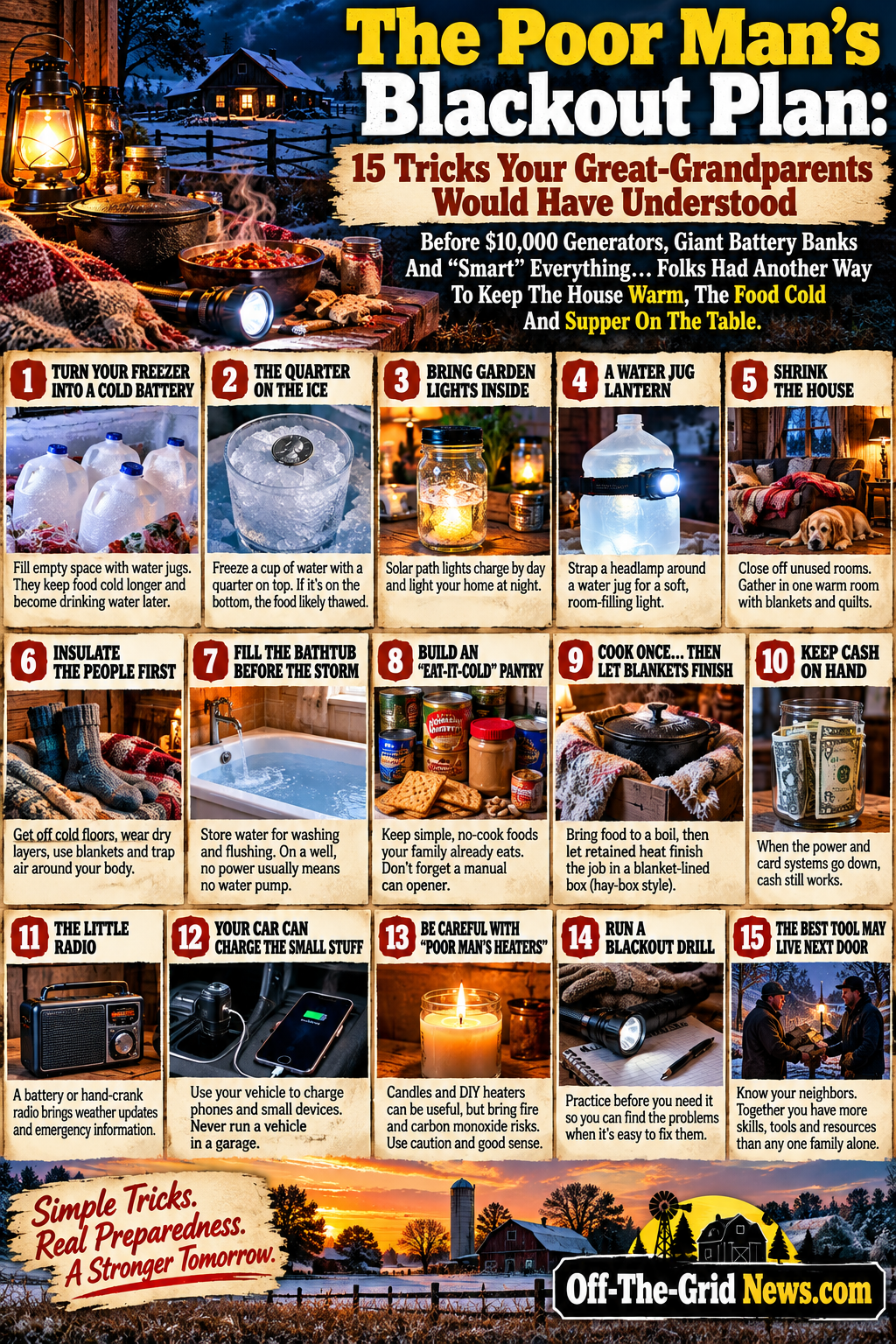
And buried inside an old collection of blackout tricks are some wonderfully cheap ideas worth bringing back.
Here are 15 of my favorites.
1. Turn Your Freezer Into A Cold Battery
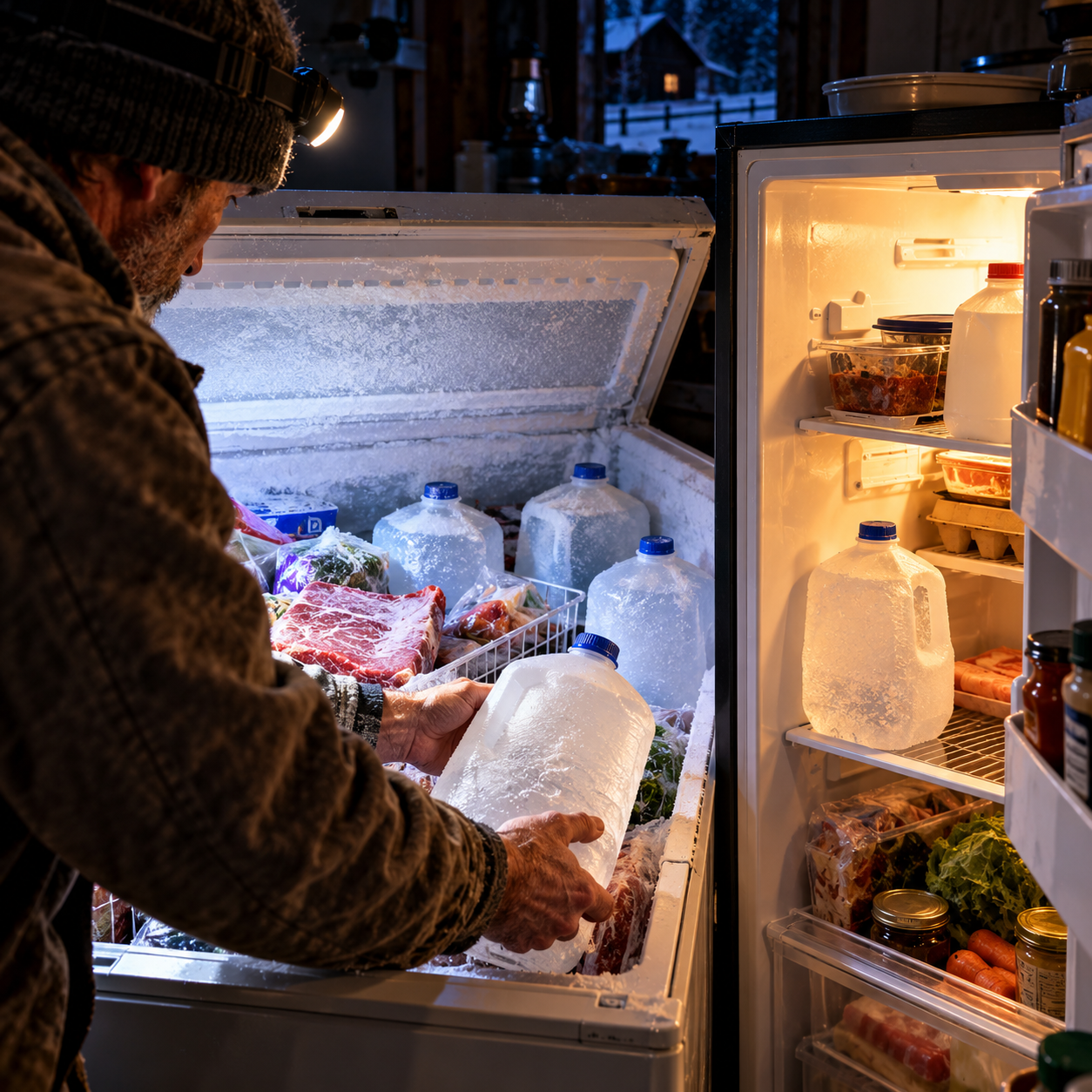
Before a storm arrives, fill empty freezer space with jugs or containers of water and freeze them solid.
That frozen water becomes thermal mass — basically a poor man’s battery that stores cold instead of electricity. When the power quits, it helps keep everything else colder longer, and later those same jugs become drinking water.
The USDA recommends freezing containers of water ahead of an outage and says a closed full freezer can generally maintain temperature for about 48 hours, compared with roughly 24 hours for a half-full freezer.
Just keep that door shut.
Every time somebody opens the freezer to stare hopefully at the hamburger, you’re letting your stored cold walk out the door.
2. Put A Quarter On The Ice — But Don’t Bet Your Supper On It
Here’s a clever little indicator: freeze a cup of water solid and put a quarter on top.
If you return after an outage and discover the quarter deep in the ice, you know the ice melted substantially and later refroze. That tells you something happened while you were gone.
But here’s the important part: the quarter is a clue, not a food-safety thermometer.
USDA recommends keeping an appliance thermometer in the refrigerator and freezer. Food can become unsafe without completely thawing your cup of ice, so use actual temperature and USDA guidance when deciding whether meat, dairy or leftovers are safe.
Cheap trick? Absolutely.
Medical laboratory? Nope.
3. Bring The Garden Lights Inside
You may already have emergency lights standing beside the petunias.
Those little solar path lights spend all day charging themselves. When darkness comes, pull them from the ground and place them in jars or sturdy cups around the house.
Kitchen. Bathroom. Hallway. Bedrooms.
Then put them outside again the next morning.
That’s the kind of preparedness I love: something you already own doing a second job.
And for walking around, stairs and chores, use flashlights or headlamps rather than carrying open flames. CDC emergency guidance includes flashlights, headlamps and battery-powered lanterns among basic emergency-lighting supplies.
4. Turn A Water Jug Into A Lantern
A flashlight is terrific at illuminating one spot and terrible at illuminating a room.
Strap a headlamp around a translucent gallon jug filled with water, with the beam aimed into the jug. The water scatters that concentrated beam into a broad, softer glow.
Now the kitchen table looks less like an interrogation room.
That matters more than you might think.
After two or three nights without electricity, a little normalcy — eating supper together, playing cards, seeing everybody’s face — starts becoming part of preparedness too.
5. Shrink The House
Here’s one of the biggest lessons running through the old methods in the source material: stop trying to heat everything.
Pick one smaller room, preferably with fewer windows. Move everybody there, close the doors to unused rooms, roll towels against drafts and use blankets or quilts to reduce heat loss through windows and doorways without blocking a necessary exit.
During daylight, let the winter sun through south-facing windows.
At sundown, close things back up.
For centuries, families didn’t heat every bedroom, hallway, parlor and spare room to shirtsleeve temperature. They concentrated people and heat where they actually lived.
Don’t heat empty square footage.
6. Insulate The People First
Cold floors steal heat fast, so get yourself off them.
Use beds, couches, camp pads, folded blankets or even layers of cardboard beneath bedding in an emergency. Put on dry socks, cover your head, layer loose clothing and wrap up in a comforter.
The original material points repeatedly toward the same principle: trap little pockets of air around the body and between you and cold surfaces.
Sometimes preparedness isn’t making more heat.
It’s losing less of the heat you already have.
7. Fill The Bathtub While Water Still Runs
When severe weather is bearing down, don’t wait until the lights blink.
Fill clean containers with water. If appropriate for your household, the bathtub can hold utility water for washing and toilet flushing.
This becomes especially important on a well.
No electricity usually means no well pump.
The trick here isn’t some $499 gadget with an affiliate link attached.
The trick is doing it early.
8. Build An “Eat-It-Cold” Pantry
Everybody loves emergency food that promises to survive until your grandchildren retire.
But during a blackout, simplicity wins.
Peanut butter. Crackers. Canned beans. Tuna. Canned chicken. Fruit. Jerky. Nuts. Shelf-stable milk. Food your family already eats and that can be eaten without refrigeration or cooking.
And sitting beside it?
A $5 manual can opener.
Because during a blackout, an unopened can of chili without a manual opener is basically a paperweight with beans trapped inside.
9. Cook Once… Then Let Blankets Finish The Job
This one is downright clever.
Bring rice, beans, oats, soup or stew to the proper boil, then move the tightly covered pot into an insulated container surrounded by thick towels or blankets. The retained heat continues cooking without continuously burning fuel.
Historically, versions were called hay-box cookers.
But food safety matters here. Don’t blindly assume a blanket-wrapped pot remained at a safe temperature for hours. Use a food thermometer, follow tested recipes and reheating guidance, and when in doubt, bring food back to a safe temperature before eating.
The idea is simple:
Make heat once. Then quit throwing it away.
10. Keep Cash Where The Grid Can’t Turn It Off
The electricity goes down.
Then the internet hiccups.
Then card terminals quit.
Then the gas station has something you desperately need and your beautiful plastic rectangle suddenly possesses roughly the purchasing power of a playing card.
Keep some emergency cash tucked away, preferably including small bills.
Not because civilization has ended.
Because sometimes the network has.
11. Rediscover The Little Radio
A small battery-powered radio may look like something Grandpa left beside his tackle box.
During a widespread outage, it can become one of the most useful objects in the house.
Weather information, emergency instructions and local updates don’t require you to chew through your phone battery refreshing websites every five minutes.
CDC preparedness guidance specifically recommends a battery-powered or hand-crank weather radio.
Information is a supply.
Store a way to receive it.
12. Your Car Can Charge The Small Stuff
With the proper charger or inverter, your vehicle can keep phones, rechargeable flashlights and other small electronics alive.
But there’s a rule written in permanent ink:
Never run the vehicle in an attached garage — even with the garage door open.
Carbon monoxide is colorless and odorless. CDC warns against operating gasoline engines in garages or other enclosed spaces and recommends keeping generators outside at least 20 feet from doors, windows and vents.
Blackouts create enough problems.
Don’t manufacture another one.
13. Be Very Careful With “Poor Man’s Heaters”
The source material includes shortening lamps and other old-fashioned flame tricks, and historically people certainly used fat lamps for light.
But don’t fool yourself into believing a flowerpot, metal tub or clever internet contraption magically multiplies heat.
It doesn’t.
And open flames bring fire risk while fuel-burning equipment can introduce carbon monoxide. CDC specifically warns never to use grills, camp stoves, generators or similar fuel-burning equipment indoors.
Use battery lighting whenever possible.
A burned-down farmhouse is a mighty poor cure for a blackout.
14. Run A Blackout Drill Before You Need One
Pick an evening when nothing is wrong.
Safely shut off the power and spend a few hours pretending it isn’t coming back.
Suddenly you’ll discover the flashlight is buried behind Christmas decorations, nobody knows where the manual can opener went, your phone charger won’t work from the car, and the one room you planned to keep warm has a draft big enough to whistle Dixie through.
That’s good.
Finding your mistakes during practice is cheap.
Finding them at 2:13 in the morning when it’s 6 degrees outside is considerably more expensive.
15. The Best Blackout Tool May Live Next Door
This may be the most important trick of all.
Know your neighbors.
During Chicago’s deadly 1995 heat wave, research found that living alone and social isolation were associated with greater risk of heat-related death, while social contacts were protective.
That lesson travels remarkably well.
One neighbor owns a chainsaw. Another has a wood stove. Somebody has a well, somebody knows first aid, somebody has a truck, and somebody has enough floor space to squeeze another family into the warm room.
Separately, those are households with weaknesses.
Together, they’re a system with backups.
Our great-grandparents didn’t call that “resilience infrastructure.”
They called it neighbors.
The Poor Man’s Blackout Plan
Here’s what I like about these tricks.
None of them requires you to pretend modern equipment isn’t useful. If you’ve got a generator, solar panels, a battery bank and six months of propane, wonderful.
But equipment isn’t the same thing as preparedness.
Preparedness is knowing what to do after the gadget fails.
Freeze some water. Stock food that doesn’t need cooking. Find the radio. Locate the can opener. Put a little cash aside. Decide which room becomes the warm room. Check your carbon-monoxide detector.
Then knock on the neighbor’s door.
Because when that cold January wind starts rattling the siding and every house along the road suddenly goes black, you may discover something our ancestors understood perfectly well:
The cheapest backup system isn’t always something you buy.
Sometimes it’s something you know.
And sometimes…
It’s somebody you know.