 Print
Print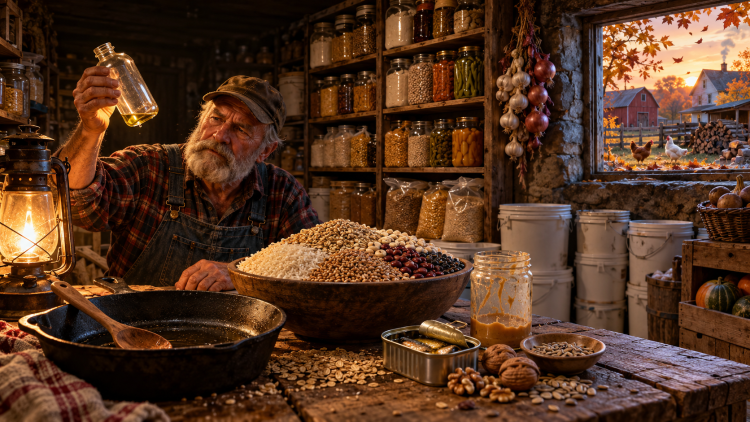
You Stored The Rice… Beans… Wheat… And Oats. But You May Have Forgotten The One Thing That Makes A Hard-Times Pantry Actually Work
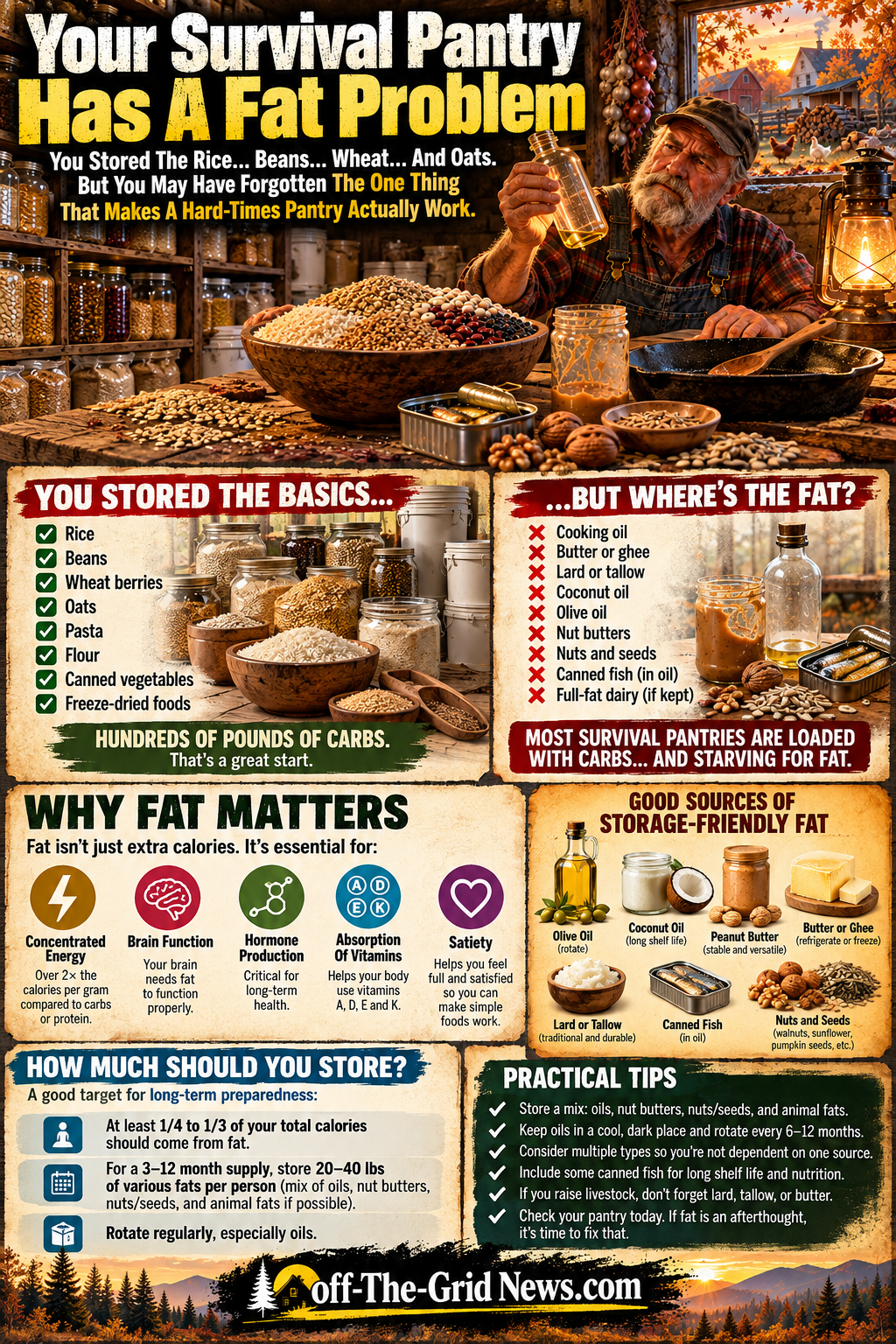
Go downstairs and look at your survival pantry. Maybe you’ve got white rice stacked in buckets, beans tucked into Mylar bags, wheat, oats, pasta, flour, powdered milk, and enough canned vegetables to make your basement look like a grocery store circa 1957.
Good.
Now let me ask you a slightly strange question: Where’s the fat?
Not the fat around your waist. I’m talking about cooking oil, peanut butter, nuts, seeds, canned fish and other foods that put dietary fat—and a whole bunch of concentrated calories—into the pantry.
Because there’s a funny little hole hiding in an awful lot of long-term food-storage plans. We got so good at storing carbohydrates that it’s easy to forget human beings don’t live on carbohydrates alone.
The Pantry That Looks Better Than It Eats
Picture a family that has carefully stored 100 pounds of rice, 50 pounds of beans, 50 pounds of wheat and another mountain of oats. On paper, that looks pretty impressive—and it is.
Those are cheap, useful staples that can form the backbone of a sensible emergency pantry. Foods such as dry beans, grains and oats also lend themselves nicely to storage, which is one reason they’ve been feeding families through lean times for generations.
But there’s also a reason Grandma kept some fat in the kitchen.
Fat does something a scoop of dry rice simply can’t do very efficiently: it packs calories into a relatively small amount of food. Dietary fat provides about 9 calories per gram, compared with roughly 4 calories per gram for either carbohydrate or protein.
That makes fat more than twice as calorie-dense by weight.
And when you’re talking about feeding people during hard times, calories suddenly stop being a dirty word.
They become fuel.
A Little Fat Can Change Supper
Take a plain bowl of rice and beans. Perfectly respectable food, and generations of people have done quite well combining humble staples into filling meals.
Now add some cooking oil and you’ve increased the meal’s energy without doubling the pile of food on the plate. Put peanut butter into oatmeal, add nuts or seeds to breakfast, or work some canned fish into supper, and you’ve added foods that can contribute fat along with other nutrients.
That can matter when people aren’t sitting behind desks all day. Cutting wood, hauling water, shoveling snow, repairing fences, tending animals and working a garden all require energy.
Hard work burns fuel.
Your pantry needs some.
But Fat Isn’t Just About Calories
Here’s where this gets more interesting. Dietary fat isn’t merely a compact way of storing food energy; some fatty acids are nutritionally essential.
The National Institutes of Health explains that alpha-linolenic acid (ALA), an omega-3 fatty acid, is essential because the human body can’t make it and therefore has to obtain it from food. NIH’s technical guidance likewise identifies both ALA and linoleic acid, an omega-6 fatty acid, as essential fatty acids.
Dietary fat also helps the body absorb the fat-soluble vitamins A, D, E and K. MedlinePlus notes that these four vitamins are absorbed more readily in the presence of dietary fat.
So no, this isn’t an invitation to sit down beside the woodstove and drink olive oil from a coffee mug.
Please don’t.
The point is much more ordinary: a preparedness pantry built overwhelmingly around lean dry staples can have a nutritional blind spot. And unlike another bucket of rice, it’s a blind spot that requires a little more planning because fats present a storage problem of their own.
And There’s The Catch: Fat Doesn’t Keep Forever
Mother Nature apparently didn’t consult the preparedness industry before designing cooking oil.
Fats and oils can oxidize and become rancid over time. Penn State Extension explains that components of edible oils react with oxygen and form compounds associated with rancidity, while Utah State University notes that foods containing fats and oils deteriorate even under good storage conditions.
Heat, light and oxygen are the enemies here. Penn State recommends storing vegetable oils in a cool, dark place and notes that refrigeration can extend quality; its guidance puts unopened vegetable oil at roughly 6 to 12 months for best quality under typical storage conditions, although actual product guidance varies and the label on what you buy matters.
That creates an interesting preparedness contradiction. Some of the foods that are easiest to put away for long periods are relatively low in fat, while many calorie-dense fatty foods require more attention to storage and rotation.
That’s not an argument against storing fats.
It’s an argument for rotating them.
Your Pantry Needs Two Clocks
Here’s a better way to think about the problem. Your survival pantry probably shouldn’t consist entirely of foods you’re planning to bury in the basement and rediscover when your grandchildren retire.
Instead, think in two layers.
First, you have deep-storage staples: foods selected partly because they store well and can provide the backbone of meals. Then you have the working pantry—the foods your family routinely eats, replenishes and rotates.
Cooking oils fit naturally into that second category. So can peanut butter, nuts, seeds, canned meats, canned fish and other foods that help round out what you’re storing.
Utah State Extension makes essentially this same rotation point in its home-food-storage guidance: store foods you actually use and don’t accumulate more than you can realistically rotate.
That’s good homestead common sense.
Instead of asking, “What fat can I buy today that will still taste wonderful 25 years from now?” ask a far more practical question:
“What fats does my family already eat that I can keep ahead and continually rotate?”
Now we’re talking like homesteaders instead of archaeologists.
Turn The Grocery Store Into Your Rotation System
Suppose your household normally uses a bottle of cooking oil every month or two. Instead of owning one bottle and replacing it only when you see daylight through the bottom, you might keep several bottles ahead and continuously rotate through them.
Oldest gets used first. As inventory drops, normal grocery trips replenish it.
Now you aren’t searching the internet for the mythical immortal jug of vegetable oil. You’re managing inventory.
Farmers understand this idea perfectly well. You don’t necessarily buy every gallon of fuel you’ll need for the next 40 years; you maintain a useful reserve and replenish what you consume.
Your pantry can work the same way.
So What Kinds Of Fat Belong In The Pantry?
There isn’t one magic answer, and that’s actually good news. What your family normally eats, dietary needs, storage conditions and the foods available to you should determine the mix.
Possible pantry foods include cooking oils, peanut butter, nuts, seeds and shelf-stable foods such as canned fish. NIH lists fish and seafood, nuts and seeds, and several plant oils among dietary sources of omega-3 fatty acids.
Peanut butter is especially interesting from a preparedness standpoint because it is familiar, calorie-dense and requires no cooking. Utah State Extension even includes peanut butter and nuts among suggested foods for a portable emergency food supply precisely because emergency foods that don’t require refrigeration, cooking, water or special preparation can be particularly useful.
But don’t misunderstand the lesson.
The answer isn’t “buy 40 jars of peanut butter.”
The answer is diversification.
Different foods solve different problems. Some provide concentrated calories, some contribute protein, some can be eaten straight from the package, and cooking oils can turn otherwise plain staples into better meals.
That’s a much stronger system than betting everything on one food.
Your Cooking Plan May Have A Fat Problem Too
Here’s another angle that doesn’t show up on many preparedness spreadsheets: fat doesn’t merely feed you.
It helps you cook.
Imagine making every meal for two weeks without oil, butter or another cooking fat. Suddenly frying potatoes gets interesting, sautéing garden vegetables becomes different, and many familiar recipes don’t work quite the way they normally do.
That matters because food isn’t merely chemistry. If you’re stuck at home through a long winter outage, a hot skillet of potatoes and onions feels a whole lot more like supper than Day Six of plain boiled grain.
Morale matters too.
A pantry ought to keep bodies going, but if possible it should also produce recognizable meals that people actually want to eat.
Now Do The Fat Audit
Here’s an experiment worth doing tonight. Walk through your stored food and look beyond the number of cans, buckets and pounds you’ve accumulated.
Ask where the calories are actually coming from. How carbohydrate-heavy is the pantry? Where are the protein sources, and where is the dietary fat?
You don’t need to turn the basement into a nutrition laboratory or calculate every gram with a spreadsheet. You’re simply looking for glaring imbalances.
If you’ve got six months of grain and beans but only one half-empty bottle of cooking oil sitting above the stove, you’ve learned something useful.
Maybe you don’t need more rice.
Maybe you need to fill a different hole.
And Remember The Weak-Link Rule
This is exactly the sort of problem we’re talking about with our new, upcoming $500 Weak-Link Test. (Stay tuned.) Preparedness isn’t about continually making your strongest category stronger; it’s about finding the overlooked weakness that can undermine everything you’ve already done.
Maybe your food storage looks spectacular because you’ve accumulated thousands upon thousands of calories. But perhaps most of those calories require clean water and cooking fuel before anybody can eat them.
Maybe the pantry is thin on fat or protein. Maybe you’ve got enough dry food for six months but only enough propane to cook it for twelve days.
Or maybe you’ve got a beautiful freezer full of meat and no workable plan for a long power outage.
That’s why a serious preparedness audit has to go beyond “How many pounds of food do you own?”
The better question is:
“Could your family actually live reasonably well on what you’ve stored?”
That’s a completely different test.
There’s Another Old Homestead Answer
Our grandparents didn’t solve every food-storage problem by ordering another plastic bucket. They also produced food.
Depending on the household, dietary fat and other nutrients could come from eggs, dairy foods, meat, fish, nuts, seeds and other foods produced or gathered closer to home. Modern nutrition guidance still identifies foods such as fish, nuts, seeds and plant oils as important sources of dietary fats.
That’s worth thinking about because a pantry is finite, while a productive homestead can renew at least part of its food supply. Chickens can produce eggs, nut trees can produce year after year, livestock can provide food, and oilseed crops such as sunflower or canola can potentially become part of a more advanced home-production system.
In fact, Penn State Extension points out an interesting advantage of storing oilseeds themselves: oil stored in the seed doesn’t become rancid the same way extracted oil does, allowing the seed to be pressed when oil is needed. That’s obviously a bigger homesteading project than buying a few extra bottles at the grocery store, but it’s a fascinating example of moving from stockpiling toward production.
Of course, none of these systems are magic. Animals need water and feed, nut trees take years to mature, gardens have bad seasons, and pressing your own oil requires crops, equipment and know-how.
But that’s the larger direction self-reliance points.
Store some. Rotate some. Produce some.
One Important Warning About Oil And Home Preservation
Since we’re talking about homesteaders, there’s one safety point worth mentioning. Don’t assume adding oil to a home-canning recipe makes food keep better.
Penn State Extension specifically warns against improvising home-canning recipes with added fats and oils because oil can interfere with tested processing assumptions. It also warns against casually storing low-acid foods such as garlic, herbs or peppers submerged in oil at room temperature because the low-oxygen environment can create conditions favorable to botulism unless a scientifically tested preservation method is followed.
In other words, Grandma’s pantry wisdom is valuable.
But microbiology still gets a vote.
Don’t Build A Food Museum. Build A Pantry.
That’s really the lesson here. Don’t build a food museum filled with buckets nobody touches and food nobody normally eats.
Build a pantry your family actually lives out of.
Store rice, beans, wheat and oats if those foods make sense for your household. Those humble staples have earned their place, and there’s nothing wrong with having plenty of them.
But don’t stare proudly at 500 pounds of dry food while the only cooking fat in the entire house is a tablespoon of oil clinging desperately to the bottom of a bottle.
Look at the whole system instead: calories, protein, fat, water, cooking fuel, nutrition, storage life, rotation and foods your family will actually eat.
Then rotate the things that don’t last forever.
Because the goal isn’t to win a contest for who owns the oldest bucket of wheat.
The goal is to feed your family.
And sometimes the biggest hole in a survival pantry isn’t what’s missing from the bucket.
It’s what’s missing from the frying pan.