 Print
Print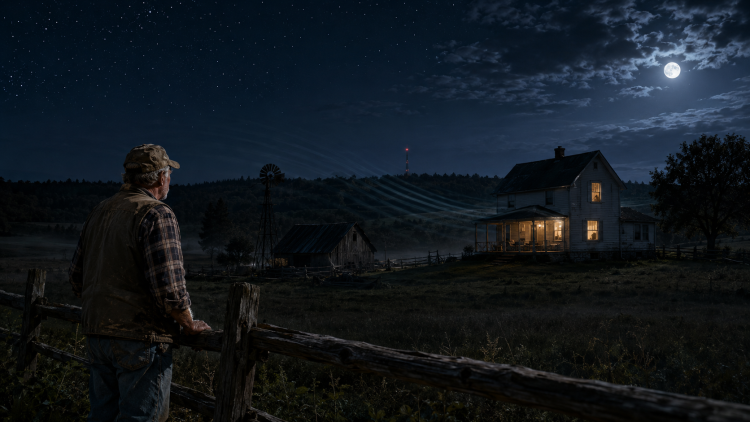
The Invisible Signals That Keep Moving While Your Family Sleeps
What Families Need To Know About Wi-Fi, Cell Towers, and the Signals That Never Sleep
Step outside after dark and look across your land. The barn is quiet, the garden rows are black beneath the moon, and a hard scatter of stars hangs above the trees. There may not be a power line or traffic light for miles.
It feels like you’ve escaped the electronic world.
Yet even beyond the pavement, most homesteads sit inside an invisible patchwork of radiofrequency signals. Cell towers reach across the countryside. Wi-Fi routers hum behind farmhouse walls. Phones, tablets, smart televisions, Bluetooth speakers, baby monitors, wireless cameras, and even newer appliances transmit signals day and night.
You can’t smell them, hear them, or see them against the evening sky. Still, they’ve become part of the environment in which our families eat, work, play, and sleep.
That raises a fair question: What is all this exposure doing to us… especially to growing children?
The Doctor Who Started Listening to Parents

Dr. Carlos Laredo Ritter says that question began following him years ago while he was working with children suffering from epilepsy and autism. According to Ritter, parents repeatedly told him that their children’s symptoms, including seizures, sometimes appeared to worsen around wireless electronic devices.
One device mentioned frequently was the Nintendo Wii.
At first, Ritter reportedly wondered whether worried parents were simply connecting two unrelated events. Video games can trigger seizures in some people with photosensitive epilepsy because of flashing lights, rapid visual patterns, and changes in brightness. That danger has been recognized for years and is one reason video games carry seizure warnings.
Still, Ritter believed the parents’ observations deserved a closer look.
He began watching the children’s brain activity with electroencephalograms, better known as EEGs. These tests record electrical patterns produced by the brain. Ritter has said that he noticed unusual disturbances around the time seizures began and came to suspect that environmental electromagnetic fields might be playing a role.
That observation sent him searching for answers well beyond ordinary clinical medicine. He studied biophysics and physics in an effort to better understand how outside electrical and magnetic fields might interact with the human nervous system.
Whether all of his conclusions hold up under larger, independent studies remains an open question. But his willingness to listen to parents carries a lesson homesteaders understand well.
When the animals act strangely, the well water changes color, or the garden starts failing in one particular corner, you don’t laugh off the pattern. You investigate.
Not All “Radiation” Is the Same
Unfortunately, discussions about electromagnetic fields often become confusing because the word radiation covers several very different things.
X-rays, gamma rays, and some ultraviolet radiation are ionizing. Each photon carries enough energy to knock electrons loose, break chemical bonds, and directly damage DNA. Heavy exposure can cause burns, radiation sickness, cancer, or death.
Wi-Fi, Bluetooth, cellphones, broadcast radio, and cell towers produce non-ionizing radiofrequency energy. It sits much lower on the electromagnetic spectrum and does not carry enough energy per photon to break DNA bonds directly, according to the National Cancer Institute.
That distinction matters.
It means living near a router is not the same as standing beside an unshielded nuclear source. The comparison may sound dramatic, but the physics and known risks are very different.
At high enough levels, radiofrequency energy can heat tissue. That is the best-established biological effect and the reason exposure standards exist. The harder question is whether long-term exposure at lower, non-heating levels can produce subtler effects that scientists have not yet fully recognized.
Researchers are still arguing over that one.
What the Cancer Classification Really Means
In 2011, the World Health Organization’s International Agency for Research on Cancer classified radiofrequency electromagnetic fields as “possibly carcinogenic to humans,” placing them in Group 2B. That decision was based largely on limited evidence involving heavy wireless-phone use and certain brain tumors.
However, “possibly carcinogenic” does not mean scientists proved that Wi-Fi or cellphones cause cancer. It means a connection appeared credible enough to investigate, but chance, bias, and other explanations could not be ruled out. The original IARC announcement was a call for more research, not a final verdict.
Since then, the evidence has remained mixed.
Some animal and laboratory experiments have reported biological changes, including DNA damage under certain experimental conditions. Other studies have failed to reproduce those findings. Meanwhile, large human studies and population trends generally have not shown the increase in brain cancer that some researchers feared would follow the explosive growth of cellphone use.
A major WHO-commissioned review published in 2024 examined 63 studies and found no increased risk of brain cancer associated with cellphone use, including long-term or heavy use. The American Cancer Society’s current overview likewise says the human evidence is mixed but that most studies have not found an increased cancer risk.
In 2026, the Department of Health and Human Services announced that it would take another look at cellphone radiation and identify remaining gaps in the research.
In other words, the honest answer isn’t “perfectly harmless” or “proven poison.”
The honest answer is that everyday wireless signals haven’t been shown to damage DNA directly, and the strongest human evidence has not established a cancer link. At the same time, long-term exposure—particularly among children—is still being studied.
Your Body Is Electrical, But It Isn’t Defenseless
Ritter often reminds families that the human body uses electricity. He’s right about that.
Your heartbeat depends on precisely timed electrical signals. Nerve cells communicate through electrochemical impulses. Muscles move when electrical activity travels along nerve fibers. Even the movement of calcium, sodium, and potassium across cell membranes helps govern everything from thought to motion.
However, that doesn’t mean every outside signal takes control of the body. Our homes are filled with weak electric and magnetic fields, while the Earth itself has a natural magnetic field. Whether an outside field affects tissue depends on its frequency, strength, distance, duration, and how energy is absorbed.
The body isn’t simply a radio waiting for the strongest station to seize the dial.
Still, reducing unnecessary exposure can be a reasonable personal choice—especially when it costs little and doesn’t disrupt family life. Homesteaders routinely use that kind of precaution. We test the well, keep smoke out of the house, ventilate the workshop, and move fuel cans away from the woodstove.
We don’t have to panic before taking sensible steps.
The Tower Beyond the Tree Line
Living in the country may reduce exposure to some wireless sources, but distance from town doesn’t make a property signal-free. Rural towers are often built high and designed to cover broad territories. A tower hidden beyond a ridge may serve farms and homes for miles around.
Even so, tower output wattage alone doesn’t tell you what reaches your bedroom. Exposure falls sharply with distance and depends on antenna direction, terrain, buildings, frequency, and other factors. The signal measured on your property is far more useful than the tower’s advertised power.
Meanwhile, the strongest source may be the phone pressed against your head or carried against your body. Distance makes a large difference. Using speakerphone, setting the phone on a table, or carrying it in a bag instead of a pocket can reduce exposure without buying questionable “radiation-blocking” stickers or pendants.
Before buying land, you can also check nearby tower locations, power corridors, substations, and proposed developments. Those things may affect property value, scenery, noise, and future construction even if their health effects remain disputed.
Walk the boundary before you sign the papers.
A beautiful pasture can hide an ugly surprise beyond the cottonwoods.
Guard the Night Before Anything Else
If there’s one place to begin, make it the bedroom.
The strongest reasons aren’t mysterious. Phones chirp, vibrate, brighten the room, tempt us to scroll, and keep the mind hitched to the outside world. Poor sleep is associated with impaired attention, mood problems, metabolic trouble, and a long list of other health concerns.
Wireless signals themselves have been studied for possible effects on sleep and brain activity, but the findings remain inconsistent. Ritter says he has seen sleep and EEG measurements improve after families shielded their bedrooms. He also reports that his own long-running insomnia eventually disappeared after he changed his home environment.
Those experiences are interesting, but personal accounts and uncontrolled observations cannot prove that shielding caused the improvement. Better studies would need to compare shielded and unshielded rooms while controlling for light, noise, temperature, expectation, and other influences.
Nevertheless, quieting the bedroom is still good sense.
Move the phone away from the bed. Put it on airplane mode when you don’t need to receive calls. Turn off unnecessary alerts. If nobody needs Wi-Fi overnight, place the router on a timer. Keep televisions, tablets, and other blinking electronics out of children’s rooms.
Those changes cost next to nothing, and they may improve sleep even if radiofrequency exposure turns out not to be the reason.
Building a Quieter Homestead
Families who want to reduce wireless traffic can hardwire computers, televisions, cameras, and other stationary devices with Ethernet cable. A wired connection is often faster and more reliable anyway, particularly inside old farmhouses with thick plaster walls.
Meanwhile, place the router away from bedrooms and the kitchen table rather than beside the couch or a child’s bed. Download movies before a long trip instead of streaming continuously with a weak signal, which can cause a phone to increase its transmitting power. Teach children not to sleep with phones beneath their pillows.
Whole-house shielding is a much bigger step. Metal mesh, conductive paint, window film, and specialized grounding systems can change radiofrequency levels, but poor design can create electrical hazards or even trap signals from devices left inside the shielded space. Anyone considering it should begin with professional measurements and qualified electrical advice—not an expensive product bought out of fear.
Measure first. Build second.
That’s how you’d handle a questionable well, a sagging foundation, or a sick orchard. The invisible world deserves the same steady judgment.
Caution Without Freaking Out
Modern families live with more wireless technology than any generation before them. We shouldn’t pretend every long-term question has been answered. Neither should we turn unanswered questions into proven catastrophes.
The best path lies between panic and blind trust.
Pay attention to new research. Reduce exposures that are unnecessary and easy to avoid. Protect your family’s sleep, keep devices away from young bodies when practical, and be skeptical of anyone selling a miracle shield backed only by frightening testimonials.
Then step outside after dark and look across your land again.
The signals may still be moving invisibly over the garden, through the timber, and past the old barn. But your family doesn’t have to live helplessly beneath them. With a few grounded habits… and a clear eye toward what science does and does not know… you can keep technology in its proper place.
As a tool.
Not the master of the house.