 Print
Print
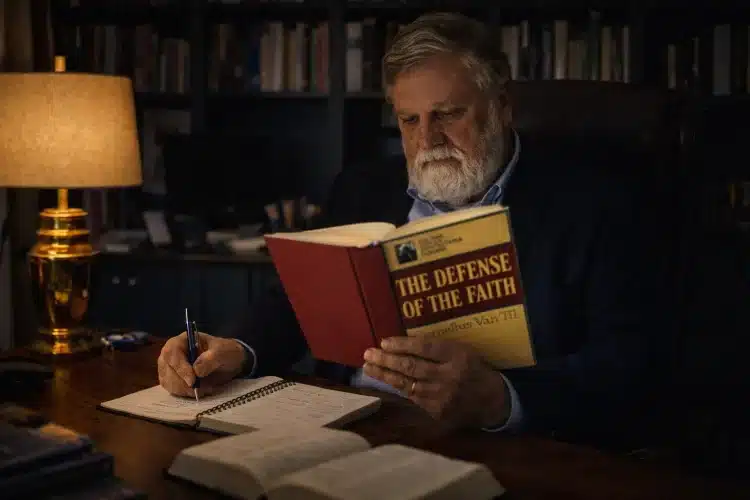
When A Pretended Pastoral Chat Turns Out To Be A Borrowed Framework
If you think Easy Chairs, Hard Words is simply Douglas Wilson explaining Calvinism in his own pastoral voice, slow down… because what you’re actually reading is a fully formed Cornelius Van Til argument, lifted whole in structure, method, and direction, then repackaged with softer language and no clear credit given to the man who built it.
Douglas Wilson’s Easy Chairs, Hard Words is often praised as a friendly, plain-English introduction to Calvinism and God’s sovereignty. It’s framed as a series of conversations… comfortable chairs, honest questions, and firm but pastoral answers. For many readers, it feels accessible, clarifying, even bracing.
But set that book beside Cornelius Van Til’s classic dialogue “Mr. Black, Mr. White, and Mr. Grey” in The Defense of the Faith, and the cushions start to slide. What initially looks like a warm pastoral chat begins to look more like a familiar structure with new upholstery.
In short, Wilson didn’t just borrow a few ideas from Van Til. He quietly rebuilt Van Til’s house, moved the furniture around, changed the paint color… and never told the reader whose blueprint he used.
That omission matters more than many are willing to admit.
Van Til’s Dialogue Was Not Decoration—It Was the Engine

To understand the problem, you have to grasp what Van Til was doing. His famous dialogue section— A Dialogue: Mr. Black, Mr. White, Mr. Grey”—was not filler, illustration, or stylistic flair. It was a signature move. A carefully designed instrument.
Van Til used fictional characters to dramatize his entire presuppositional apologetic.
- Mr. Black represents the unbeliever: outwardly respectable, intellectually confident, spiritually dead. He suppresses the truth in unrighteousness while borrowing from God’s world every time he reasons, argues, or breathes.
- Mr. White represents the consistently Reformed Christian: committed to total depravity, hostile to neutrality, and unwilling to grant autonomous reason even an inch of ground.
- Mr. Grey is the real target. He’s the Arminian or evidentialist evangelical… trying to defend Christianity while sharing the unbeliever’s assumptions about reason, facts, and freedom.
Through sharp dialogue, Van Til exposes Mr. Grey as the man who wants peace talks where Scripture demands unconditional surrender. He wants to keep one foot in revelation and one foot in autonomy… and ends up collapsing both.
Van Til’s dialogue isn’t cute. It’s a demolition job.
A Familiar Skeleton in a Comfortable Pastoral Sweater Vest
Now enter Easy Chairs, Hard Words.
Wilson frames his book as reconstructed conversations between an older pastor, Martin Spenser, and a younger man struggling with Calvinism… questions about assurance, perseverance, fairness, responsibility, and divine sovereignty.
Chapter after chapter, the pattern repeats:
- The young man raises a reasonable-sounding objection.
- Martin patiently dismantles it.
- The objection is revealed as man-centered, works-based, or rooted in sinful autonomy.
- God’s absolute sovereignty is reasserted as the only coherent alternative.
On the surface, this looks like a standard catechetical setup. A knowledgeable pastor answering questions. Nothing to see here.
But put Wilson’s book next to Van Til’s dialogue and the resemblance becomes unmistakable.
Martin Spenser is Mr. White with a coffee mug.
The young man is Mr. Grey with softer edges.
Mr. Black lurks in the background as the logical endpoint of all man-centered theology.
Different names. Same roles. Same logic. Same destination.
The Argument Patterns Line Up Like Carbon Paper
This isn’t just about structure. The argument flow itself tracks Van Til almost beat for beat.
Total Depravity and Inability
Van Til insists that Mr. Black’s problem is not ignorance but death. He is spiritually dead, morally incapable, and hostile to God. Only regeneration can change that.
Wilson mirrors this precisely. Questions about “losing salvation” are reframed as questions about whether regeneration itself can be undone. Faith is not something the sinner contributes; it is something God grants. If God gives it, God keeps it.
Different packaging. Same doctrine. Same presuppositional logic.
No Neutral Ground
Van Til spends pages dismantling Mr. Grey’s appeal to “facts” and “logic” as neutral tools. Grant neutrality, and you’ve already surrendered the war.
Wilson does the same work with different language. “Carnal reasoning.” “Man-centered instincts.” “Protecting human freedom.” Again and again, Martin insists that these instincts are not innocent mistakes… they are moral rebellion.
Both men aim at the same target: autonomous reason wearing evangelical clothes.
Half-Measures as Gospel Betrayal
Van Til portrays Mr. Grey as the man who wants to add Christianity as a second story to the unbeliever’s house without touching the foundation. Van Til calls this a betrayal, not a compromise.
Wilson calls revivalism and Arminianism “salvation by works.” He portrays them as systems that give the sinner a veto over grace… a rotating door instead of a resurrection.
The metaphors differ… Van Til uses dentists and watches; Wilson uses lifeguards and adolescence… but the work being done is identical.
This Isn’t Plagiarism… It’s Something Trickier
To be clear: this is not a case of verbatim plagiarism.
Wilson does not lift Van Til’s sentences. He doesn’t reuse distinctive phrases or academic critiques. His prose is simpler, friendlier, more conversational.
But that’s exactly what makes this case harder… and more serious.
What we’re dealing with is unacknowledged conceptual and structural dependence. The kind that wouldn’t pass muster in a seminary paper. I’m guessing it’s the kind of tactic New Saint Andrews students are warned against when they borrow an argument’s skeleton but change the skin.
Wilson didn’t quote Van Til.
He inhabited him.
And he did so without telling the reader.
Why the Silence Is the Issue
Some defenders wave this off. “Everyone knows Wilson is Van Tillian.”
But that’s not how intellectual honesty works.
Van Til didn’t just influence Wilson’s conclusions. He created a distinct literary and pedagogical genre… dialogue as apologetic weapon. Wilson adopted that genre wholesale and presented it as his own pastoral discovery.
That’s like using someone else’s map, following every turn, reaching the same destination… and then selling it as a new route.
Worse, Wilson’s history makes the silence louder. When someone with documented plagiarism controversies continues to blur attribution lines, the benefit of the doubt runs thin.
Bad Pedagogy, Worse Example
The real damage isn’t to Van Til. He doesn’t need defending.
The damage is to readers.
Young Reformed Christians come away thinking Wilson invented this dialogical approach. They never learn where it came from. They’re catechized into Wilsonism without being told the framework is really Van Til.
That’s not only dishonest teaching. It’s also a kind of robbery as it keeps folks from seeing Van Til’s own footnote trail. Further, it trains people to value a grand pooh-bah personality over lineage, charisma over credit, and platform over honest scholarship.
And it models a double standard: students must cite sources. Pastors get to pretend they’re original thinkers.
The Fix Was Simple… and Never Made
This could have been solved with one honest paragraph in the preface:
“The dialogical form and apologetic framework of this book are deeply indebted to Cornelius Van Til’s ‘Mr. Black, Mr. White, and Mr. Grey’ in The Defense of the Faith.”
That sentence never appears.
Instead, Van Til’s presence is everywhere in the architecture and nowhere on the sign.
Integrity Should Match Theology
Reformed theology insists God is sovereign over truth, ethics, and knowledge itself. That doctrine demands integrity… not just in doctrine, but in method.
If we demand absolute submission to God’s authority, we can’t simply shrug at borrowed frameworks passed off as original insight.
Easy Chairs may make for comfortable seated reading.
But Hard Words demand honest attribution.
And until Wilson acknowledges the house he built on Van Til’s foundation, Easy Chairs, Hard Words will remain what it is: a well-furnished room with someone else’s load-bearing walls.