 Print
And Why That Compost Pile Behind Your Barn Is Starting To Look Like Money In The Bank
Here’s Why Farmers Will Get Stuck With the Short End of the Shovel
When you live in the country, trouble usually announces itself. The pump quits. The freezer goes quiet. The tractor leaves a fresh puddle under its belly just when you need it most.
But this trouble comes in a yellow pile on the other side of the world. Sulfur supplies are getting squeezed, and the consequences could turn up in your fertilizer bill, your feed costs and the price of putting supper on the table.
Now, most folks associate sulfur with a rotten-egg well or a match struck in a cold barn. Strictly speaking, pure sulfur is odorless; sulfur compounds supply those familiar smells. Still, this plain yellow element has a reach that would surprise anybody who thinks farming starts and stops at the fence line.
You can own the ground, save the seed and fix your own tiller—and still get handed a bill from a shipping lane thousands of miles away.
One Narrow Waterway Can Reach Clear Into Your Garden
First, look at the Strait of Hormuz. This narrow passage connects the Persian Gulf to the open ocean, making it a critical exit for cargo from the region.
Here is a number worth getting straight: the Middle East accounts for roughly 24 percent of global sulfur production. That does not mean exactly 24 percent of the world’s sulfur passes through Hormuz; production and international trade are different measures, as this analysis of the sulfur chokepoint makes clear.
The shipping picture has changed during the conflict, too. Reuters reported on June 26 that sulfur and fertilizer shipments had begun moving out again, although flows remained below normal and security problems persisted.
So we should not pretend that every cargo has stopped forever. The danger is that an unreliable route makes essential supplies harder to obtain—and replacement cargoes more expensive.
Think of it as the one bridge between your farm and the elevator. It does not have to wash away completely to make harvest a miserable business.
The Yellow Ingredient Hiding Inside Your Fertilizer Bill

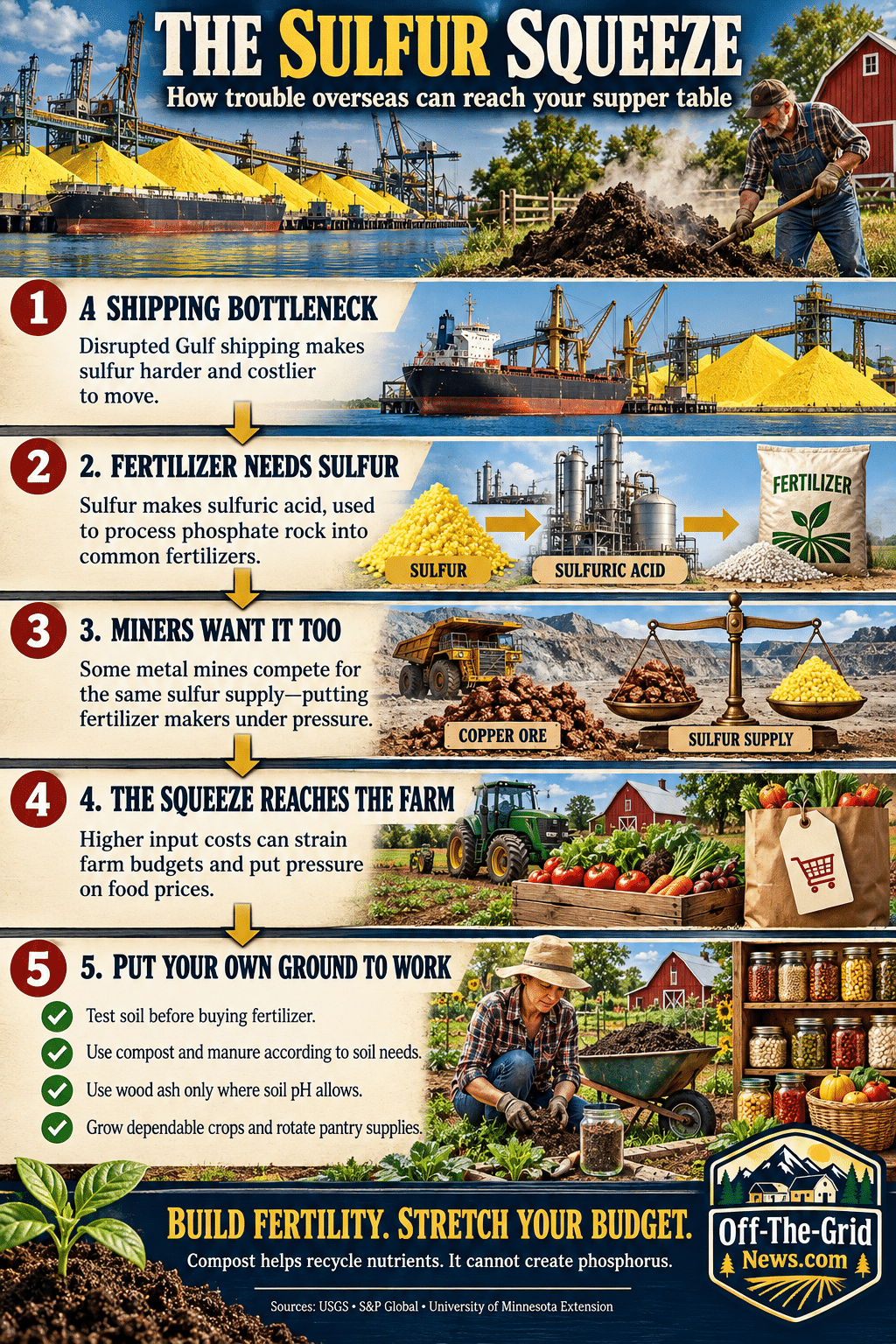
Next comes the connection that makes this a food story. Sulfur is used to manufacture sulfuric acid, a workhorse chemical that helps turn phosphate rock into widely used fertilizers.
Plants need phosphorus. It supports the processes that let them grow, and farmers cannot replace that essential nutrient with a pep talk or a fresh government press release.
According to S&P Global’s Chemical Economics Handbook, fertilizer is the ultimate destination for about half of world sulfur production. Phosphate fertilizer accounts for about 85 percent of that fertilizer-related use—roughly 42.5 percent of the total sulfur market.
Those figures describe sulfur consumption, not a precise breakdown of all sulfuric acid use. Either way, the practical point is plain: agriculture has a big appetite for this yellow ingredient.
When the supply gets tight, the fertilizer plant has to find more sulfur, pay more for it, draw down inventory or make less product. Somewhere along that road, the farmer gets squeezed.
Then the squeeze starts traveling toward the grocery cart.
Your Farm Is Bidding Against a Copper Mine
Unfortunately, the fertilizer industry does not have the sulfur pile to itself. Sulfuric acid also serves chemical manufacturing and metal processing, and it is the electrolyte inside familiar lead-acid batteries.
That includes batteries in plenty of old farm trucks and some off-grid power systems. The same broad chemical supply chain reaches from an industrial plant to the equipment sitting behind your barn.
More immediately, mining competes for sulfur used to make acid. Certain copper, nickel and uranium operations depend on acid to help recover metal from ore; their needs do not disappear because farmers are having a rough year.
On October 13, the Financial Times reported that miners were outbidding fertilizer producers for scarce sulfur, with prices around $1,000 a metric ton and fertilizer output under pressure. Strong metal revenues give some mining companies more room to absorb the cost.
That does not mean every mine wins every purchase. It means a farmer’s future fertilizer supply can depend partly on what somebody else is willing to pay to extract copper.
Try explaining that one while you’re figuring the cost of a row of sweet corn.
Why We Cannot Just Open Another Sulfur Mine
At this point, a sensible person asks a sensible question: if sulfur is so valuable, why don’t we dig up more?
Historically, people did. Sulfur came from deposits in places such as Sicily and from underground formations along the U.S. Gulf Coast, where the Frasch process used hot water to recover it.
Over time, though, the economics changed. Oil refining and natural-gas processing supplied enormous quantities of recovered sulfur, and dedicated sulfur mining lost much of its advantage.
Today, SFA Oxford describes oil and gas processing as the source of roughly 90 percent of elemental sulfur production. The U.S. Geological Survey’s 2026 sulfur summary likewise identifies petroleum refineries and natural-gas-processing plants as major U.S. recovery sources.
In other words, much of the sulfur business rides alongside the fuel business. It is recovered while somebody is producing something else.
A high sulfur price can encourage investment and redirect shipments. But it cannot instantly build recovery equipment, restore a damaged plant or turn an old deposit into a working mine.
You know the difference between deciding you need another barn and actually having one before the snow flies. Industrial supply works the same way, with considerably more paperwork.
Yesterday’s Pollution Became Today’s Farm Input
There is another twist here. Recovering sulfur helps keep troublesome compounds out of fuels and industrial emissions.
As the EPA explains in its overview of acid rain, sulfur dioxide and nitrogen oxides can react in the atmosphere to form acids. Those pollutants have come from several sources, including fossil-fuel combustion; coal-fired power generation has been an important part of that history.
So this was never simply a story about one refinery discovering a profitable waste pile. Cleaner-fuel requirements, pollution controls and changes in processing all helped shape the sulfur supply system we use today.
The result is a strange dependency. A material recovered from energy production helps feed the fertilizer industry that helps feed us.
When that arrangement works smoothly, hardly anybody notices. When it stumbles, the bill can travel a very long way.
Now Add Fuel Costs and a Difficult Weather Forecast
Meanwhile, sulfur is only one part of a farm’s expense sheet. Nitrogen fertilizer production commonly relies on natural gas, while diesel keeps machinery and freight moving.
Trouble in an energy-producing region can therefore reach agriculture through several doors. The prices will not necessarily rise together or stay high for the same length of time, but a grower still has to make planting decisions with the quotes available that week.
Then there is the weather. In its October 8 ENSO outlook, NOAA warned of a strengthening El Niño, with a strong to very strong event likely to continue into early 2027 and an elevated chance of record strength.
That deserves attention. It does not tell us exactly how much rain will fall on your township, and it does not guarantee a smaller world harvest.
El Niño can shift rainfall patterns, increasing drought risks in some places and heavy-rain risks in others. Expensive inputs leave farmers with less room to recover when conditions turn ugly.
A seed invoice does not get smaller because the field flooded.
Before You Buy Another Bag of Fertilizer Test the Ground
For the homesteader, the first useful response is wonderfully unglamorous: find out what your soil actually needs. A soil test can identify phosphorus, potassium and pH conditions before you spend money fixing a shortage you may not have.
If you need purchased fertilizer, call the co-op and compare availability, delivered prices and suitable alternatives. Buying ahead can make sense when the need, storage conditions and household budget all line up.
But do not let a scary headline talk you into buying a pallet your ground does not need. Fertilizer sitting in the shed is not automatically a good investment.
Sometimes the smartest bag is the one you leave at the store.
Put the Barnyard to Work Without Overfeeding the Garden
Next, take inventory of the fertility you can manage close to home. Finished compost, properly handled manure and suitable cover crops can reduce dependence on purchased inputs while improving how you care for your ground.
Still, a manure pile is not a magic fertilizer factory. As University of Minnesota Extension explains, repeated manure applications can oversupply phosphorus, especially when you apply enough to meet a crop’s nitrogen needs.
Wood ash needs care as well. It can supply potassium and raise soil pH, but it supplies no useful nitrogen and cannot stand in for a balanced fertilizer program; use clean, untreated wood ash only where soil conditions justify it.
Cover crops have limits, too. Legumes can add nitrogen through their partnership with soil bacteria, while other covers help hold and recycle existing nutrients; none creates phosphorus out of thin air.
The goal is to use what you have intelligently. Your garden should not become the place where every bucket from the barn and woodstove gets dumped on principle.
Make the Pantry Earn Its Floor Space
Beyond the garden, walk through the pantry with a pencil. Count meals your family actually eats, check dates and make a plan to replace gaps a little at a time.
Then look ahead to the next growing season. Save suitable seed, maintain your tools and consider whether an extra bed of dependable crops would serve you better than another expensive gadget.
A shelf of canned tomatoes will not repair international shipping. But it can keep a price jump from deciding what goes into your soup pot that evening.
And that is the useful lesson in this sulfur squeeze. A long supply chain gives distant trouble plenty of opportunities to arrive at your gate.
You cannot steer a freighter through Hormuz from the kitchen table. You can test your soil, manage your fertility and put more of next winter’s supper under your own roof.
Start with the ground beneath your boots. It is a lot closer than the Persian Gulf.