 Print
Print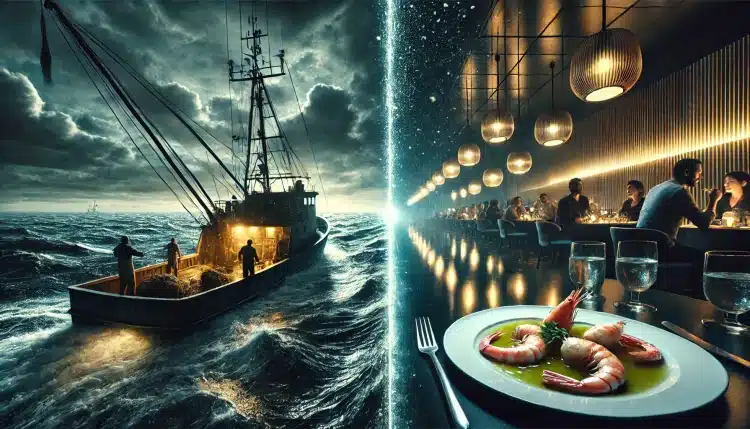
The Seafood Scandal Hiding in Plain Sight
Most of us love a plate of shrimp. It’s easy. It’s familiar. It’s the sizzling scampi at a seafood joint. The frozen shrimp cocktail trays stacked high in grocery store freezers. The “endless shrimp” special that feels like a small victory over food prices.
But beneath the butter, garlic, and cheerful marketing lies one of the darkest supply chains in the entire global food industry.
And it’s not just about bad management or shady deals. It’s about human lives. It’s about corporate greed. And it’s about the horrifying real-world price of cheap seafood.
The Real Story Behind “Endless Shrimp”

When Red Lobster declared bankruptcy in 2024, most folks shrugged. Another big chain bites the dust. Another victim of rising costs, poor leadership, or shifting tastes.
But then the layers started peeling back.
Years earlier, private equity firm Golden Gate Capital had already stripped the company down through a sale-leaseback scheme. Red Lobster sold off its own land just to finance its own buyout—turning stable restaurants into rent-burdened liabilities overnight. Golden Gate’s leadership traced back to Bain Capital and Bain & Company, names tied to a long list of hollowed-out brands.
By the end, Red Lobster wasn’t really a seafood company anymore. It was a shell carrying massive rent bills.
Still, the shrimp kept coming.
Then Thai Union Group entered the picture. One of the world’s largest seafood suppliers quietly bought 100% of Red Lobster—and just as quietly cut off every competing shrimp supplier.
Not long after that came the now-infamous “Endless Shrimp” promotion. It turned into an $11 million loss in a single quarter. But the real loss wasn’t financial.
The real loss was what it exposed.
The Global Shrimp Cartel
Thai Union isn’t some small overseas operation. It owns 62 seafood companies worldwide, including big-name brands like Chicken of the Sea. It controls shrimp farms and processing plants across Asia and South America. On paper, it ranks as a “sustainability leader.”
That’s the brochure version.
Behind the glossy green marketing lies a brutal economic truth: at the rock-bottom prices Western companies pay for shrimp, exploitation is not optional. It’s baked into the business model.
A report from Sustainability Incubator laid it out plainly—at today’s prices, shrimp production cannot operate without forced labor somewhere along the chain.
And somehow, the cruelty doesn’t even stop with the people.
The Science of Corporate Shrimp Farming
Shrimp don’t cooperate nicely with factory farming. Stress shuts down their ability to reproduce. That used to be a major problem—until something disturbing happened in the 1970s.
Thai shrimp farmers discovered that when a female shrimp loses an eye, her hormone levels spike and she becomes fertile almost immediately.
So began the practice known as eyestalk ablation—the industry’s polite term for slicing off a shrimp’s eye to force reproduction. Today, it’s standard practice worldwide.
Picture it: shallow tanks packed with thousands of pale, writhing bodies. Hot lights overhead. Plastic walls scraping their shells raw. Then a worker moves down the line with scissors, snips an eye, and tosses the shrimp back into the swirling mass. Weird, right?
Modern shrimp farming was born that way.
And from that moment on, the demand never stopped growing.
From Slave Boats to Your Plate: The Hidden Life of Shrimp
Whenever a market explodes, cheap labor usually follows. For Thailand’s shrimp empire, that labor poured in from Myanmar—formerly Burma—a nation scarred by poverty and war.
Refugees crossed borders hoping for factory jobs. What many found instead was human trafficking.
One fisherman named Tun Lin told his story in The Secret Life of Groceries. Promised a small factory job, he was loaded onto a truck, then forced onto a fishing boat. There were beatings. Starvation. Twenty-hour workdays.
Fourteen years at sea.
He watched men die. Some were beaten. Others were thrown overboard. The boats were resupplied while still at sea so they never had to dock. Floating prisons.
And this wasn’t rare.
Thousands of men remain trapped on boats just like that today.
The fish they catch—often too small or rotten to sell—gets ground into “trash fish” meal. That meal becomes shrimp feed. That shrimp becomes dinner on your plate.
Every link in the chain stinks—literally and morally.
The Women Behind the Shrimp
Back onshore, the torture never stops.
Before dawn, migrant women step into icy processing sheds. Shoulder to shoulder. Hands submerged in freezing water for hours. Heads ripped off shrimp. Shells stripped. Blood diluted into cloudy rinse water.
One worker in India told reporters she earns less than $4 a day. Others lose fingers to untreated infections. Some bring their children to work—not from choice, but necessity.
Many of these workers are employed by companies tied directly to Thai Union. When confronted, the company claims its branded trucks were merely “leased out.”
But the fingerprints are everywhere.
And when one country draws too much attention, production simply shifts somewhere cheaper and quieter—Vietnam, Ecuador, India, Indonesia. The misery migrates just ahead of the headlines.
The Fraud on Our Own Shores
But the deception doesn’t stay overseas.
Earlier this year, researchers DNA-tested shrimp sold in Gulf Coast restaurants. What they found stunned even longtime industry watchers.
In Tampa Bay and St. Petersburg, 96% of shrimp labeled “local Gulf shrimp” were fake—cheap imports repackaged as domestic.
In Baton Rouge, nearly one-third of shrimp samples were mislabeled.
So the shrimp in your gumbo might not come from the Gulf at all. It might come from an Indian factory where workers make $3 a day—or a Thai fishing boat where men haven’t touched land in years.
Meanwhile, American shrimpers try to play by the rules. And they’re being undercut by an industry that plays by none.
The High Price of Cheap Seafood
We like to think of ourselves as ethical shoppers. We look for buzzwords. “Sustainable.” “Fair trade.” “Responsibly sourced.”
Most of the time, those labels mean almost nothing.
Audits are often announced in advance. Paperwork can be faked. Inspections can be staged. And loopholes are wide enough to sail trawlers through.
Meanwhile, our hunger for more food at lower prices pushes the system harder every year.
Those endless shrimp promotions aren’t harmless fun. They help bankroll a supply chain built on forced labor, tortured animals, and corporate shell games.
Every discount platter carries invisible fingerprints—from men like Tun Lin and from women standing ankle-deep in freezing water for twelve-hour shifts.
Looking Beneath the Surface
Of course, nobody can trace every bite of food back to its origin. Perfection isn’t the goal.
Awareness is.
Because once you see how the system really works, you can’t unsee it. You start asking different questions. Where was this caught? Who processed it? Why is it this cheap?
At some point, convenience crosses a line into complicity. And while consumers play a role, so do retailers, regulators, and corporate boards that profit from the illusion of sustainability.
We’ve built a world that runs on impossible prices.
And as long as we keep believing that “endless shrimp” can exist without endless carnage, the machinery keeps grinding.
So the next time a menu boasts about bottomless shrimp, remember this:
Everything has a price tag. The big question is… who ultimately pays?