 Print
Print
The 47-Story Building That Fell On 9/11… Without Being Hit By A Plane
Building 7: The Fire Story Nobody Out Here Believes
Anybody who’s ever pulled down an old barn knows how a heavy thing dies. It groans. It leans. It twists against you, and sometimes it hangs there crooked while you’re standing 40 feet away with a chain around the tractor hitch wondering why in the world you volunteered for this job in the first place.
Then, when it finally gives, half the time it kicks sideways and lands square across the fence you fixed last Saturday. Beams resist. Nails hang on. Posts buckle. Rafters twist.
Even rotten lumber makes gravity earn its supper.
So when you watch a 47-story skyscraper suddenly drop with startling symmetry, your gut speaks up before your brain gets a chance to be polite about it. Something about it looks wrong, and for nearly 25 years Americans who noticed something strange about Building 7 have basically been told to quit noticing.
Chris Martenson of Peak Prosperity isn’t doing that. More importantly, he isn’t claiming he knows who brought Building 7 down, assuming somebody did; he’s asking a simpler—and in some ways much more uncomfortable—question:
Does the official explanation actually account for what our eyes, stopwatches and basic physics tell us happened?
To get there, he skips past the two towers everybody remembers and walks straight over to the skyscraper millions of Americans still barely know existed.
The Third Skyscraper That Fell On 9/11
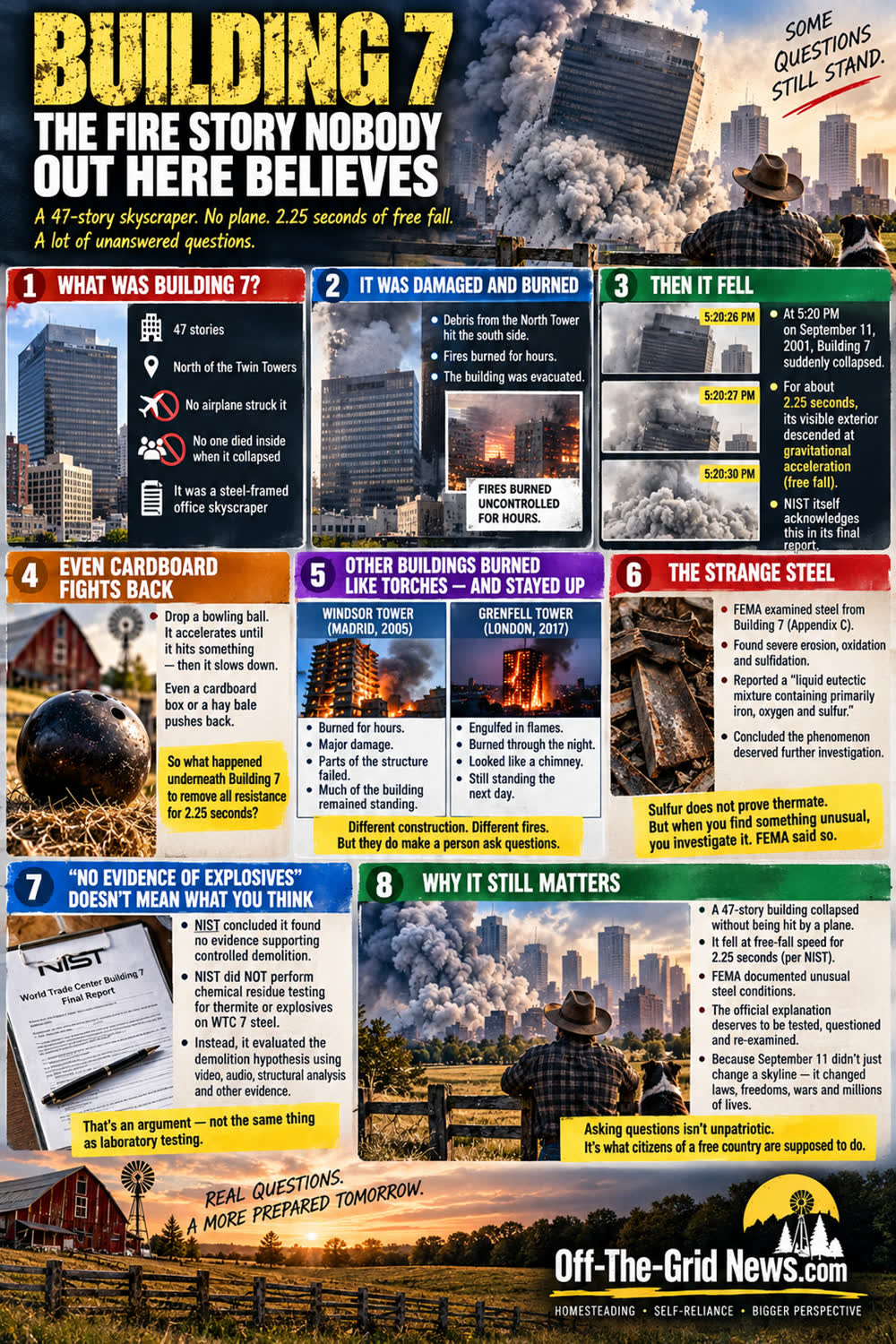
World Trade Center 7 wasn’t some garden shed hiding behind the Twin Towers. It was a 47-story steel-framed skyscraper standing north of the main World Trade Center complex, and as the NIST investigation itself documents, no airplane struck it.
But it was damaged. Debris from the collapse of the North Tower struck WTC 7, particularly on its south side, and fires burned uncontrolled for hours before the building came down late that afternoon.
The National Institute of Standards and Technology’s final WTC 7 report concluded that heat from the fires caused structural members to expand, eventually triggering failures around Column 79 and setting off a cascading internal collapse. NIST described this as the first known instance in which fire-induced local damage led to the total collapse of a tall building.
That’s the official explanation.
Now watch this video.
There’s smoke. There are fires. And yes, there was significant damage on the south side that isn’t obvious in the familiar north-face footage. But then the exterior starts coming down, and that’s where every farmer who has watched a corn crib collapse, every carpenter who has torn out a load-bearing wall, and every guy who has ever dropped something heavy through something else starts scratching his head.
For part of the descent, it doesn’t look like something fighting its way through 47 stories of structure.
It looks like somebody opened a trapdoor underneath it.
Other Towers Burned Like Torches—And Stayed Up
Now look at Madrid’s Windsor Tower fire. In 2005, fire tore through the high-rise for hours, flames rolling through floor after floor and lighting the thing up against the night sky like somebody had shoved a giant torch into downtown Madrid.
Parts of its steel perimeter structure failed, while much of its reinforced-concrete core remained standing. That comparison comes with an important fencepost: Windsor wasn’t built like WTC 7, and its reinforced-concrete structural components behaved differently under fire.
So no cheating.
A photograph of Windsor doesn’t magically disprove NIST’s explanation.
But it does make a fellow ask questions.
Then there’s Grenfell Tower in London. In 2017, fire raced up combustible exterior cladding and engulfed the 24-story residential tower in one of the most horrifying high-rise fires ever caught on camera.
By nighttime, the thing looked like a chimney standing in hell. Yet the primary structure remained standing.
Again—different construction. Different fire. Different structural system. Different failure mechanism.
Fine.
Then let’s quit arguing from photographs and get to something measurable.
Let’s drop a bowling ball.
Go Ahead And Drop The Bowling Ball
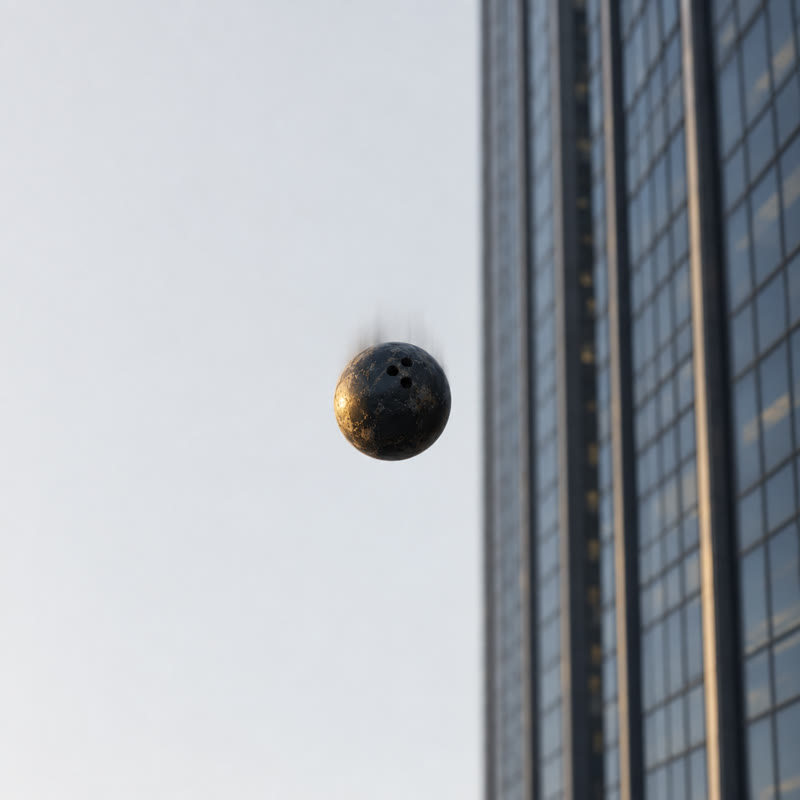
Imagine standing beside Building 7 when its visible exterior begins coming down. Hold a bowling ball out in front of you and let go.
For approximately 2.25 seconds, something remarkable happens. According to NIST’s own explanation of the measured descent, the north face of Building 7 entered a period of gravitational acceleration.
Plain English?
Free fall.
For that interval, the visible exterior was accelerating downward essentially the way your bowling ball would accelerate through open air.
And here’s where the history gets interesting. After criticism of the draft analysis, including challenges from independent researcher David Chandler, NIST’s final analysis divided the visible descent into three stages and identified the middle interval—roughly 1.75 to 4.0 seconds—as gravitational acceleration.
So we don’t have to argue anymore about whether free fall occurred.
NIST says it did.
Now we have a much better question: What happened underneath that exterior to remove enough structural resistance for roughly eight stories of gravitational acceleration?
Because gravity doesn’t negotiate.
Even Cardboard Fights Back
Go out to the barn and try something. Drop a feed sack onto a hay bale, drop a hammer through an old cardboard box, or throw a chunk of firewood onto a rotten pallet.
Something pushes back.
It may break. It may crush. It may buckle like a cheap lawn chair under your brother-in-law after Thanksgiving dinner. But it pushes back.
Watch a stuntman jump off a roof into cardboard boxes. He accelerates through open air, hits those boxes, and immediately begins slowing down.
Paper, glue and air.
Even cardboard fights back.
That’s why the free-fall interval matters. If a falling mass encounters intact structure capable of exerting meaningful upward force, some energy has to go somewhere: steel bends, connections break, columns buckle, floors accelerate, and material gets crushed, twisted and shoved out of the way.
All of that costs something.
Physics keeps receipts.
Now, NIST has an answer. Its position is that the building’s interior had already undergone catastrophic progressive collapse before the exterior entered that free-fall interval, leaving the exterior structure temporarily unsupported.
Okay.
Then that’s the argument.
Not whether free fall happened, but what removed the support—and whether the proposed collapse sequence adequately explains how it disappeared so completely over that interval.
That’s a perfectly legitimate question.
Gravity Doesn’t Take Government Holidays
Newton doesn’t care who you voted for. He doesn’t care what CNN said, what Fox said, what your uncle posted on Facebook after three bourbons, or which federal agency stamped its logo across the front of a report.
Gravity is wonderfully rude that way.
It just works.
If a falling object encounters meaningful resistance, its motion changes. Energy goes into bending, breaking, buckling, heating and accelerating whatever is underneath it.
That’s why Martenson keeps hammering this point. He’ll entertain theories, but he won’t suspend gravity for one afternoon in 2001 just because the paperwork gets easier.
And when ordinary people put footage of Building 7 beside footage of conventional controlled demolitions, you can understand why they look at the screen and say:
“Okay. Explain that.”
Proof of demolition?
But neither is it stupidity.
Then we get to the steel.
And this is where the story gets downright strange.
Steel That Looked Like A Blacksmith’s Nightmare
Before NIST completed its investigation, FEMA conducted an earlier building-performance study. Buried in Appendix C of FEMA’s World Trade Center Building Performance Study is one of the strangest pieces of physical evidence in the entire World Trade Center story.
Investigators performed what they called a “limited metallurgical examination” on severely eroded structural steel, including an A36 steel sample identified as coming from WTC 7. And “eroded” is putting it mildly.
The photographs look like somebody fed the steel to an angry blacksmith. Edges are eaten away, sections are thinned, and the metal looks less like a structural member than something dragged out of the bottom of an industrial furnace.
FEMA reported that a liquid eutectic mixture containing primarily iron, oxygen and sulfur had formed during what investigators called a “hot corrosion attack” on the steel.
Read that again.
That isn’t something typed by a fellow in a bunker with canned beans stacked behind him.
That’s FEMA.
The investigators documented oxidation and sulfidation and concluded that the severe corrosion phenomenon warranted further investigation. Their report discusses sulfur penetrating the steel’s grain boundaries and iron sulfide formation in the affected material.
Now sulfur gets interesting. Sulfur can dramatically alter the behavior of iron at elevated temperatures, and critics have pointed out that sulfur is also associated with incendiary formulations such as thermate.
But here’s an important distinction.
Sulfur does not equal thermate.
Gypsum wallboard and other ordinary building materials also contain sulfur, so merely finding sulfur in the steel doesn’t prove somebody planted an incendiary material.
Fair enough.
But country common sense still gets a chair at this table.
If you pull a dead calf out of the pasture and find something unusual in its stomach, you don’t throw the stomach away because you already have a theory about why the calf died. You investigate the weird thing.
FEMA found a weird thing.
And FEMA said so.
“No Evidence Of Explosives” Doesn’t Mean What Most People Think It Means
NIST ultimately concluded that it found no evidence supporting controlled demolition. Its WTC 7 FAQ addresses the demolition question directly, including the possibility of explosives or thermite.
But there’s an important fencepost here, and somebody needs to paint it bright red so everybody can see it. NIST says it did not test WTC 7 steel for explosive or thermite residue, explaining that other evidence made those hypotheses implausible.
Instead, NIST evaluated the demolition hypothesis using video, audio, structural analysis and other evidence. Among other things, investigators argued that an explosive charge powerful enough to fail the critical column would have produced an enormous sound that should have been plainly recorded.
That’s an argument.
Maybe it’s a good one.
But it isn’t the same thing as laboratory residue testing.
There is a world of difference between saying:
“We evaluated the explosive hypothesis and concluded the evidence doesn’t support it.”
And saying:
“We chemically tested the recovered material for explosive and incendiary residues and found none.”
Those sentences are not twins.
They’re not even cousins.
And when somebody points out the difference, the proper response isn’t to hand him a tinfoil hat.
Answer the question.
Questions Aren’t Conclusions
This is where everybody needs to keep his truck between the ditches. One crowd sees Building 7 and immediately claims it proves who planned 9/11, how they did it, why they did it and probably what everybody involved ate for breakfast.
Nope.
Evidence doesn’t give you permission to invent the missing pieces.
But the other crowd is just as bad. They hear “Building 7” and immediately start smirking, as though asking questions about a 47-story skyscraper falling on September 11 automatically means you think Elvis planted explosives with Bigfoot.
Knock it off.
The free-fall interval is real, and NIST acknowledges it. The unusual sulfur-related corrosion is real, and FEMA photographed and documented it.
No airplane struck Building 7. The building also suffered significant debris damage and uncontrolled fires, and NIST produced an extensive fire-induced progressive-collapse explanation that deserves to be represented accurately before anybody tries to knock holes in it.
Those facts can all sit on the same workbench.
Then start measuring.
Don’t Tell Me The Fence Is Straight—Stretch A String
That’s what bothers ordinary people about this whole subject. Out here, you don’t settle an argument about a fence line by announcing that the county has officially determined the fence is straight.
You stretch a string.
If the survey looks wrong, you run it again. If your well water suddenly smells funny after the neighbor spreads manure uphill, you don’t drink another gallon because somebody in an office says the odds are probably fine.
You test it.
And if three calves get sick after eating from the same feeder, you don’t shrug and announce that coincidence remains the leading hypothesis.
You check the feed.
That isn’t conspiracy thinking.
That’s how people who live around things that can kill them learn to think.
What We’re Owed
None of this tells you who. It doesn’t prove explosives, it doesn’t prove thermate, and it doesn’t give anybody permission to grab whatever theory happens to fit his politics and start pounding square pegs into round holes.
But it absolutely justifies questions.
Hard questions.
A 47-story skyscraper that wasn’t struck by an airplane collapsed on September 11 after hours of fire and debris damage. During part of that collapse, its visible exterior underwent approximately 2.25 seconds of gravitational acceleration, something NIST itself acknowledges in its explanation of the collapse.
Meanwhile, FEMA documented severe erosion, oxidation and sulfidation in recovered structural steel and described the phenomenon as deserving further investigation. Those facts don’t finish the story.
They’re the reason you keep investigating it.
And look at what America built on the foundation laid that morning: the Patriot Act, enormous expansions of surveillance and federal security power, wars stretching across decades, trillions of dollars spent, thousands of American dead and wounded, and families changed forever.
Those consequences weren’t theories.
They happened.
So asking whether every important physical question surrounding September 11 received the investigation it deserved isn’t unpatriotic. It’s exactly what citizens of a serious republic are supposed to do.
Government reports are not Scripture. Engineers are not apostles. Federal agencies are not infallible.
And gravity doesn’t salute the flag.
If the official explanation is right, throw every hard question we have at it. Let the measurements come, let the critics come, and let independent engineers kick the tires, crawl underneath with a flashlight and bang on the frame with a wrench.
Truth doesn’t need the questions kept outside the fence.
And if the survey still doesn’t square with the fence posts, don’t tell the farmer to quit looking at his fence.
Go back out and survey the field again.