 Print
Print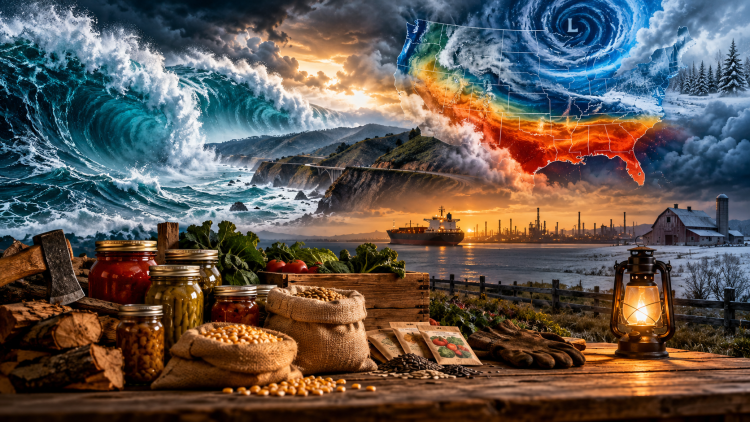
A Powerful El Niño Is Coming… But The Trouble Behind The Storm Clouds Could Hit Your Pantry Even Harder
A Historic El Niño Is Loading The Storm Track… While Trouble In Fertilizer, Fuel And Food Is Quietly Loading Something Much Bigger
Right now, the Pacific Ocean is brewing a monster. And California isn’t waiting around to see whether that monster actually throws a punch.
On September 21, Gov. Gavin Newsom declared a statewide emergency to prepare California for what officials say could become a historic El Niño winter. The order begins staging flood-fighting equipment, pumps, sandbags, road crews and emergency supplies—and prepares the California National Guard to assist with flooding, search-and-rescue, engineering and logistics if things get ugly. California’s own emergency proclamation makes clear this is preparation for storms that haven’t even arrived yet.
Think about that for a moment. The winter storms they’re preparing for haven’t even formed, and they’re already moving equipment into place.
That tells you something.
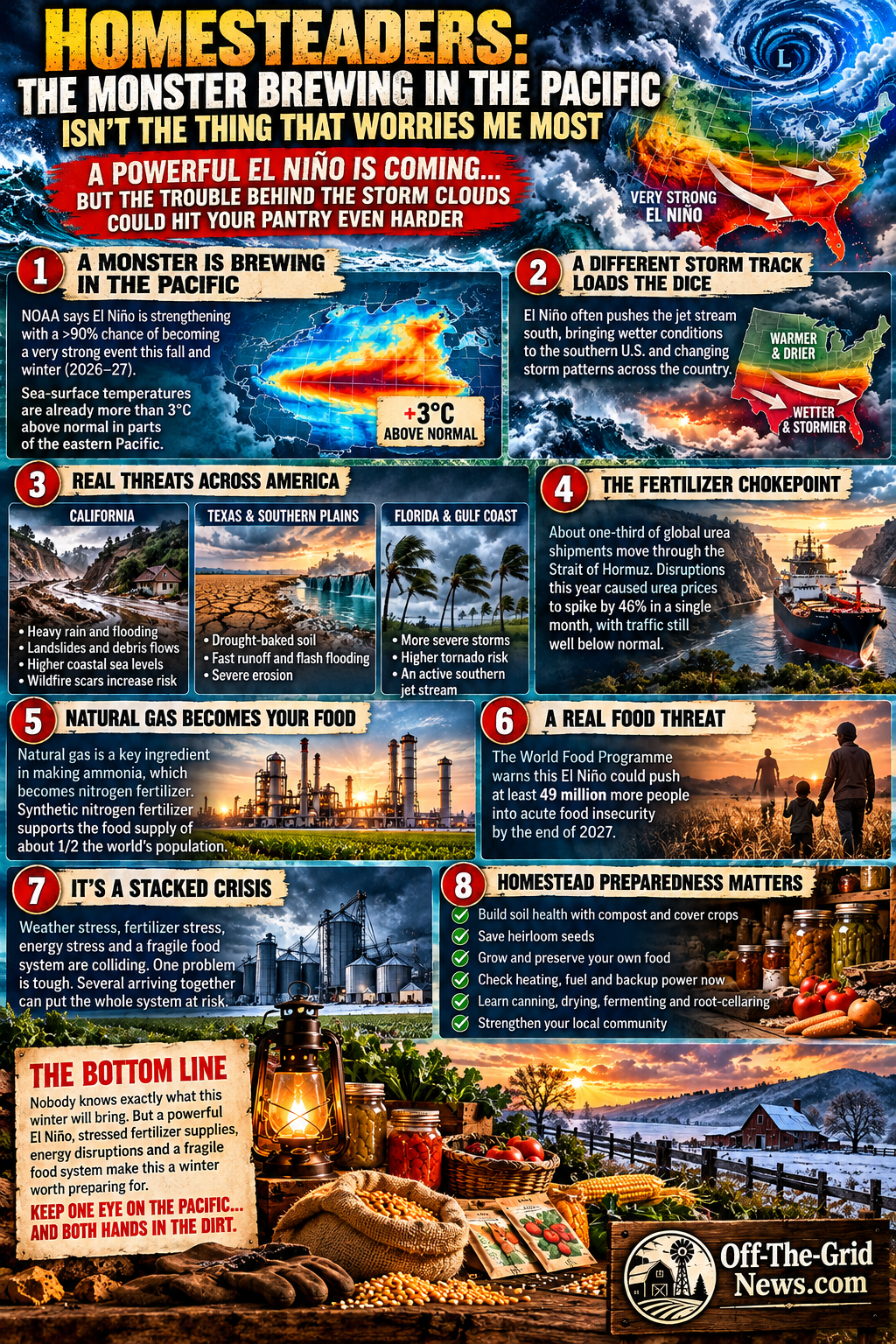
According to NOAA’s September El Niño advisory, El Niño is strengthening, with a greater than 90 percent chance of becoming a very strong event during the fall and winter of 2026–27. Sea-surface temperature anomalies have exceeded 3°C above normal in parts of the eastern equatorial Pacific, with the Niño-1+2 region reaching about +3.4°C in August.
Now, that doesn’t mean every scary weather prediction is going to come true. El Niño loads the weather dice; it doesn’t tell us exactly where they’ll land.
But when the barn door starts banging in the wind, a smart farmer doesn’t wait until the roof comes off to look for his hammer.
And here’s where this story gets more interesting.
Because the weather may only be the opening act.
A Monster Storm Track Is Setting Up
El Niño starts with warm Pacific water, but it doesn’t stay politely in the Pacific. Those unusually warm waters alter tropical rainfall and atmospheric circulation, which in turn can move the jet stream—the great atmospheric highway that steers storms across North America.
NOAA explains that during El Niño winters, the Pacific jet stream commonly shifts southward, increasing the odds of wetter conditions across much of the southern United States. NOAA is careful to point out that these are tendencies rather than guarantees because every El Niño behaves a little differently.
Think of it like moving the gutter on your barn roof. Move that gutter six feet and suddenly water that used to drain harmlessly into the pasture is pouring beside your foundation.
That’s roughly what happens when a major atmospheric highway moves.
California is particularly concerned about heavy rain, flooding, coastal damage, landslides and debris flows. Areas below recent wildfire scars are especially vulnerable because damaged soil and vegetation can shed rainfall rapidly, sending water, mud, rocks and burned debris downhill.
Then there’s the coast. El Niño can temporarily elevate coastal sea levels, and when that elevated water gets stacked together with storm surge, big waves and the year’s highest astronomical tides, water can wind up considerably farther inland than folks are accustomed to seeing it.
None of that means California is guaranteed another Noah’s Flood. But it explains why officials aren’t waiting until rain is bouncing off the governor’s windows before getting ready.
Texas Could Go From Dust To Water In A Hurry
Then look east toward Texas, Oklahoma and New Mexico, where some areas have been wrestling with prolonged drought.
You’d think rain would be nothing but good news there.
Sometimes it is.
But anybody who’s ever dumped a bucket of water onto sun-baked garden soil knows what can happen. Instead of soaking in nicely, the water runs across the top carrying dirt, gravel and whatever else happens to be downhill.
The U.S. Geological Survey is specifically warning about this possibility during the 2026–27 El Niño. USGS says heavy rainfall falling on hard soils could produce extensive runoff, flash flooding, erosion and even landslides in vulnerable areas.
That’s the strange thing about drought.
Sometimes the first cure creates another problem.
A long, soaking rain spread over several days can recharge ponds, aquifers and thirsty fields. Three inches coming down like somebody tipped over God’s washtub is a different animal altogether.
Florida Has Another Problem
Meanwhile, Florida gets its own version of the El Niño lottery.
The southern jet stream tends to become more active during strong El Niño winters, creating conditions that can favor severe thunderstorms across Florida and the Gulf Coast. Historical research from the National Weather Service in Melbourne found a particularly notable relationship between strong El Niño episodes and strong dry-season tornadoes in Florida.
Again, that doesn’t mean Florida is guaranteed a tornado outbreak this winter. Weather doesn’t work like a kitchen timer.
It means the atmospheric dice are being loaded differently.
And that’s worth knowing before somebody starts rolling them.
But The Bigger Threat May Be Sitting On A Cargo Ship
While everybody watches clouds gathering over the Pacific, something far quieter has been happening thousands of miles away.
The global fertilizer system took a serious hit this year.
The Strait of Hormuz isn’t just an oil story. Before the Middle East war, roughly one-third of global urea shipments moved through that narrow stretch of water, along with enormous quantities of sulfur, ammonia and other fertilizer-related materials. Reuters reported in June that fertilizer shipments had begun moving again after the earlier near-closure, but traffic remained well below pre-war levels.
And the problem hasn’t disappeared.
As of late September, commercial traffic through Hormuz remains severely disrupted. Reuters reported September 22 that only two commodity vessels were observed crossing the strait on one Monday, compared with an average of roughly 125 large commercial ships per day before the conflict escalated.
That’s not a little kink in the garden hose.
That’s somebody standing on it.
When traffic through the strait collapsed earlier this year, fertilizer markets reacted violently. A May analysis published in Nature reported that urea prices jumped nearly 46 percent in a single month as geopolitical and energy shocks hammered nitrogen supply chains.
Prices have since backed away from some of those peaks, and that’s important to say. But the plumbing underneath the fertilizer market is still badly stressed, and a fertilizer shortage doesn’t have to empty your grocery store tomorrow to cause trouble next year.
Agriculture has a long fuse.
Natural Gas Goes In… Food Comes Out
Most people think of natural gas as the stuff that heats the house. Farmers know there’s another side to that story because natural gas is also a crucial ingredient and energy source in the manufacture of ammonia, which becomes nitrogen fertilizer.
That nitrogen fertilizer is one of the quiet miracles holding up modern agriculture. Researchers writing this summer in Nature Medicine noted that synthetic nitrogen fertilizers produced through the Haber-Bosch process currently support the food supply of approximately half the world’s population.
Stop and chew on that number.
Half the planet is standing, at least partly, on bags of nitrogen.
So when energy gets expensive, fertilizer can get expensive. When fertilizer gets expensive, farmers start sharpening their pencils and deciding whether to apply less, switch crops, plant fewer acres or borrow more money and hope commodity prices cooperate.
And here’s the important part: you don’t necessarily notice any of that Tuesday afternoon at Walmart.
The fertilizer problem happens first. The planting decision comes later, the yield problem comes months after that, and only then does the grocery shopper discover somebody farther up the chain already pulled the pin.
The Hidden Food Threat
This is where El Niño and the fertilizer crisis begin bumping into each other.
The World Food Programme warned in August that the strengthening 2026–27 El Niño could push at least 49 million additional people into acute food insecurity by the end of 2027. Its analysis covers 45 countries where El Niño could significantly alter rainfall, temperature, flooding and drought patterns.
WFP isn’t saying El Niño automatically starves 49 million people. It’s saying these weather shocks could land on populations already struggling with conflict, poverty, high food prices and fragile agriculture.
That’s an important distinction.
But it’s hardly comforting.
The danger isn’t one clean problem arriving all by itself. It’s weather stress sitting on fertilizer stress, fertilizer stress sitting on energy stress, and energy stress sitting on a food system that already has millions of people hanging onto the wagon by their fingertips.
One broken fence post isn’t usually a disaster.
Five broken posts along the same stretch of fence can put the whole herd on the highway.
Remember The Food War Game?
Here’s another uncomfortable piece of history.
Back in 2015, policymakers, academics, business executives and other participants gathered in Washington for something called Food Chain Reaction: A Global Food Security Game. It wasn’t a prophecy or some secret blueprint—it was a stress test designed to see what might happen if climate problems, crop failures, political instability and food shortages started feeding on one another.
According to the CNA report on the exercise, the fictional scenario eventually produced two major food crises and global food prices approaching 400 percent of their long-term average.
Again, that doesn’t mean somebody “predicted” your grocery bill would quadruple.
That’s not what simulations do.
But it demonstrates something planners have understood for years. Food systems can absorb one punch and sometimes two, but things become considerably more dangerous when the punches start arriving from several directions at once.
Weather.
Energy.
Fertilizer.
Transportation.
War.
Harvests.
Now look back at what’s happening in 2026 and ask yourself whether keeping a little extra food in the pantry really sounds crazy.
Fuel, Fertilizer And Your Farm
And that’s where this stops being a story about California governors, Pacific temperatures and cargo ships halfway around the planet.
Walk outside and pick up a handful of dirt.
That’s where your insurance policy begins.
A homestead dependent upon a truck delivering fertilizer every spring isn’t entirely independent. Neither is a garden that requires a box of chemical inputs from the store before it’ll grow supper.
So start building fertility at home. Compost kitchen scraps and manure where appropriate, learn what your soil actually needs instead of blindly throwing fertilizer at it, and begin thinking about fertility as something you grow instead of something you buy.
Cover crops deserve special attention. The USDA’s Natural Resources Conservation Service says cover crops can reduce erosion, improve water infiltration, build organic matter and improve nutrient availability, while legumes such as clover can contribute nitrogen to the soil.
That’s not prepper theory.
That’s farming.
And save seed.
Not because every commercial seed company is going to disappear tomorrow morning, but because seed is stored possibility. It’s next year’s garden sitting quietly in a jar.
Grandpa understood that.
A sack of seed corn hanging from the rafters wasn’t decoration.
It was next year’s supper.
Grow It… Then Figure Out How To Keep It
Of course, growing food is only half the job. A garden bursting with tomatoes in August doesn’t do much for you in February if every tomato rotted behind the barn.
So relearn the boring stuff: canning, dehydrating, fermenting, root-cellaring, freezing where dependable electricity is available, and dry storage for beans, grains and seed. The National Center for Home Food Preservation maintains research-based instructions for canning, freezing and drying food, which is especially worth bookmarking if Grandma’s old recipe happens to include instructions like, “Boil it awhile and it’ll probably be fine.”
Some traditions deserve preserving.
Botulism isn’t one of them.
Those old preservation skills aren’t quaint hobbies for people who like gingham curtains and antique Mason jars. They’re technologies—cheap, understandable technologies that have kept human beings alive considerably longer than smartphone apps have.
Heating, Harvesting And Holding The Line
Energy deserves exactly the same treatment.
Don’t wait until the first ice storm to discover the generator hasn’t started since Easter. Run it now, check the oil, rotate old gasoline where appropriate, test the battery, look at the propane gauge, clean the chimney and stack firewood somewhere it can actually stay dry.
Then walk around your house on a windy evening and figure out where January is going to sneak through the cracks. A $12 tube of caulk isn’t glamorous preparedness, but neither is sitting in the living room wearing three coats because the wind is blowing through the window frame.
Interestingly, NOAA’s September seasonal outlook currently favors above-normal temperatures across large portions of the country during parts of the coming season. But seasonal forecasts describe broad averages—not whether your county gets hammered by one nasty Arctic outbreak during a particular week.
That’s another lesson homesteaders understand instinctively.
A “mild winter” can still contain three miserable days capable of freezing pipes, killing livestock and knocking electricity out.
You don’t prepare for the average.
You prepare for the bad Tuesday.
Keep One Eye On The Pacific… And Both Hands In The Dirt
Nobody knows exactly what this winter will bring. California could get hammered, some predicted storms may miss, Texas could get desperately needed rain while still suffering destructive flooding in places, and Florida could experience a nasty severe-weather season—or dodge much of it.
That’s weather.
But the bigger picture is harder to ignore. NOAA says we have a greater than 90 percent chance of a very strong El Niño this fall and winter. Fertilizer and energy systems have already been battered by a major geopolitical disruption, while the World Food Programme is warning that the effects of this El Niño could carry into future harvest cycles and push millions more people toward serious hunger.
You don’t need to build a bunker.
You need to build resilience.
That means good soil, stored food, backup heat, backup power, seeds, tools, water and practical skills. And perhaps most importantly, it means having neighbors who still answer the phone when something goes wrong.
Because when the snow is blowing sideways, the power line is lying across the road and your tractor won’t start, Washington is a mighty long way from the barn.
Your neighbor isn’t.
So keep one eye on that warm Pacific Ocean, but keep both hands in the dirt. Because whatever comes over the horizon this winter, the strongest insurance policy may still be the oldest one mankind ever invented:
A productive piece of ground… a stocked pantry… and people willing to help one another when the weather turns mean.