 Print
Print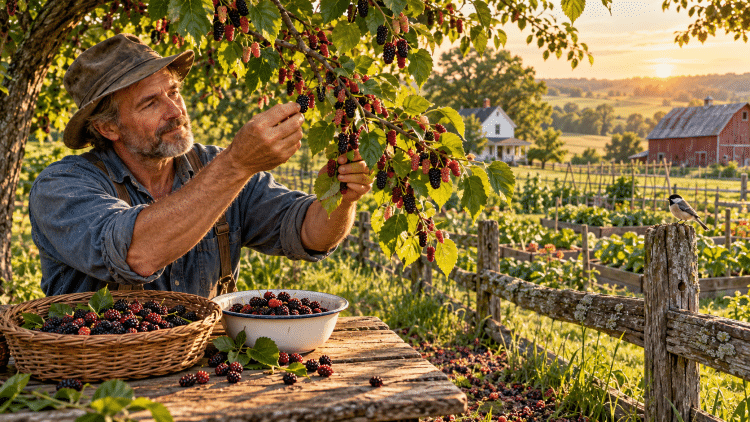
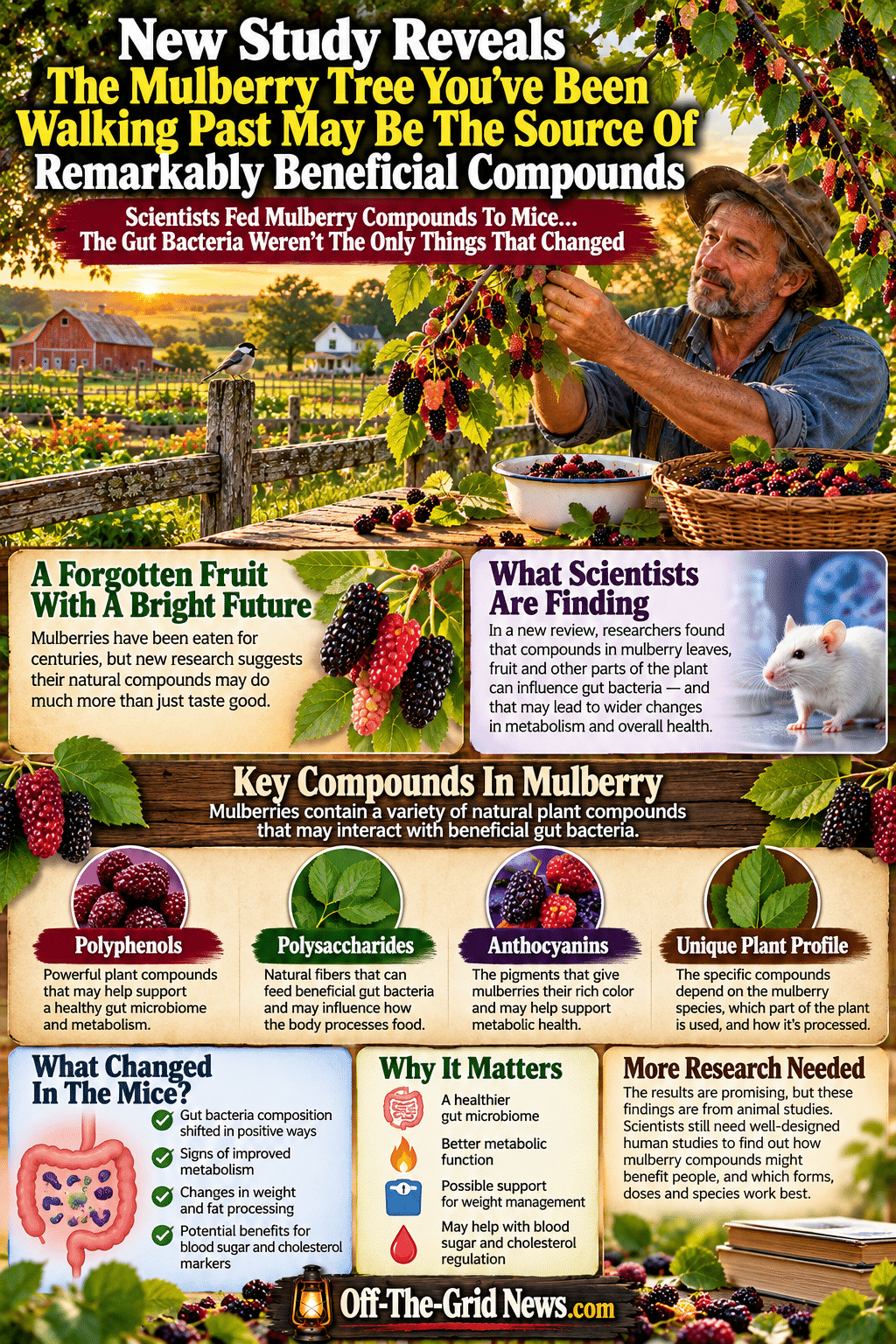
Scientists Fed Mulberry Compounds To Mice… The Gut Bacteria Weren’t The Only Things That Changed
Birds Have Been Getting Your Mulberries… Have They Been Getting Your Powerful Polysaccharides?
Somewhere along a fence line, a mulberry tree is dropping fruit while somebody scrolls through an advertisement for the latest expensive “gut health breakthrough.”
There’s a little country comedy in that picture. We’ll walk past food growing on a tree, then pay good money for a bottle promising to reconnect us with nature.
Now, researchers are giving mulberry a closer look. And what they’re finding is interesting enough to make you reconsider that purple mess on the ground.
A review published in Biomolecules, involving researchers at Wroclaw Medical University, examines how mulberry preparations may influence gut microorganisms, intestinal function, and metabolism. The results suggest real possibilities—but the plant part, species, and processing method matter considerably.
Before anybody starts printing “miracle berry” labels, understand one thing: the promising gut findings come primarily from animals and laboratory experiments.
You and a laboratory mouse don’t wear the same overalls.
Your Gut Has A Work Crew… And It Matters What You Feed It
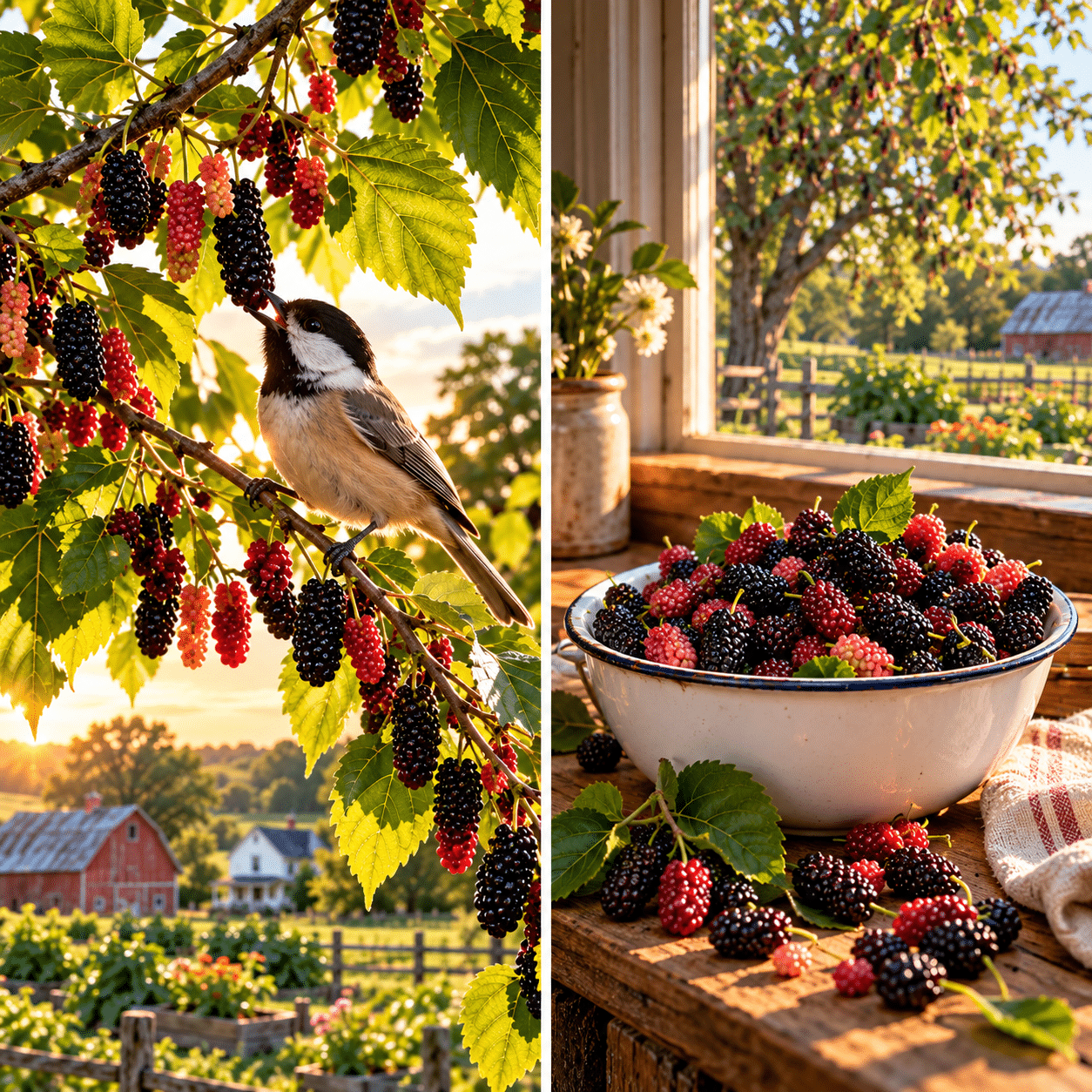
A homesteader understands that a garden is more than dirt holding up tomato plants. There’s a living community underneath, and what happens down there helps determine what happens aboveground.
Your digestive tract has its own living community. Bacteria and other microorganisms help process what reaches them, producing substances that can influence the intestinal environment.
Think of them as a work crew operating behind the barn doors. You may never see the crew, but that doesn’t make its work unimportant.
Among its products are short-chain fatty acids, including acetate, propionate, and butyrate. These arise when microbes ferment certain dietary materials and help support normal intestinal function.
That’s part of what makes mulberry interesting. Its compounds may influence both which microbes thrive and what those microbes produce.
The question isn’t simply, “What nutrients are in this berry?” It’s also, “What happens when the creatures living inside us get hold of it?”
A Berry, A Leaf, And A Capsule Aren’t The Same Thing
Here’s where a perfectly good plant story can turn into a perfectly lousy sales pitch.
Somebody hears that mulberry showed promise in a study. Suddenly, every tea, powder, capsule, and gummy with “mulberry” on the label wants credit for the result.
But that’s like saying a fence post and a rocking chair are interchangeable because both came from a tree.
Much of the research concerns white mulberry, Morus alba. Black mulberry, Morus nigra, has also attracted attention, particularly its fruit.
The leaves contain compounds including 1-deoxynojirimycin, mercifully shortened to DNJ, which is associated with carbohydrate metabolism. They also contain polyphenols and polysaccharides.
Black mulberry fruit, meanwhile, is particularly rich in anthocyanins, along with other phenolic compounds and polysaccharides.
Those chemical differences matter. Results from a concentrated leaf preparation don’t automatically tell us what a handful of ripe berries will do.
And neither tells us what’s happening inside a bottle with a cheerful tree printed on it.
The Recipe May Matter As Much As The Crop
Now add another wrinkle: processing.
Drying, fermentation, extraction, and other preparation methods can change the amounts and proportions of compounds in the finished material. Two products starting with the same plant part can end up meaningfully different.
Any gardener who has turned cabbage into sauerkraut already understands the general principle. What you do after harvest can change what you end up eating.
In the mulberry research, different extraction methods produced black mulberry fruit polysaccharides with different structures. Those differences affected how gut microbes used them.
Water-extracted fractions and fractions obtained using an enzyme called pectate lyase showed particularly promising prebiotic potential in the experiments described.
That’s useful information for researchers trying to identify what works. It isn’t a recipe telling the rest of us to boil some leaves and expect the same result.
The details are the experiment.
The Most Interesting Result Came From A Team Effort
One particularly intriguing experiment involved mice eating a high-fat diet.
Researchers tested fractions from white mulberry fruit containing polyphenols, polysaccharides, or a combination of both. The combined preparation produced more favorable gut microbial changes than either fraction alone.
Those changes accompanied improvements in some measurements related to metabolic disturbances and intestinal health.
Think of a farm crew. The fellow who fixes equipment and the fellow who knows the soil may accomplish more together than either manages alone.
That doesn’t prove every whole food always outperforms every isolated compound. It suggests that, in this experiment, the combination mattered.
Then researchers took the investigation another step.
They transferred gut microbiota from mice receiving the combined preparation into other animals. Those recipients also showed improvements in certain metabolic disturbances.
That strengthens the case that the microbial changes helped produce the effects, rather than simply occurring alongside them.
It’s an interesting clue. It still isn’t a human treatment plan.
The Missing Piece Has Two Legs And Pays Grocery Bills
Here’s the largest unanswered question: does this work in people?
The supplied research summary reports that human studies directly examining mulberry preparations’ effects on gut microbiota were still missing. Most of the evidence came from animal models and laboratory experiments.
That distinction deserves more than tiny print underneath a shopping-cart button.
A preparation may change bacteria in a laboratory vessel without delivering the same benefit inside a person. And an improvement in a mouse doesn’t establish how much a human should take, for how long, or with what result.
Researchers also need to know precisely what they’re testing. “Mulberry extract” is a loose description when species, plant part, processing, and chemical composition can all influence the outcome.
Otherwise, comparing studies becomes like comparing harvests without knowing who planted corn and who planted turnips.
Proper human trials need well-characterized preparations, meaningful measurements, and enough detail to explain what actually happened.
Don’t Let A Good Food Become Another Expensive Fairy Tale
For the homesteader, the sensible response is curiosity with both boots on the ground.
Mulberry has a long history as food and in traditional medicine. That makes it worth investigating, but history alone cannot establish the specific metabolic benefits now under discussion.
Likewise, promising research doesn’t turn a food into a cure.
Enjoying mulberries as food is one proposition. Buying a concentrated preparation to change your blood sugar, body weight, or gut bacteria is another—and this research doesn’t make those promises reliable.
Before spending money, ask a plain question: Was this exact preparation tested in people for the benefit being advertised?
If the answer wanders off into laboratory mice, proprietary blends, and “ancient wisdom,” keep hold of your wallet.
Sometimes The Interesting Thing Is Already Outside
The mulberry story doesn’t need a miracle claim to deserve attention.
An old food contains compounds that interact with an extraordinarily complicated living system. Scientists are finding that the combinations and preparation methods may matter as much as the plant’s name.
That’s a better story than another magic capsule.
So take a second look at the ordinary food growing around you. Learn what it is, understand its uses, and follow the evidence without making it carry more weight than it can bear.
That mulberry tree may have more going for it than purple stains and happy birds.
But let the researchers finish measuring before the salesmen finish promising.