 Print
Print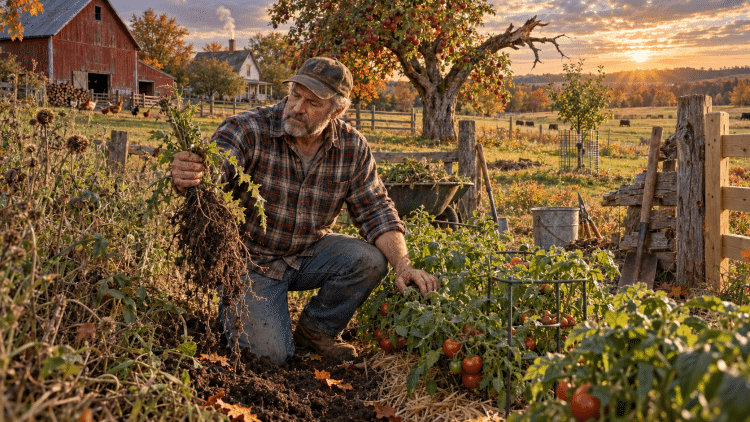
Why Real Freedom Means Knowing What To Keep… And What To Pull Up
Sometimes The Most Important Thing A Free Man Can Say Is: “Not In This Field”
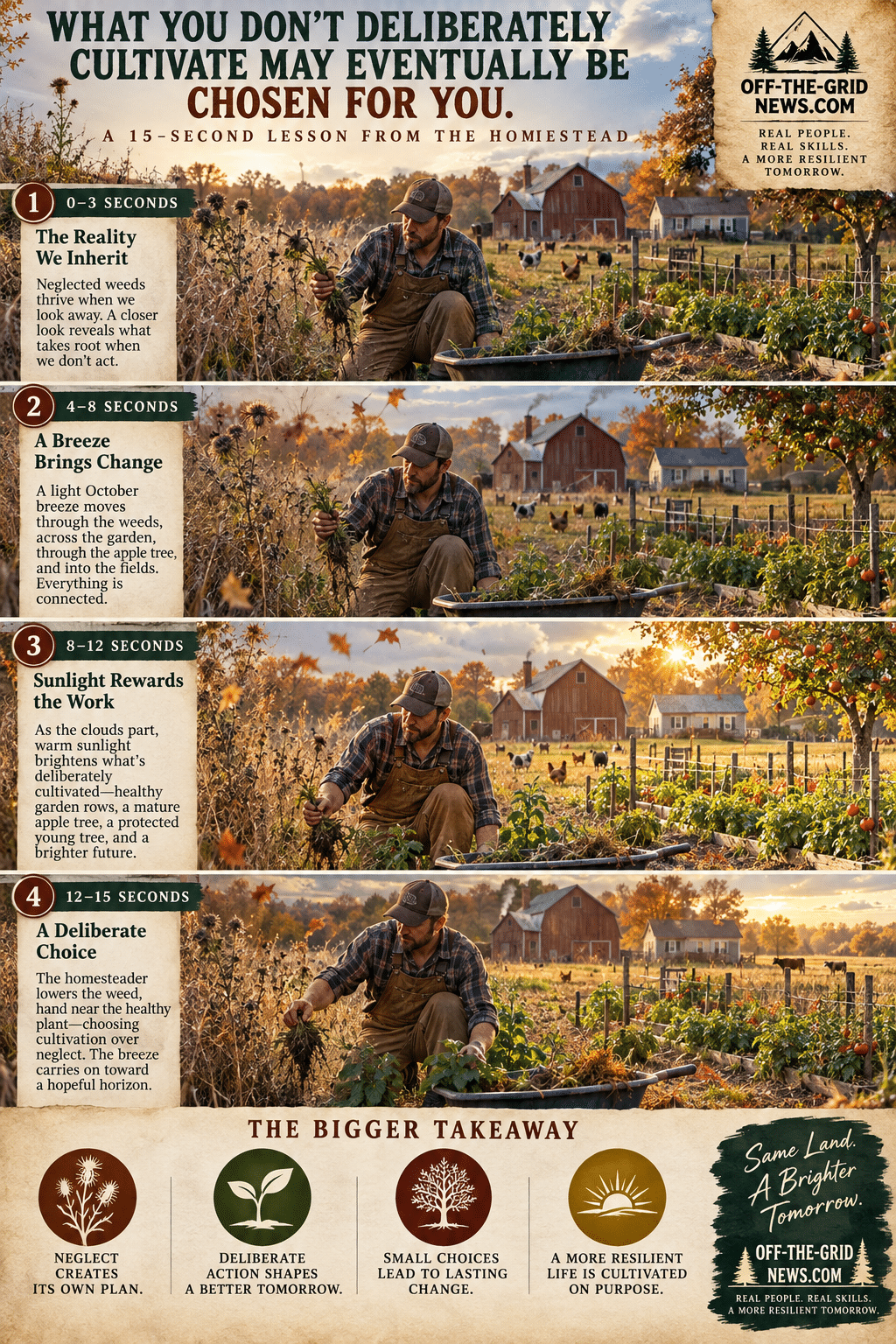
Walk out to your garden in May and leave it alone until August. Don’t weed it, mulch it, prune anything, thin anything or pull anything that doesn’t belong there.
Just let nature take its course.
Then come back in late summer and take a good look. You’ll probably still have a garden—technically—but the tomatoes will be fighting bindweed, lamb’s-quarter may be shoulder-high, the cucumbers will have disappeared beneath something you don’t remember planting, and whatever carefully drawn garden plan you made back in February will look like ancient history.
Now here’s the funny part.
The garden followed the trend perfectly.
Nobody interfered. Nobody imposed his judgment on it, and nobody had the arrogance to declare one plant desirable and another plant a weed.
The field was free to become whatever came naturally.
And it became a mess.
There’s a lesson hiding in those weeds, and it takes us right back into the Four Fields.
The Future Doesn’t Automatically Get Better
We’re surrounded by a strange modern assumption that almost nobody bothers to examine: the future is coming, therefore the future must somehow represent progress.
New is better. The latest idea is smarter than the old one, the latest technology must improve our lives, the newest philosophy must be more enlightened, and whatever society is moving toward must somehow be superior to whatever we’re leaving behind.
In other words, there’s a trend.
And once somebody announces that something is “the trend,” we’re expected to climb aboard without asking where the wagon is headed.
But why?
The source material behind this article makes a wonderfully simple point: a decent man shouldn’t automatically be for the trend or against the trend. He should ask whether the thing itself is good.
That’s a much tougher job because sometimes the trend is right. And sometimes the bandwagon is rolling downhill with nobody sitting behind the steering wheel.
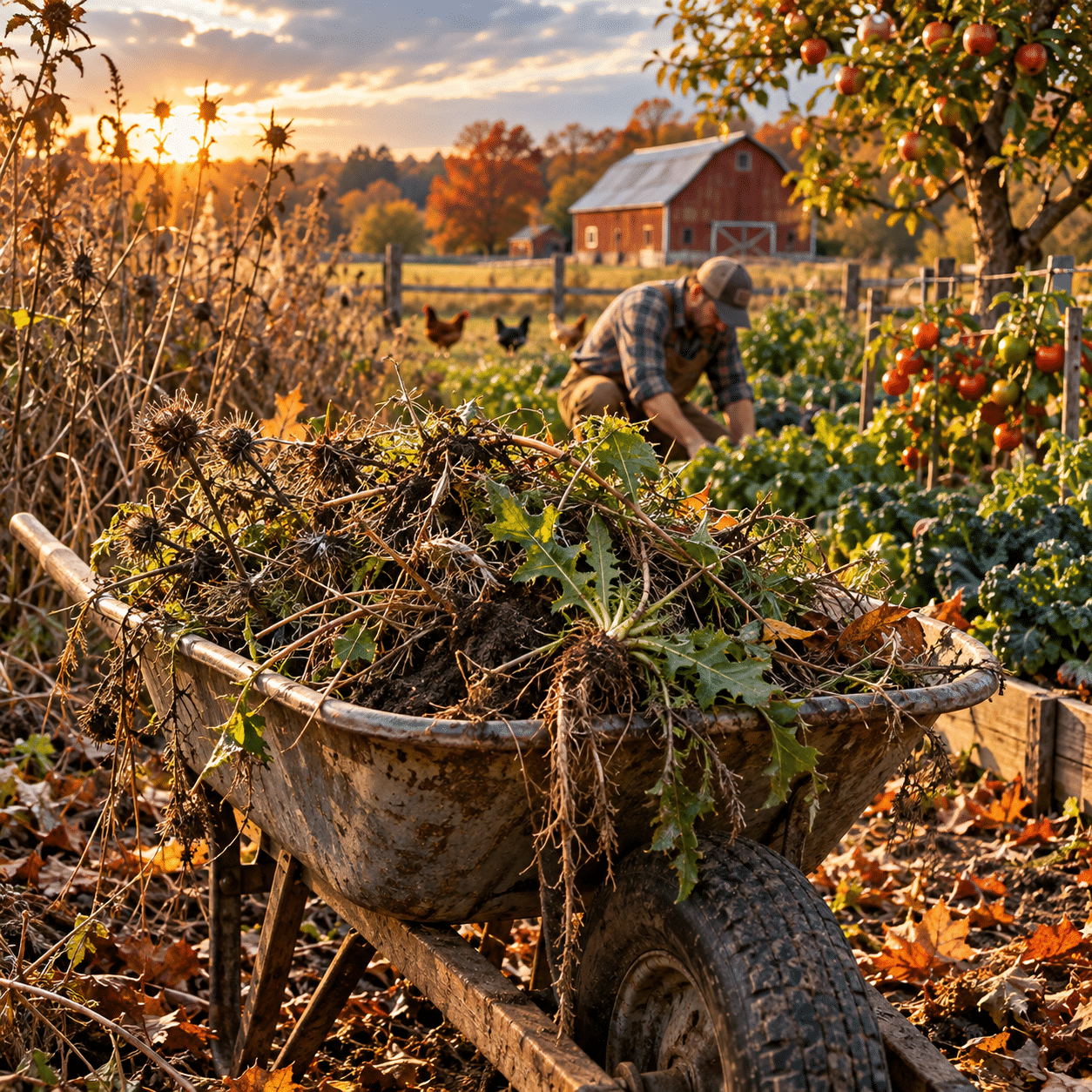
A farmer understands this immediately. If the trend in your pasture is toward thistles, you don’t stand at the fence admiring their historical inevitability.
You mow the thistles.
If your apple tree develops a diseased limb, you don’t celebrate its progress toward becoming firewood. You cut the limb because sometimes preserving the tree requires removing something that’s growing on it.
And if weeds are swallowing the beans, you don’t congratulate the weeds for being on the right side of history.
You pull them.
That’s not resisting the future.
That’s helping decide what kind of future arrives.
The Field Ahead: Tomorrow Is Growing Right Now
This is where the field ahead becomes very real.
We like to picture the future as empty ground somewhere beyond the horizon. But most of tomorrow is already germinating beneath our boots, and anybody who has owned a house, farm or garden for very long knows exactly what I mean.
Look at an abandoned barn. The roof doesn’t suddenly collapse one Tuesday morning for no reason.
First, a shingle blows loose. Then water gets underneath it, the sheathing softens, the rafters begin to rot, and eventually a heavy snow finishes a job that actually started years earlier.
By the time the roof falls in, the future has been growing for a long time.
The same thing happens in a garden. Today’s little weed becomes tomorrow’s seed head, and tomorrow’s seed head can become next year’s headache.
That’s why freedom isn’t simply the ability to sit on the porch and leave everything alone.
Sometimes freedom means getting off the porch.
The source makes this point using almost exactly that garden picture: if you leave valuable plants alone, weeds may eventually overwhelm them. But if you weed the garden now, the future that otherwise would have happened doesn’t happen.
Think about that for a minute.
You changed tomorrow.
That’s what human beings do. We plant windbreaks because we know January is coming, put food in jars because tomatoes won’t be growing in February, and repair the roof because we know water doesn’t improve plywood.
The USDA’s Natural Resources Conservation Service makes a similar practical point about soil: healthy ground doesn’t simply happen because we leave the future to chance. Management choices involving soil cover, living roots, diversity and disturbance help determine what that ground becomes.
Likewise, we teach a child to work because someday Dad won’t be standing beside him explaining which wrench he needs. We save money because someday something expensive will break, and we plant trees whose best shade may belong to somebody else.
The field ahead isn’t merely where we’re going.
It’s something we’re cultivating right now.
The Field Behind You: Not Everything Old Is Dead
Of course, there’s another ditch on the opposite side of the road.
Some people worship whatever is new, while other people worship whatever is old. Neither position requires much discernment.
You’ve probably met the fellow who believes everything built before 1965 was better. Old trucks were better, old tools were better, old houses were better, old politicians were better and old music was certainly better.
Give him another cup of coffee and eventually he’ll explain how rainfall was better.
But age alone doesn’t make something true.
The field behind you contains tremendous wisdom, but it also contains mistakes, broken equipment, foolish ideas and things our grandparents themselves were perfectly happy to leave behind.
That’s why the job isn’t simply preservation.
It’s inheritance with judgment.
Imagine walking into Grandpa’s workshop after he’s gone. There’s an old hand plane on the bench that still works beautifully, and beside it sits a splitting maul with a hickory handle polished smooth by 40 years of hands.
Keep those.
Then you find three coffee cans filled with bent nails, a cracked extension cord wrapped in electrical tape, and a chainsaw that hasn’t run since Reagan was president. You don’t have to build a shrine around those simply because Grandpa owned them.
The Four Fields never ask us to drag everything from yesterday into tomorrow.
They ask us to recognize what is still alive.
The Inner Field: Somebody Has To Decide What’s A Weed
And that’s where things get uncomfortable, because eventually somebody has to decide.
That’s the work of the inner field.
You have to look honestly at your habits, beliefs, traditions, ambitions and loyalties and ask a hard question: Is this producing fruit… or is it choking something that should be producing fruit?
Jesus used agricultural language constantly because farming makes these distinctions hard to hide. In Matthew 7:16–20, He says a tree is known by its fruit… the nature of something eventually becomes visible in what it produces.
That’s useful far beyond orchards.
Maybe there’s a family tradition worth protecting.
Protect it.
Maybe there’s a family habit that’s been producing misery for three generations. Pull it up before you hand it to a fourth generation and call it heritage.
Maybe the way Grandpa handled money was remarkably wise. Keep it.
Maybe the way Grandpa handled anger wasn’t.
Don’t hand that inheritance to your children and call it tradition.
This is what makes the inner field hard work. You can’t simply ask, “Is it old?” or “Is it new?”
You have to ask:
Is it good?
The Outer Field: Freedom Gets Dirt Under Its Fingernails
Once you’ve decided what matters, eventually you have to do something about it.
That’s the outer field.
Modern people love freedom as an abstraction. We put the word on bumper stickers, T-shirts, campaign signs, and coffee mugs, but actual freedom is usually considerably less glamorous.
It often looks like repairing something, planting something, teaching somebody or saying no to something. Sometimes it means walking away from something that’s making you weaker, and sometimes it means keeping a promise when breaking it would be easier.
The source material describes freedom in an unusual but useful way: the ability to carry something good from the past into the future while preventing a destructive future from becoming inevitable.
That’s exactly what a gardener does.
He looks at a tomato plant and says, “You stay.” He looks at the thistle beside it and says, “You don’t.”
Then he reaches down and pulls.
No committee, five-year strategic plan or motivational seminar required.
Just dirt under the fingernails.
You Are Not A Tractor With One Gear
There’s another big idea in the source that fits the Four Fields beautifully: a healthy person must be able to change modes.
There are times to push outward and times to pull inward. There are times to fight and times to rest, times to conserve and times to change, and wisdom includes knowing which time you’re actually standing in.
The source criticizes our tendency to reduce people to permanent categories… as though somebody must always be an introvert or extrovert, always progressive or always conservative. Its larger point is that healthy human beings have enough flexibility to respond differently when circumstances genuinely require something different.
A homestead works exactly like that.
You aren’t in planting mode twelve months a year, thank goodness. There’s a season to plant, another to cultivate, another to harvest and another to let the ground rest.
Ecclesiastes puts it plainly: “To every thing there is a season, and a time to every purpose under the heaven.” The larger passage in Ecclesiastes 3:1–8 runs through the same rhythm… planting and gathering, breaking down and building up, keeping and casting away.
The wise homesteader doesn’t simply announce, “I’m a planter.”
He asks what season he’s standing in.
Because planting corn in November doesn’t make you committed.
It makes you foolish.
Strength Is Knowing When To Put The Tool Down
That’s another place we get confused. We often imagine strength as being able to do one thing harder and longer than everybody else.
But sometimes strength is the ability to stop.
A chainsaw is wonderful when a tree needs cutting, but it’s considerably less useful when you’re trying to graft an apple branch. A tractor can pull a plow through hard ground, but you probably don’t want to use one to weed between carrot seedlings.
Tools become destructive when we forget what they’re for.
People can too.
The source spends considerable time using military life to make this broader point: a society—or a person—can’t remain permanently in battle posture. The ability to move from conflict back into peace matters as much as the ability to mobilize when genuine danger arrives.
That’s true around a household too.
There are times Dad needs to take charge because the basement is filling with water, and there are times Dad needs to sit down, close his mouth and listen. There are times to defend your family, and there are times to hug them.
There are times to work until dark, especially when weather is moving in. And there are times to shut the barn door, go inside and eat supper with the people you’re supposedly working so hard for.
A person who knows only one gear eventually tears something up.
Management Isn’t The Same Thing As Leadership
This brings us to another distinction worth carrying onto the homestead.
You can manage things. You manage feed inventory, fuel, fence supplies, schedules, money, garden rotations and equipment maintenance.
But people aren’t fence posts.
The source draws a sharp distinction between management and leadership. Management organizes resources, while leadership, in the source’s framing, involves identification, trust and a willingness to share the cost being asked of others.
Every father knows the difference, whether he uses those words or not.
“Go stack that firewood while I watch television” is management.
“Grab your gloves. We’ve got wood to stack” is leadership.
One gives instructions.
The other puts on boots.
The same principle applies to children, neighbors, churches and communities. People will often follow somebody through remarkably difficult circumstances when they know he isn’t asking them to walk somewhere he refuses to go himself.
That’s why leadership has less to do with a title than example.
You lead from inside the work.
The Four Fields Need Each Other
And now the whole picture begins coming together.
The field behind you contains what you’ve inherited. Some of it deserves another hundred years, and some of it should have been thrown away 50 years ago.
The inner field is where you develop enough wisdom and character to know the difference. It’s where you ask what is true, what is good, what is fruitful and what has simply been growing so long that everybody stopped noticing it was a weed.
The outer field is where you actually pick up the shovel, pruning saw, Bible, wrench or hammer and do something about it. Conviction that never reaches your hands isn’t much use on a homestead.
And the field ahead is what all those choices are quietly creating.
Ignore any one of the four and eventually the whole place suffers. Live only in the field behind you and nostalgia takes over; live only in the field ahead and every shiny new idea starts looking like salvation.
Stay only in the inner field and you become a fellow with wonderful opinions and nothing repaired. Live only in the outer field and you can become so busy working that you forget what all the work was supposed to accomplish.
You need all four.
Don’t Let The Weeds Choose Your Future
Tomorrow morning, walk outside and look at something growing. A garden is preferable, but a fence row will do.
You’ll probably see the whole argument right there.
Something is growing that you want, and something else is probably growing that you don’t. The future of that little patch of ground depends partly on whether you can tell the difference… and whether you’re willing to do anything once you do.
That’s life.
Freedom isn’t pretending every possible future is equally good. And it isn’t stubbornly preserving everything merely because somebody handed it to you.
Freedom means having enough wisdom to say:
This stays. This goes. This needs pruning. This needs planting. This needs another season.
And then having enough courage to act before the decision gets made for you.
Because the future isn’t automatically your friend.
Leave the barn alone and it rots. Leave the fence alone and it falls. Leave the garden alone and weeds eventually decide what grows there.
Leave your character alone long enough and don’t be surprised when bad habits take root too.
The Four Fields give us another way.
Take what is good from the field behind you and judge it honestly in the inner field. Then put your hands to work in the outer field and plant deliberately toward the field ahead.
You don’t control every storm that crosses the ridge. You don’t control the rain, the markets, the people around you or how many seasons God gives you.
But you aren’t helpless either.
You can plant, prune, preserve and pull weeds. You can repair what’s worth saving, discard what isn’t and put something good into the ground for a season you may never see.
And sometimes one of the most important things a free man can do is walk into a field everybody else says is “following the trend,” bend down, grab the weed by the roots, and say:
“Not in this field.”