Print


What An Outlaw Reformer Can Teach Us About Facing A World Gone Mad
You Taught Your Grandson To Start The Generator… But Can He Explain His Faith?
It’s late October. The wind is rattling the barn door, the garden is about finished, and you’ve been putting things by. Beans, rice, canned meat, water barrels, firewood. There’s a generator in the shed and a plan for the night the power company quits answering the phone.
Good. A little preparation beats standing in an empty grocery aisle, holding a shopping cart with one squeaky wheel and wondering what happened.
But here’s the question that doesn’t fit neatly on a preparedness checklist: What happens when the things you depend on can’t carry you any farther? The fuel runs low, the medicine runs out, or trouble walks through a door your deadbolt can’t lock.
Psalm 46 answers that question. And its answer has considerably more backbone than the cheerful little sayings we paste over our fears. This is comfort with its work boots on… the kind you need when the ground starts moving.
An Outlaw With Something Worth Singing
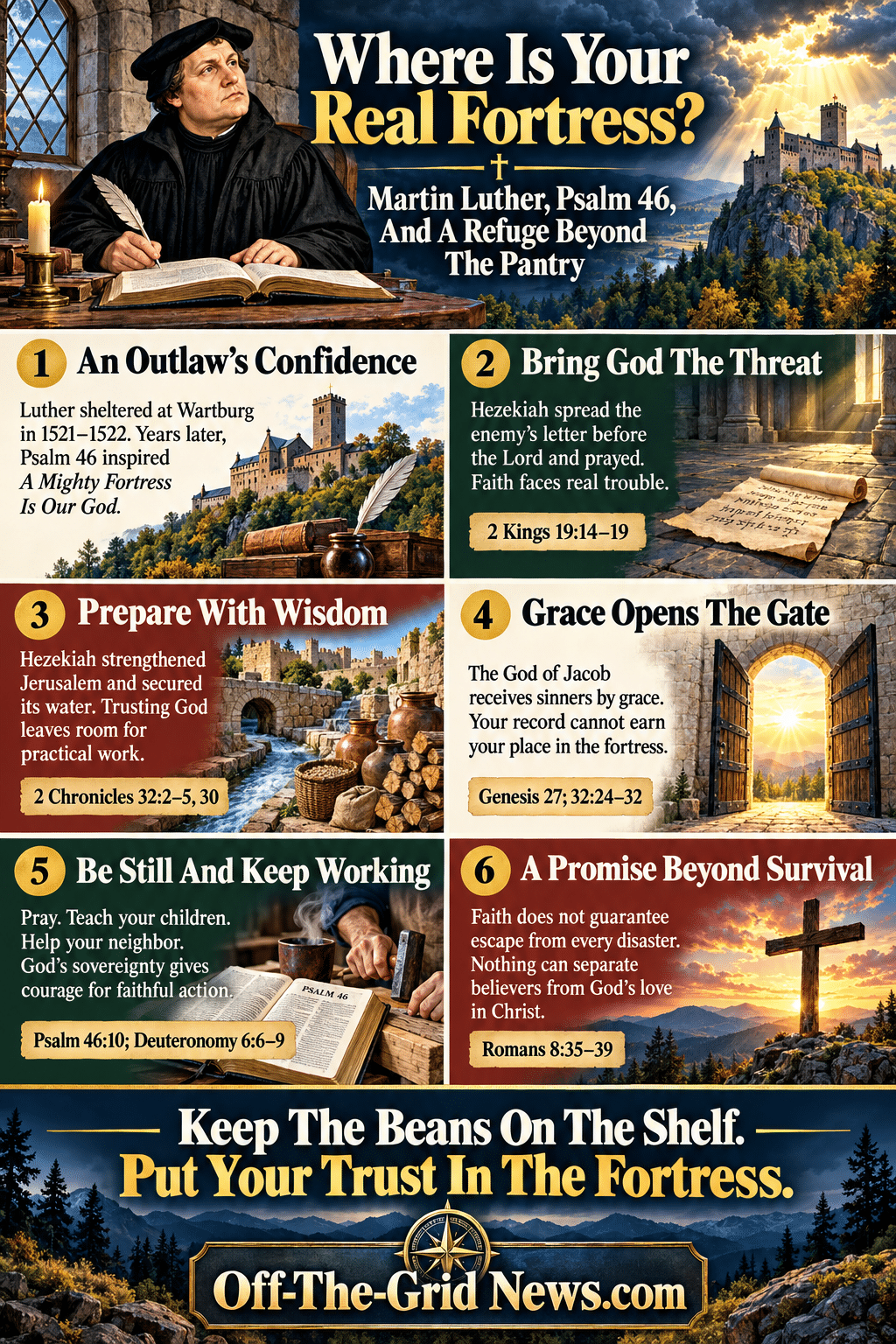
First, consider Martin Luther. After refusing to recant at Worms in 1521, he needed more protection than a sturdy front door. Supporters arranged a staged capture and took him to Wartburg Castle, where he stayed in 1521–1522 and translated the New Testament into German.
Years later, he wrote A Mighty Fortress Is Our God, generally dated to 1527–1529. Drawing on Psalm 46, the hymn gave frightened Christians something sturdier to sing than their own good intentions.
By then, Luther had learned that stone walls could shelter a man without settling the fears inside him. Here was a man who knew danger, and he sang about a refuge no emperor could tear down. His confidence reached beyond the castle that had once hidden him.
That’s a useful song to have in your pocket when the people running things decide your conscience is an inconvenience.
The Bully Outside the Gate
Next, let’s go back a bit further, picture Jerusalem in 701 BC. Assyria had already conquered Israel’s northern kingdom, and Sennacherib’s forces had overrun fortified cities in Judah. Jerusalem now faced the kind of enemy that liked to announce its reputation before finishing the job.
In 2 Kings 18, the Assyrian spokesman called the Rabshakeh speaks where the people on the wall can hear him. His message is simple: Other nations trusted their gods, and look where that got them. Why should Jerusalem expect anything different?
It’s intimidation dressed up as common sense. Your king is fooling you. Your God can’t save you. Open the gates and stop making this difficult.
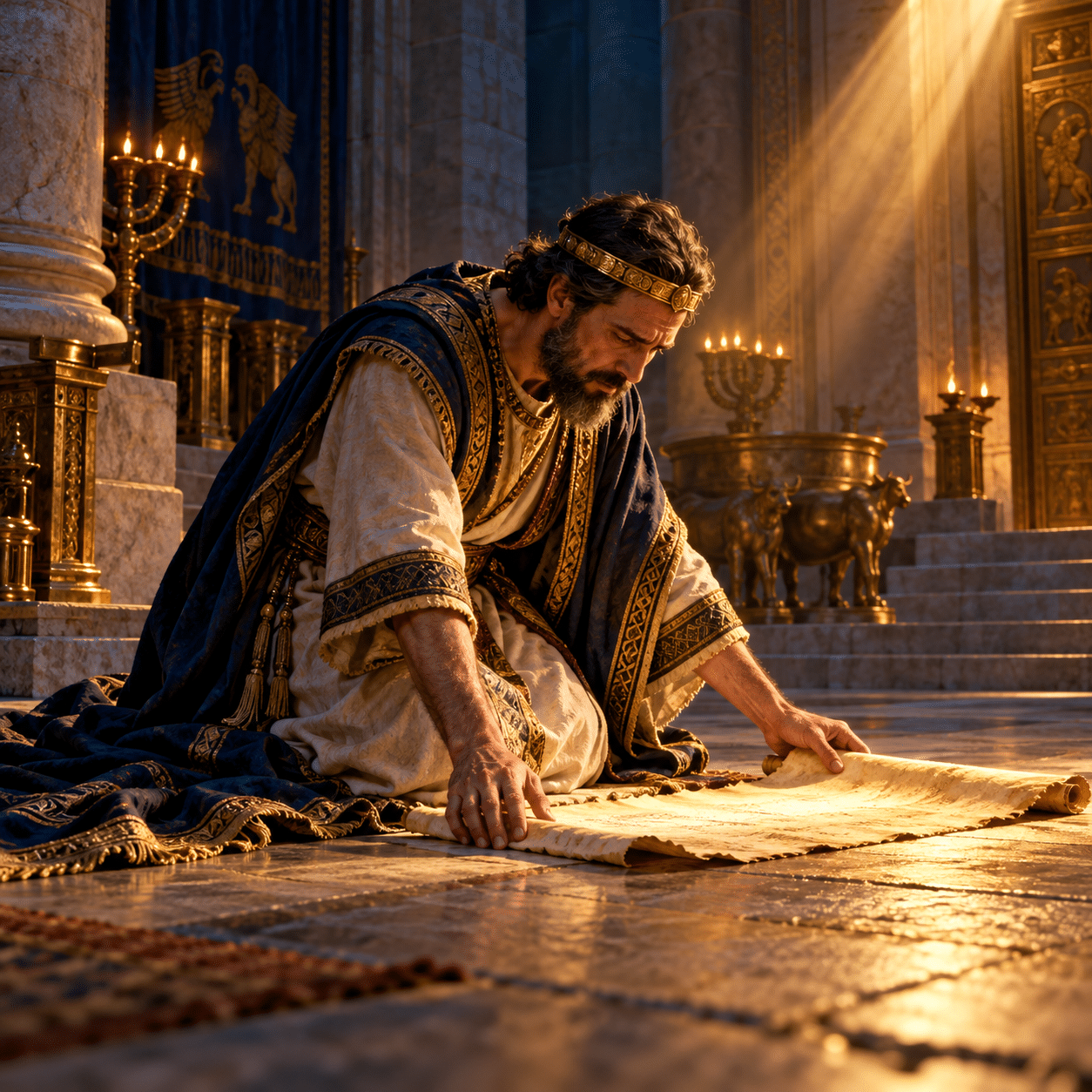
But then Hezekiah does something worth remembering. When the threatening letter arrives, he takes it to the temple, spreads it before the Lord, and prays. You can read the account in 2 Kings 19:14–19.
He doesn’t pretend the army is imaginary. He lays the real threat before the real God. There’s a whole lesson in prayer right there: Bring the letter, the diagnosis, the overdue notice… the actual thing that has been chewing on you since three in the morning.
Then, according to 2 Kings 19:32–36, God delivers Jerusalem. The angel of the Lord strikes 185,000 in the Assyrian camp, and Sennacherib withdraws. The promised assault on the city never comes.
The biggest army in the neighborhood had discovered that it wasn’t the biggest authority in the neighborhood.
When the Ground Under You Comes Loose
Now, Psalm 46 doesn’t name Sennacherib or tell us exactly which crisis prompted it. Its connection with Hezekiah’s deliverance is a longstanding interpretation, not a date stamped on the manuscript. Still, that history gives us a vivid picture of the confidence the psalm announces.
It begins with God as his people’s refuge, strength, and present help in trouble. Notice the location of the help: in trouble. The psalm doesn’t say that faithful people get a private road around it.
Then the scenery comes apart. Earth gives way, mountains tumble into the sea, and the water roars like it means to swallow the whole place. Everything you thought was nailed down starts sliding across the floor.
And right there comes the astonishing conclusion: We will not fear.
That isn’t a man whistling past the graveyard. It’s faith taking its measurements from God instead of the size of the hole opening beneath its feet. The trouble is enormous; the refuge is greater.
This is where comfortable religion starts shifting in its chair. We’d prefer a promise that the market will recover, the tests will come back clear, and the children will never wander. The psalm gives us God himself, even when we cannot see how the circumstances will end.
The Water the Enemy Cannot Shut Off
Then the picture changes. Outside, the waters rage; inside the city of God, streams bring gladness. The roar gives way to a river.
For anybody who has hauled drinking water during an outage, that image needs very little explanation. You can own a mountain of dried beans and still have a serious problem if you can’t fill the pot. In a siege, a dependable water supply could mean the difference between living endurance and surrender.
Hezekiah understood practical preparation. 2 Chronicles 32:2–5, 30 describes defensive work and his redirection of the waters of Gihon. Trusting God evidently didn’t prevent the king from organizing his people and getting useful things done.
But the psalm’s river reaches beyond waterworks. Its point is God’s life-giving presence with his people. The city stands because he is in her midst… the plumbing isn’t the source of the promise.
So build the rain catchment system. Repair the pump. Just remember that a full cistern and a faithful God belong in different places on your list of ultimate dependencies.
Why the Fortress Bears a Cheater’s Name
Then comes a name that ought to stop us: the God of Jacob. Of all the people to name in a song about security, why him?
Jacob (with his mother’s help) deceived his father and took the blessing assigned to Esau, as Genesis 27 records. His story includes family favoritism, some interesting scheming, flight, and consequences that followed him down the road.
Yet God bound himself to this man by promise. That doesn’t make every aspect of Jacob’s story admirable. But it does make God’s grace astonishing.
And there’s something here for the person who reads an article like this and thinks, Fine for good Christians, but you don’t know what I’ve done. Listen, the God of Jacob already knows what sinners are like. You don’t enter Christ’s refuge by polishing your record until it shines. Nope, you come confessing your sin and trusting the Savior who receives sinners.
If the fortress admitted only people who had earned their place, the courtyard would be empty.
Sometimes the Blessing Comes With a Limp
Of course, grace doesn’t mean God leaves us comfortably in charge of ourselves. In Genesis 32:24–32, Jacob wrestles through the night, receives a new name, and walks away limping after his hip is put out of joint.
He leaves blessed. He also leaves changed in a way he can feel with every step.
Now, we shouldn’t pretend we can explain every illness, loss, or hardship by pointing to some particular sin. Scripture itself knocks that easy arithmetic apart in John 9:1–3. But neither should we erase the Bible’s teaching that a loving Father disciplines his children.
Hebrews 12:5–11 says that discipline hurts in the moment and later bears good fruit. Anybody who has straightened a bent tool knows that useful work sometimes involves pressure. Our Father’s purposes are wiser and kinder than ours, even when we would very much like him to loosen his grip.
That’s a tougher comfort than the promise of a trouble-free afternoon. It means pain cannot, by itself, prove that God has abandoned you.
Be Still Does Not Mean Play Dead
Then we reach the line everybody knows: “Be still, and know that I am God.” It’s frequently treated like background music for a quiet morning with a warm mug and a clean kitchen counter.
But look at the neighborhood that verse lives in. Nations rage, kingdoms shake, and God brings warfare to an end. This stillness has the sound of human pride being told to stop talking.
In his commentary on Psalm 46, John Gill discusses how God addresses hostile nations before applying the words to fearful believers. His point for believers is practical: Trusting God doesn’t require becoming unfeeling or inactive. It calls us away from panic, impatience, and restless agitation.
In other words, take your hands off the throne. You have work to do, but running the universe isn’t part of your job description.
So pray, make the call, fix the leak, and help your neighbor. You can act firmly without pretending the final outcome depends on the strength of your grip. Christian stillness can have dirt under its fingernails.
The Promise That Survives the Funeral
Now comes the part that can get left out when we turn faith into a preparedness accessory. Psalm 46 is not a guarantee that every Christian survives every catastrophe. Your pantry may carry you through an emergency; no pantry can carry you past death.
The New Testament is wonderfully clear about both suffering and security. In Romans 8:35–39, Paul names hunger, persecution, danger, and death while insisting that nothing can separate believers from God’s love in Christ. He doesn’t make the dangers disappear to make the promise work.
That’s also the hard confidence running through Luther’s hymn: Earthly losses, even the loss of life, cannot overthrow Christ’s kingdom. Read that slowly, because it changes what we mean by being safe.
The Christian’s hope reaches beyond the last heartbeat. Christ promises resurrection, not merely a longer stay in the bunker. A fortress that holds only until the funeral isn’t large enough for the trouble we actually face.
Teach Your Children More Than an Escape Route

Meanwhile, danger doesn’t always arrive with a battering ram. That’s what the devil would like you to believe. Sometimes it comes through a screen, a fashionable lie, or the quiet assumption that God’s authority stops at the church parking lot. A household can have emergency food stacked to the ceiling while its understanding of right and wrong is being carted out the back door.
Here’s an uncomfortable question: Can your children explain why Christ deserves their trust, or have they mostly learned that Christianity is something the family does on Sunday? We can teach a youngster to start a generator and somehow never teach him what to do with guilt, fear, temptation, or death.
Deuteronomy 6:6–9 puts instruction in ordinary life… at home, along the road, at bedtime, and in the morning. That sounds a lot like the supper table, the pickup cab, and an afternoon stacking wood. There’s a lot of room for theology beside the splitting maul.
And the lesson must show up in our conduct. A father who speaks about God’s sovereignty while living in permanent outrage teaches a second sermon that usually drowns out the first.
Keep the Pantry Full and the Door Open
Finally, the Lord who ends wars in Psalm 46 doesn’t give us permission to cultivate hatred. Jesus tells his people to love their enemies, and Paul gives that love a wonderfully concrete shape: Feed a hungry enemy and give a thirsty one something to drink.
That ought to put some direction into our preparedness. Store enough to share. Learn skills that make you useful. When frightened people come knocking, let them find somebody whose faith has made him generous as well as steady.
So yes, fill the pantry. Stack the firewood, check the batteries, and make sure the water pump works. Hezekiah prepared, and we can prepare as well.
But when the wind rises and the barn door bangs, remember where your final confidence belongs. The Lord of hosts is with his people. The God of Jacob still receives sinners by grace.
Keep the beans on the shelf. Put your trust in the fortress.
Postscript: If this article sounds like sermonizing, full transparency… it is. But I wrote this as much for me as for readers of Off-The-Grid News. Even at 68 years old, I need to be reminded of my forgetfulness, my shortcomings, and my sin. I also need to be reminded of the remarkable blessings God has made to flow into my life. And yep, this includes the hardships for which I’m thankful.