 Print
What Rutgers Researchers Found About Titanium Debris And The Key Immune Cells Guarding Your Health
The Tiny Metal Shavings That May Be Making Some Infections Harder To Fight
Anybody who runs a farm knows you can replace a part, but you cannot replace maintenance. Hang a brand-new gate, set fresh posts, and admire your handiwork all you like. Sooner or later, you still have to walk that fence line.
Meanwhile, trouble has a habit of starting where you cannot see it. A post looks solid above ground while something nasty works on it underneath. According to researchers at Rutgers, the titanium posts holding replacement teeth in our jawbones may have their own hidden maintenance problem.
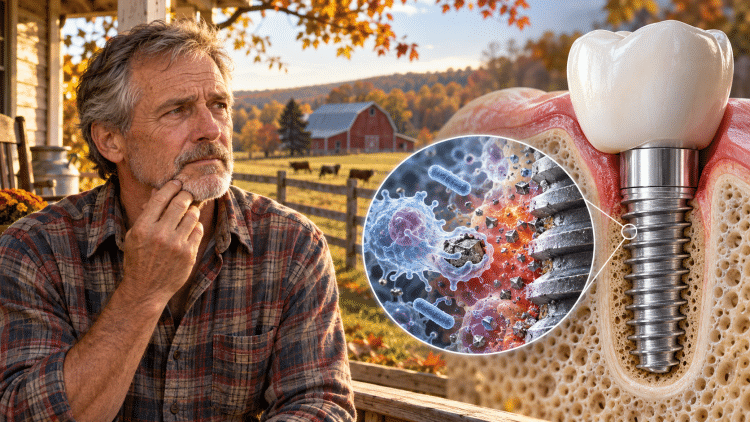
For tens of millions of people, dental implants have been a godsend: fixed, working replacements for missing teeth instead of removable dentures. As Rutgers explains in its research report, however, the tissue around those implants can develop a serious infection. And tiny fragments from the hardware itself may help that trouble settle in.
That is the unsettling part. The metal that makes an implant strong can, under the wrong conditions, shed debris that interferes with the body’s cleanup crew. Picture the fence shedding little pieces that keep the hired hands busy while the cattle walk through the opening.
The Trouble Starts Around the Post

First, meet the condition dentists call peri-implantitis. The name is a mouthful, but the problem is straightforward: inflammation and infection around an implant can destroy the bone holding it in place. Once that support starts disappearing, you have more to worry about than a sore gum.
According to the Rutgers report, an estimated 10 to 20 percent of implant patients eventually develop the condition. The same report puts the worldwide annual healthcare cost at more than a billion dollars. Those are report estimates, but they tell you why researchers are paying attention to what happens around these little titanium posts.
For years, scientists concentrated heavily on the bacteria. That makes sense, because bacterial colonies get the trouble going. Yet the infections can be stubbornly difficult to treat, leaving dentists with a familiar country problem: you patched the obvious opening, so why does the trouble keep coming back?
This time, the Rutgers team looked harder at the hardware. In their PNAS Nexus study, they investigated whether implant-derived titanium particles could help explain why the body’s defenses struggle around diseased implants. Bacteria remain central to the story, but the researchers found evidence of another contributor hiding in the debris.
Titanium Is Tough but the Surface Still Matters
Now, titanium is no flimsy scrap of barn tin. It resists corrosion remarkably well, which helps explain its usefulness in implants. Still, resistant does not mean untouchable, especially in an inflamed, bacteria-rich environment.
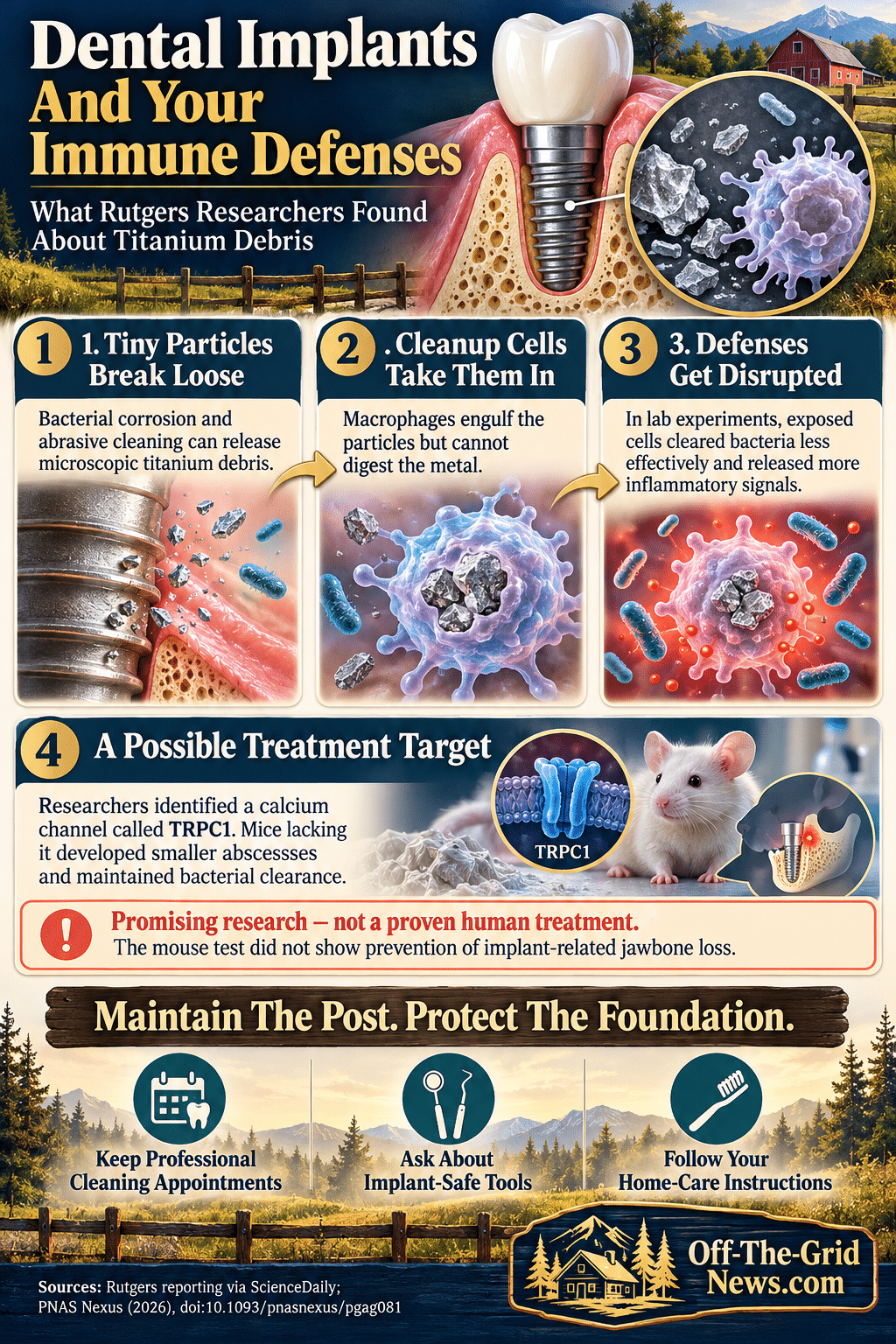
Bacteria build sticky communities called biofilms on implant surfaces. Their acidic surroundings can help damage the protective surface and promote corrosion. This is not the orange, flaky rust you knock off an old gate with a wire brush; it is microscopic damage happening where you cannot inspect it over morning coffee.
Over time, according to the Rutgers report, that process can release billions of titanium particles, each smaller than a red blood cell. You will not spot them in the bathroom mirror. But something does not have to be visible to make a mess.
Then there is the cleaning question. The report notes that metal instruments intended for natural teeth can scratch implant surfaces and knock loose additional particles. An appointment meant to help can become part of the problem if the tools and methods are wrong for the job.
Fortunately, implant care has changed. Rutgers describes nonabrasive techniques as standard practice today, aimed at cleaning the implant while protecting its surface. Just as you would choose the right tool for a copper pipe or a delicate fitting, the material in your mouth deserves tools suited to it.
The Cleanup Crew Gets a Load It Cannot Haul
Here is where the story takes a sharp turn. Those tiny titanium fragments can attract a bacterial toxin called lipopolysaccharide, or LPS. With that material coating their surfaces, the particles become tempting targets for immune cells that normally swallow unwanted invaders.
Enter the macrophages. These white blood cells are part patrolman, part cleanup crew: they engulf bacteria and process what they collect inside digestive compartments. Around an implant, that is useful work you want done promptly and well.
Unfortunately, a macrophage cannot digest titanium the way it handles a bacterium. It can take the particle in, but finishing the job is another matter. Imagine feeding a handful of metal shavings into equipment built to handle garden waste.
In the Rutgers team’s experiments, titanium particles disrupted the cells’ internal processing machinery, including compartments called lysosomes. The macrophages became more inflammatory while becoming less effective at clearing bacteria. In plain English, the crew kept sounding the alarm while getting less of the actual cleanup done.
According to the Rutgers news report, particle-exposed macrophages engulfed fewer than half as many bacteria as unexposed cells in laboratory testing. That is a laboratory comparison, rather than a prediction of what happens in every patient’s mouth. Still, it gives the problem some teeth.
Meanwhile, bacteria benefit when the cleanup falls behind. Inflammation lingers, the surrounding tissue stays under pressure, and the bone supporting the implant can suffer. The body’s defenses are busy, but busy and effective are two different things.
That helps explain why simply going after bacteria may leave part of the problem untouched. If titanium debris keeps disrupting the immune response, the local trouble has another source of fuel. The study points toward a damaging partnership between microbes, metal particles, and a defense system struggling to finish its work.
Researchers Found a Possible Repair Point
Next, the team followed the problem deeper into the macrophages. They identified a calcium channel called TRPC1 as an important part of the damaging response. Think of a channel as a tiny passage involved in controlling signals inside the cell.
That does not mean calcium itself is the villain or that changing your diet will fix an implant infection. The issue here is how cells regulate calcium signaling when they encounter titanium particles. The researchers were studying cellular machinery, not testing a kitchen-table remedy.
To investigate the channel’s role, they used mice engineered without TRPC1. When challenged with titanium particles and bacteria, those animals developed much smaller abscesses, produced fewer inflammatory signals, and maintained effective bacterial clearance. The findings gave researchers a specific pathway to investigate further.
However, keep one boot planted firmly on the ground. The mouse experiment measured abscess formation and immune responses; it did not demonstrate prevention of jawbone loss around implanted teeth. And removing a gene in an experimental mouse is a long way from handing a patient a proven medicine.
The team also examined human samples. At diseased implant sites, they found particles consistent with titanium debris, along with stronger TRPC1 signals in diseased tissue than in healthy tissue. Those observations help connect the laboratory work to actual patients, but they do not turn the study into a successful human treatment trial.
A promising repair point is still a promising repair point.
According to the Rutgers report, the NIH-funded group is testing drug candidates aimed at the same pathway in human cells. That is encouraging research, and it could help guide future treatments. For now, though, there is no new treatment from this study to request at your next cleaning.
Ask About the Tools Before Trouble Takes Root
So what does somebody with an implant do with all this? Start with the practical lesson already sitting in the first paragraph: maintenance matters. A replacement tooth still depends on living gum and bone, and neither one becomes maintenance-free when the titanium goes in.
The Rutgers report emphasizes regular professional cleaning as the strongest known protection against peri-implantitis. That is a good reason to keep the appointments instead of treating them like an optional tune-up. A sturdy-looking post is no excuse to stop checking what holds it in place.
Also, ask about the cleaning itself. Which instruments and methods are appropriate for your particular implant? How does the office clean around it while protecting the surface, and what should you be doing between visits?
Those are ordinary ownership questions. You ask what oil belongs in the tractor and which fitting goes on the pump. Asking how to care for hardware anchored in your own jaw seems at least as reasonable.
Then follow the home-care instructions your dental professional gives you. This research is a reason to understand your care and stay on schedule, not to change prescribed treatment on your own. You do not need to master cell biology to be an informed patient; you need clear answers about the work being done and the maintenance expected of you.
Walk the Fence Line Before You Need a New Fence
Finally, self-reliance includes knowing when skilled help earns its keep. We maintain wells, sharpen tools, and check winter fuel because neglect has a way of presenting its bill at the worst possible moment. The same habit belongs in the care of our teeth.
Dental implants have helped millions of people, and this study does not erase their value. It helps explain how trouble can persist around them and gives researchers another place to look for a solution. For implant owners, it also brings the conversation back to something useful and familiar: look after what you depend on.
A replacement tooth is not a maintenance-free tooth.
Keep the cleaning appointments. Ask about the tools. And remember that the most important part of a good post is often what is holding it steady below the surface.
Sources
Rutgers University reporting via ScienceDaily, “Dental implants can hijack your immune system, scientists discover,” October 23, 2026.
Girón Bastidas and colleagues in PNAS Nexus, “Implant-derived titanium particles impair macrophage bacterial clearance via TRPC1 and lysosomal dysfunction,” published March 21, 2026, in volume 5, issue 4. Read the full study.