 Print

What Washington’s Debt Problem Means For A Self-Reliant Household
How Yesterday’s Borrowing Will Eat Your Grandkids Alive
Imagine buying a tractor on credit, mailing the bank a check every month, and discovering years later that you still owe just about what you borrowed. The money left your pocket, but it never bought you another inch of ownership.
Now imagine borrowing more money to help make the next payment. The tractor gets older, the note gets bigger, and the banker keeps getting his check.
Welcome to Washington’s farm ledger.
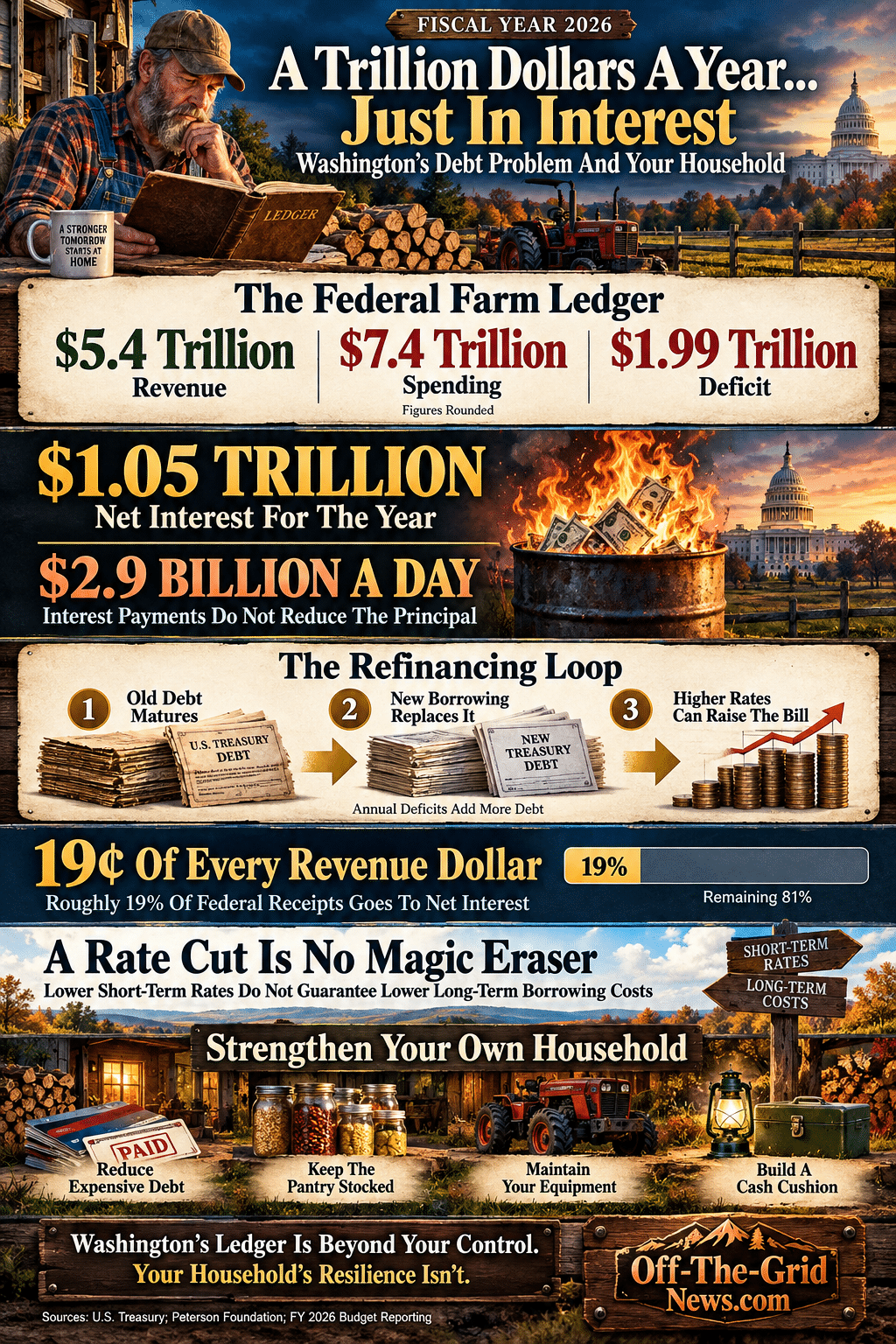
The federal government finished fiscal year 2026 with roughly $7.4 trillion in spending against $5.4 trillion in revenue. That left a $1.99 trillion hole, about $217 billion deeper than the year before, according to the year-end budget reporting.
But here’s the number that ought to make a man put down his coffee: net interest on the federal debt reached about $1.05 trillion. Gross interest was higher still, at roughly $1.36 trillion.
Before those two figures get tangled like baling wire, understand the difference. Gross interest includes interest credited to federal trust funds and other government accounts; net interest is the budget measure that accounts for offsets such as government interest receipts. They measure different things, so you shouldn’t swap one for the other when comparing costs.
Either way, that’s a mighty expensive privilege: owing money.
Nearly Three Billion Dollars Before Tomorrow’s Chores
Spread $1.05 trillion across a year and you get about $2.9 billion a day. That’s roughly $120 million an hour, rolling along while you’re fixing a gate, feeding the chickens, or sleeping under an extra quilt.
And what does that interest payment buy today? No new bridge, no extra ammunition, no fresh stretch of highway. It pays the financing cost of money Washington already borrowed, and the payment itself doesn’t reduce the principal.
Of course, some of that earlier borrowing paid for things people wanted or needed. But paying interest on yesterday’s spending doesn’t give you another bridge today, any more than the interest on your tractor note gives you a second tractor.
Net interest now exceeds defense spending and ranks behind only Social Security and Medicare among the major federal budget categories. The Peterson Foundation’s interest tracker follows the growing bill and its pressure on the rest of the budget.
Meanwhile, interest costs rose about 8% over the year, compared with roughly 3% growth in federal revenue. Washington brought in more money, and the cost of carrying its old borrowing grew faster anyway.
Try running a homestead that way and see how long the feed store extends credit.
The Old Note Comes Due And Washington Writes A New One

Here’s how the refinancing machinery works. When Treasury securities mature, Washington generally issues new debt to replace them rather than paying the whole amount out of current revenue. Then it borrows still more to cover the gap between this year’s spending and this year’s receipts.
Refinancing by itself isn’t some exotic financial trick. Businesses do it, homeowners do it, and governments do it. The trouble comes when the balance keeps swelling and the replacement loan costs more than the one coming due.
Picture a neighbor refinancing the farm every few years. Each trip to the bank adds another chunk to the note, but he keeps pointing to the freshly signed paperwork as proof that everything is under control.
Eventually, the rate changes. Then the same acres have to carry a heavier payment.
Washington enjoyed exceptionally low borrowing costs during the pandemic years. Too many spending decisions treated cheap money as if it were a permanent feature of the landscape, like the creek behind the barn.
It wasn’t. The average interest rate on outstanding federal debt has climbed to about 3.53%, more than twice its 2021 level. Treasury publishes the underlying measures through its average interest rate data.
Even that average doesn’t tell the whole story. Older fixed-rate bonds keep their existing coupons until maturity, but replacing them at higher rates gradually pushes more expensive financing into the federal ledger.
The old cheap note doesn’t protect you forever. It protects you until the due date.
A Bigger Debt Pile Grows A Bigger Interest Bill
By late September, debt held by the public stood around $32.4 trillion, while gross federal debt had passed $40 trillion. Those are different totals: publicly held debt includes Treasury obligations owned by investors outside federal government accounts, while gross debt also includes intragovernmental holdings.
Treasury’s Debt to the Penny dataset separates those categories. Keeping them straight matters, especially when someone starts throwing around interest calculations like handfuls of chicken feed.
For a simple illustration, add one percentage point to the interest cost on a $40 trillion balance and the arithmetic produces $400 billion a year. That is a rough gross-interest illustration, not a forecast that tomorrow’s budget suddenly gets a $400 billion bill.
Different securities reset or mature at different times, and the gross total includes government accounts. Still, the lesson is plain enough: when the debt pile is enormous, even a modest change in borrowing costs can eventually move a mountain of money.
Then comes the unpleasant loop. Higher interest can widen the deficit, a wider deficit requires more borrowing, and more borrowing adds to future interest obligations.
It’s a leak that makes the bucket heavier.
The Treasury Can Rearrange The Notes But It Can’t Erase Them
Treasury Secretary Scott Bessent comes out of global macro trading. He understands that investors have choices, and Washington doesn’t get to announce whatever borrowing rate would make its budget look prettier.
Treasury can adjust the mix of short-term bills and longer-term bonds. It can also conduct buybacks to improve market functioning, but buying back a bond generally requires cash or replacement financing. The obligation doesn’t disappear because somebody shuffled the paperwork.
There are tradeoffs, too. Shorter borrowing can sometimes look cheaper today while leaving more debt exposed to the next refinancing date. Longer borrowing can lock in a rate, but that protection has a price.
It’s much like choosing between a fixed farm loan and a note that resets sooner. You can change the arrangement; you can’t make the lender’s claim vanish by moving it to another drawer.
Meanwhile, the Federal Reserve under Chairman Kevin Warsh influences short-term interest rates. It also affects financial conditions and longer-term yields, but a cut in its policy rate doesn’t guarantee cheaper long-term Treasury borrowing.
Bond buyers still care about inflation, future rates, and how much government debt is coming to market. If they demand a better return, Washington has to reckon with that demand.
Japan Has A Say In This Farm Auction Too
Now look across the Pacific. Japan spent decades carrying a huge public debt alongside exceptionally low interest rates, and Japanese investors have long been major buyers of U.S. Treasury securities.
That connection matters. Treasury’s international capital reports track foreign holdings, including those associated with Japan. America’s borrowing market stretches a long way beyond America’s borders.
When Japanese government bonds offer more attractive yields, some Japanese investors have more reason to put money to work closer to home. Currency hedging costs, regulations, and portfolio needs also affect those decisions, so this isn’t as simple as comparing two numbers on a screen.
Nor does it mean Japan will unload its American holdings tomorrow morning. A slower appetite for additional Treasuries can matter even without a dramatic selloff.
Washington must keep finding buyers while other governments and private borrowers are looking for money, too. At that auction, America may be a very big bidder for the world’s savings, but it isn’t the only one standing beside the auctioneer.
You Can Argue About The Fence But The Bank Still Wants Its Check
Meanwhile, politicians stage their spending fights over programs that often look small beside the biggest obligations. There are worthwhile arguments to have about waste, but finding loose change under the sofa won’t cover a mortgage payment this size.
Interest on valid federal obligations is a payment Washington is obligated to make. Treating it as optional would threaten the credit reputation that helps the government borrow in the first place.
As that bill swallows more revenue, Congress has less room for other priorities unless it cuts other spending, raises more revenue, or borrows still more. None of those choices becomes easier because a politician gives it a cheerful name.
Decades of borrowing have produced a customer who shows up every morning and never forgets his bill.
The Fed Doesn’t Have A Magic Eraser
Some folks figure the Federal Reserve can cut rates and rescue the whole arrangement. But long-term bond yields can remain high, or even rise, if investors expect stubborn inflation or heavier borrowing down the road.
The Fed can also buy Treasury securities, creating bank reserves in the process. Large purchases can lower some yields and support market functioning, but they don’t cancel Treasury’s debt. The Fed explains these tools in its monetary policy materials.
And using monetary policy to hold down government financing costs carries risks, especially if it undermines confidence in inflation control. A lower quoted rate is a poor bargain for a household if the dollars left in its pocket buy less food, fuel, and lumber.
You can print dollars. You can’t print the purchasing power of a full woodshed.
That’s why this belongs at the kitchen table, not just on a trading desk. Families live with what their dollars will purchase, long after the officials finish explaining what those dollars are supposed to mean.
Record Receipts And Still A Hole In The Roof
Perhaps the ugliest part of the 2026 ledger is that Washington ran this enormous deficit while the economy was still growing. This wasn’t simply a year when tax receipts collapsed and an emergency swallowed everything else.
Federal revenue reached about $5.4 trillion, yet spending ran roughly $2 trillion beyond it. Spending grew around twice as fast as receipts, leaving the government farther from balancing the books despite collecting more money.
A household can have a good harvest and still go broke if every extra bushel becomes an excuse for a bigger equipment payment. More income helps, but it doesn’t cure a habit of spending beyond it.
Both parties helped build this debt pile. Republicans and Democrats have each found reasons to postpone the arithmetic, then blamed the other fellow when the figures got uglier.
The interest bill doesn’t care whose campaign sign is out by the road.
What This Means At Your Kitchen Table
Divide roughly $1.05 trillion in net interest by $5.4 trillion in receipts, and about 19 cents of every revenue dollar goes to the net interest bill. That’s money committed to financing past borrowing before the next argument over new priorities even begins.
There’s a difference between borrowing for something productive and borrowing because you can’t cover ordinary expenses. A well-planned irrigation line might help pay its own way; borrowing to meet last month’s obligations leaves you needing another solution next month.
The federal government has powers a household doesn’t, including taxation and a central bank operating in its own currency. But those powers don’t manufacture real resources or guarantee that investors will accept whatever return Washington prefers.
The sovereign debt danger isn’t simply that America will run out of dollar bills. It’s that rising debt service, weaker confidence, and pressure on purchasing power can steadily narrow the country’s choices.
That doesn’t put a collapse on next Tuesday’s calendar. It does give ordinary households a reason to strengthen what they can control.
So keep expensive debt from taking root where you can. Build useful reserves, maintain the equipment you already own, and keep a pantry that gives you breathing room when prices jump or income gets interrupted.
A sound roof, a manageable note, and food on the shelf won’t rewrite the federal budget. But they can keep somebody else’s bad arithmetic from running your whole household.
Yesterday’s borrowing demands today’s interest. Today’s deficit adds another claim on tomorrow.
Washington isn’t solving the debt problem. It’s financing the cost of refusing to solve it.