 Print
Print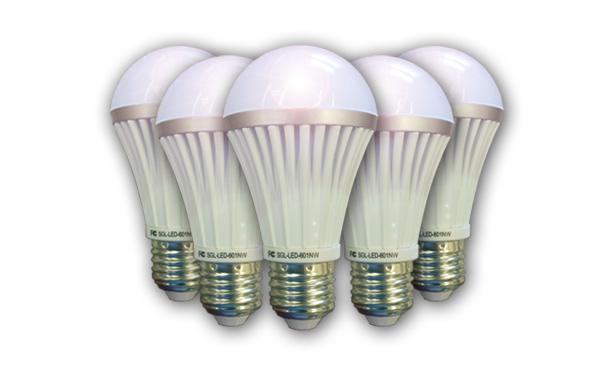
Outdoor options in solar lighting have been around long enough to become quite familiar to solar energy aficionados. Flood lights,  security lights, path lights, and garden lights that harvest the hidden power of the sun’s rays require little care or attention once installed, and the perpetual illumination they provide in driveways, yards, walkways, and outdoor play areas has made them a favorite among those who appreciate great off-the-grid-style technologies wherever they can find them.
Now, some excellent solar-powered lighting options for indoor settings have started to hit the market as well, making things easier for people looking to integrate solar into their lifestyle to the maximum extent possible. Additionally, some clever methods to capture and use the sun’s natural light are also starting to draw the attention of do-it-yourselfers, many of whom are determined to improve upon the old “south-facing window” approach to bringing solar illumination indoors.
150 Ways to Cut Your Energy Bills Now…
General Purpose Solar-Powered Lighting
Multipurpose indoor solar lights are versatile enough to be deployed in many different locations – homes, garages, offices, patios, workspaces, basements, etc. These lights are not necessarily known for their aesthetic attractiveness, but they are a highly functional option for anyone who wants to bring more light into darkened interiors. Many of the multipurpose lights that have come on the market recently feature high-quality LED bulbs which can run rings around incandescents and fluorescents in the longevity department. Multipurpose solar lights come with solar panels that can be installed outdoors on rooftops, and because these types of lights are so sharply efficient the panels required are actually quite small and unobtrusive.
Solar lamps that resemble camping lights are another indoor possibility. These types of lights have attached mini-solar panels that can collect a charge after sitting out in the sun for awhile during the daytime, and they can then be hung up or set on tables or shelves to provide illumination to modest sized indoor spaces during the evening hours. They also work well as reading lights or as night lights, and they would be perfect for camping trips or summer nights spent relaxing out on the patio or in the gazebo.
One of the drawbacks of solar lamps is that their supply of available light even when fully charged is often limited to no more than two or three hours. But there is a lot of buzz in the industry right now about a new type of solar lamp that could make this problem a thing of the past. Designed by Belgian designer Alain Gillies, the Nomad Solar Lamp from O’Sun can last up to 35 hours on a single charge if set at 15% power, and even when used on its most intense setting the Nomad can provide good strong light for up to six hours before it will need to be put back out into the sun for re-charging. The Nomad features a built-in 5-watt solar panel, two lithium-ion batteries, and 12 long-lasting LED bulbs contained within a sleek and stylized plastic shell made to withstand rough handling and heavy use.
Primarily, the Nomad has been designed to meet the needs of those living in developing countries who need a safe and reliable alternative to propane. There have been many fires and a number of deaths by asphyxiation connected to this highly toxic and combustible fuel, which is commonly used as a source of both power and light by poor people everywhere around the world. This new state-of-the-art solar lamp will be available for retail purchase in September 2012, and in addition to its utility for people living in poorer parts of the world it could also offer exciting possibilities for off-the-grid solar enthusiasts right here in the US.
Techniques For Natural Light Enhancement
Passive solar design can bring sunlight far enough into interior spaces to provide abundant natural illumination in many instances. However, a few inventive souls have come up with ingenuous ways to enhance the effectiveness of natural light captured from the sun, and these techniques deserve closer scrutiny by those looking for affordable and convenient lighting options.
Light shelves could be a good addition to the home of any natural light buff. These square planes of shiny aluminum help diffuse sunlight more broadly in rooms with access to south-facing windows. Running horizontally at a 90 degree angle to those windows, light shelves intercept sunlight as it enters the room and bounce it off the ceiling. Ceiling panels are generally coated with a reflective material to increase the efficiency of this process, and the result is a scattered pattern of illumination that lights a room more evenly and completely. To set up a good angle of reflection, light shelves are generally mounted about seven feet above the ground, which is high enough to prevent anyone from accidentally running into them – unless of course a professional basketball player should happen to be paying a visit. Light shelves are available for sale commercially, but determined home inventors could certainly find the materials they would need to make their own light shelves and mounting equipment without too much difficulty.
Heliostatic schemes are another possibility that could appeal to many DIYers. Heliostatic set-ups use an array of movable mirrors to track and reflect light through windows and into rooms, and a well-designed heliostatic system can be used as a source for broadly-distributed indoor illumination. A few commercially manufactured heliostatic mirror arrays are being used on various large-scale building and development projects around the world, but for use on smaller scales it will be up to industrious DIYers to figure things out on their own. Fortunately, plans for creating heliostatic mirror arrays for home use are out there and can be found on the internet, and while these projects are a bit complex this approach to redirecting the sun’s emanations to provide quality interior natural lighting represents a promising and intriguing option.
For those who like to keep their do-it-yourself projects within a reasonable budget, plastic solar light bulbs could be just the ticket. To make one of these incredibly simple natural light transmitters, the only materials you will need are a 32-ounce or one liter plastic bottle filled with a mix of water and chlorine bleach, and a small square piece of corrugated metal roofing material. A circular hole that is a little smaller than the diameter of the bottle will need to be cut into the corrugated metal, and then a series of tabs will need to be cut in around the circumference of the hole so that when the bottle is pushed up through the tabs will bend backward and hold the bottle snugly in place. With its top section facing the sky, the bottle will be inserted into another circular hole cut in the roof of the structure that is to be supplied with natural light, and the corrugated metal will then be fastened down to keep the whole arrangement in place. So when the installation of the plastic solar light bulb is complete, what you will see from the inside of the building is the bottom of a water-filled plastic bottle suddenly popping out of the ceiling, looking to all the world as if it had crashed through the roof after being dropped from an airplane at about 10,000 feet.
The water inside of these home-made solar light bulbs will diffract the sun’s rays as they strike and spread them more widely throughout the room, providing excellent indoor illumination to previously darkened spaces. Because of their ability to scatter and redirect light, plastic solar light bulbs really do glow just exactly like a normal incandescent bulb would if it were connected to the grid and drawing power – and hence the name, plastic solar light bulb. Needless to say, a person could install as many of these cheap faux light bulbs over a single space as they wished to, provided of course they did not mind drilling holes in the roof of the structure they were illuminating.
This is another idea that has caught the attention of those concerned about helping people living in poor countries, and a non-profit organization called My Shelter Foundation is sponsoring a campaign to install hand-made plastic solar light bulbs in the roofs of one million homes and other buildings throughout the city of Manila in the Philippines.
Letting The Sunshine In
Our sun bathes the planet in copious amounts of heat and light every second of every day, and our ability to capture or redirect this energy for our own use is probably only limited by our imaginations and the scope of our vision. As we have seen, even the walls that we build around us to shelter and protect us from the forces of nature do not have to prevent us from fully utilizing this source of limitless energy.
Commercially, indoor solar lighting is a growth industry that offers rapidly-expanding choices for the discriminating buyer. Meanwhile, do-it-yourself’ers should have a blast experimenting with some of the really inventive natural lighting systems and techniques that have been created by enterprising folks all across the globe.