 Print
Print
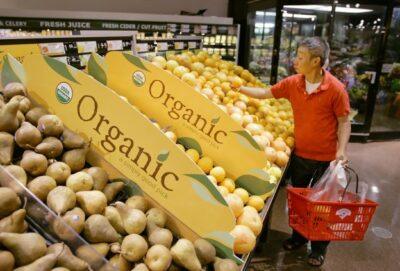
Organic product claims can be misleading, making a deeper understanding of labeling procedures helpful to determine if a product lives up to high organic standards.
According to labeling standards used by the United States Department of Agriculture, a product must meet certain criteria in order to be classified as organic. Criteria include avoiding genetic engineering and receiving oversight by a USDA National Organic Program certifying agent.
But a certified organic product does not have to be completely organic to receive the USDA organic seal or to make organic claims on its label, the USDA noted.
The USDA uses a tier system for labels:
- “100 percent organic” – product is fully organic.
- “Organic” – product has 95 percent or more of organic ingredients.
- “Made with” organic ingredients – food has at least 70 percent organic ingredients.
The USDA allows a product containing up to 5 percent non-organic ingredients – other than water and salt – to retain the USDA organic seal. A product with up to 30 percent non-organic ingredients can still be advertised as “partially organic,” although it is not allowed to be stamped with the USDA organic seal.
Understanding product labeling and ingredient listing can help clarify which products are truly organic and which have limited organic value.
“Learning what’s behind the label is a key piece in making an informed decision about how green a product really is,” said Renee Loux, author of Easy Green Living. “Some labels carry more clout than others and are backed up by defined standards that are regulated and enforced by trustworthy organizations.”
Warning Signs That Triggered The Deadliest Famines In History…
Certified organic seals generally can be trusted to signify a product with high organic standards, Loux said. While partially organic and fully organic products can both showcase the certified organic seal, the USDA said that only a fully organic product can claim to be “100 percent” organic. Thus, it’s only fully organic if it says “100 percent.”
As a result, a product that contains even minute amounts of non-organic ingredients can use the term “organic,” although it won’t say “100 percent.”
The USDA also said that the label of a certified organic product must list the certifying agent’s name, a process that helps consumers determine whether a product’s organic claims have been verified by a third party.
In addition, the USDA only allows a product with at least 70 percent certified organic ingredients to make organic claims on its principal display panel, which is the part of a label most visible to a consumer.
Loux noted some popular labeling terms, such as “natural,” are not regulated and add little value to the health or safety of a product.
“Though the US Food and Drug Administration does not allow artificial colors or flavors to be included in foods that are labeled ‘natural,’ highly refined ingredients like high fructose corn syrup can be considered natural,” Loux said.
Along with reading labels, another effective way to determine whether a product is truly organic is by reading the information panel, which includes a product’s ingredient list. The USDA stated that a product must show which ingredients are certified organic in the ingredient list, whether the product is 100 percent organic or made with few organic ingredients.
A product’s information panel must list the percentage of ingredients from highest to lowest. Reading the ingredient list, therefore, can not only reveal how many certified organic ingredients are in a product but also can provide an estimate of how much of an organic ingredient a product contains.
“Information is powerful and liberating, and becoming informed about what labels really mean makes it easier than ever to go green,” Loux said.
Sign up for Off The Grid News’ weekly email and stay informed about the issues important to you