 Print
Print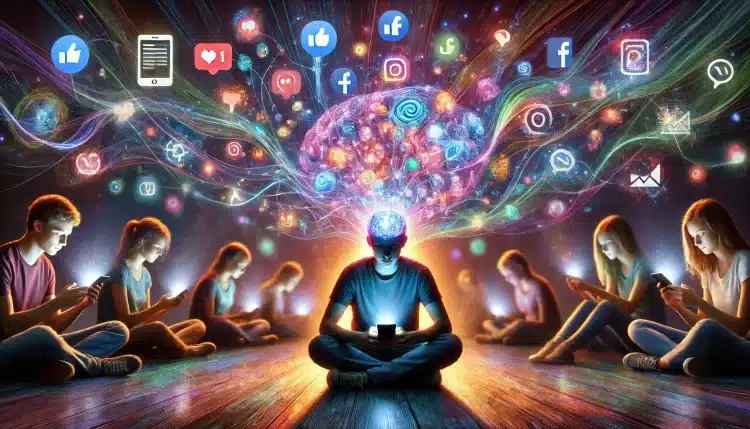
How Technology is Rewiring the Adolescent Mind
Picture a teenager right now. Their world glows from the palms of their hands—TikTok clips flashing like fireflies, Instagram stories piling up like waves, and news fed to them in bits and droplets, never quite enough to chew on.
Yet beneath that flickering surface, something far more dramatic is happening. Young brains today aren’t merely soaking up information differently… they’re brains are being remodeled. Neurons, synapses, whole networks of activity are being rewired and resculpted by the speed, intensity, and constant novelty of the digital age.
Sure, it’s easy to toss out the old line: “Kids these days don’t read—they’re glued to screens.” But if you squint at the data, you notice something surprising. They do read. They do write. In fact, many teens type out more words in a week than some adults do in a month… it’s just all bite-sized. Snippets. Headlines. Subtitles. Memes. This cultural shift isn’t just behavioral; it’s structural. It’s slowly being etched into the folds and grooves of the growing, developing adolescent brain.
So let’s dig into why that actually matters.
“Fast Food” for Memory

To start, imagine bingeing short-form videos or scrolling through AI-generated news summaries. All that quick-hit content ends up parked in the medial temporal lobe—the brain’s short-term storage bay. It’s perfect for glancing, skimming, and flitting from topic to topic. But it’s terrible for deep memory.
That’s why kids can hum thirty viral TikTok songs but forget a news headline by breakfast.
However, here’s the scientific kicker: real learning—what neuroscientists call consolidation—happens through effort. Through wrestling. Through slow, methodical struggle. Like learning music: nailing a riff quickly feels great, but it’s sweating through the awkward notes that actually wires the skill into your neural circuitry.
The problem? Quick dopamine hits crowd out that slow grind. Kids become masters of dipping in and out, but not digging deep.
And that’s where the cost shows up.
When Brains Rewrite Their Own Rules
Now, let’s hit rewind. A thousand years ago, intelligence was measured by memory. Medieval scholars could recite entire books after a single reading because writing was scarce. When printing arrived, the human mind offloaded this task—and instantly switched gears. Memory declined, but innovation exploded. Calculus. Astronomy. Engineering. Brains adapted to what society rewarded.
Today, we’re witnessing another seismic shift.
The “intelligent” skills culture now values—speed, surface recall, instant answers—are exactly the things machines do flawlessly. AI can retrieve facts before you’ve even finished your question.
So here’s the tension: what happens to young minds when the markers of intelligence are tasks a machine performs better than any person alive? No wonder kids feel overwhelmed and adults feel out of step. The brain is adapting faster than the culture around it.
Building Brain Muscles That Count
At this point, it helps to break memory into two scientific buckets:
Semantic memory: the stuff you know—facts, vocab, trivia.
Procedural memory: the stuff you can do—skills, mastery, practiced expertise.
Deep understanding lives in procedural memory. Neurosurgeons spend years building it so they can think creatively while their hands move almost automatically. Athletes grind for hours so their bodies respond faster than conscious thought.
Yet thanks to technology’s seductive convenience, kids increasingly skip the messy, repetitive work that builds procedural strength.
But here’s the bright side: teachers, coaches, and mentors who insist on real practice—real struggle—real tests (like oral exams) give kids something AI can’t. They help them build the kind of brainpower that sticks. The kind machines can’t fake.
What’s Actually Going On Upstairs?
So let’s peek inside the skull.
True learning isn’t about storing a highlight reel of facts. It’s about physically remodeling the brain. Axons thicken. Synapses strengthen. Networks reorganize. Chemical flashes turn into real, biological change.
But when kids only skim and scroll, they skip that neural “renovation.” It’s like watching bike-riding tutorials forever without once touching the handlebars. You know about riding—you just can’t do it.
And there’s another problem: generation gap turbulence.
Adults, with their deep procedural memory and slower-paced formative years, often find today’s info-storm disorienting. Meanwhile, kids absorb massive amounts of content but feel more anxious, less grounded, and emotionally stretched thinner than ever.
This is what happens when the environment outpaces the brain’s natural rhythm.
Left Brain, Right Brain—Old Divisions, Fresh Frontiers
Let’s zoom out even more. Before writing existed, humans leaned heavily on the right hemisphere—home of imagination, intuition, emotional depth, spiritual perception. Myths and gods weren’t distant ideas; they felt alive.
Writing shifted power to the left hemisphere—logic, structure, analysis. Creativity got pushed into the background.
But now, as AI swallows up semantic tasks and rule-based thinking, something fascinating may be happening: a resurgence of right-brain hunger. Teenagers crave meaning, emotion, connection, and imagination. They want what machines can’t simulate.
We may be standing on the edge of a new era… where logic isn’t king and the “softer” skills suddenly become the most prized.
Culture Clash and Boundary Erosion
Meanwhile, the internet has torn down cultural fences faster than the brain can process change. Ideas from every corner of the globe collide nonstop. Tribes form and fracture. Algorithms serve tailor-made worlds to each person, carving individuals into siloed realities.
Every meme, every AI-generated idea, every micro-story leaves a small fingerprint—an actual neural change.
Unlike past generations… where knowledge moved slowly… generative AI creates, blends, and distributes information quicker than our brains evolved to handle. It’s not just a new pipeline of facts; it’s a hurricane of new ideas shaping young minds daily.
The Clutch Between Human and Machine
Now, here’s the heart of the science: machines can compute, categorize, and synthesize. But they can’t feel. They can’t sense emotional nuance. They can’t cradle a baby instinctively on the left side (the right hemisphere’s empathy hub). They can’t read the subtle dance of human expression.
These right-hemisphere gifts—intuition, creativity, connection—are undervalued today but may become tomorrow’s superpowers.
And maybe, just maybe, both boys and girls will be pushed to develop emotional intelligence as much as traditional toughness—ushering in a generation with more balance and depth.
The Race to Stay Human
Here’s the real pressure point: past shifts unfolded slowly. Precise speech took a while. Writing took centuries. Printing took generations. But AI? It took months—months—to reshape global culture.
Young people today grow up in a world moving faster than any brain in history has had to adapt to. The danger isn’t just speed. It’s the disappearance of stable identity markers. Adults feel the floor moving, and kids feel the ceiling coming down.
That’s why the “adults in the room”—mentors, parents, coaches, pastors, steady guides—matter now more than ever. Young brains need anchors, not algorithms.
The Next Era: Enchantment and Essence
And here’s a twist: the future might not be about competing with machines—but exploring the parts of the mind machines can’t reach.
Intuition. Creativity. Different types of pattern recognition. Emotional intelligence. Even fields once dismissed may be revisited under the epistemological microscope: hyper-intuition, extended perception, you know, stuff that might seem way out right now. Neuroscience is already digging into things once considered fringe.
Machines can crunch data. Humans can perceive meaning.
That difference is enormous—and biologically real.
The Curve of Humanity or the Cliff?
Still, disruption brings risk. As AI snaps up jobs—from law to accounting to coding—we risk losing the long apprenticeships that create true experts. If foundational training disappears, the whole system becomes brittle.
But history shows this too: crises force adaptation. Societies learn. People re-skill. New models of expertise emerge.
And the next generation will find its footing in skills that machines simply can’t replicate.
Restricting Information Always Backfires
Most importantly, history teaches a powerful lesson: restricting technology always backfires. Blocking printing presses in the 1400s held whole regions back for centuries. Yep, information hoarding has always led to collapse.
Instead, the real challenge is managing flow—keeping the channels open while giving people the tools to swim instead of sink.
Wrapping It Up—A Call to Curiosity
At the end of the day, young brains aren’t passive victims. They’re remarkable, adaptable, alive. Every day, teens are building and rebuilding neural networks in response to a world we’re still struggling to understand.
So the task falls to all of us—parents, mentors, educators, community leaders—to nurture deep learning, curiosity, emotional growth, and the courage to think beyond the algorithm.
Because where machines stop, the human story begins.
And today’s young minds… restless, brilliant, and overwhelmed… are carrying the torch into whatever comes next.