 Print
Print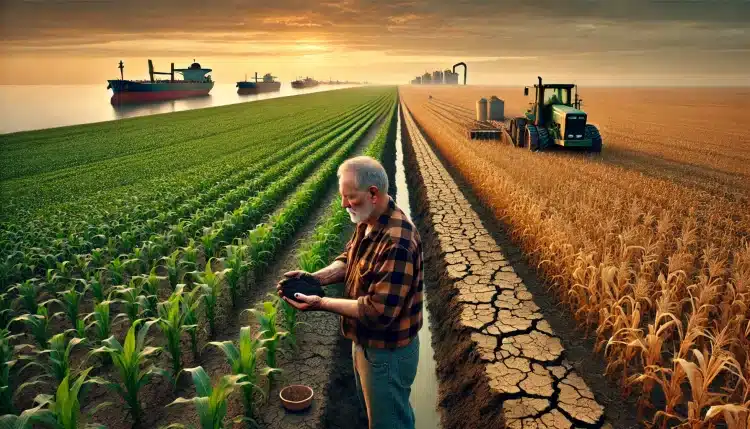
From “End Endless Wars” to Endless Entanglements
At first glance, it looked like Washington might finally step back. Campaign promises were made. Speeches were delivered. The phrase “end endless wars” echoed across rallies.
But then, slowly—almost quietly—the machinery kept turning.
Instead of a clean break, policy drifted right back into the same well-worn grooves shaped by decades of intervention. The same strategic voices, the same assumptions, the same habit of treating the Middle East like a chessboard instead of a powder keg.
And here’s where it gets real.
Because when foreign policy gets stuck in that loop, it doesn’t stay “over there.” It bleeds into shipping lanes, fertilizer flows, and grain markets. In other words, it shows up right in your pantry.
So while the headlines talk about missiles and sanctions, the deeper story is about something far more basic:
Food.
When War Stops Being About Land—and Starts Being About Bread

History makes one thing painfully clear: empires don’t just fight over territory.
They fight over calories.
Time and again, wheat has been more powerful than weapons—not because it wins battles, but because it determines who survives afterward.
Consider the pattern.
First, ancient Rome didn’t just expand for glory—it depended on grain shipments from North Africa and Egypt. Cut those off, and the empire starved.
Then, during World War I, Britain wasn’t just defending borders—it was scrambling to keep grain flowing under relentless submarine attacks.
Later, Nazi Germany pushed east with a chilling level of clarity. Propaganda openly framed the campaign as a mission to seize farmland—“grain and bread” to feed an empire.
Meanwhile, in Stalin’s Soviet Union, grain itself became a tool of control. Food was taken, exported, withheld—used to break resistance at a massive human cost.
And more recently, in Syria, the fight for cities often came down to something deceptively simple:
Who controlled the bakeries.
Who controlled the silos.
Who controlled the bread.
Because once you control food, you don’t need to fire another shot.
Ukraine and the Return of the Grain Wars
Fast forward to today, and the same pattern is playing out again—just with modern tools.
Before 2022, Russia and Ukraine together supplied roughly a quarter of the world’s wheat exports. Add in corn, barley, and sunflower oil, and you’re looking at one of the most critical food regions on Earth.
Then the war hit.
Almost overnight, the Black Sea turned into a chokepoint.
Ports were blocked. Ships stalled. Insurance costs exploded. Grain sat trapped while markets panicked.
And suddenly, something as ordinary as wheat started behaving like a strategic weapon again.
Prices surged. Countries dependent on imports felt the squeeze immediately. Governments scrambled. Families paid more at the store.
Same story. New century.
Because when just a few million tons of grain get stuck in the wrong place at the wrong time, it doesn’t just shift markets—it destabilizes entire regions.
The Strait of Hormuz: Where Fertilizer Becomes a Flashpoint
Now here’s where things take a sharper turn.
If Ukraine was the warning shot, the Strait of Hormuz is the pressure point.
Picture it.
A narrow stretch of water—just 21 miles wide in places—through which an enormous share of the world’s energy and agricultural inputs must pass.
And not just oil.
Fertilizer.
Right now, roughly one-third of global seaborne fertilizer moves through that single corridor. Urea. Ammonia. The backbone of modern agriculture.
In plain terms?
A huge chunk of the world’s ability to grow food depends on a shipping lane narrower than many rural counties.
So when tensions rise in that region, it’s not just about geopolitics—it’s about whether crops get planted.
Already, the early warning signs are there.
Prices jump as risk increases. Shipping insurance spikes. Delays ripple outward.
And because modern farming is tightly timed, even a short disruption can cascade into something much bigger:
Missed planting windows. Lower yields. Higher food prices months down the line.
It doesn’t take a full shutdown.
Just enough friction.
The Modern Food System: A Miracle Hanging by a Thread
Now step back and look at the system as a whole.
On the surface, it’s astonishing.
Eight billion people fed every day.
Food moving across oceans with precision timing.
Crops grown at massive scale using advanced inputs.
But underneath?
It’s fragile.
Because modern agriculture depends on a few critical assumptions:
First, that synthetic fertilizer—made from natural gas—will always be available and affordable.
Second, that global shipping routes will remain open and secure.
Third, that supply chains stretched across continents will keep humming without interruption.
And finally, that a handful of corporations managing fertilizer and grain flows will continue operating smoothly.
That’s a lot of “ifs.”
So when you stack geopolitical tension, energy volatility, and supply chain strain on top of each other, you start to see the cracks.
Not dramatic at first.
Just subtle shifts.
A price increase here. A delay there.
Until suddenly, it’s not subtle anymore.
Why This Isn’t “Over There”—It’s Right Here at Home
It’s easy to think of all this as distant. Foreign. Abstract.
But it’s not.
Because when fertilizer prices jump overseas, it doesn’t stay overseas.
It shows up in input costs for farmers.
It shows up in feed prices.
It shows up in grocery bills.
And it shows up fastest in places that are already stretched thin.
In a tightly connected system, local stability depends on global flow.
So when that flow gets disrupted—even slightly—the effects travel fast.
Weeks, not years.
What History Suggests Comes Next
If history is any guide, we’re not looking at a one-off disruption.
We’re looking at a pattern.
War pressures supply chains.
Supply chains stress food systems.
Food systems strain populations.
And populations, eventually, push back.
That cycle has repeated for centuries.
The only thing that changes is the scale.
And right now, the scale is global.
How to Step Outside the System—Before It Tightens
Now here’s the part that actually matters.
Because while global systems may be fragile, individual households don’t have to be.
In fact, this is where small, practical steps start to carry real weight.
First, building a food buffer isn’t extreme—it’s historical common sense. Families that had reserves have always weathered disruptions better than those that didn’t.
Then, reducing dependence on imported inputs becomes critical. Compost, local manure, regenerative practices—these aren’t just “old ways,” they’re ways of stepping outside a vulnerable system.
Next, shortening your food chain matters more than ever. The closer your food source, the less exposure you have to global shocks.
And finally, community resilience—shared resources, local growers, small-scale storage—creates stability where large systems can’t.
None of this requires panic.
Just awareness.
And a little foresight.
The Narrow Margin Between Abundance and Scarcity
Here’s the truth most people miss.
The gap between full shelves and empty ones is thinner than it looks.
A narrow strait.
A delayed shipment.
A disrupted season.
That’s all it takes to start shifting the balance.
History has already shown us what happens when food becomes a lever of power.
The real question now is simpler:
Will families recognize the pattern early enough to adapt?
Or will they wait until the system reminds them the hard way?
Because in the end, bread—not bullets—decides how these stories play out.