 Print
Print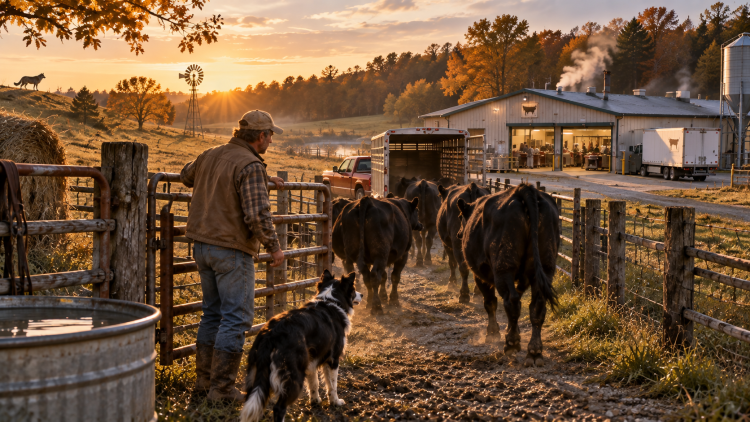
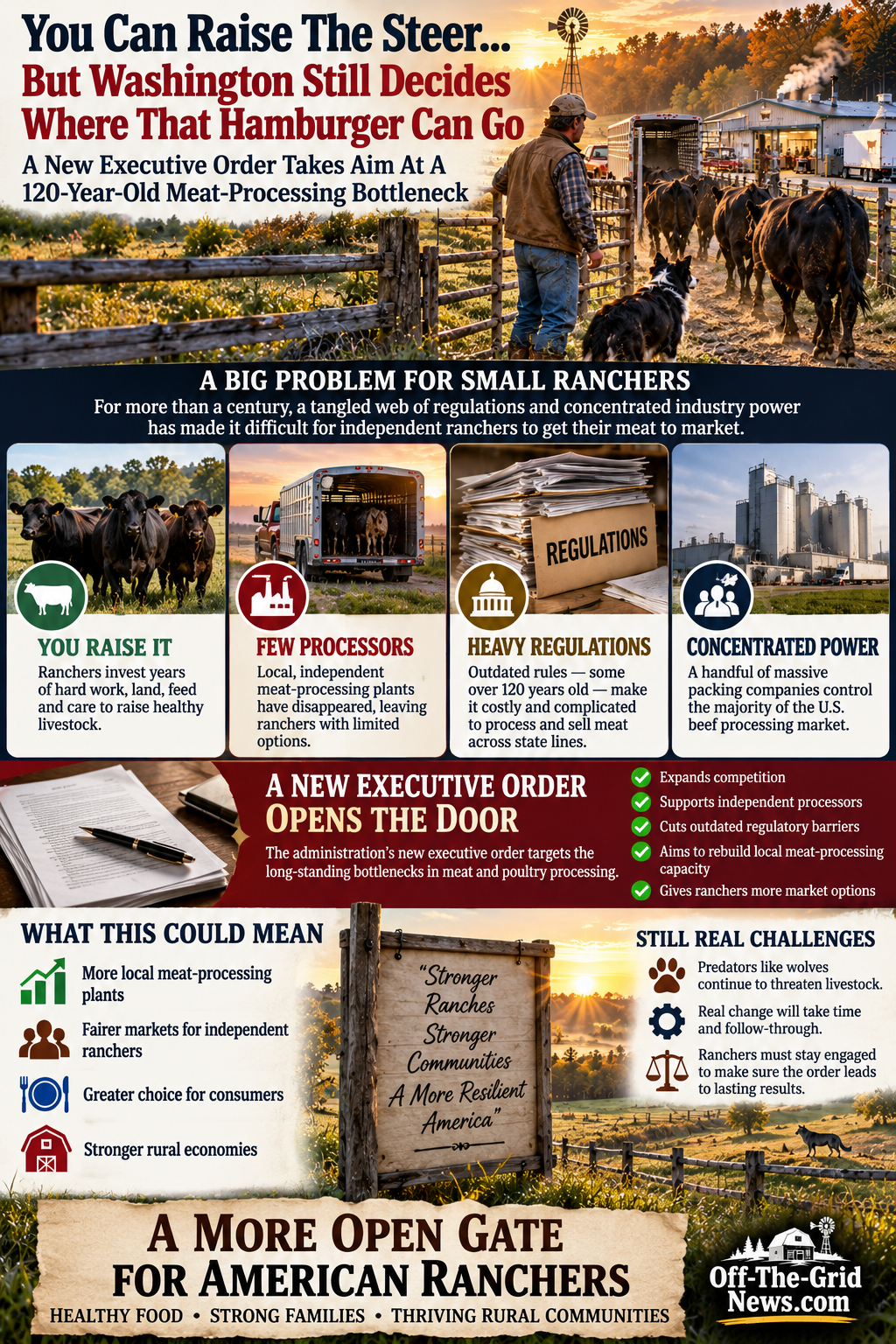
A New Executive Order Takes Aim At A 120-Year-Old Meat-Processing Bottleneck
If You’ve Ever Waited A Year For A Butcher Date… Read This
There’s something downright strange about raising a steer on your own pasture, feeding him hay you put up yourself, hauling him to a little locker down the road — and then discovering that Uncle Sam may have a whole lot to say about where you can legally sell those packages of hamburger.
The roots of that system go back more than a century.
And on September 4, President Donald Trump signed two executive orders aimed at problems ranchers have been complaining about for years. One — Executive Order 14424 — targets competition, inspection and processing bottlenecks in the cattle business. The other — Executive Order 14425 — orders a fresh federal review of protections for gray wolves and Mexican wolves.
If you run a few head, sell freezer beef, depend on a small-town locker, or live someplace where the biggest thing moving along the tree line isn’t always a coyote, both orders are worth watching.
Because Washington may have just cracked open two gates ranchers have been leaning against for a long time.
The Century-Old Bottleneck At The Local Locker

The basic federal meat-inspection system reaches back to the Federal Meat Inspection Act of 1906. Over the decades, Congress has amended and expanded it, but the practical dividing line familiar to small producers remains: meat entering ordinary commercial channels generally must be slaughtered and processed under an approved inspection system.
That sounds simple enough on paper.
Out here in cattle country, it can look very different.
A small producer may have the animal, the customer and the money waiting — but no inspected processing slot. Small plants can be booked months ahead, and in some areas producers haul cattle long distances simply because the nearest processor able to handle the job is nowhere near the farm.
That turns the local butcher into a bottleneck.
And it means something as ordinary as selling beef from one family farm to another family can require navigating a regulatory system built for a meat industry that looks very different from the one that existed when the original law was written.
USDA’s own Food Safety and Inspection Service explains the state-inspection system here, including the basic rule that ordinary state-inspected product is generally restricted to commerce within that state.
Meanwhile, the processing end of the beef business has become heavily concentrated among a handful of enormous companies.
That is where the first September 4 order comes in.
Washington Is Taking Another Look At The Beef-Processing Squeeze
Executive Order 14424 is called “Promoting Fair Competition in Livestock Markets and Expanding Market Access for American Meat Producers.”
That sounds like something written by a committee trapped in a conference room.
Strip away the Washington language, though, and the order contains several things small ranchers and processors ought to pay attention to.
First comes enforcement.
The order directs the Secretary of Agriculture to prioritize enforcement of the Packers and Stockyards Act, including investigations involving unfair, deceptive, discriminatory or anticompetitive practices in livestock markets.
That law isn’t some dusty museum piece, either. USDA’s Packers and Stockyards Division continues bringing enforcement actions involving livestock dealers, markets and packers today.
The new order also calls for additional enforcement resources and coordination with the Department of Justice where appropriate.
That matters because the Packers and Stockyards Act dates to 1921 — another old law written during an era when Americans were already worried about concentrated power in the meatpacking business. USDA describes its purpose as protecting farmers and ranchers while promoting fair competition and guarding against unfair, deceptive and monopolistic practices.
A century later, we’re still having the argument.
The Second Piece Could Matter Even More To The Little Guy
Next comes something much closer to the local butcher shop.
There are already State Meat and Poultry Inspection programs operating in much of the country. USDA currently identifies 29 states with their own meat or poultry inspection programs.
But there’s an important catch.
Ordinarily, meat produced solely under state inspection stays inside that state.
That’s why the Cooperative Interstate Shipment program matters.
Congress created CIS through the 2008 Farm Bill, allowing qualifying small and very small state-inspected establishments to ship meat and poultry in interstate commerce while operating under a cooperative federal-state inspection arrangement.
USDA even maintains a current list of processors participating in CIS.
And the program is still expanding. In August 2026, USDA announced that Georgia had joined the Cooperative Interstate Shipment program.
The trouble is, participation still varies enormously by state, and navigating the system isn’t exactly like ordering seed corn from a catalog.
So the new executive order tells USDA to work on expanding participation, simplifying the process and increasing awareness of these programs. The stated goal is straightforward: create more legitimate avenues for American-raised meat to reach customers without sacrificing food safety.
For a 5,000-head operation, that might be paperwork.
For the fellow raising 20 steers behind his barn, it could eventually mean another market.
That’s a big difference.
Then There’s The Local Locker
The order also recognizes something anybody who has tried booking a butcher date already knows:
You can’t build a local beef economy without local slaughter and processing capacity.
So USDA is directed to provide technical assistance and training for small and very small processors, improve information showing producers where slaughter and processing capacity exists, and establish a more coordinated point of contact inside the department for producers and processors trying to navigate federal programs.
And this isn’t starting entirely from scratch.
USDA already operates a Meat and Poultry Inspection Readiness Grant program designed to help existing processors obtain federal inspection or qualify to operate through a state CIS program.
There’s also USDA’s Meat and Poultry Processing Expansion Program, which provides funding intended to increase independent processing capacity.
In fact, USDA announced another $60 million round of processing-expansion funding in 2026, including separate opportunities for very small, small and intermediate processors.
USDA’s broader 2026 beef-industry plan also calls for prioritizing beef-processor applications under the Business and Industry Guaranteed Loan Program, with guaranteed loans potentially reaching $25 million to increase local processing capacity.
That may sound like another government program until the butcher in your county closes.
Then it becomes painfully practical.
A local processing plant isn’t just another business on Main Street. For small cattle producers, it is infrastructure every bit as real as a bridge, grain elevator or livestock auction barn.
Lose it, and suddenly cattle have to travel.
Costs climb. Appointments disappear.
And selling beef directly to local families gets harder.
The Most Interesting Sentence May Be Buried In The Inspection Language
There’s another part of Executive Order 14424 I’d watch especially closely.
USDA is directed to review and modernize meat inspection with an emphasis on actual food-safety outcomes while looking for reporting requirements and overly prescriptive rules that may not meaningfully advance food safety.
That distinction matters.
Nobody wants unsafe hamburger.
But there’s a mighty big difference between a regulation that keeps E. coli out of somebody’s kitchen and a regulation that mainly keeps a small butcher filling out forms until midnight.
The question is whether USDA can tell the difference — and then actually do something about it.
Two Reports Could Tell Us Whether This Has Teeth
Executive orders make headlines.
The follow-up paperwork tells you what may actually happen.
Under Executive Order 14424, USDA has deadlines to examine participation in cooperative inspection programs and identify legal and regulatory obstacles standing in the way of broader interstate market access.
The order also specifically directs attention toward the statutes and trade considerations affecting state-inspected and custom-exempt meat.
That last category should make homesteaders sit up in their chairs.
USDA has an entire FSIS guideline explaining when a livestock slaughter or processing business may qualify for an exemption from federal inspection requirements, as well as a separate Custom Exempt Review Process.
Custom-exempt processing is where a lot of small freezer-beef operations live. Typically, ownership of the animal or a portion of it is established before slaughter, and the meat is processed for the owner’s household use rather than sold afterward as ordinary inspected retail meat.
It works.
But it also creates a fence around what that little producer can do with the finished product.
USDA’s own rules make that distinction important because violations can include the sale or distribution of uninspected custom-exempt meat.
So getting the federal government to identify exactly which statutes and regulations create those barriers could be important.
Think of it as finally asking Washington to walk the fence line with us and point at every post.
But Don’t Confuse A Map With An Open Gate
This is where the distinction matters.
The executive order does not, by itself, suddenly give every rancher in America the legal right to butcher a steer behind the barn and sell hamburger across state lines.
Changing statutory requirements ultimately may require Congress.
In fact, USDA’s own CIS guidance traces the current interstate-shipment exception back to Congress amending the Federal Meat Inspection Act through the 2008 Farm Bill.
The order itself repeatedly conditions agency action on existing law and available appropriations.
In other words, the President can order the bureaucracy to examine the fence, clear brush away from it and identify which posts need moving.
He cannot simply pretend Congress never built the fence.
So these reports matter because they could tell lawmakers precisely what would have to change.
That is much more significant than another press conference — but it still isn’t the same thing as changing the law.
Then There’s The Other Problem Walking Around On Four Legs
The second September 4 order is Executive Order 14425, “Supporting America’s Ranchers”.
And buried among its broader ranching provisions is something Western livestock producers have been fighting about for decades:
Wolves.
The order directs the Secretary of the Interior to determine whether the gray wolf and Mexican wolf have met applicable recovery criteria for delisting or downlisting under the Endangered Species Act. If Interior determines those criteria have been met, the department is directed to begin the appropriate process.
For anybody wanting to see what those standards actually look like, the U.S. Fish and Wildlife Service maintains its gray wolf recovery information here and its Mexican wolf recovery program here.
There is even a 2022 Mexican Wolf Recovery Plan spelling out measurable downlisting and delisting criteria.
The administration is also directed to develop legislative recommendations concerning wolf delisting and, following a positive federal recovery determination, work with states regarding their own protected-species rules and standards governing lethal takes.
That could become a very big deal in cattle and sheep country.
Because A Wolf At The Fence Isn’t An Abstract Policy Debate
Wolf management sounds academic when you’re sitting under fluorescent lights in Washington.
It feels considerably less academic at 2:17 in the morning when cattle are bawling.
Federal wolf protections have bounced through agencies, courts and lawsuits for years, leaving producers in different parts of the country operating under different rules.
The Fish and Wildlife Service’s current gray wolf recovery page explains that following the February 2022 federal court decision, wolves are federally listed as threatened in Minnesota and endangered in much of the rest of the lower 48, with the Northern Rocky Mountain population treated differently.
The Fish and Wildlife Service also maintains the formal regulatory history of reinstating those ESA protections.
The new order doesn’t instantly remove those protections.
Instead, it forces Interior to make another recovery determination and potentially begin the legal process that follows from that finding. It also directs Interior and USDA to examine compensation programs, evidentiary standards and procedures used when producers seek payment for livestock lost to predators.
That last part doesn’t generate many headlines.
But ask the rancher standing over a dead calf whether it matters.
And This Is Happening With The American Cattle Herd Already Scraped Thin
The timing isn’t accidental.
USDA reported 86.2 million cattle and calves on American farms as of January 1, 2026, down from 86.7 million one year earlier.
That puts the national herd near historic lows.
And when cattle numbers are already tight, every additional expense matters — feed, fuel, processing, transportation, financing and predator losses included.
A rancher doesn’t experience those things as separate policy categories.
He experiences them as one checkbook.
Now Comes The Part That Matters
There will almost certainly be fights over implementation.
Wolf policy has spent years bouncing between federal agencies and federal courts. Meatpacking competition involves enormous corporations, complicated markets and laws written generations ago.
And expanding local processing capacity takes more than signing a piece of paper.
You need butchers.
You need plants.
You need inspectors.
You need financing.
And somewhere along the way, somebody has to make the rules simple enough that a family operation can actually use them.
Still, these two orders put several long-running ranch-country complaints squarely onto the federal government’s workbench.
That’s worth paying attention to.
Three Things Small Ranchers Should Watch Next
So if you’ve got cattle behind the fence or freezer-beef customers waiting for the next butcher date, don’t just watch the political headlines.
Watch what happens on the ground.
First, find out whether your state is among the states operating its own meat-inspection program, then check whether processors serving your area participate in the Cooperative Interstate Shipment program.
Second, talk with your local processor about USDA assistance and financing programs as the department begins implementing the order. The Meat and Poultry Processing Expansion Program and Meat and Poultry Inspection Readiness Grant pages are good places to start watching.
A good small-town butcher is becoming one of the most valuable pieces of infrastructure a rural community can have.
And third, keep an eye on the reports and agency actions required by Executive Order 14424 and Executive Order 14425.
Because that’s where we’ll learn whether Washington merely walked out to the pasture for a photograph…
…or whether somebody is finally going to move a few fence posts.
For the small rancher, the difference could mean everything.