 Print
Print
For most of us, finding out the day’s weather is as easy as turning on our television or checking the forecast on our smartphones, but the native people of North America had to rely on what they were taught.
They simply read the signs of nature – a skill we should practice more.
Learning to read the signs of nature, which are often right in front of us, can help us track animals for food, find safe sources of food and water, and even predict the weather.
In fact, most indigenous children were able to survive on their own at a very young age because they were taught the signs to look for almost as soon as they could talk.
Unfortunately, many of these skills have become forgotten by most in our society over the last few centuries, but you can still pick up these important survival skills and learn directly from nature.
1. Following the Weather
No matter what part of the country you are living in, bad weather can sneak up on you. Indigenous people were always aware of their surroundings, knowing that dangerous animals, enemies or storms could be just around the corner.
Get The Essential Secrets Of The Most Savvy Survivalists In The World!
By paying attention to nature’s signs, native people knew that one can almost feel bad weather before it starts. Before a big storm, the wind generally picks up, making the leaves on trees twist and showing you their lighter-colored underside. Look into the distance and see if you can see rain further out. Take a deep breath. Native people find that you can smell rain in the distance, even if mountains prevent you from seeing it. Birds will fly lower to the ground and begin to gather in the trees, even though it is still mid-day. Crickets will stop chirping. Fish sometimes come to the surface and even leap out of the water. If wildlife around you suddenly disappear or if you spot seagulls farther inland than normal, a storm is surely on its way.
2. Finding Water
Over the centuries, native people relied on the same water sources year after year. But for non-nomadic tribes, or when traveling, finding water was a skill no one could afford not to learn! To find water, native people learned to look for green-leafed trees, such as aspens or cottonwoods. The presence of birds, dragonflies or other animals usually means that there is water somewhere nearby. Native people learned to watch for animal trails, such as deer paths, and to follow them downhill. Since animals need water as well, you can bet that a trail will eventually lead to a watering hole. Also, if animals were drinking it, the water was most likely safe to drink. Canyons that face north are more likely to have watering holes, even in the summer, as the sun does not penetrate that far inside the canyon. Natives knew that a dry river bed might still have water. They would look for green plants clinging to the edges and dig right next to them. Chances are that water was just a few inches below the surface.
3. Knowing Which Wild Plants Were Safe for Eating
This is another skill that native people passed down to one another, and it varies greatly depending on where you are. While indigenous people knew that cattails were quite edible, there were not many in the deserts or dry valley areas. Non-nomadic tribes, such as the Ojibwa, raised crops on family plots, but nomadic tribes learned over the centuries which plants were safe to eat and when to harvest them. Native people learned to watch the animals for reliable food sources. Squirrels, blue jays, crows and other animals sometimes hide food — such as acorns — for later consumption. If food was scarce, these were dug up and eaten. Many tribes knew that when birds, deer or other animals were eating berries, these were generally safe for humans as well. Many wild berries, such as blackberries, grow near the forest edges. Plantain is found almost everywhere in the U.S. and can be eaten raw or cooked. Dandelions are another edible plant. (But don’t ever consume mushrooms unless you are 100 percent certain you know what you are choosing, as many are poisonous.) The indigenous people looked to the trees to find nuts or fruit. Native people learned to avoid plants that smelled like almonds, or any plant that has thorns.
4. Finding their Way Home
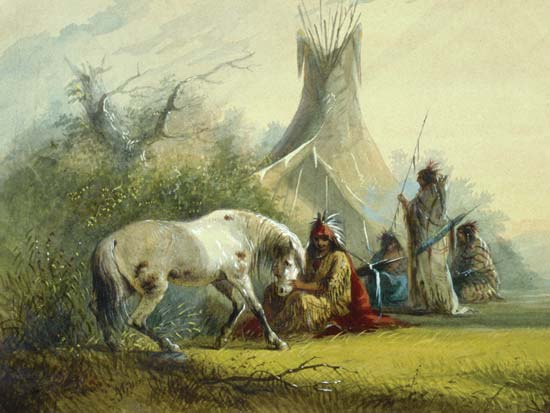
Ever wonder how the native people of this land never seemed to get lost? Even when a single young man would walk out into the woods to hunt, they never seemed to have trouble finding their way back. How did they do this? Again, indigenous people were always aware of their surroundings. They knew a marker (such as a mountain or a particular growth of trees) that would help to guide them back. Also, without a compass, they still knew the four directions.
New ‘Survival Herb Bank’ Gives You Access to God’s Amazing Medicine Chest
Even without sunlight, they would know that the north end of a gorse bush, for example, had the thickest tufts of “flowers.” They also knew that trees tend to grow longer or grow more branches on the side that faces south. Before they even left camp, indigenous people knew what direction their camp lay in relation to their journey, so finding their way back was pretty easy.
5. Finding Meat
Native people ate quite a bit of meat when they could find it. Since animals tend to migrate or move about to find their own food, meat choices for indigenous people varied, depending on the season. Fishing was always a good source of food. Nets, not poles, were the preferred method of fishing, although spears were also sometimes used in deeper water.
Many women made traps near water sources or along known animal trails. Birds, such as ducks and geese, were often caught using traps, bolas or slings. Even small children learned to use slings or slingshots to kill rabbits, raccoons and squirrels.
For most of us, skills such as these would take a lifetime of learning, or at least several years of classes, plus practice. However, for the native people of North America, reading the signs of nature was as normal as putting on moccasins in the morning.
What skills would you add to this story? Share your thoughts in the section below:
Learn How To ‘Live Off The Land’ With Just Your Gun. Read More Here.