 Print
Print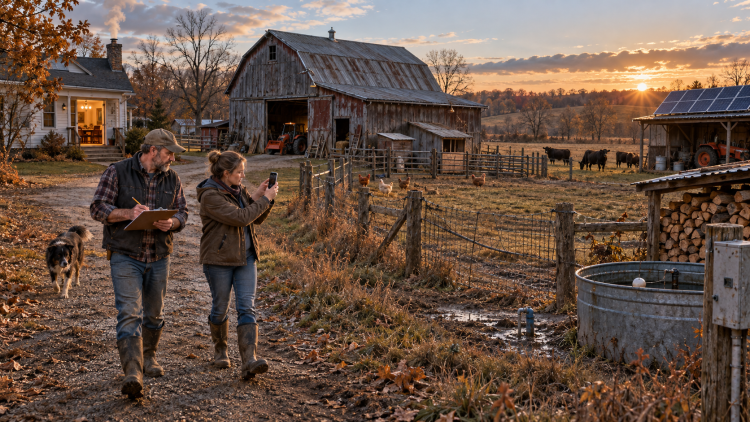
Five Hard Questions Every Homestead Head Needs To Answer
The Weakest Part Of Your Homestead May Be The Thing You’ve Never Thought To Question
Every homestead has a weak point. It may not be the gate that sticks when the temperature drops, the sagging stretch of fence you keep promising yourself you’ll tighten next Saturday, or the rusty piece of equipment sitting behind the barn.
It may be something much harder to see — an assumption.
Something everybody in the family has been doing the same way for three years because that’s simply how you’ve always done it. Nobody questions it anymore, and after walking past the problem a thousand times, nobody even sees it.
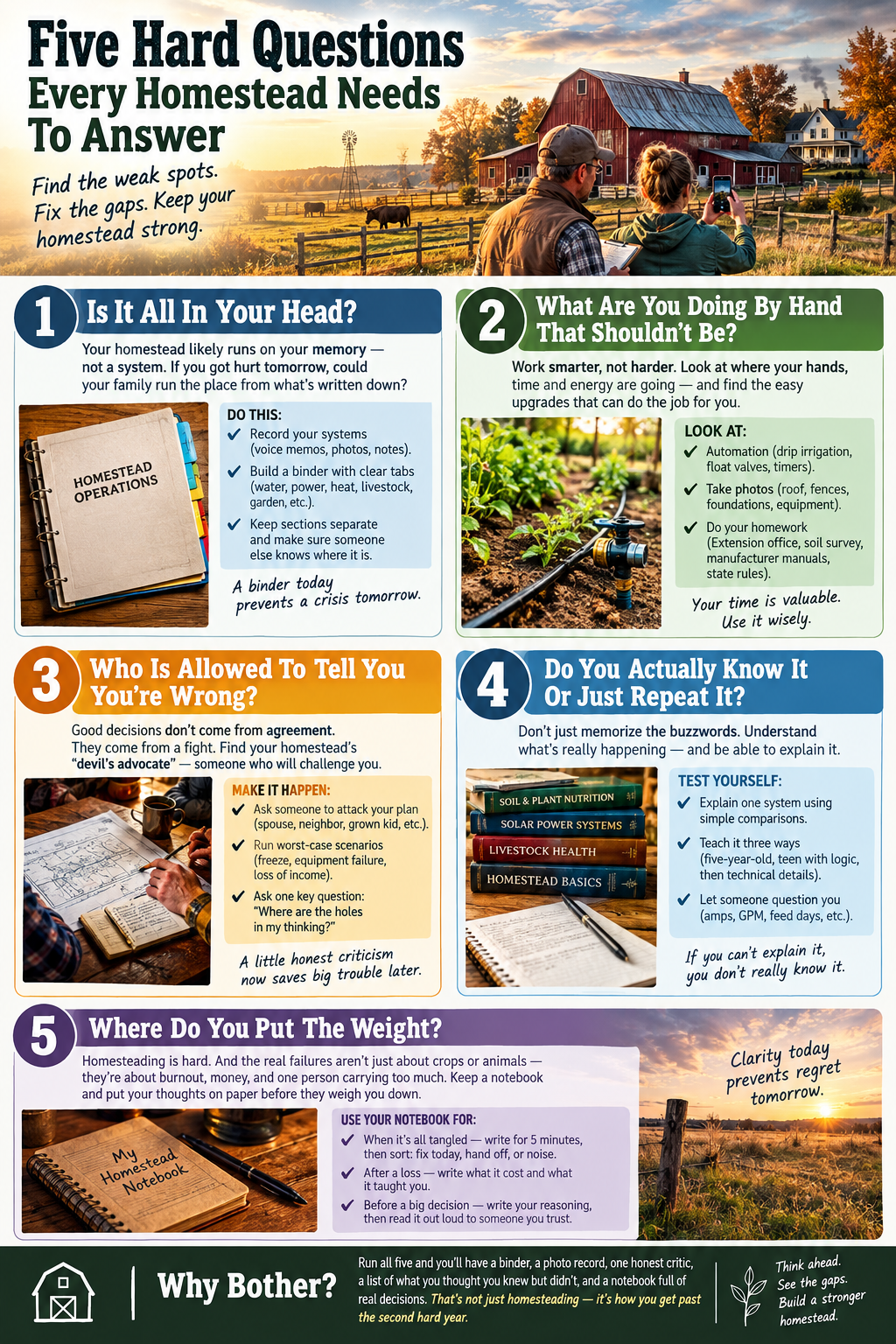
Then comes the worst week of winter. The temperature drops below zero, the truck won’t start, the well pump quits and somebody gets sick — and suddenly that little assumption you’ve been walking past for years becomes the biggest problem on the property.
Recently, I ran across a framework a technology executive uses to get more useful work out of artificial intelligence. There were five basic strategies behind it, but the more I looked at those strategies, the more I realized they weren’t really about computers at all.
Strip away the software, algorithms and Silicon Valley language, and what’s left is a pretty good stress test for a homestead. That’s because homesteads have exactly the same problem most businesses and organizations eventually develop: the people running them become too close to the operation to see it clearly.
That’s us.
So set aside some Saturday afternoon. Put a pot of coffee on, get everybody around the kitchen table and run your place through these five questions — answering them honestly, especially when the honest answer stings.
Question One: Is Your Homestead Stored Inside Your Head?
Software has a strange problem. Shut some programs down without saving anything and everything disappears, and a surprising number of homesteads operate exactly the same way.
Except you’re the program.
Which breaker feeds the well pump? Which apple tree produces the late keeper? Where does that buried water line cross the driveway, and what did the propane gauge actually read during the coldest morning last February?
How much firewood did you really burn last winter — not how much you remember burning? Where are the septic lines, what’s the well depth, which hydraulic fluid does the tractor take, and what’s that odd little trick you have to do to get the generator started when it’s ten below?
Somebody knows those answers. Usually, it’s the person who built, repaired or installed the system.
And that’s the problem.
If you got hurt tomorrow and were laid up for six weeks, could your family run the place from what’s written down?
For an awful lot of homesteads, the answer is no. That’s not merely a paperwork problem; it’s a genuine vulnerability, and fortunately it’s one you can fix in a weekend.
Start With A Walk
Grab your phone, turn on the recorder and walk the property for an hour. Don’t organize anything, don’t worry about sounding smart and don’t edit yourself — just walk from the well to the barn, from the electrical panel to the wood stove, from the chicken coop to the tractor shed.
Describe every system, but more importantly, describe the quirks. “This valve sticks when it’s cold.” “That breaker is labeled wrong.” “If the pressure tank starts doing this, check this first.”
Those little scraps of knowledge are often more valuable than the owner’s manual because they’re lessons you already paid for. They came from frozen fingers, busted knuckles, wasted Saturdays and the peculiar education that arrives only after something breaks at the worst possible time.
Then Build The Homestead Binder
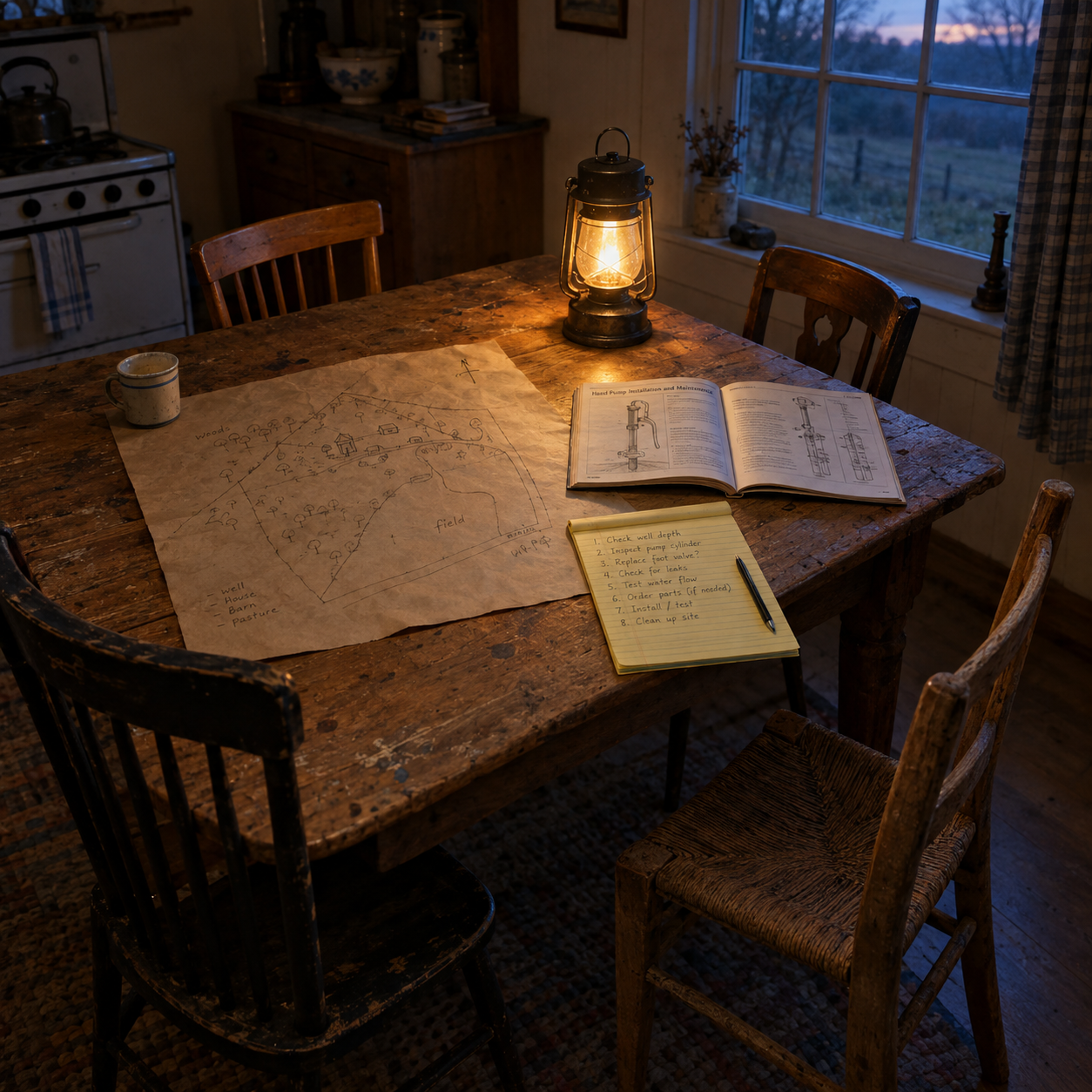
Turn that rambling walk into one binder with clear tabs: Water. Power. Heat. Livestock. Garden. Vehicles. Food Storage. Tools. Emergency Contacts.
Write down model numbers, part numbers, well depth, amp ratings, fuel requirements, maintenance schedules and the phone number of the guy who actually knows how to fix your tractor. Keep the sections separate, too, because a binder containing everything in no particular order eventually becomes a binder nobody opens.
And make sure somebody besides you knows where it is.
Because there’s a big difference between a homestead and one person’s complicated hobby.
Question Two: What Are You Doing By Hand That You Shouldn’t Be Doing At All?
Some days on a homestead, it feels like you need six arms. You’ve got two, yet somehow you’ve written a to-do list for somebody with twelve.
But this question isn’t really about working harder. It’s about looking honestly at where your hands — and your hours — are going.
Look At Your Hands
What are you still doing one step at a time that a simple mechanism could do while you’re sleeping? Maybe you’re hand-watering a garden that could run from drip irrigation and a timer, hauling water that gravity could move downhill for free, or checking a stock tank morning and evening when a float valve could handle most of the job.
Not everything needs automation, and sometimes the simplest manual system is still the most dependable system. But every hour spent doing a job a cheap valve, timer, switch or gravity line could reliably handle is an hour you don’t have for jobs requiring an actual human being.
Your time is one of the most expensive tools on the property. Treat it that way.
Now Use Your Eyes
Next, stop describing problems from memory and photograph them. Take pictures of the roofline, foundation, fence corners, barn posts, equipment, drainage ditches, creek banks and that suspicious wet spot that keeps appearing in the pasture.
Photography does something memory doesn’t: it freezes the evidence. You’ve walked underneath that sagging purlin four hundred times and eventually your brain stops seeing it, but put last year’s photograph beside this year’s photograph and suddenly the change jumps off the screen.
Do this every spring and fall and date the photographs. Five years from now you’ll have a visual record of your soil, buildings, fences, treeline, drainage and equipment that your memory could never reproduce.
Finally, Do Your Homework
Some of the most expensive homestead mistakes begin with four innocent words: “I’ve always heard that…”
Before the next big purchase or project, spend an afternoon checking real sources. Start with the Cooperative Extension System, pull up the USDA’s Web Soil Survey, read the manufacturer’s actual manual and check your state’s regulations instead of relying on somebody’s interpretation in a Facebook comment from 2019.
The USDA’s Web Soil Survey is especially useful because it lets you define your own property as an area of interest, see its mapped soils and investigate how those soils are suited to different uses. It’s the kind of free information that can answer questions about a piece of ground before you spend money trying to make the ground do something it doesn’t particularly want to do.
One boring afternoon of research can save an entire wasted growing season.
That’s a pretty good trade.
Question Three: Who Has Permission To Tell You You’re Wrong?
For centuries, the Roman Catholic Church’s canonization process included an adversarial role whose job was essentially to challenge the case being made for sainthood. The formal office known as the Promoter of the Faith became popularly known as the “Devil’s Advocate” because its job included raising objections, questioning alleged miracles and forcing the positive case to survive scrutiny.
There’s a surprisingly useful lesson buried in that old institution. When the stakes are high, don’t merely collect arguments supporting what you already believe — find somebody willing to attack them.
Your homestead needs somebody like that.
And right now, that chair may be empty.
The reason is painfully simple: we fall in love with the things we build ourselves. You can look at your neighbor’s barn and spot the design flaw in nine seconds, while you’ve walked past the flaw in your own barn every morning for four years.
You built it. You picked that livestock breed, designed that water system, chose that tractor and decided how much feed to store, which makes you emotionally invested in proving yesterday’s decision was correct.
Telling yourself to “be objective” doesn’t magically fix that. So appoint somebody — your spouse, a neighbor, a grown kid or an old farmer down the road who’s smart enough to understand the problem and stubborn enough to disagree with you.
For one hour, their job isn’t to encourage you.
Their job is to find the hole.
Don’t Ask, “What Do You Think?”
That’s an invitation to be polite. Instead, put the plan on the kitchen table and say, “Try to make this fail.”
Attack it. What happens if the pump quits, diesel costs far more than you budgeted, your hay supplier disappears, the power is out for three days or winter lasts three weeks longer than expected?
Then take it another step and stage the disaster before it happens. Run the freeze that lasts eight days instead of two, the truck dying in November, the generator refusing to start, or the loss of a second-job paycheck that quietly subsidizes the whole operation.
Argue through those scenarios around the kitchen table while the lights are on and the wood stove is warm. You don’t want to discover the answer at 2:17 in the morning with a flashlight between your teeth.
Finally, ask somebody familiar with your place one uncomfortable question: “Where are the holes in my thinking?” A few good seasons can produce two dangerous habits — you start trusting your own judgment too much, and you start spending more time around people who agree with you.
This question protects you from both.
Question Four: Do You Actually Know It — Or Have You Just Heard It A Hundred Times?
There’s a famous story told about Nobel Prize-winning physicist Max Planck and his chauffeur. The chauffeur supposedly heard Planck’s lecture so many times that he could eventually repeat the whole thing from memory, but reproducing the words wasn’t the same thing as understanding the physics underneath them.
Whether every flourish in the often-repeated story happened exactly as later storytellers tell it isn’t important here. The distinction between memorizing an explanation and understanding what’s underneath it certainly is.
An awful lot of homestead knowledge is chauffeur knowledge.
We’ve heard something on a podcast, watched somebody say it in a video, read it in three articles and repeated it so many times that eventually it feels like something we discovered ourselves. Familiarity sneaks in wearing the clothes of understanding.
“Comfrey is a nutrient accumulator.”
Fine. Which nutrients, how does that process work, and does it matter in your soil? Is your ground even deficient in the thing you’re supposedly accumulating?
Suddenly the slogan isn’t quite enough.
Explain It Without The Fancy Words
Pick one important system on your property and explain it using something you already understand. Take your solar charge controller: could you explain what it’s doing by comparing electricity to water moving through pipes, tanks and valves?
Could you explain your pressure tank the same way? What about your septic system, pasture rotation, battery bank or soil amendments?
If you can’t explain something without hiding behind its technical vocabulary, there’s a decent chance you don’t understand it as well as you think.
Then Explain It Three Times
First, explain it to a five-year-old. Then explain it to a teenager with the reasoning included, and finally explain it all the way down to the technical bones — volts, amps, gallons per minute, pounds per acre, BTUs, bushels or whatever measurements actually govern that system.
Wherever you stumble is where your knowledge stops. That’s not embarrassing; that’s useful information because now you know exactly what you need to learn next.
Then let somebody question you. How many amps? How many gallons per minute? How many days of feed are actually sitting in the barn? How long can those batteries carry the critical loads?
Confidence that collapses under three follow-up questions wasn’t knowledge.
It was familiarity wearing overalls.
Question Five: Where Do You Put The Weight?
Nearly two thousand years ago, Roman emperor Marcus Aurelius wrote private philosophical notes largely for his own use. Those writings eventually became what English readers know as Meditations, although scholars note that the work was probably untitled originally and the traditional Greek designation translates roughly as “To Himself.”
That detail matters because Marcus wasn’t sitting down to write a bestseller. He was wrestling privately with duty, frustration, character, fear, mortality, and the burden of responsibility.
There’s something any homesteader can learn from that.
This life can be hard, quiet, and considerably lonelier than the photographs make it look. People see the sunset behind the barn, but they don’t see the argument over money in the kitchen; they see the overflowing garden basket, but they don’t see the crop that failed last year.
They see the calf in the pasture, wood stacked against the shed and smoke curling from the chimney. They don’t see the exhaustion behind it.
And some of the failures that finally end homesteads aren’t agricultural failures at all. They’re burnout, resentment over who’s carrying what, financial pressure nobody wants to discuss, or one person’s dream slowly becoming everybody else’s chore.
So keep a notebook. Not because you’re trying to become Marcus Aurelius, but because sometimes a problem needs to be placed somewhere other than in your head.
When Everything Feels Like A Crisis, Sort It
Write for five minutes without stopping, then divide what you wrote into three columns: what I can fix today, what I need to hand off, and what’s just noise. You’ll be surprised how often something that felt like one enormous problem turns out to be six small problems piled on top of one another.
Sometimes a crisis is just a sorting problem wearing a scary costume.
When Something Dies, Breaks Or Fails, Write It Down
After a real loss — a crop, an animal, a machine or a business decision — write two things side by side: What did this cost me? What did this teach me?
Writing the lesson down won’t bring the animal back, repair the engine or refill the bank account. But it can keep one bad event from turning into six months of bad decisions.
Before A Decision You Can’t Easily Undo, Write Your Reasoning
Buying another piece of land, taking on debt, adding livestock, building another structure or quitting the town job all have one thing in common: they’re much easier to contemplate than to reverse. Before you jump, write out exactly why you’re doing it, including the numbers, what has to go right and what happens if you’re wrong.
Then read the whole thing out loud to somebody you trust. You don’t necessarily need their permission or even their opinion; hearing your own reasoning spoken aloud has a funny way of exposing things that looked perfectly sensible on paper.
The Five Things You Should Have When You’re Finished
Run your homestead through all five questions and you won’t end Saturday afternoon with another barn, another acre or another shiny piece of equipment. Instead, you’ll have a binder and photographic record, one honest critic, a list of things you thought you understood but really didn’t, and a notebook full of decisions you can finally see clearly.
None of those things, by themselves, are homesteading.
They’re the thinking that helps you survive the second hard year.
Most of us were raised to measure a day’s value by what it produced. How much wood did we split, how many fence posts went in, how many rows got planted and how many jars went onto the pantry shelf?
Homesteading pushes us even harder in that direction because there’s always more work than daylight. There’s always another hinge squeaking, another fence leaning, another animal needing something and another chore waiting around the corner.
But every now and then, the most productive thing you can do on a homestead is put the tools down. Walk the property, ask uncomfortable questions, write down what you know, admit what you don’t know, and invite somebody you trust to tell you where you’re wrong.
Give yourself one Saturday afternoon to do that.
The chores will still be waiting Monday morning.
But you may walk outside seeing your own place with entirely different eyes.