 Print
Print
The Clock On The Wall Never Changes. Yet Somehow The Years Do.
Science is just starting to explain why time feels like it’s speeding up… and why understanding it may help you make the seasons you have left feel richer, fuller, and longer.
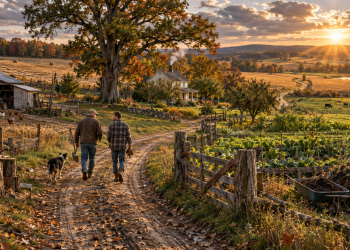
The old clock hanging in the farmhouse doesn’t know how old you are. It ticks the same steady rhythm whether you’re ten years old racing through the pasture or seventy years old watching another sunrise with a cup of coffee in your hands. Every second passes with the same quiet certainty it always has.
Out in the open air, we tend to trust what we can see and measure. A sunrise is a sunrise. A season is a season. A year is a year. The calendar turns one page at a time, and every day arrives with the same twenty-four hours our grandparents were given.
According to science, that’s exactly how it works. A second measured by an old pendulum clock, a quartz wristwatch, or one of the world’s incredibly precise atomic clocks is still one second. Even under Einstein’s theory of relativity, if you’re standing on your own porch watching the evening settle over the fields, time continues moving at exactly the same pace.
On paper, time is perfectly dependable.
Yet if you’ve lived long enough to watch children grow into parents and old fence rows disappear beneath young timber, you’ve probably noticed something the clock never mentions. The years don’t seem to carry the same weight they once did. They seem to slip by faster, almost as if someone quietly turned the pages of the calendar while you weren’t looking.
The clock isn’t lying.
But it isn’t telling the whole story.
The Calendar Never Changes—But We Do

Now, think about it for a moment. Your first year on earth lasted 365 days. Your fiftieth year also lasted 365 days. If you make it to eighty, that year will contain exactly the same number of mornings, afternoons, and evenings as every year before it.
Nothing about the mathematics changes. The sun still rises over the eastern horizon. Spring still follows winter. Tomatoes still ripen in August, and firewood still needs to be stacked before the first hard freeze.
And yet those years feel completely different.
When you were young, a single summer seemed endless. Today, one season rolls into another before you’ve finished putting away the garden tools from the last one. Each Christmas fades into spring planting, and before long, you’re hearing the first geese heading south again.
Almost everyone notices it.
Very few people stop to wonder why.
Scientists have spent decades studying how human beings experience time, and what they’ve discovered is surprisingly comforting. Time itself isn’t speeding up. Instead, your brain changes the way it measures the passage of life.
In other words, there are really two kinds of time.
There’s clock time… the kind that keeps your appointments and reminds you when it’s time to feed the livestock.
Then there’s lived time—the kind your memories are built from.
Those two don’t always agree. Interesting, right?
Remember When One Summer Felt Like Forever?
Close your eyes for a minute and think back to an ordinary summer when you were eight or nine years old. Not your birthday or your favorite vacation… just an average stretch of hot afternoons that seemed as though they would never end.
You probably spent hours wandering through tall grass chasing grasshoppers or turning over rocks in search of crawdads. Maybe you rode your bicycle until dark, climbed trees with your friends, or wandered along a creek catching frogs while your parents wondered where you’d disappeared. Most of us grew up this way.
Every day felt enormous because every day was packed with discovery. The smallest things seemed fascinating, and bedtime often felt like the end of a genuine adventure.
Now think about last summer.
You probably remember a family cookout, a vacation, or finally finishing a project around the homestead. Beyond those highlights, however, many of the ordinary days seem to blend together until suddenly you’re pulling sweaters out of the closet and wondering how autumn arrived so quickly.
That’s not simply nostalgia talking.
It’s one of the most predictable ways the human mind works.
Why Every Year Feels Smaller Than the Last
More than a century ago, French philosopher and psychologist Paul Janet made an observation that still resonates today. He said that every passing year becomes a smaller fraction of your total life, changing the way your mind experiences its length.
It’s easier to understand with a simple example.
When you’re one year old, that year represents your entire existence. Every sound you’ve heard, every face you’ve seen, every experience you’ve ever had fits inside those first twelve months. Naturally, that year feels enormous because it contains 100% of what you know.
By the time you’re ten, one year represents only one-tenth of your life. It’s still significant, but now your brain has years of memories to compare it with.
At twenty, another year becomes one-twentieth of your experience. At fifty, it’s one-fiftieth. By seventy, another year is only a thin layer added to a lifetime already overflowing with memories, relationships, and experiences. (Think about Noah having over 900 planting and harvesting seasons. Yikes!)
So the calendar hasn’t changed.
Your perspective has.
Each new year occupies a smaller percentage of the story you’ve already lived, making it seem shorter even though it contains exactly the same number of days.
Why Routine Makes the Years Fly
Most folks assume country life naturally slows things down. After all, there aren’t many traffic jams on gravel roads, and very few homesteaders spend their mornings staring at office clocks.
Ironically, the steady rhythm of rural life can actually make time seem to move faster.
The reason is simple. Our brains are designed to conserve energy. Once a routine becomes familiar, the brain stops paying close attention to every little detail and begins operating on something very close to autopilot.
You gather eggs.
Feed the chickens.
Check the fence.
Pull weeds.
Stack firewood.
Repeat tomorrow.
There’s nothing wrong with routine. In fact, routine is one of the reasons homesteads thrive. Gardens get watered because someone faithfully remembers to do it. Animals stay healthy because chores happen whether anyone feels like doing them or not.
Still, routine has an unexpected side effect.
When your brain stops noticing the details, it also stops creating as many vivid memories. Later, when you look back, those weeks contain fewer mental landmarks, making them feel as though they disappeared almost overnight.
The days were real.
They just weren’t recorded with the same richness.
Children See a World That’s Always New
Another reason childhood feels longer is that nearly everything is happening for the first time.
The first blackberry picked from a hedgerow tastes unforgettable. The first calf born on the farm, the first fish caught without help, the first snowfall, and the first time hearing coyotes sing across a frosty field all leave deep impressions because the brain is encountering something entirely new.
Novelty demands attention.
Your brain responds by slowing down, observing carefully, and storing the experience with remarkable detail.
As adults, we’ve seen thousands of sunsets. We’ve planted dozens of gardens and watched countless thunderstorms roll across open fields. Those experiences are still beautiful, but they aren’t unfamiliar anymore.
Because they’re familiar, the brain doesn’t devote as much attention to recording them.
Life hasn’t become less meaningful.
It’s simply become wonderfully familiar.