 Print
Print
 When we speak of honoring our ancestors, we are not referring to revering the lives of our forebears and living in a way that they would approve of (although doing so has its merits). Nor are we discussing one or two generations back, necessarily. Rather than in familial terms, think anthropologically. Indeed if you were paying attention in history and/or anthropology class, you already know that humans were once hunters and gatherers. It was the means by which they filled their bellies and made their livelihoods. They did not have 24-hour supermarkets to go to with the intention of stocking up on bread, eggs, cheese, milk, Pop Tarts or whatever else your average modern citizen buys. They had to track, hunt, kill, skin, and prepare their own meat. Later, when agriculture supplanted the hunter-gatherer means of finding sustenance, instead of turning the latest meaty beast du jour into a pincushion prior to grilling it up medium rare, people began to grow crops.
Animals continued to play a part, but unlike the wild and sometimes dangerous animals that were once hunted for every meal, these were domestic. Sheep, goats, cows, chicken, even buffalo and the like became all too common, and were highly praised for the myriad uses to which they could be put. Wool, milk, eggs, even the meat of these creatures could be used. Rarely, if ever, was anything wasted. In “modern” times, one of the best examples of this sort of a society is that of the Native Americans, who maintained a level of respect and dignity in their reverence for the land that is thought provoking.
What Can We Learn From Our Forebears?
In the modern context, with times getting increasingly tougher, those of us who live off the grid (or who intend to) can return to those roots. Although times are quite different from the hunter-gatherer days, or even those of the time when Adam and Eve were first figuring things out for themselves, you can start off slowly by simply growing your own crops, and even hunting.
What’s For Dinner?
Assuming you live in the United States, deer (white-tail, mule) are the most common game animal. Different states have stipulations about what animals can be hunted and in what quantity. Other states, like Hawaii, allow hunting of game animals that have become pests, such as the wild boars that cause damage to local vegetation. Other game species that can be hunted dependent upon region are:
- Elk
- Moose
- Geese
- Grouse
- Fox
- Opossum
- Quail
- Rabbit
- Pheasant
- Partridge
- Duck
- Dove
- The common snapping turtle
Black bear and bison can also be hunted, though these animals and a few others have even tighter controls on how many can be hunted and when. For instance, in Arizona, you can hunt turkey, bobcats and bighorn sheep. In Oregon, you can hunt bighorn sheep, cougar, Rocky Mountain goat and black bear. And of course, if you live near a body of water, you can fish, too. Bass, salmon, sturgeon, whitefish, catfish, trout, tuna, sunfish— all make wonderful, healthy meals. It also goes without saying that different countries, like the United Kingdom or Uganda (for example), are home to vastly different animals than you might encounter stateside. Yet, hunting is possible there, as well. With a little knowledge about when the various hunting and fishing seasons begin and end, as well as info on local regulations where you live, along with a little patience in catching your meals, and with the right prep (including the right spices), you can enjoy a diverse and wonderful diet from some of Mother Nature’s and the Almighty’s choicest bounty.
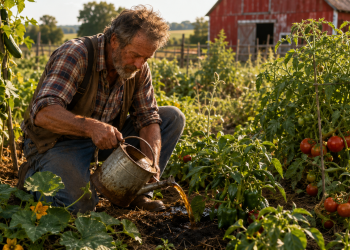
 If hunting really does not appeal to you, you can of course raise your own livestock. Sheep, cows, goats, buffalo, chickens—these all make wonderful sources of both extra income (if that’s what you want to do) as well as their numerous byproducts. And speaking of roots, hunting and fishing is not your only choice when it comes to what goes on your plate. People living in industrial nations take places like supermarkets for granted. But the truth of the matter is that growing your own food is so much better for you. Here are a few reasons why:
- Seeds are cheaper than vegetables
- Fresh veggies from your garden contain no harsh chemicals or additives
- Nothing goes to waste (don’t forget that you can compost any (non meat) spoiled goods)
- Vegetable gardens are a renewable, edible resource. From plants come more seeds, which come more plants, and so on.
- Some crops can be utilized as feed if you have your own livestock, which means you can save money on feed
Of course, you will not plant just any old thing. Remember as a kid how you hated Brussels sprouts? If you still do, there is no reason why you should have to endure them now. So, based on the soil quality where you are, the climate and what is available, you can grow a range of crops, from peas, to spinach, broccoli, corn, squash, tomatoes, fruit, et cetera.
Reconnecting with nature, as your ancestors did, is not nearly as daunting a task as you might believe. Imagine this: they figured it all out (indeed over generations) by the phases of the moon, trial and error (a whole lot of error), and the belief that God would provide for them. Surely, in our technologically advanced age, we can too.