Print


The Powerful “Inescapable Truth” They Bury… And The Human Saviors Who Always Rise In Its Place
Stuff You’ll Never Hear In Church
Seriously, there’s a doctrine sitting right there in the first chapter of Ephesians that most modern pulpits step over the way a man steps over a snake curled up beside the woodpile. They know it’s there. They’ve read the words.
They’d just rather not pick the thing up.
Paul doesn’t step over it. In fact, he opens the door and practically puts it on the kitchen table. Before he gets very far into grace, forgiveness, the church, marriage, spiritual warfare, or the armor of God, he tells us that believers were chosen in Christ “before the foundation of the world” and “predestinated… according to the good pleasure of his will.”
Read Ephesians 1:4–11 slowly and notice how Paul keeps circling back to the same idea. He is an apostle “by the will of God.” We were chosen before the foundation of the world. We were predestinated according to His good pleasure. Then, in verse 11, Paul drives the post into the ground: we were predestinated according to the purpose of the One who “worketh all things after the counsel of his own will.”
That isn’t a theological footnote.
It is one of the foundation stones Paul lays before building the rest of the house.
Which raises a question we don’t ask nearly enough: Why does Paul connect salvation so quickly with the sovereign purpose of God?
The answer is intensely practical. It reaches into history, government, suffering, freedom, the hospital room, the funeral home, and the ordinary Christian’s assurance that tomorrow morning the universe will still belong to God.
And that may help explain why the doctrine has become so uncomfortable.
You Don’t Get Rid Of Predestination… You Just Find Another Predestinator

Start here: some idea of order is unavoidable.
Think about it: no one actually believes in their heart and then lives as though reality were absolute chaos. Nobody plants sweet corn, checks a frost date, builds a battery bank, digs a well, or watches storm clouds rolling across the western horizon while believing there is no dependable order whatsoever.
The farmer puts seed into the ground because he expects a created order to greet him there.
Scripture goes further. Psalm 19 says the heavens declare the glory of God. The Christian confession is not merely that the universe has order, but that its order comes from its Maker.
Throughout history, rival worldviews have offered rival explanations for that order. The ancient world spoke of fate. Eastern religions developed ideas of karma. Materialists appealed to impersonal forces. Marxism interpreted history through material and economic conflict. Modern bureaucratic societies put enormous confidence in forecasting, expertise, regulation, modeling, and centralized planning.
The names change.
The hunger for control doesn’t.
Here is the part worth thinking about: when divine providence is pushed out of a culture’s heart and soul, the desire for providence doesn’t necessarily disappear. Human institutions always fill the empty chair.
And once human beings imagine themselves capable of comprehensively planning society, the stakes get very practical. Now we’re talking about land, water, seed, fuel, money, education, property, family, food, work, and the thousands of little decisions ordinary people make every day.
The biblical question, then, isn’t simply whether history has direction.
It is who ultimately directs it.
Every Would-Be Savior Eventually Wants The Steering Wheel
This is where the argument gets uncomfortable.
Modern philosophies have sometimes imagined human freedom in radically self-creating terms. Jean-Paul Sartre famously described human existence as preceding essence: man finds himself in the world and then attempts to define what he will become. Push that impulse far enough and freedom no longer means acting responsibly as a creature inside reality. It begins looking like the desire to define reality itself.
The temptation is ancient: Ye shall be as gods.
And that brings us straight back to salvation and sovereignty.
A savior who promises complete security will eventually be tempted to demand enough power to produce that security. If an institution promises to protect people from every risk, every shortage, every economic shock, every bad decision, and every uncertainty, it will naturally reach for more information, more authority, and more control.
The promise and the power tend to travel together.
Christianity makes a radically different claim. God’s sovereignty is not the sovereignty of one creature wrestling other creatures for control. God stands above creation as Creator. He doesn’t occupy one more square on the chessboard.
He made the board.
That distinction matters because God’s providence and human action are presented together throughout Scripture. Joseph’s brothers acted wickedly and voluntarily, yet Joseph could tell them, “ye thought evil against me; but God meant it unto good.” Human intention was real. Divine purpose was real.
The Bible refuses to surrender either one.
That is also why divine providence is fundamentally different from human central planning. When a human authority tries to exercise godlike control, it must do so from inside creation. It needs your compliance, your information, your property, your labor, or your obedience.
God doesn’t need to confiscate the farm in order to remain sovereign over the farmer.
That’s quite a difference.
The Reformation Knew Something We’ve Forgotten
This argument isn’t something dreamed up yesterday.
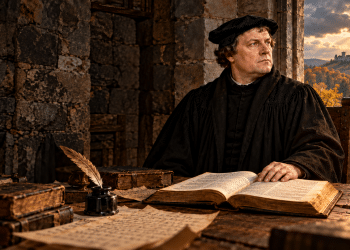
During the Reformation, the relationship between grace, human will, election, and divine sovereignty became one of the great battlegrounds of Western Christianity. Martin Luther’s dispute with Erasmus in The Bondage of the Will wasn’t a side argument about theological trivia. Luther believed the controversy reached directly into the question of whether salvation finally rested upon God’s grace or the decisive contribution of man.
John Calvin was equally direct.
In Book III, chapter 21 of the Institutes of the Christian Religion, Calvin argued that Christians will never understand as clearly as they should that salvation flows from God’s free mercy until they understand election. He also warned that ignorance of the doctrine detracts from God’s glory and undermines genuine humility.
You can read Calvin’s discussion of election and predestination in the Institutes for yourself.
That last point is easy to miss.
Predestination wasn’t supposed to make a Christian strut around the barnyard announcing that he had solved the secret counsels of God. Properly understood, Calvin argued, it was supposed to knock the strut out of him.
You didn’t save yourself.
You didn’t invent grace.
You didn’t put God in your debt.
You received mercy.
That ought to make a man humble.
When God Gets Smaller, Something Else Usually Gets Bigger
History gets especially interesting when Christians try to preserve salvation while shrinking the sovereignty behind it.
The instinct sounds harmless enough: I don’t need all that theology. Just give me Jesus.
There’s a good impulse buried in there. Christ really is the center. Christianity isn’t salvation by passing a systematic-theology exam.
But the trouble begins when “just give me Jesus” quietly becomes “don’t tell me anything Scripture says about the God who saves me.”
Because Paul wouldn’t cooperate with that arrangement.
He connects redemption, adoption, inheritance, election, God’s purpose, and God’s will in the opening verses of Ephesians. Romans does the same thing. The salvation Paul preaches rests upon the God Paul describes.
Remove the foundation and eventually the house starts leaning.
And there is a broader cultural danger here too. Human beings don’t stop looking for security simply because they stop looking upward. If God is no longer understood as the final governor of history, people can begin demanding that human institutions provide the certainty, protection, provision, and control once associated with providence.
That doesn’t prove that every government program is tyranny, nor does Scripture teach that civil government has no legitimate authority.
It does mean the state makes a lousy god.
Every human institution does.
Predestination Eventually Walks Into A Hospital Room
But the truth is… none of this is merely an argument for a seminary classroom.
It belongs at the kitchen table at two in the morning.
It belongs beside a hospital bed.
It belongs beside the freshly dug grave.
Scripture describes God’s providence in startlingly ordinary details. Christ speaks about sparrows falling and the hairs of your head being numbered. Proverbs 16:33 even says that the lot is cast into the lap, “but the whole disposing thereof is of the LORD.”
Then Scripture takes us somewhere darker.
Judas betrayed Christ willingly and wickedly, yet Jesus said the Son of Man went “as it was determined.” Peter preached that Christ was delivered up according to God’s determinate counsel and foreknowledge, while still holding the men who crucified Him morally responsible.
That means the worst crime in human history was not outside God’s sovereign purpose.
And if Calvary wasn’t outside His purpose, your darkest Tuesday isn’t either.
Nothing Fell Through A Crack
Think about what the alternative can sound like when suffering becomes real.
A family is standing in a hospital corridor after losing someone they love. The fluorescent lights hum overhead. There’s cold coffee sitting untouched on a table. Somebody is crying into somebody else’s shoulder.
What do you tell them?
“God wanted to stop this, but He couldn’t”?
“Well, it’s a random, chaotic world and shit happens. (seventies talk)
“The universe simply got away from Him for a moment”?
“Satan won this round”?
Those answers may be intended to protect God from responsibility, but they can leave the grieving Christian with something worse: a universe in which terrible things can happen outside the final governing purpose of God.
There isn’t much comfort there.
Biblical providence offers something harder, but ultimately stronger: nothing fell through a crack.
That doesn’t make evil good. Scripture never asks us to call death beautiful, cruelty righteous, betrayal innocent, or grief pleasant. Joseph’s brothers meant evil. Judas committed evil. The men who crucified Christ acted wickedly.
But evil never gets the last word.
That is why Romans 8:28–30 carries so much weight. “All things work together for good to them that love God, to them who are the called according to his purpose.”
Notice the words.
All things.
Not merely the pleasant things. Not merely the things we understand. Not merely the things that make sense six weeks later.
All things.
And “all things” can finally work toward one purpose only if all things remain beneath one governing hand.
That is what turns Romans 8:28 from refrigerator-magnet theology into something strong enough to carry into an ICU.
Grief Doesn’t Need A Smaller God
There is a strange temptation in modern Christianity to comfort suffering people by making God smaller.
We tell ourselves that if God didn’t know, couldn’t prevent, didn’t govern, or simply stood helplessly beside the tragedy, then somehow we have protected His goodness.
But what have we given the grieving person in exchange?
A God who sympathizes but cannot rule?
Biblical comfort goes the other direction. It gives us the God of Joseph, Job, David, Paul, and ultimately Jesus Christ… a God whose purposes can run through human wickedness, suffering, betrayal, crosses, graves, and tears without ever being defeated by them.
Calvary is the supreme example.
On Friday afternoon it looked as though evil had swallowed the world.
By Sunday morning we discovered evil had been carrying out its own defeat.
That is counseling-grade theology.
Grief doesn’t need a smaller God. It needs a sovereign one.
Your Salvation Doesn’t Depend Upon How Tight You Can Hold On
And then there is perseverance.
Paul continues the thought in Romans 8: “whom he did predestinate, them he also called: and whom he called, them he also justified: and whom he justified, them he also glorified.”
Look at that chain.
Predestinated.
Called.
Justified.
Glorified.
Paul speaks with such certainty about the final destination that glorification appears alongside the accomplished acts. The point is not that Christians never stumble. Anybody who has been following Christ longer than fifteen minutes knows better than that.
The point is that God finishes what He starts.
Jesus makes the same promise in John 10:27–29 when He says His sheep hear His voice, He gives them eternal life, and no man is able to pluck them out of His Father’s hand.
Ask an honest Christian whether his assurance rests upon his own consistency and you’ll probably get a tired laugh.
We know ourselves too well.
Our prayers wander. Our courage comes and goes. Our faith sometimes feels like an old fence post after three days of rain… leaning hard and needing support.
Assurance doesn’t finally come from the strength of your grip on God.
It comes from the strength of His grip on you.
Off-The-Grid… But Never Outside Providence
That brings us back to the homestead.
There is something healthy in the off-grid instinct when it says: don’t hand your whole life to a system you cannot inspect, controlled by people you cannot hold accountable, on the promise that they will take care of everything if you simply surrender enough responsibility.
Grow some food.
Know where your water comes from.
Learn useful skills.
Know your neighbors.
Fix what you can fix.
Keep some beans in the pantry and some firewood stacked before January arrives.
But the Christian version goes deeper than self-reliance, because Christianity ultimately destroys the myth of self-reliance too.
The homesteader isn’t sovereign.
Neither is Washington.
Neither is Wall Street.
Neither is the doctor, the algorithm, the billionaire, the preacher, the bureaucrat, the farmer, the king, or the man staring back at you from the bathroom mirror.
There is already a throne.
And it is occupied.
That is why the doctrine of predestination, properly understood, doesn’t produce fatalism. It should produce courage. You still plant the field. You still teach the children. You still make decisions, repent of sins, pray for healing, oppose evil, build fences, help neighbors, and get out of bed tomorrow morning.
But you do all of it knowing history isn’t dangling by a thread.
Your salvation isn’t dangling by one either.
Paul closes the great sweep of Romans 9–11 not by apologizing for God’s sovereignty but by worshiping. His argument finally ends where ours ought to end too:
“For of him, and through him, and unto him, are all things: to whom be glory for ever. Amen.”
That may be the most off-grid doctrine of them all.
You don’t need another human savior.
The throne is already occupied.